
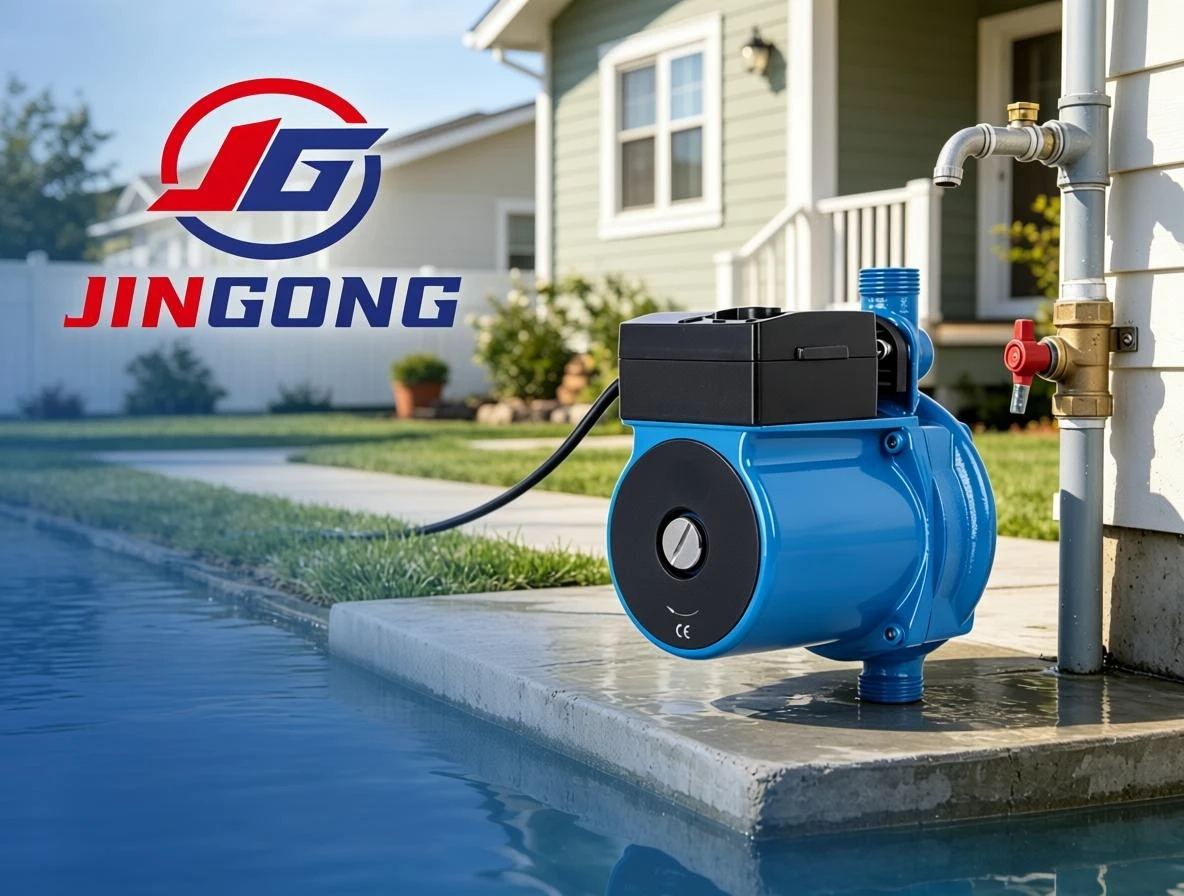
Quick Answer: Which Water Pump Is Best for Your House?
Water Pump for Home There is no single “best” water pump for all homes. The ideal choice depends entirely on your water source and intended use. Based on our 15+ years of manufacturing home water pumps at Jingong, here is the direct breakdown:
| Scenario | Best Pump Type | Core Reason |
|---|---|---|
| Apartment / Condo (Low Pressure) | Inline Booster Pump | Compact, quiet, fits under sinks. |
| Single-Family House (City Water) | Whole-House Booster | Stabilizes pressure for multiple fixtures. |
| Rural House (Well < 8m) | Self-Priming / Jet Pump | Can lift water vertically without flooding. |
| Deep Well (≥ 25m) | Submersible Well Pump | Only efficient way to move water from depth. |
| Garden / Rainwater Tank | Utility / Surface Pump | High flow, low head requirements. |
| Off-Grid Cabin | Solar DC Pump | No grid power required. |
| Flood / Emergency | Gasoline / Diesel Pump | Reliable during power outages. |
Why Trust Water Pump for Home This Guide (Jingong Experience)
As a leading manufacturer based in Zhejiang, China, Jingong (Zhejiang Jingong Technology Co., Ltd.) specializes in the R&D and production of industrial and residential pumping solutions. Unlike generic review sites, this guide is written by our engineering team.
- Experience: We have supplied pumps to distributors across North America, Europe, and Southeast Asia, witnessing firsthand the challenges of voltage differences (110V/60Hz vs. 220V/50Hz) and water quality.
- Expertise: We produce five core categories relevant to homeowners: Booster Pumps, Submersible Pumps, Surface/Land Pumps, Solar Pumps, and Gasoline/Diesel Pumps.
- Authority: Our products comply with international standards for residential water supply equipment.
- Trust: We focus on factual specifications, not affiliate commissions.
Water Pump for Home Classifications (Residential vs. Commercial)
Understanding the classification is the first step to avoiding costly mistakes. Residential pumps prioritize low noise, energy efficiency, and compact size over raw power.
1. Booster Pumps (For Pressure Increase)
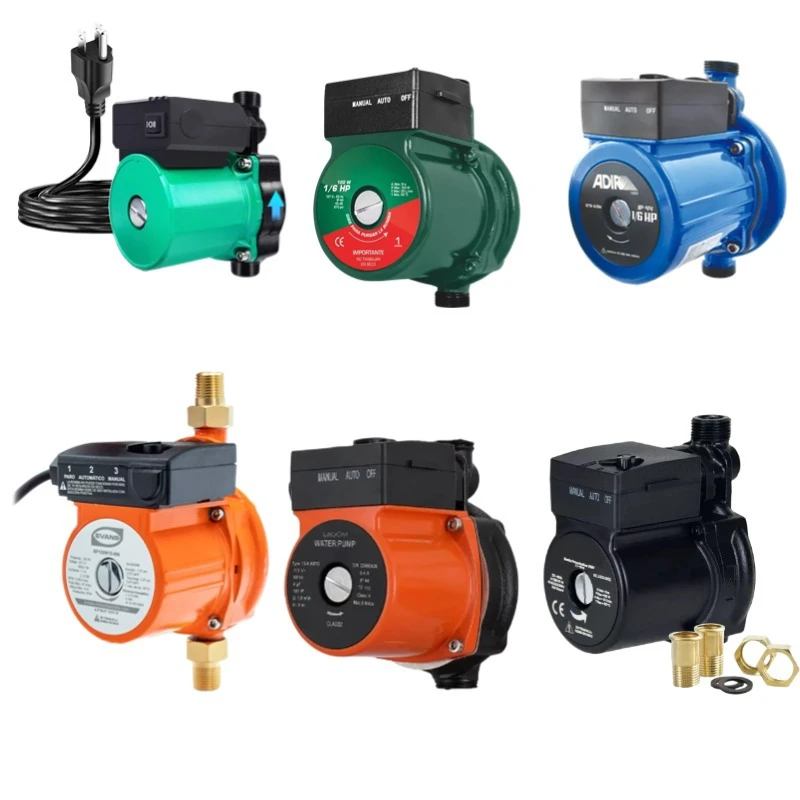
These are installed on your incoming water line. They do not “suck” water from a well; they “push” existing water harder.
- Use Case: Apartments with weak municipal pressure; Homes with large baths.
- Jingong Spec: Our stainless-steel inline series features IE3 efficient motors and intelligent controllers to prevent pressure spikes.
2. Self-Priming / Surface Pumps
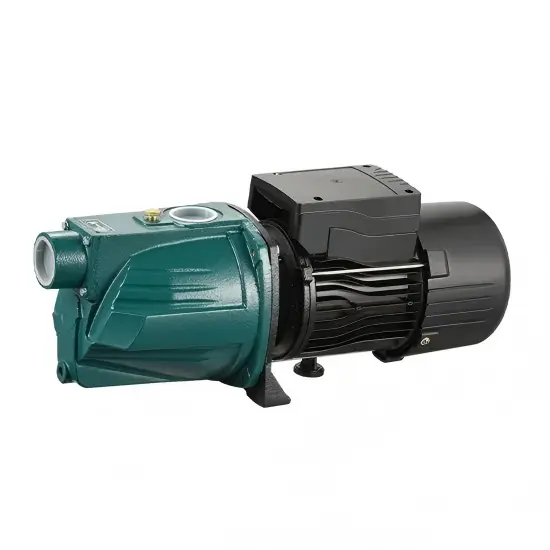
Mounted above ground, these pumps create a vacuum to suck water up.
- Use Case: Shallow wells (under 8m), drawing water from rivers or cisterns.
- Limitation: They are louder than submersible pumps and cannot handle deep water sources.
3. Submersible Well Pumps

Designed to sit underwater in a well. They push water to the surface using multiple impeller stages.
- Use Case: Deep wells, boreholes, underground rainwater tanks.
- Advantage: Silent operation, cooling via water, high efficiency.
- Link: View our 4-inch Submersible Well Pump Series.
4. Solar DC Home Pumps
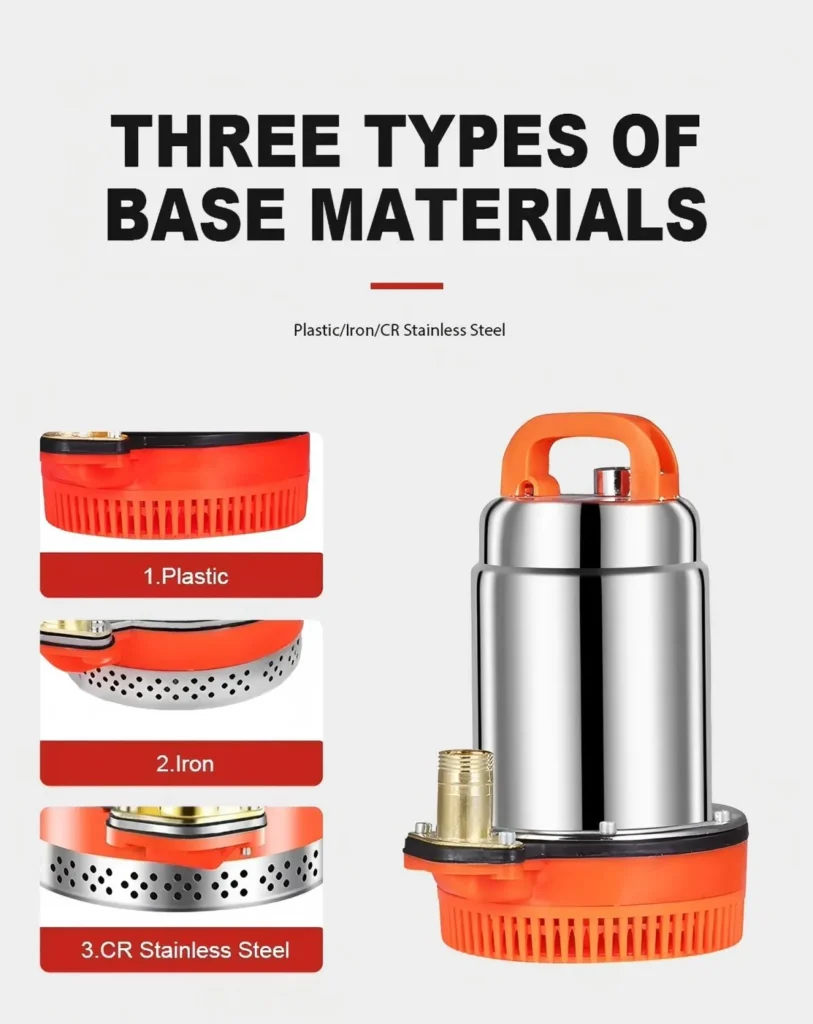
Powered directly by photovoltaic panels via an MPPT controller.
- Use Case: Off-grid homes, agricultural irrigation, areas with unreliable electricity.
- Trend: Rapidly growing in demand due to rising energy costs.
5. Gasoline / Diesel Pumps
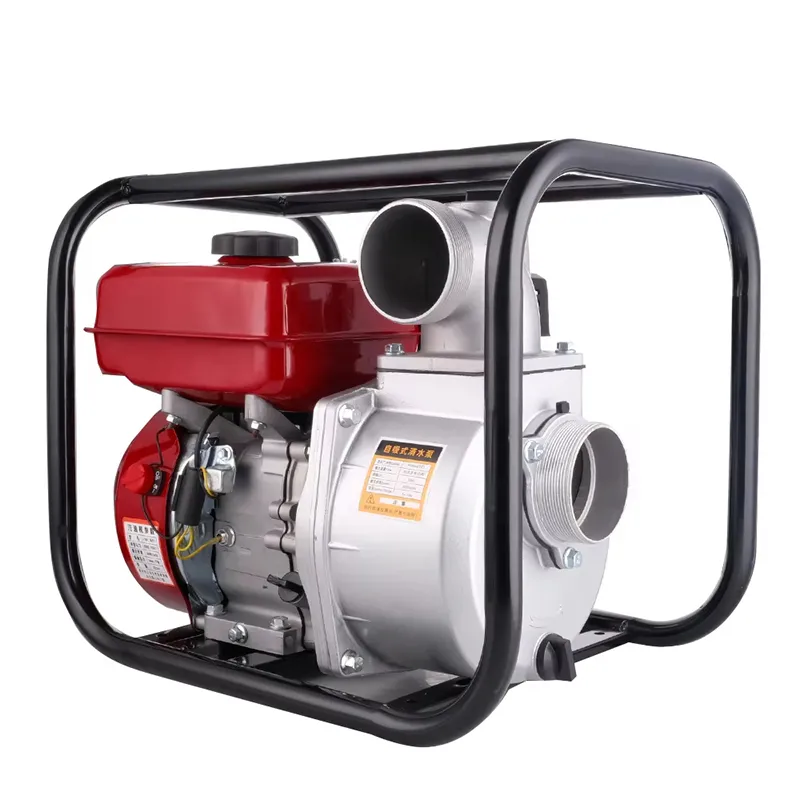
Engine-driven pumps for temporary or emergency use.
- Use Case: Basement flooding, construction sites, emergency fire fighting.
- Note: Not for continuous daily use (high maintenance).
Key Parameters: How to Read the Specs That Actually Matter
Many homeowners focus solely on Horsepower (HP). As manufacturers, we advise focusing on the following metrics:
Flow Rate (GPM / L/min)
This is the volume of water the pump moves.
- Apartment: 10–25 L/min (2.5–6.5 GPM)
- Standard House (2 baths): 30–50 L/min
- Irrigation: 60–150 L/min
Head Lift (Total Dynamic Head – TDH)
This is the vertical distance the pump can push water, plus friction losses in pipes.
Rule of Thumb: If your well is 30m deep, buy a pump rated for at least 50–60m head to account for friction and desired pressure at the tap.
Voltage & Frequency (110V/220V / 50Hz/60Hz)
This is critical for international buyers. A 60Hz motor running on 50Hz will spin slower and lose 20% flow. Conversely, a 50Hz motor on 60Hz will spin faster and may overload. Always match your region’s grid.
IP Rating & Noise
For indoor boosters, look for IPX4 (splash-proof) and a noise level below 45 dB. For submersibles, IP68 is the standard for waterproofing.
Best Home Water Pump by Scenario (Jingong Recommendations)
Apartment High-Rise → Booster Pump
If you live on the 15th floor and the shower is a trickle, you need a compact booster pump. These units are typically 0.5–1 HP and designed to fit inside a kitchen cabinet or utility closet without causing vibration noise to neighbors.
Deep Well (≥25m) → Submersible Well Pump
This is where buyers often overspend on HP while ignoring the head curve. For a 40m deep well supplying a family of four, a 1.0–1.5 HP multistage submersible pump with a 70–90m head curve is ideal.
Jingong Tip: Ensure the pump has a brass or stainless-steel impeller to resist sand abrasion common in deep wells.
Rainwater Harvesting & Irrigation
Moving water from a rain barrel to a garden requires high flow but low head. A simple vortex utility pump is sufficient. If the system also flushes toilets, add a small pressure tank.
Off-Grid / Solar Solutions
Sizing a solar pump is complex. It’s not about “how many panels,” but “wattage and voltage.” A typical 1 HP equivalent solar well pump requires a 1000W–1300W PV array. Undersizing the array leads to stalling during peak sun hours—a common mistake we see in imported DIY kits.
Water Pump for Home Common Buying Mistakes (What Overseas Buyers Get Wrong)
- The HP Trap: Buying a 2 HP pump when a 1 HP pump with the correct head curve would perform better.
- Ignoring Voltage: Ordering a 220V/50Hz pump for a 110V/60Hz US home. It simply won’t work or will burn out immediately.
- No Margin for Friction: Calculating exactly 30m of head for a 30m well. Pipe friction and fittings will reduce pressure significantly.
- Wrong Application: Using a submersible pump to boost city water pressure (use a booster) or using a booster pump to draw water from a pond (use a self-priming pump).
Installation, Maintenance & Lifespan
DIY Installation Checklist
- Isolation Valves: Always install ball valves before and after the pump for servicing.
- Check Valve: Prevents backflow that can damage the impeller.
- Pressure Tank: Essential for reducing pump cycling, extending motor life.
Winterizing & Anti-Corrosion
In cold climates (Northern US, Canada, Europe), drain lines to prevent freezing. In coastal areas, opt for 304 or 316 Stainless Steel casings to prevent rust caused by salt air.
Troubleshooting
- Pump runs, no water: Air lock or suction leak.
- Cycling rapidly: Failed pressure tank bladder.
- Humming, won’t start: Failed capacitor (surface pumps) or dry-run protection activated.
Frequently Asked Questions
What is the most reliable water pump for home use?
Reliability comes from material quality and correct sizing. For wells, choose a multistage submersible with a stainless-steel casing. For pressure boosting, an inline stainless booster with an electronic controller is best. Avoid plastic-bodied pumps for whole-house use.
Which is better, booster pump or self-priming pump for home?
They serve different purposes. A booster pump increases the pressure of water already in the pipes. A self-priming pump lifts water from a source (like a well or tank) into the pipes. You cannot use a booster pump to draw water from a well.
How many HP water pump is best for home?
For most single-family homes, 0.75 HP to 1.5 HP is the sweet spot. Apartments usually require only 0.5 HP. Focus on the ‘Head’ (vertical lift capacity) and ‘Flow Rate’ (GPM) rather than just HP to ensure the pump meets your specific needs.
Are submersible pumps good for residential use?
Yes, they are excellent for specific applications. They are much quieter than surface pumps because they are underwater. They are the only practical choice for deep wells and are highly efficient for underground rainwater harvesting systems.
How long does a Water Pump for Home last?
A quality residential booster pump lasts 7–10 years. A submersible well pump lasts 8–12 years, depending heavily on water quality (sand content) and electrical stability. Gasoline pumps have a shorter lifespan measured in engine hours (500–1000 hours).
Conclusion & How to Get a Custom Recommendation
There is no universal “best water pump for home use”—only the best pump for your specific house. At Jingong, we provide factory-direct expertise to ensure you get the right specification the first time.
Ready to select your pump?
- Browse our full catalog: Jingong Pump Catalog
- Contact our technical team for a custom sizing quote: Get a Quote
Jingong Technology: Powering Homes Worldwide with Precision Pumps.

0 Comments