
How to Select a Water Pump for House:JINGONG The Complete Buyer’s & Sizing Guide
1. Introduction: Why Your House May Need a Water Pump (and Why “Guessing” Costs You)
For many homeowners — especially in rural areas, multi-story houses, and regions with unreliable municipal pressure — a water pump for house isn’t optional. It’s the difference between a refreshing shower and a disappointing drizzle.
Yet most pump failures aren’t caused by bad pumps. They’re caused by wrong selections: mismatched flow rate, underestimated head, or choosing a pump type that simply isn’t designed for the water source. The symptoms are familiar:
- Shower low pressure that never improves, even after “upgrading” the pump
- Pump short-cycling (frequent on/off) that burns out the motor within 12–18 months
- Excessive noise from a jet pump installed next to a bedroom wall
- Overheating or dry-run burnout because no automatic controller was specified
A true residential water pump system is a balance of pump type × flow rate × head (lift) × pressure requirement × water source condition. Get any one wrong, and the whole system underperforms.
In this guide — written from a pump factory engineer’s perspective, not a generic content writer — you’ll learn:
- Which types of water pumps for homes exist and which one matches your scenario
- The technical parameters you actually need to calculate (with worked examples)
- A scenario-based selection shortcut so you can stop second-guessing
2. Types of Water Pumps for Homes: Which One Actually Fits Your Scenario?
Not all “house pumps” are created equal. The fastest way to narrow your choice is to answer one question: Where is the water coming FROM, and where does it need to GO?
2.1 Booster Pump (Home Water Pressure Booster Pump)
Also called: pressure booster pump · domestic pressure pump
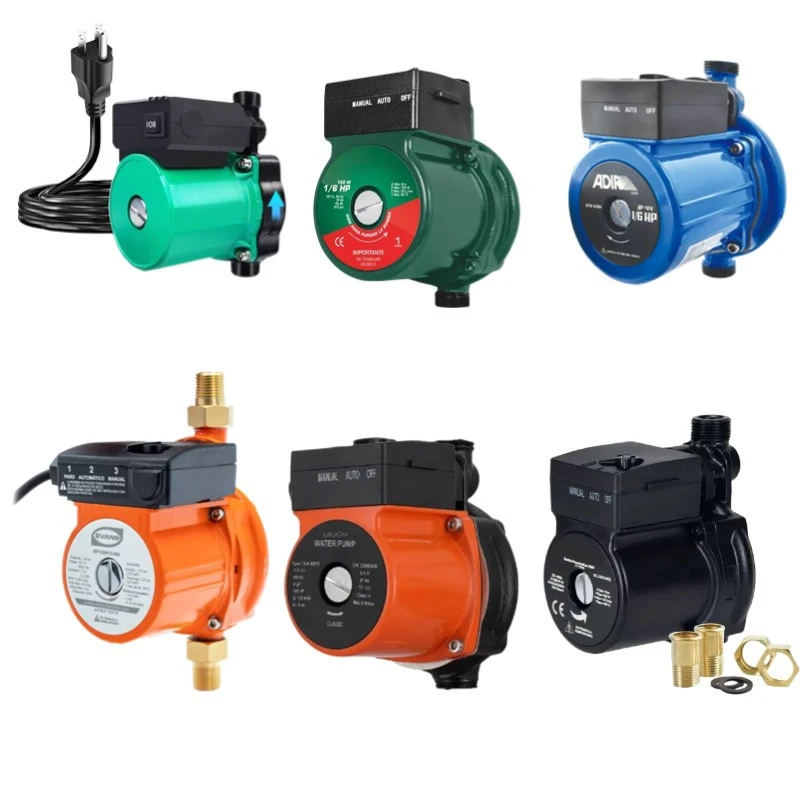
| Best For | Pros | Watch-outs |
|---|---|---|
| Low municipal / city water pressure Fixing “weak shower” without re-plumbing Already have water supply, just need more push | Compact · Relatively easy install on main line · Immediate pressure improvement · Works with pressure tank or integrated controller | Cannot magically create water volume the city doesn’t deliver · Needs stable inlet supply · Oversizing = short-cycling & wasted energy |
Typical domestic spec range: 0.5–1.5 HP · 1–5 m³/h (≈4–22 GPM) · boost ~1.5–3.0 bar (≈22–43 PSI) depending on model · 220V single-phase standard for homes.
👉 Explore our automatic booster pump series →
2.2 Submersible Well Pump (Residential Submersible / Borewell Pump)
Also called: deep well submersible pump · borehole pump · underwater well pump
| Best For | Pros | Watch-outs |
|---|---|---|
| Wells deeper than ~25 ft (8 m) · Whole-house water supply from private well · Requires push from deep underground | Highly efficient (pushes water up vs. sucking) · Very quiet (installed underwater) · Handles significant depth · Long service life when sized correctly | Harder DIY access if service is needed · Requires proper well casing diameter · Must match well’s refill/recovery rate or you’ll pump it dry |
Materials matter: for potable water, stainless steel or food-grade composite housings, plus NSF-rated seals, are the professional recommendation — not painted cast iron that can leach or corrode over years of submersion.
👉 Explore our submersible pump series →
2.3 Jet Pump (Shallow Well / Deep Well Jet Pump)
Best for: Shallow wells (typically up to 25 ft / 8 m for shallow-well jet; special two-pipe configurations extend deeper) · Applications where you want the motor above ground for easier access/maintenance · Outdoor pump house installs.
- Advantage: Above-ground = serviceable without pulling from the well · Self-priming designs available
- Trade-off: Less efficient than submersible for real depth · Can be noisier · Requires correct priming & airtight suction piping (any leak = loss of prime)

👉 Explore our jet pump series →
2.4 Centrifugal / Surface Transfer Pump (Household Use)
Best for: Moving water between tanks · Garden irrigation · Pool filling · General clean-water transfer — not for deep suction lifts. Installs above water level; relies on flooded inlet or self-priming design.
- Simple, robust, cost-effective
- Most common pairing: a centrifugal pump + float switch / controller for automatic tank-to-tank transfer
👉 Explore our centrifugal pump series →
2.5 Automatic Water Pump with Controller (Smart / Intelligent Pump)
Modern residential installs increasingly default to automatic pumps — meaning an integrated or inline pressure switch / electronic flow controller / VFD (variable frequency drive) that:
- Auto-starts when a tap opens
- Stops when flow stops
- Protects against dry run (no water = motor kills power instead of burning out)
- In VFD/constant-pressure models: keeps outlet pressure nearly flat even as more taps open
This is the “house pump” configuration most families actually want: set-and-forget, quiet, protected.
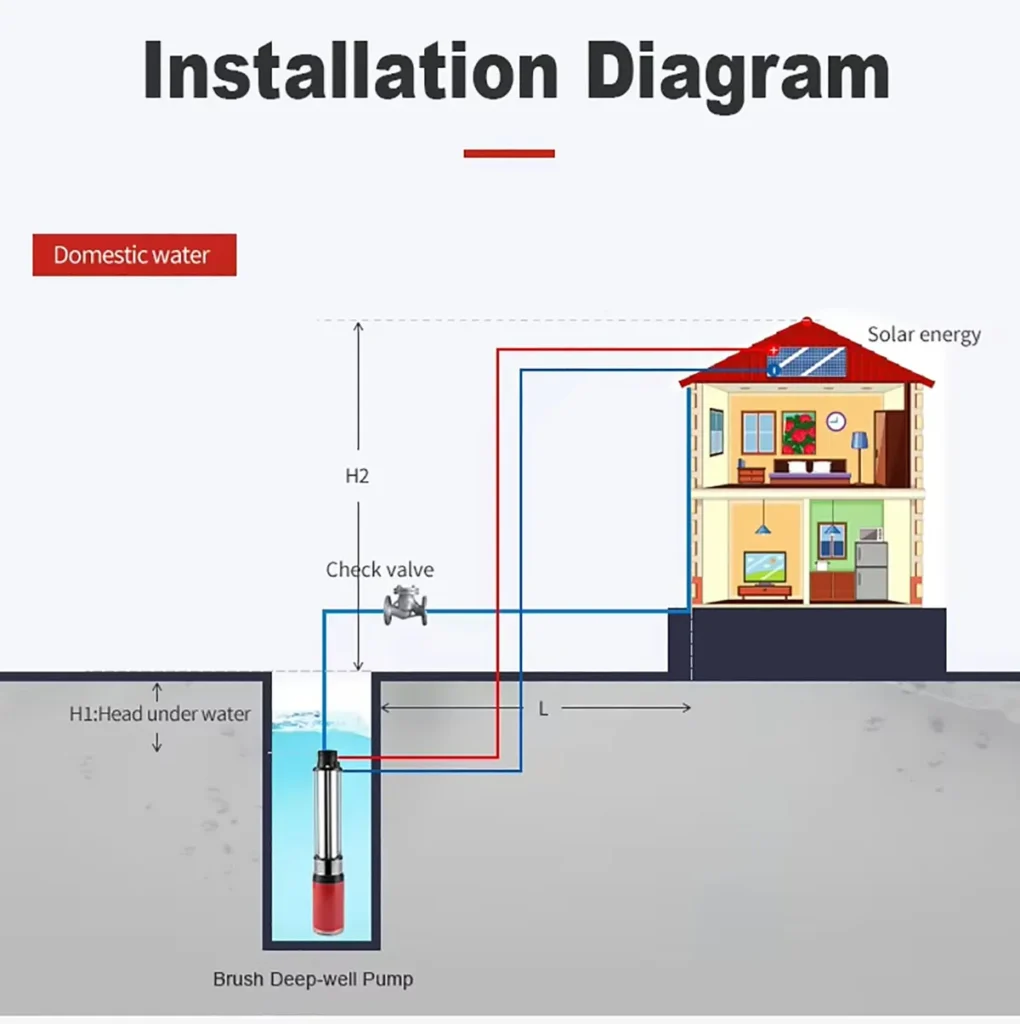
2.6 Solar Water Pump for Home (Off-Grid / Yard / Rainwater Scenarios)
If your scenario is off-grid, a remote tank fill, livestock trough, or a rainwater system where running AC mains is expensive, a DC solar water pump (brushless DC · MPPT controller) can be the right call. Just remember: solar pumps trade continuous on-demand availability for energy independence — size the panel array and tank storage accordingly.
3. Key Technical Parameters: How to Actually Size a House Water Pump (No Guesswork)
This section is where E-EAT lives. Anyone can list pump types; few show you the math a factory engineer uses on a real project.
3.1 Flow Rate (How Much Water — m³/h or GPM)
Flow rate = volume over time. In homes we measure it in m³/h (metric) or GPM (imperial: gallons per minute). 1 m³/h ≈ 4.4 GPM.
Rule-of-thumb for residential peak demand (realistic, not “all taps open at once”):
| Home Profile | Estimated Peak Flow Needed | Practical Pump Flow Range |
|---|---|---|
| Small apartment / 1-bath house (1–3 people) | ≈ 0.8–1.5 m³/h (≈ 3.5–6.5 GPM) | 1–2 m³/h |
| Standard 2-bath house / villa (3–5 people) | ≈ 1.5–3.0 m³/h (≈ 6.5–13 GPM) | 2–4 m³/h |
| Large villa · irrigation + indoor · multiple suites | ≈ 3.0–5.0+ m³/h (≈ 13–22+ GPM) | 3–6 m³/h (may split into zones) |
Pro tip from the shop floor: Don’t size the pump to the absolute theoretical max of every fixture added together. Size to the realistic simultaneous peak (e.g. shower + kitchen faucet + washing machine filling) — then give yourself ~15–20% margin.
3.2 Head / Lift — The Most Commonly Underestimated Number
Head is pump-speak for “how hard the pump must push.” The number you actually need is called Total Dynamic Head (TDH):
TDH ≈ Static Head (vertical lift) + Friction Loss (pipe + fittings) + Pressure Head (desired outlet pressure)
Step-by-step:
- Static Head = vertical distance from water surface (well / tank bottom) to the highest outlet in the house. Measure in meters (or feet).
- Friction Loss = resistance in pipes. Rule-of-thumb: every ~10 m of straight horizontal pipe ≈ +1 m head equivalent for ½–1″ lines; each elbow/valve adds equivalent length. (For precision, use a friction-loss chart matched to your pipe ID & flow.)
- Pressure Head = your target pressure at the tap converted to head:
- Desired pressure ~2.5–3.0 bar (≈ 36–43 PSI) is comfortable for most homes
- 2.5 bar ≈ 25 m head · 3.0 bar ≈ 30 m head
- Add 15–20% safety margin so the pump isn’t running at its limit curve.
Worked Example (typical 2-story house + shallow well / tank feed):
- Static lift: 12 m (tank to 2nd-floor bathroom)
- Friction loss (piping + elbows + filter): ~3 m
- Target pressure head: 25 m (≈2.5 bar at fixture)
- TDH ≈ 12 + 3 + 25 = 40 m → with 20% margin → spec for ~48 m head
Now you go to the pump curve chart: find a model whose curve delivers your required flow (say 2.5 m³/h) at ≥48 m head. That is how pros select — not “buy 1 HP and hope.”
3.3 Water Pressure Targets (bar / PSI)
| Comfort Level | Pressure Range | Notes |
|---|---|---|
| Bare minimum (survivable) | 1.0–1.5 bar (15–22 PSI) | Showers feel thin; some valves hiss |
| Standard comfortable home | 2.0–3.0 bar (29–43 PSI) | Most fixtures happy; washing machines OK |
| Premium feel (“hotel shower”) | 3.0–4.0 bar (43–58 PSI) | May need pressure-balancing valves on mixing points |
3.4 Power & Voltage — Keep It House-Friendly
- Residential standard = 220V / 230V single-phase in most international markets (check your country: some use 110–120V; others 240V). Confirm before ordering.
- Horsepower ranges that cover 90% of homes: 0.37 kW (½ HP) → 1.1 kW (1.5 HP). Going bigger “just because” = higher amp draw, heavier start surge, shorter life if your plumbing can’t use the extra capacity.
- Look for 100% copper winding motors (not aluminum-wound) for heat tolerance and lifespan — this is one of the factory-level quality markers we insist on at Jingong.
3.5 Water Source Condition — Clean vs. Sandy / Sediment
- Clean municipal / cistern / rain tank water → standard impeller (brass / SS / technopolymer) is fine
- Well water with sand / sediment → you want a pump designed for it or a sediment filter before the pump (otherwise sand eats the impeller in 6–12 months — a classic warranty-killer that isn’t a “bad pump,” it’s a wrong application)
- Potable water → confirm material compliance (NSF/NSF-aware supply chain if shipping to regulated markets)
4. Scenario-Based Selection Guide: “I Have This Problem — Which Pump Do I Pick?”
Below is the shortcut table our export team actually uses when distributors email us saying “customer has ___ situation, recommend something.”
| Your Situation | Go-To Pump Type | Key Specs to Prioritize |
|---|---|---|
| Shower / bathroom low pressure — city water exists but feels weak | Automatic booster pump on main inlet (after meter, before branches) | Pressure boost to 2.5–3.0 bar · Flow must exceed peak fixture combo · quiet operation · auto controller with dry-run protection |
| Well water supply — water is 8–25 ft down (shallow well) | Shallow-well jet pump (self-priming) OR convertible jet | Suction lift limit (~7.5 m theoretical max · stay under 6–7 m safe) · pressure tank recommended · check foot valve & suction line airtightness |
| Deep well / borehole — 25 ft+ depth (common 30–150+ ft) | Submersible well pump (multi-stage for pressure) | Match flow to well recovery rate · calculate TDH properly · use torque-arrestor & centralizers · SS housing for potable |
| Garden / lawn irrigation — tank-to-sprinkler | Centrifugal / self-priming surface pump (clean water) | Higher flow, moderate head · timer / float switch · strainer on inlet · weather-protected enclosure |
| Rainwater harvesting — collected rain to flush toilets / garden | Self-priming centrifugal + controller · or booster if tank is elevated but pressure still weak | First-flush filter before tank · screen on pump inlet · non-potable labeling if not treating to drinking standard |
| Whole-house from a storage tank on roof/ground | Booster pump (tank→house) or centrifugal fill pump (source→tank) depending on layout | If tank is above house: gravity may suffice; if tank is below: booster required · size for peak GPM not average |
| Off-grid / no mains electricity | DC solar water pump + tank storage + PV array sized to daily lift volume | Decouple “pump when sun shines” from “water when you need it” via tank volume · MPPT controller essential |
5. Pre-Purchase Checklist (Save This Before You Order)
- ✅ Measure vertical lift (water surface → highest tap) in meters/feet — don’t eyeball it
- ✅ Count realistic simultaneous fixtures → convert to required m³/h (or GPM)
- ✅ Identify your voltage (220V/230V single-phase? 110V? 380V 3-phase?) — mismatches kill pumps on Day 1
- ✅ Is water clean or sandy? → filter strategy before pump if sediment present
- ✅ Does your system need a pressure tank / controller? → almost every house pump benefits from one (short-cycling prevention = motor life)
- ✅ Can you service it later? → submersible = plan a haul route; jet/surface = keep clear access
Need Help Sizing? We’ll Do the Math With You
At Jingong Pump Technology we’re not a trading company guessing from a spreadsheet — we’re the factory in Daxi, Taizhou, with 10,000 m² of production space, 100+ pump specialists, and 15+ years optimizing hydraulic curves for real homes and farms.
If you’re a homeowner sending us your numbers — or a distributor building a quote for your customer — send us:
- Water source (municipal / well depth / tank height)
- Vertical distance & approx. pipe run length
- Number of bathrooms + irrigation zones (if any)
- Your local voltage
👉 Contact Jingong Engineers for a Free Sizing Check
FAQs About Selecting a Residential Water Pump
What size water pump do I need for a 2-bathroom house?
Most 2-bath homes need 1.5–3.0 m³/h (≈ 6.5–13 GPM) at a head that puts 2.5–3.0 bar at the top-floor fixtures. That typically lands you in the 0.5–1.1 kW (¾–1.5 HP) range — but the right answer depends on your actual vertical lift and pipe layout, not just “bathroom count.”
Booster pump vs submersible pump — which one do I need?
If water already exists (city line or tank) but pressure is weak → booster pump. If you need to lift water from a well or underground source → submersible (deep) or jet (shallow). Using a booster to “suck from a deep well” won’t work and can damage the unit.
How long should a residential water pump last?
A correctly sized, clean-water, properly protected pump typically runs 8–15 years. Lifespan killers: dry-running, sand abrasion, chronic short-cycling (no pressure tank), and chronic under-specced head forcing the motor into overload zone.
Can I install a house water pump myself?
Surface pumps (boosters, jets, centrifugals) are often DIY-friendly if you’re comfortable with basic plumbing and electrical bonding/grounding. Submersible well pumps — we recommend professional install (drop pipe, torque arrestor, wiring splice, well cap sealing). Always follow local electrical code.

0 Comments