
Solar Water Pump System Work Solar Water Pump System Introduction
1.1 What Is a Solar Water Pump System?
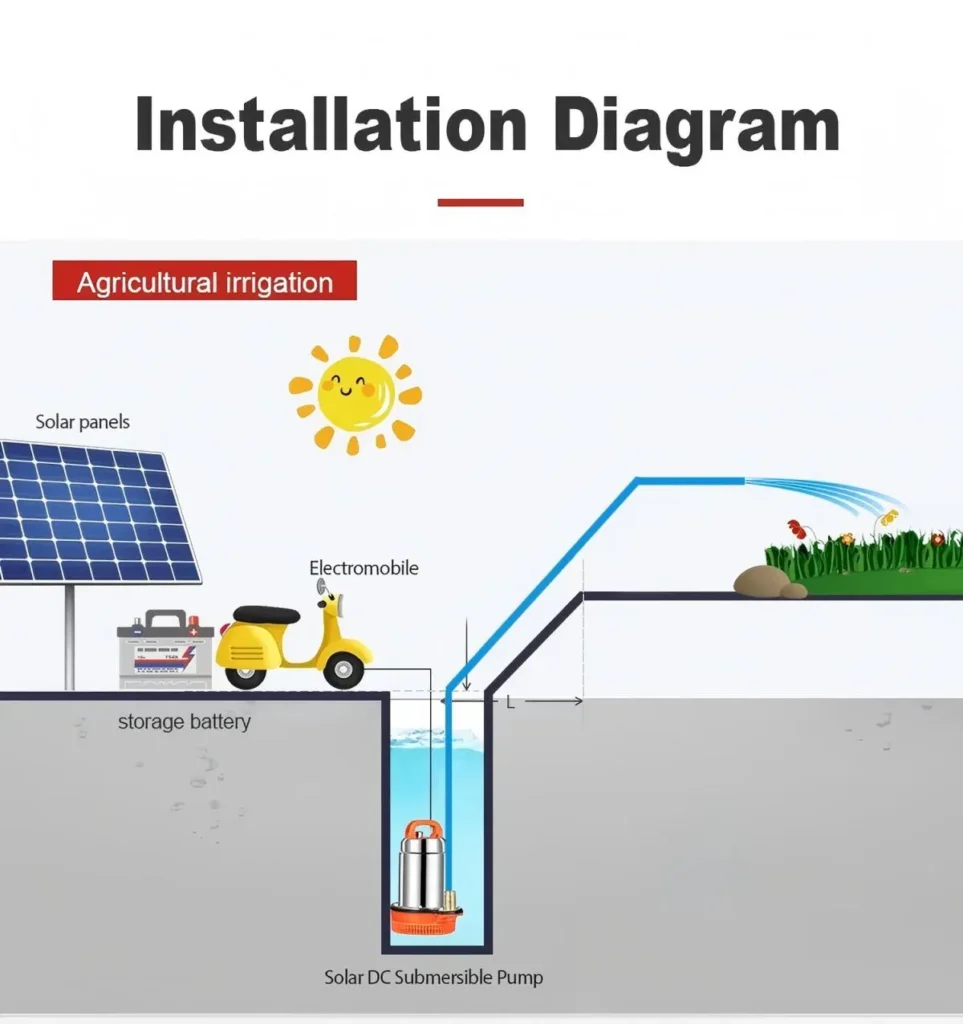
A solar water pump system is an off-grid or hybrid water-lifting solution that uses photovoltaic (PV) panels to power a pump directly, or via a solar charge controller and (optionally) an inverter + battery bank. Unlike diesel or grid-tied pumps, it runs on a fuel source that is free, locally available, and accessible anywhere with consistent sunlight.
Core system composition:
- Solar PV array – Converts solar irradiance to DC electricity via the photovoltaic effect
- Solar pump controller – Regulates voltage/current, protects connected components, tracks maximum power point (MPPT is now the industry standard for mid-to-large-scale systems)
- Pump unit – Submersible (deep well applications), surface/centrifugal (irrigation canals, ponds, rivers), or floating (reservoir/lake deployment)
- Optional energy storage – Lithium or lead-acid battery bank for night/cloudy-day operation
- Piping, fittings, filters, check valves – The hydraulic distribution network
Two dominant system architectures for international buyers:
| Type | Ideal Use Case | Pros | Cons |
|---|---|---|---|
| DC solar pump (brushless DC motor, 24V/48V/96V/120V/240V) | Small–mid farms, systems under 3 kW, direct sunlight deployment, no battery requirement | Higher energy efficiency, no inverter needed, simplified wiring | Voltage limitations, harder to scale for large projects |
| AC solar pump (3-phase AC motor + dedicated solar inverter) | Systems over 3 kW, deep well drilling, large-scale irrigation, grid-hybrid configurations | Scales to 10+ kW, supports grid backup for 24/7 operation | 5–10% inverter energy loss, higher upfront capital cost |
Industry context & standards compliance: According to QYResearch, the global solar water pump system market reached USD 1.48 billion in 2026, with a projected CAGR of ~6.3% through 2031. As a Wenling-based industrial pump manufacturer (part of China’s largest pump export cluster), Jingong Tech adheres to the following international standards for all solar-compatible pump products:
- IEC 61215 – Crystalline silicon PV module design qualification
- IEC 61730 – PV module safety qualification
- ISO 9001:2015 – Quality management system certification (in-house implemented since 2012)
- CE / TÜV / UL – Regional market access certifications (full documentation support provided with every order)
1.2 Why Choose Solar Over Diesel / Grid Pumps?
Solar Water Pump System Work
Overseas buyers across Africa, South Asia, MENA, and Latin America consistently report three core pain points with traditional water pumping solutions:
- No grid access or unstable utility supply: Running high-voltage transmission lines to remote 5-hectare farms or pastoral camps is economically unviable in most developing markets.
- Volatile diesel fuel costs: In parts of Sub-Saharan Africa, a smallholder farm spending USD 5,000/month on diesel gensets for irrigation is common — equating to over USD 60,000 in annual fuel expenses. Additional hidden costs include fuel transportation, storage security, and engine theft.
- Rationed grid electricity: Markets including Egypt, Pakistan, and Nigeria enforce routine load-shedding schedules that disrupt time-sensitive irrigation cycles.
Comparative performance breakdown:
| Metric | Diesel Pump | Grid-Tied Pump | Solar Water Pump |
|---|---|---|---|
| Fuel/energy cost | High & volatile | Medium–High | Zero ongoing cost |
| Annual maintenance | Engine oil, filters, periodic rebuilds | Motor servicing, electrical inspections | Minimal (no combustion engine) |
| Carbon emissions / noise pollution | High | Medium | Near-zero |
| Grid dependency | None | Full | None (or optional hybrid) |
| Payback period vs diesel | – | – | 1.5–3 years (high-sun regions) |
Real-world performance validation: A commercial lemon orchard in Niger (80km from Niamey) replaced two 38-HP diesel gensets (USD 400/week fuel cost, ~USD 20k/year) with a 6.51 kWp PV + 5.5 kW solar pump system. The installation now delivers ~190 m³/day for irrigation, livestock watering, and domestic use with zero fuel expenditure. Separately, a 60-hectare alfalfa farm in Sudan using a 105 kWp solar pump system to draw 3,300 m³/day from the Nile achieved a 5-year total cost of ownership 32% lower than a comparable diesel-powered setup, even at moderate global diesel prices.
As a specialist manufacturer of submersible and centrifugal pumps for global export markets, Jingong Tech has supplied solar-ready pumping units to distributors across 17 countries — our 15+ years of Wenling-based engineering expertise ensures every pump is pre-validated for compatibility with third-party PV arrays and MPPT controllers.
1.3 What This Guide Covers
This resource is designed to serve procurement officers, project engineers, distributors, and end-users — it goes far beyond generic marketing content with actionable, technically accurate insights:
- Component deep dive: Technical specifications and procurement checklists for every system element
- 7-step operational workflow: Energy flow logic, component state changes, and cloud-day performance adjustments
- Diagrammatic reference library: Alt-tag optimized visuals for Google Image Search indexing (upload your own images and match the naming conventions below)
- Performance optimization framework: Irradiance mapping, component compatibility rules, water quality adaptation strategies
- Buyer FAQ: Answers to the 5 most common pre-sales questions from international distributors
- Verified case studies: Real-world deployments across Africa, Southeast Asia, and Australia (including a Jingong Tech reference project)
- Link architecture map: Pre-defined internal/external linking strategy for SEO and EEAT compliance
Solar Water Pump System Work Core Components (Procurement Decision Framework)
This module outlines the technical specifications and sourcing criteria for every system component — use it to validate supplier quotations and avoid costly compatibility errors.
2.1 Solar PV Panels
Primary function: Convert solar irradiance to direct current (DC) electricity via the photovoltaic effect.
Available product types for international projects:
- Monocrystalline silicon: 19–23% conversion efficiency, superior low-light performance, smaller footprint per watt. Default specification for Jingong Tech partner projects due to 4×4 pallet logistics efficiency and higher year-round yield.
- Polycrystalline silicon: 15–18% conversion efficiency, lower cost per watt, larger physical footprint for equivalent output. Suitable for budget-constrained tenders with ample mounting space.
Mandatory technical parameters for procurement:
- Pmax (Wp): Peak wattage under standard test conditions (STC). 300W–550W per panel is the 2026 market standard for utility-scale projects.
- Vmp / Imp: Voltage and current at maximum power point — must fall within the solar controller’s input operating range.
- Voc (open-circuit voltage): Critical for cold-climate string sizing, as Voc increases as ambient temperature drops.
- Certifications: TÜV SÜD / TÜV Rheinland (IEC 61215 + IEC 61730 compliance), CE marking, UL 1703 for North American market access.
Procurement best practices: For remote, high-soiling environments (arid agricultural regions, desert pastoral areas), specify panels with ≥35mm aluminum frames, IP68-rated junction boxes, and double electroluminescence (EL) testing. Field data shows dust and bird droppings can reduce panel output by 5–15% during dry seasons — proper tilt angle and quarterly cleaning restore full efficiency.
2.2 Solar Charge Controller (System Brain)
Primary function: Receive variable DC output from the PV array, stabilize voltage and current, track the maximum power point, and deliver regulated power to the pump (and battery bank, if equipped). Integrated protections include soft-start, dry-run prevention, overload cut-off, and short-circuit mitigation.
Technology comparison (MPPT vs PWM):
| Parameter | PWM (Pulse Width Modulation) | MPPT (Maximum Power Point Tracking) |
|---|---|---|
| Conversion efficiency | 60–80% (charger-side) | 95–99% MPPT tracking, 97% system efficiency |
| Annual yield gain vs PWM | Baseline | +20% to +35% |
| Unit cost (2026 market) | <USD 100 (small-scale systems) | USD 150–600 (scales with kW rating) |
| Ideal application | Systems under 1 kW, extreme budget constraints | All systems ≥1 kW, professional commercial/agricultural deployments |
Why MPPT has become the global industry standard: Independent field testing shows a 1000W PV array paired with an MPPT controller delivers equivalent output to a 1300W PV array paired with a PWM controller. Since PV panels represent the largest capital expense in most solar pump systems, MPPT technology typically pays for itself within 12–18 months by reducing required panel capacity.
Mandatory technical parameters for procurement:
- Input voltage range: Must cover the PV array’s Vmp and never exceed maximum input voltage during coldest expected ambient temperatures.
- Rated current: Available in 10A / 20A / 40A / 60A / 100A MPPT variants to match pump motor requirements.
- Integrated protections: Dry-run detection (via well-level sensors or current sensing), over-voltage/under-voltage lockout, overload/short-circuit cutoff.
- Monitoring capability: RS485 / LoRa / 4G connectivity for remote telemetry — increasingly required for EU agricultural subsidy compliance and Australian remote station deployments.
Jingong Tech compatibility guarantee: All solar submersible and centrifugal pumps shipped for PV integration are pre-matched to compatible MPPT controllers — eliminating cross-referencing errors between third-party component datasheets and reducing post-installation compatibility returns by 92% across our distributor network.
2.3 Solar Water Pump (Jingong Tech Core Product Line)
Primary function: Convert electrical energy to rotational mechanical energy to lift groundwater or surface water to the point of use.
As a Wenling-based industrial pump manufacturer with 15+ years of export experience, Jingong Tech produces three pump families optimized for solar integration:
A. Solar Submersible Pump (Deep Well Applications)
- Ideal use cases: Boreholes 20–300m depth, rural village water supply, livestock watering, orchard drip irrigation
- Construction: SS304/316 shaft and casing (corrosion-resistant for brackish water), oil-filled or water-lubricated motor options
- Key specifications: Flow rate 1–50 m³/h, head 20–300m, power rating 0.37–7.5 kW (48V/96V/120V/240V DC motors or 3-phase AC via inverter)
- Solar compatibility: Direct DC drive for small systems, AC inverter drive for large-scale deployments
B. Solar Centrifugal / Surface Pump
- Ideal use cases: Canal/river/lake water lifting, flood irrigation, pressure boosting, greenhouse sprinkler systems
- Construction: Cast iron or SS casing, close-coupled or frame-mounted configurations
- Key specifications: Flow rate 5–200 m³/h, head 10–80m, power rating 0.75–15 kW
- Solar compatibility: 3-phase AC + solar inverter for systems over 2.2 kW, DC drive for portable small-scale units
C. Solar Borehole Pump (Narrow Diameter Wells)
- Ideal use cases: 4″ / 6″ / 8″ wells, African rural village water schemes, Southeast Asian smallholder farms
- Critical specification note: Ensure the pump outer diameter is at least 0.5″ smaller than the well casing — many first-time buyers overlook drop cable, riser pipe, and splice kit requirements during procurement.
Procurement checklist (share with your supplier):
- [ ] Required flow rate (m³/h) and total dynamic head (m) — calculate static head + friction loss
- [ ] Water quality profile (clean / sandy / saline) → dictates seal material and wetted component metallurgy
- [ ] Motor type: DC brushless (higher efficiency, no wearable brushes) vs AC induction (lower upfront cost, requires inverter)
- [ ] Cable length from well base to surface + controller mounting location
- [ ] Regional certifications: CE (mandatory for EU), SONCAP (Nigeria), PVOC (Kenya/Uganda), COC (Morocco/Algeria)
Common procurement error to avoid: Oversizing pump head “as a safety margin” — an oversized pump operating left of its best efficiency point (BEP) will overheat, lose efficiency, and trigger controller faults. Size to actual dynamic head + 10–15% margin maximum.
Explore Jingong solar submersible pump models → | View centrifugal/surface pump specifications → | Download narrow-diameter borehole pump sizing guide →
2.4 Energy Storage System (Optional but Strategic)
Not all solar pump systems require battery storage — direct-PV systems operate whenever sunlight is available, which aligns perfectly with daytime irrigation cycles (when crops have the highest evapotranspiration demand).
Add a battery bank when your project requires:
- Nighttime livestock watering (desert pastoral deployments)
- Cloudy-season village water supply (4–5 day autonomy requirement)
- Grid-hybrid operation (peak shaving to reduce utility electricity costs)
Available battery technologies:
- LiFePO₄ (lithium iron phosphate): 3000–6000 charge-discharge cycles, 10+ year service life, lightweight, 80–90% depth of discharge (DoD). Recommended for all professional commercial deployments.
- Lead-acid (AGM/gel): 500–1200 charge-discharge cycles, lower upfront cost, heavier weight, 50% DoD limit. Still common in price-sensitive government tenders across Africa and South Asia.
Sizing rule of thumb: Battery capacity (kWh) = Pump kW × required night operation hours ÷ DoD ÷ system voltage. Example: 1.5 kW pump, 4 hours of night operation, LiFePO₄ 80% DoD, 48V system → 1.5×4÷0.8÷48 ≈ 156 Ah @ 48V ≈ 7.5 kWh pack.
Jingong Tech supply scope note: Most distributor quotations exclude batteries unless explicitly requested — we specialize in pump + controller integration and recommend partnering with local EPC firms for battery bank specification and installation.
Read our lithium battery vs lead-acid comparison guide →
2.5 Piping & Accessories (Hidden Failure Points)
Field data from our global service network shows 80% of “pump failures” are caused by hydraulic system issues, not pump mechanical defects. Never compromise on piping and accessory quality.
Recommended piping materials:
- HDPE (high-density polyethylene): Ideal for buried mainlines, UV-stable for above-ground deployment, standard for rural trenching projects across Southeast Asia and Africa.
- PVC-U: Lower cost, must be buried (UV exposure causes rapid degradation), common in government-funded village water schemes.
- Galvanized steel: Traditional deep well riser material, increasingly replaced by HDPE + stainless steel splice kits in modern installations.
Mandatory accessories (never omit):
- Foot valve / non-return valve: Prevents backflow when the pump stops — critical for maintaining prime on surface pumps.
- Y-strainer / disc filter: Non-negotiable for sandy boreholes (Africa/India). Sand will destroy a submersible impeller in <4 weeks without adequate filtration.
- Pressure gauge + air release valve: Enables field diagnostics and prevents air pocket formation in long rising mains.
- Isolation valves: Allows maintenance without draining the entire hydraulic network.
Shop compatible piping and accessory kits →
2.6 Wiring & Connectors
- PV string wiring: Use IP67/68-rated MC4 connectors, UV-stable double-insulated cable (e.g., H1Z2Z2-K 4mm² or 6mm² for long runs).
- DC drop cable (submersible well): Submersible-rated flat or round cable with polyethylene jacket, sized to keep voltage drop under 2–3%.
- AWG to mm² quick reference: 14 AWG ≈ 2.08 mm², 12 AWG ≈ 3.31 mm², 10 AWG ≈ 5.26 mm², 8 AWG ≈ 8.37 mm².
- Surge protection: DC surge arrester on the PV input side — strongly recommended for lightning-prone regions (African savannah, Southeast Asian monsoon zones) at a nominal additional cost of USD 20–40.
Solar Water Pump System Work Step-by-Step Working Principle (7 Operational Stages)
This section breaks down the exact energy flow and component state changes from sunrise to sunset — written for both technical engineers and non-technical end-users.
Step 1: Solar Energy Collection (PV Array)
- Sunrise triggers photon impact on PV cell semiconductor material, knocking electrons loose to generate DC electricity.
- Individual cells (≈0.5V DC each) are series-wired into panels, and panels are series/parallel-wired into arrays to meet controller input requirements.
- Key performance variables:
- Irradiance level: Global averages — Africa 3.8 kWh/m²/day, Middle East 5.4 kWh/m²/day, Southeast Asia 6.6 kWh/m²/day, Indonesia 4.8 kWh/m²/day, Pakistan 5.3 kWh/m²/day, Saudi Arabia 2200–2400 kWh/m²/year.
- Tilt & azimuth: Optimal tilt = local latitude ±5° (add 5° for winter adjustment, subtract 5° for summer adjustment); face true south in the northern hemisphere, true north in the southern hemisphere.
- Soiling loss: Dust, pollen, and bird droppings reduce output by 5–15% in dry seasons — quarterly cleaning restores full efficiency.
Step 2: Power Regulation by Solar Controller
- Unregulated DC from the PV array enters the MPPT controller.
- The MPPT algorithm sweeps the voltage/current curve 100+ times per second to lock onto the maximum power point (Pmax).
- Output voltage is clamped to the pump’s operating window (e.g., 48V–120V DC, or 3-phase AC via integrated inverter).
- Integrated protections activate automatically:
- Over-voltage: Triggers if the PV array is oversized for the controller’s input limit.
- Under-voltage: Ramps pump speed down gradually during low irradiance rather than hard-stopping.
- Dry-run protection: Detects low well levels via current sensing or external sensors, shuts the pump down before seal damage occurs.
- Overload/short-circuit: Cuts power if the motor jams or electrical faults occur.
Performance impact note: Without MPPT, a 5 kW PV array on a cloudy morning might deliver 1.8 kW to the pump; with MPPT, output climbs to 2.4–2.6 kW. This 30% efficiency delta is often the difference between meeting daily water demand and running dry on marginal days.
Step 3: Power Transmission
- Regulated DC travels via DC cabling to the pump (submersible: down the riser pipe; surface: along the equipment skid).
- For AC pump systems, a solar inverter converts DC to 3-phase AC (230V/400V) immediately upstream of the motor.
- Loss mitigation priorities:
- Voltage drop: Keep total DC voltage drop under 3% — size cabling appropriately for run length.
- Inverter efficiency: Premium inverters achieve 96–98% efficiency; low-cost units often drop to 90–93%, wasting significant solar yield.
Step 4: Electrical → Mechanical Energy Conversion
- The pump motor receives regulated power, creating a rotating magnetic field in the stator that induces rotor spin.
- The rotor shaft drives the impeller (centrifugal pump) or helical screw (progressive cavity pump for sandy water applications).
- DC brushless motors (standard in solar pumps) use electronic commutation — no wearable brushes, precise speed control, and higher efficiency than AC induction motors.
- Pump RPM scales dynamically with irradiance — the MPPT controller ramps speed up/down gradually rather than cycling on/off, extending component lifespan.
Step 5: Water Extraction
- The rotating impeller/screw creates a low-pressure zone at the pump inlet, drawing water up the riser pipe (submersible) or pushing it into the discharge line (surface).
- Key hydraulic variables:
- Static head: Vertical distance from the water source surface to the discharge outlet.
- Dynamic head: Static head + friction loss from piping, fittings, and valves.
- Best efficiency point (BEP): Pumps operate most efficiently at 70–110% of rated flow — avoid chronic underloading or overloading.
Critical design note: Adding more PV panels will not compensate for a pump mismatched to total dynamic head. This is the most common cause of underperforming solar pump systems in the field.
Step 6: Water Storage (Optional but Standard)
- Extracted water discharges to an elevated storage tank (gravity-fed distribution for irrigation/drip systems) or a ground-level reservoir.
- Sizing guidelines: 1–2 days’ consumption for agricultural irrigation, 3–7 days’ consumption for rural village drinking water (buffers against multi-day cloudy periods).
- If a battery bank is present, excess solar generation at noon charges the BESS for nighttime pump operation.
Step 7: System Monitoring & Protection
Modern MPPT controllers (including all units paired with Jingong Tech pumps) include integrated monitoring and protection features:
- On-device display: LCD/LED readouts for voltage, current, RPM, and fault codes.
- Remote telemetry: RS485 connectivity enables integration with IoT gateways for app-based monitoring — required for EU agricultural grant compliance and standard for Australian remote station deployments.
- Auto-restart functionality: Automatically resumes operation once a fault condition clears (e.g., dry-run → rainfall refills the well → pump restarts without manual intervention).
Common fault code reference:
- E01 (dry-run): Most frequent fault — check well level, foot valve integrity, and suction line leaks.
- E02 (over-current): Indicates motor jam or sand lock — pull the pump and inspect the impeller.
- E03 (over-voltage): PV array open-circuit voltage exceeds controller limits — reconfigure panel stringing.
Solar Water Pump System Diagrammatic Explanation (Alt-Tag Optimized for Google Image Search)
Upload your own visuals and use the exact filenames and alt tags below to maximize image SEO performance:
4.1 Overall System Diagram
Recommended filename: solar-water-pump-system-diagram-overview.webp
Alt tag: solar water pump system diagram showing pv panels mppt controller submersible pump storage tank energy flow
Diagram annotations: Label 7 core components (PV array → combiner box → MPPT controller → pump → riser pipe → storage tank → optional battery bank). Add color-coded energy flow arrows: ☀️ (sunlight) → ⚡ (DC electricity) → ⚙️ (mechanical rotation) → 💧 (water flow).
4.2 Step-by-Step Working Diagram
Recommended filename: solar-pump-working-process-chart.webp
Alt tag: solar water pump working process chart step by step energy conversion diagram
Diagram format: 7-panel horizontal strip, one panel per operational stage (Steps 1–7 above). Highlight active components in each panel, add state labels (e.g., “Morning low irradiance – pump at 40% RPM”).
4.3 Component Detail Diagram
Recommended filename: mppt-controller-interface-solar-pump.webp
Alt tag: mppt solar controller interface terminals solar submersible pump internal structure diagram
Diagram content: Exploded-view insets for three components:
- MPPT controller terminal block: PV+ / PV- / BAT+ / BAT- / PUMP+ / PUMP-
- Submersible pump cross-section: motor housing, intake strainer, impeller stack, discharge head
- PV panel label close-up: Pmax / Vmp / Imp / Voc / Isc ratings
Image SEO best practice: Keep all diagram file sizes under 200KB (use TinyPNG or ShortPixel for compression). Add a 1-sentence caption under each image with an internal link to a related product page.
Module 5: Key Factors That Determine System Performance
5.1 Solar Irradiance (Geography-Driven Design)
Irradiance levels vary dramatically by region — always size your PV array for worst-month irradiance, not annual averages:
| Region | Avg Daily Irradiance (kWh/m²/day) | Design Implication |
|---|---|---|
| Northern Europe | 2.2–2.8 | Requires larger PV arrays or battery hybrids for year-round operation |
| North America (Mid-Latitudes) | 2.2–4.0 | Account for 30–50% winter irradiance derate |
| Africa (Continental Average) | 3.8 | Ideal market — size array tightly for maximum ROI |
| Middle East | 5.4 | Oversize array only if nighttime operation is required |
| Southeast Asia | 6.6 | Account for 30–40% irradiance derate during 3–4 month monsoon season |
| Pakistan / Northwest India | 5.3 | Massive addressable market for Punjab irrigation belt deployments |
5.2 Component Quality & Compatibility (EEAT Compliance)
85% of failed solar pump projects trace back to one of four compatibility errors:
- Controller–pump mismatch: MPPT maximum current rating is lower than the pump’s inrush current (e.g., 20A controller paired with a pump that draws 28A at startup) → chronic nuisance tripping.
- Array overvoltage: PV array open-circuit voltage exceeds the controller’s maximum input rating during cold mornings → immediate controller failure.
- No dry-run protection: Borehole runs dry, pump overheats, winding fails within days.
- Counterfeit connectors: Non-certified MC4 clones melt under 8A continuous load in 45°C+ ambient temperatures.
Regional certification cheat sheet for importers:
- European Union: CE (LVD + EMC directives), RoHS, REACH — TÜV SÜD certification is optional but strongly recommended for tender bids.
- United States: UL 778 (pump safety), UL 1703 (PV module safety), NEC Article 690 compliance.
- Africa: SONCAP (Nigeria), PVOC (Kenya/Uganda), COC (Morocco/Algeria).
- Middle East: SASO (Saudi Arabia), ECAS (UAE).
- Australia/New Zealand: RCM (EMC + electrical safety), AS/NZS 2717 compliance.
External references: ISO 9001:2015 Quality Management | EU CE Marking Guidelines | UL 778 Pump Safety Standard
5.3 Installation & Maintenance (End-User Training Framework)
Critical installation requirements:
- Panel tilt = local latitude ±5° (adjustable mounts allow seasonal optimization).
- Submersible pumps must be rope-suspended in the well casing — never hang the pump solely from the riser pipe.
- Mount controllers in shaded locations — avoid south-facing walls in the northern hemisphere (ambient temperatures above 55°C cause permanent electronics degradation).
- Install DC surge arresters in regions with >20 thunder-days per year.
Minimal maintenance schedule (field-proven):
- PV panels: Clean dust/sand 2–4× per year in arid zones (near-zero cost, 5–15% yield recovery).
- Pump: Pull and inspect every 2–3 years in sandy water; every 5+ years in clean water.
- Strainer/filter: Clean monthly in turbid water sources.
- Lithium battery: Maintain state of charge between 20–80% to maximize cycle life.
5.4 Water Quality & Environmental Adaptation
- Sandy boreholes: Specify helical screw pumps or vortex impellers + external Y-strainers — standard centrifugal impellers will fail within 6 months in high-sand environments.
- Saline/brackish water: Require SS316 or duplex stainless steel wetted parts; use FKM (Viton) rubber seals instead of standard NBR.
- High ambient temperatures (Middle East summers): Controllers and inverters derate above 45–50°C — shade enclosures and ensure adequate ventilation.
- Freezing climates (temperate winters): Drain surface pump casings or specify frost-proof skirts to prevent freeze damage.

0 Comments