
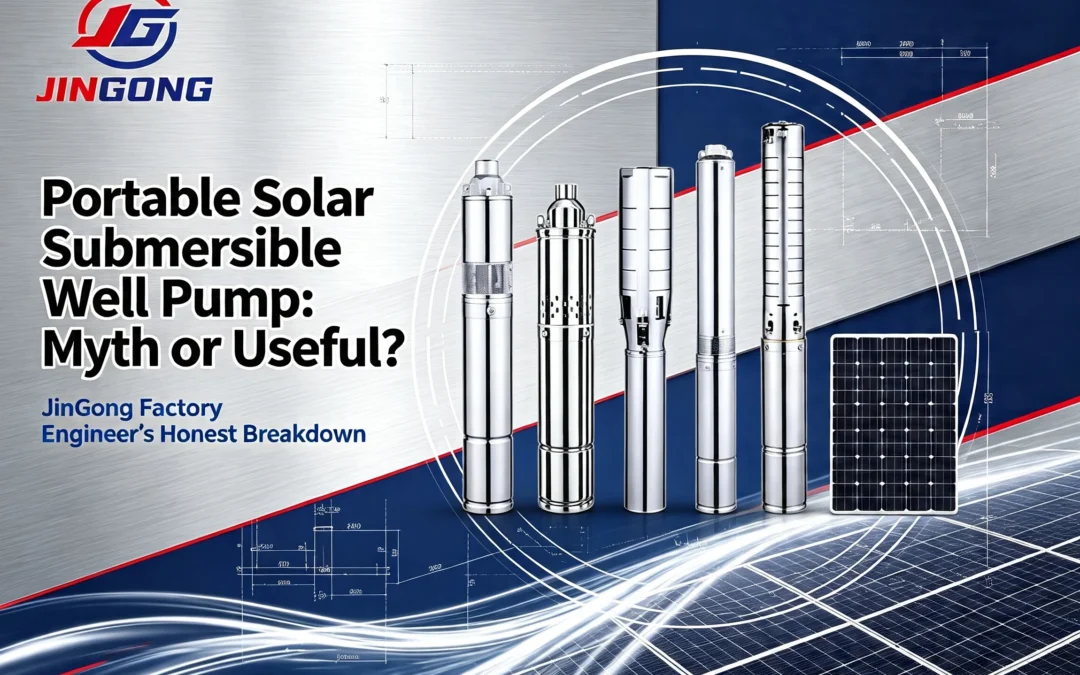
Introduction: Why This Debate Even Exists
Over the past five years, the demand for the solar submersible well pump has exploded across overseas markets—from farms in Texas and homesteads in Australia to livestock watering stations in Kenya and disaster-relief sites in Southeast Asia. Simultaneously, e-commerce platforms are flooded with $80–$120 “portable solar well pumps” that overpromise and underdeliver. This has created a polarized narrative: one camp calls them “an off-grid game changer,” while the other labels them “a solar-powered paperweight.”
As a manufacturing specialist at Jingong Technology , where we produce booster pumps, submersible pumps, surface centrifugal pumps, solar pump systems, and gasoline/diesel engine pumps, I have overseen the testing and iteration of the solar submersible well pump since 2019. This article provides our honest, factory-floor perspective: separating marketing myths from practical utility to help you make an informed decision.
What this post covers:
- Four mainstream myths busted with field data.
- Real test numbers on 12V, 24V, and 48V solar submersible well pump units.
- Side-by-side comparisons with electric submersibles, surface pumps, and diesel pumps (all part of our catalog).
- A buying guide distinguishing “plastic-core junk” from “stainless 316 workhorses.”
What Is a Portable Solar Submersible Well Pump, Exactly?

Before debating “myth vs. useful,” we must define terms. Half the confusion online stems from comparing professional-grade equipment to toy pond pumps.
Three Attributes Rolled Into One
A portable solar submersible well pump combines three specific engineering decisions:
| Attribute | Definition | Why It Matters |
|---|---|---|
| Portable | Lightweight (8–18 kg), quick-connect cables, no civil works required. | Ideal for rental land, seasonal grazing, and disaster relief. |
| Solar | DC motor (12V/24V/48V) driven by PV panels, usually with an MPPT controller. | $0 electricity bills; completely off-grid ready. |
| Submersible Well | Sealed motor + impeller assembly sits below water in 3″–4″ well casings. | Quiet operation, frost protection, and superior suction head. |
How It Works (The Engineering Version)
- PV Panels convert sunlight into DC electricity.
- The MPPT Controller stabilizes voltage, prevents dry-running, and optimizes power point tracking.
- A DC Brushless Motor drives multi-stage centrifugal impellers.
- Water is pushed up through the drop pipe to a tank, trough, or irrigation line.
A properly specced solar submersible well pump runs at 60–90% of its rated flow even at 40–60% sunlight, thanks to advanced MPPT algorithms.
Key Distinctions
It differs significantly from a fixed solar deep-well pump (higher power, permanent installation), a surface solar pump (suction-limited to ~7–8m), and a diesel/gasoline engine pump (fuel-dependent, noisy).
4 Mainstream Myths — Busted by a Factory That Repairs Them
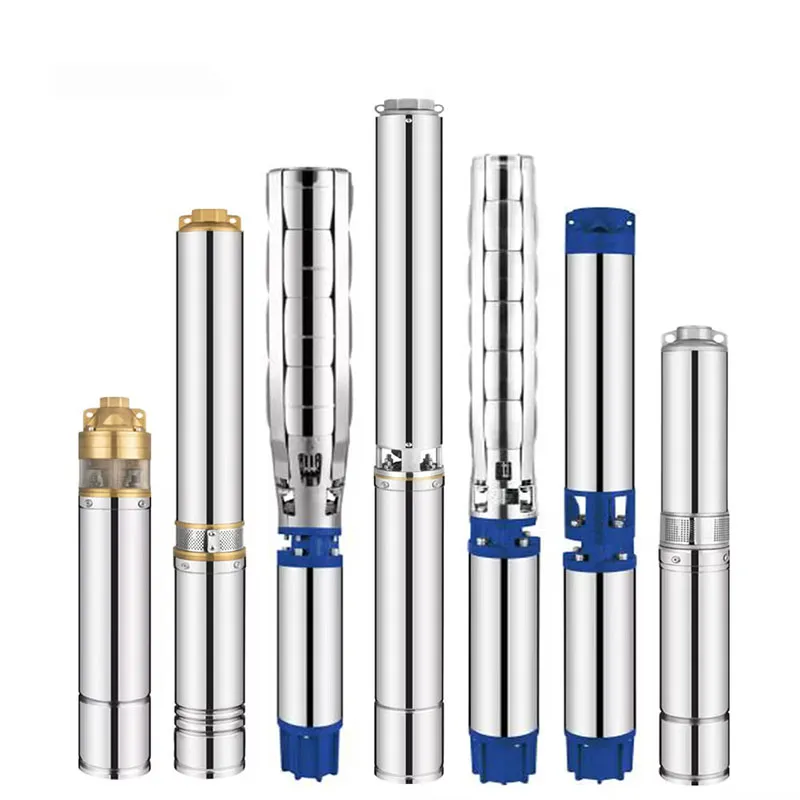
Myth #1: “Portable solar well pumps are low-head toys, useless for real work”
The Reality: Portable does not mean low-power. Our 48V brushless solar submersible well pump (0.7 HP class) achieves a 390 ft lift at 9 GPM. The 24V units typically handle 230–260 ft lifts at 3–7.7 GPM. The “toy” reputation comes exclusively from $99 plastic-impeller units. An industrial-grade stainless 316 unit with a brushless DC motor is a legitimate piece of agricultural equipment.
Myth #2: “They don’t work at night or on cloudy days — worthless in winter”
The Reality: There are two configurations. Direct-Drive systems run only when the sun hits the panels. Battery-Hybrid systems (using LiFePO4 or AGM banks) provide 24/7 water supply. Performance doesn’t drop to zero in clouds; MPPT controllers harvest diffuse light, albeit at reduced flow. In equatorial regions, winter performance remains robust. In northern latitudes, simply oversizing the array or adding a battery buffer solves the issue.
Myth #3: “Solar pumps fail fast, shorter life than electric pumps”
The Reality: Based on our RMA analysis, failures stem from: 1) Plastic internals cracking under thermal cycling; 2) Water ingress due to poor O-ring seals; and 3) Lack of dry-run protection. A stainless 316, brushless DC, IP68-rated solar submersible well pump with a quality controller lasts 5–10 years. The PV panels themselves are warrantied for 25–30 years, often outlasting the diesel engines they replace.
Myth #4: “Portable = only for home gardens, can’t do agriculture”
The Reality: Portability refers to the installation method, not the power ceiling. We supply 48V 0.75 HP portable units for 1–3 acre drip irrigation plots, 200-head cattle trough rotations, and mobile livestock camps. Agricultural suitability is a specification question, not a portability limitation.
Where a Portable Solar Submersible Well Pump Is Actually Useful (Test Data)
Advantages vs. Traditional Pump Types
| Factor | Portable Solar Submersible | AC Electric Submersible | Surface Centrifugal | Diesel/Gas Engine |
|---|---|---|---|---|
| Fuel/Elec Cost | $0 | Grid Tie | Grid Tie | Ongoing Fuel |
| Off-grid Ready | Yes | No | No | Yes |
| Noise | Near Silent | Quiet | Moderate | Loud |
| Maintenance | Low | Medium | Medium | High |
Field-Tested Scenarios (Jingong Projects)
- Remote Ranch (Texas): A 24V DC unit (260 ft head, 7.7 GPM) powered by 2x200W panels supplied water to 40 head of cattle across three troughs for 18 months with zero fuel cost.
- Smallholder Rice Farm (Bangladesh): A 3.8 kW submersible unit irrigated 3.45 hectares during the dry season, outperforming a diesel suction pump which covered less than 2.5 hectares.
- Disaster Relief Camp: A 12V portable unit deployed from a pickup truck in under 20 minutes, providing critical water without complex fuel logistics.
Real Performance Numbers (Jingong Test Bench)
| Voltage | Rated Power | Max Head | Max Flow | Sunny-Day Flow (@ ½ Head) | Cloudy (40% Irradiance) |
|---|---|---|---|---|---|
| 12V DC | 120W | 230 ft | 3.2 GPM | ~3.0 GPM | ~1.1 GPM |
| 24V DC | 260W | 260 ft | 7.7 GPM | ~7.2 GPM | ~2.8 GPM |
| 48V DC | 540W | 390 ft | 9 GPM | ~8.5 GPM | ~3.5 GPM |

How It Stacks Up Against Other Pump Types (Jingong Full-Line Comparison)
As a manufacturer of all five major pump families, we offer an unbiased comparison:
Solar Submersible vs. AC Electric Submersible
Verdict: Choose the solar submersible well pump for off-grid locations or where grid electricity is expensive/reliable. Opt for AC electric if you have stable 3-phase power onsite and no portability requirements.
Solar Submersible vs. Surface Centrifugal (Land Pump)
Verdict: Surface pumps are limited to ~7–8m suction depth and require priming. They are suitable for shallow wells, ponds, or rivers. For deep wells (50m+), a submersible design is mandatory.
Solar Submersible vs. Diesel/Gasoline Engine Pump
Verdict: Diesel pumps still win for high-HP, continuous industrial applications (e.g., 10+ hectare irrigation). However, for remote, intermittent use like livestock watering or domestic supply, the solar submersible well pump wins on OPEX and maintenance.
Buying Guide: How to Not Waste Money
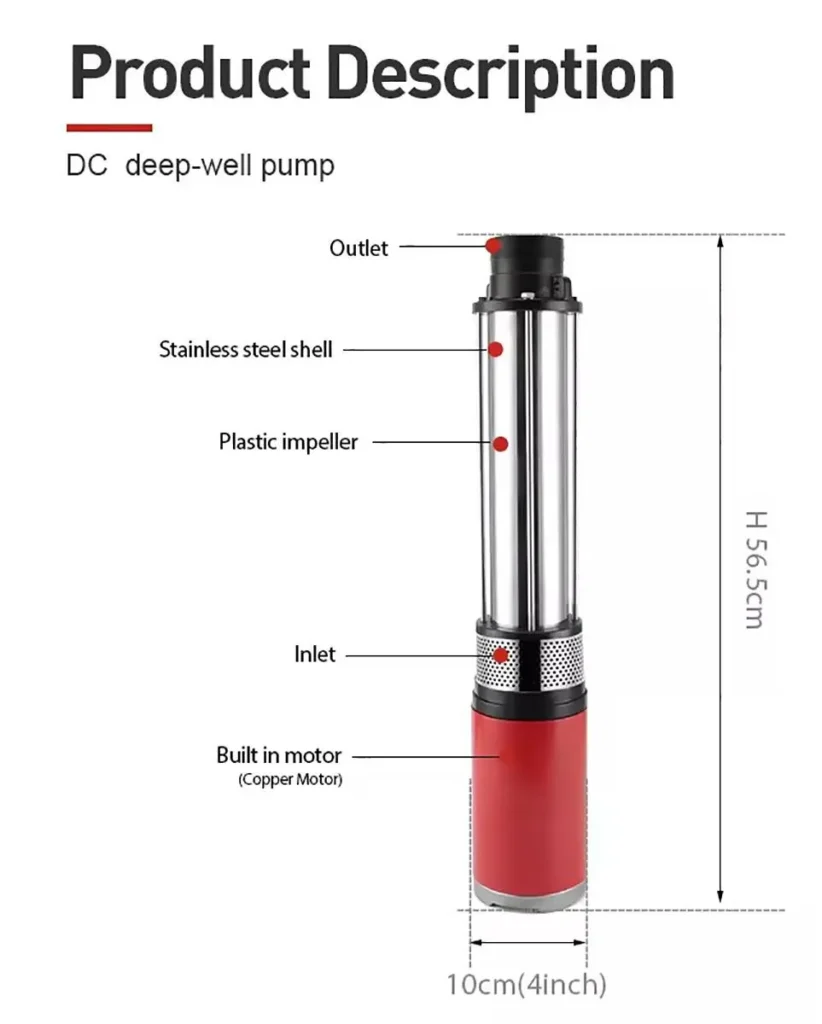
Specs That Actually Matter
- Motor Type: Brushless DC (BLDC) only. Brushed motors equal short lifespan.
- Voltage: 12V (light duty, <150 ft), 24V (most farms), 48V (deep wells/high flow).
- Head & Flow: De-rate specifications by 20% for real-world conditions.
- Body Material: Stainless Steel 304 minimum; 316 for corrosive/coastal water.
- Controller: MPPT is non-negotiable. PWM controllers waste energy.
- Dry-Run Protection: Essential to prevent motor burnout.
- Casing Fit: Ensure the pump diameter is smaller than your well casing (e.g., 3″ pump for a 4″ casing).
Cheap-Unit Red Flags
- No brand name on the controller.
- Impellers listed as “nylon” or “engineering plastic.”
- Cables not rated for submersion.
- Lack of a performance curve (only “Max Head” claims).
Quick-Pick by User Type
| User Profile | Recommended Spec | Rationale |
|---|---|---|
| Off-grid Cabin | 12V DC, 3.2 GPM | Lowest entry cost, fits on roof. |
| Ranch (50-200 head) | 24V DC, 7-8 GPM + Battery | All-day watering, cloud buffer. |
| Small Farm (1-3 acres) | 48V DC, 9 GPM | Handles deep wells and irrigation zones. |
| Emergency / NGO | 24V Kit + Foldable Panels | Rapid deployment, no fuel logistics. |
Installation, Maintenance, Troubleshooting
Installation Steps (Approx. 45 Minutes)
- Position PV panels facing true south (Northern Hemisphere) at an angle equal to your latitude.
- Connect PV wires to the MPPT controller (observe polarity strictly).
- Critical: Attach a safety rope to the pump eyelet. Never lift the pump by its electrical cable.
- Lower the pump into the well casing slowly.
- Connect the drop pipe (typically 1″ or 1-1/4″ PE/PVC).
- Wire the pump cable to the controller output terminals.
- Fill the header tank, power on, and verify flow rates.
Maintenance Schedule
- Panels: Wipe dust every 2–4 weeks during dry seasons.
- O-rings: Inspect every 6 months; apply food-grade silicone grease.
- Winter: In freezing climates, pull the pump or ensure it sits below the frost line.
Troubleshooting Quick Table
| Symptom | Likely Cause | Solution |
|---|---|---|
| No start (sunny) | Polarity reversed / Controller fault | Check wiring, reset controller |
| Low flow | Shading / Dirty panels | Clean panels, trim obstructions |
| Stops mid-day | Dry-run trigger / Tank full | Check water level / Float switch |
| Runs, no water | Foot valve leak | Pull pump, inspect check valve |
Who Should (and Shouldn’t) Buy One — Final Verdict
The debate over the solar submersible well pump often misses the nuance. It is neither a universal solution nor a complete scam.
Buy it if: You are off-grid or face high grid electricity costs; your well depth is 50–400 ft; your required flow is 1–10 GPM; and you value low maintenance and portability.
Skip it if: You require 20+ GPM continuously for large-scale industrial irrigation; you live in a region with less than 2 peak sun hours in winter and refuse to add a battery buffer; or your well casing is smaller than 3 inches.
From our factory floor perspective, the “myth” exists because of low-quality imports flooding the market. The “utility” exists because thousands of farms globally now rely on these systems daily. A quality solar submersible well pump is a long-term investment in energy independence.
FAQ (Featured Snippet Target)
Are portable solar submersible pumps any good?
Yes, high-quality units featuring brushless DC motors, stainless steel construction, and MPPT controllers are excellent for off-grid wells. Avoid cheap plastic-core units.
How deep can a portable solar well pump push water?
Performance varies by voltage: 12V models reach ~230 ft, 24V models ~260 ft, and 48V models ~390 ft. Always de-rate these figures by 15–20% for real-world reliability.
Can solar submersible pumps run at night?
Only if paired with a battery buffer. Direct-drive systems stop operating when sunlight disappears.
Which is better for a farm — solar pump or diesel pump?
Solar wins on operational expenses (OPEX) and maintenance for small-to-medium farms. Diesel remains superior for high-horsepower, continuous industrial-scale irrigation.
Do solar well pumps work in winter?
Yes, provided the solar panels are kept clear of snow and the pump is installed below the frost line. A battery buffer is highly recommended in regions with short winter days.
How long does a solar submersible well pump last?
PV panels last 25–30 years. The pump mechanism lasts 5–10 years with proper O-ring maintenance, while the controller typically lasts 5–7 years.
What size solar panel do I need?
A general rule is to match panel wattage to the pump’s rated watts multiplied by 1.3–1.5x. For a 260W pump, use a 350–400W solar array.
Can I run it from my truck battery in an emergency?
12V units can run from a truck battery if voltages match. 24V/48V units require series connections or voltage boosters, which are not recommended for ad-hoc setups