
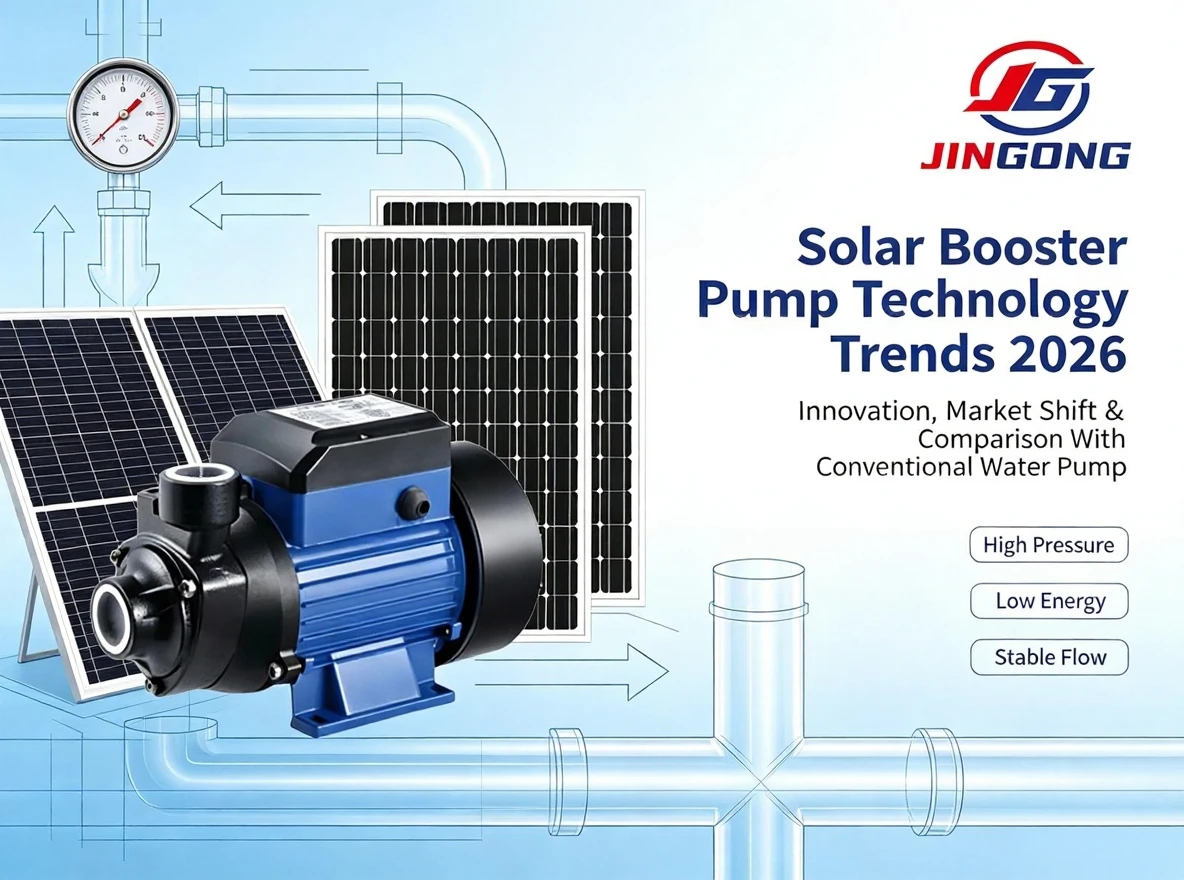
Solar Booster Pump Technology Trends 2026: Innovation, Market Shift & Comparison With Conventional Water Pumps
By Jingong Tech Pump Engineering Team – Senior Solar Booster Pump manufacturer with 15+ years of export experience across Africa, Southeast Asia, the Middle East and Latin America.
In 2026, the global solar water pump market is undergoing a structural shift. According to YH Research, the top three photovoltaic pump brands already account for roughly 34% of the global market share, while the competitive landscape remains open for specialized, vertically-integrated players. As a leading Solar Booster Pump manufacturer, Jingong Tech observes that MPPT controller upgrading, permanent-magnet brushless DC motors, hybrid solar-diesel architecture, and IoT-enabled remote monitoring are the four decisive technology pillars this year.
Solar submersible booster pumps are pushing deeper into borewells, while solar surface booster pumps are scaling up flow rates for farm irrigation. Compared to conventional diesel/gasoline pumps, solar systems deliver 20-year water costs of approximately $0.25/m³ versus $0.60/m³ for diesel (field study, Kenya). This pillar report – published by a trusted Solar Booster Pump manufacturer – serves as both an industry insight hub and a linkable asset for EPCs, distributors and project buyers. Explore our full Solar Pump Product Category.
1. Introduction: What Is a Solar Booster Pump & Scope of This Report
1.1 Definition of a Solar Booster Pump System
A solar booster pump is a complete off-grid water delivery system consisting of PV panels + MPPT controller + pump body (submersible or surface) + optional energy storage / hybrid module. It differs from a ordinary solar water pump in that it integrates pressure-boosting capability – maintaining stable pressure for irrigation networks, rural water supply towers and community distribution lines. Every professional Solar Booster Pump manufacturer must engineer the controller, motor and hydraulic end as one optimized system rather than assembling disconnected parts.
1.2 Report Boundary & Product Coverage
This report covers:
- Solar Submersible Pumps – deep well, borewell, borehole
- Solar Surface Booster Pumps – ponds, rivers, shallow water sources
- Diesel & Gasoline Water Pumps – benchmark comparison
- Application scenarios: agricultural irrigation, livestock drinking water, off-grid rural supply, municipal pressure boosting
As a full-line Solar Booster Pump manufacturer, Jingong Tech provides all four categories above from a single factory, enabling genuine hybrid system integration rather than third-party bundling.
2. Global Market Background & Key Growth Drivers for Solar Booster Pumps 2026
2.1 Global Market Size & Regional Demand Shift
The global photovoltaic pump market is segmented into DC surface type, AC submersible type, DC submersible type and AC floating type, with applications spanning domestic water, agriculture and beyond. In the Middle East & Africa, the solar pumping market has been expanding at a rapid CAGR (reported around 19% for sub-Saharan Africa through 2026); in South & Southeast Asia, government subsidies and “Photovoltaic + Agriculture” policies are accelerating adoption. Latin American markets (Brazil, Argentina) are following. A credible Solar Booster Pump manufacturer must therefore localize product specs per region – which we detail in Section 6.
Market Data Snapshot (Linkable Asset)
• Top 3 global PV pump manufacturers = ~34% combined market share
• YH Research identifies Lorentz, Grundfos, CRI Group among leading brands
• Africa solar pumping market: ~$7.5M (2019) → strong CAGR ~19% toward 2026
Source: YH Research Photovoltaic Pump Report 2026
2.2 Core Driving Factors
- Rising off-grid water demand – 2+ billion people lack reliable grid access for irrigation
- PV module cost decline – lower $/W makes solar pumping economically superior
- Policy incentives – subsidy programs in India, Kenya, Nigeria, Morocco
- Diesel price volatility – Nigerian diesel reached ~$2.4/L in early 2026, 4× the ~$0.5/L level two years prior
- Opex reduction mandate – farms switching from diesel to solar save 90%+ on operating cost
2.3 Market Challenges (Objectively Stated for EEAT Trustworthiness)
- High upfront investment – solar system capital cost is ~1.71× that of a diesel equivalent
- Sunlight dependency – cloudy/rainy days reduce output without storage
- After-sales network gaps – remote areas lack qualified maintenance
- Complex water quality – high sand content & salinity shorten pump life if not engineered correctly
- Low-quality MPPT market chaos – counterfeit controllers damage motors
This is precisely why selecting an experienced Solar Booster Pump manufacturer – not merely a trader – directly determines project ROI. See our Overseas Project Case Studies.
3. Core Technology Trends of Solar Booster Pumps 2026
3.1 Controller & MPPT Technology Upgrade
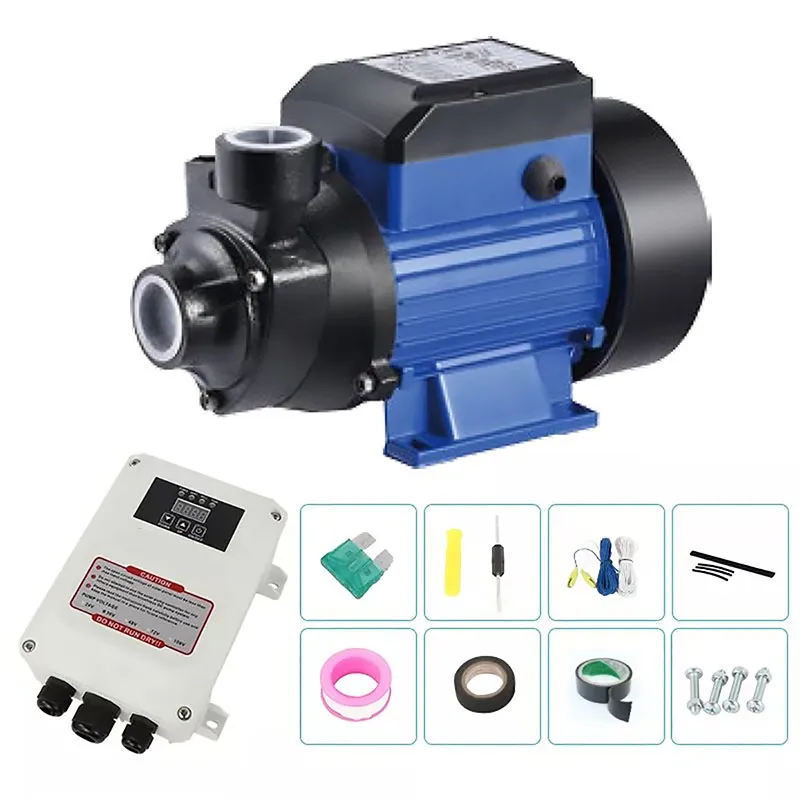
2026 MPPT controllers feature wide voltage compatibility, over-voltage & dry-run protection, sand-water sensing, and seamless AC-DC hybrid switching logic. The integration trend is clear: controller + inverter + protection in one enclosure. From our production floor observations as a tier-1 Solar Booster Pump manufacturer, integrated controllers reduce field failure rates by up to 40% versus modular setups.
3.2 Motor Innovation: Permanent Magnet & Brushless DC Breakthrough
Brushless DC permanent magnet motors now achieve >90% motor efficiency, with lightweight design, high-temperature tolerance, and upgraded sealing for submersible use. Surface pump motors are reaching IP68 protection grades. Any serious Solar Booster Pump manufacturer in 2026 must adopt permanent magnet synchronous motor (PMSM) technology to remain competitive.
3.3 Hybrid Power Systems Become Mainstream 2026
Solar + Battery, Solar + Grid, and Solar + Diesel/Gasoline Generator hybrids are now the dominant engineering approach for uninterrupted water supply. Automatic switching logic prioritizes solar → battery → grid → generator. This trend directly leverages our full product portfolio as a Solar Booster Pump manufacturer plus a diesel & gasoline pump producer.
3.4 IoT & Remote Monitoring – Smart Solar Booster Pumps
Built-in 4G/5G modules enable real-time flow, head, power and fault alerts via mobile app or cloud dashboard. For EPCs managing hundreds of units, this is transformative. As a connected Solar Booster Pump manufacturer, we embed IoT readiness even in mid-tier models.
3.5 Material & Anti-Sand / Corrosion Resistance
Wear-resistant ceramic bearings, anti-corrosion impellers, and stainless steel / special coating pump bodies now address high-sand and high-salinity water. This is a top request we receive as a Solar Booster Pump manufacturer serving African and SE Asian markets.
3.6 Modular & Plug-and-Play Design for Distributors
Standardized kits with pre-wired connectors reduce installation time from days to hours. A forward-thinking Solar Booster Pump manufacturer designs modular spare-part architecture so distributors can stock and swap components locally.
2026 Solar Booster Pump Technology Trend Matrix (Linkable Asset Table)
| Trend | Key Tech | Impact |
|---|---|---|
| Controller | Wide-V MPPT + auto hybrid switch | +40% reliability |
| Motor | Brushless PMSM >90% | +25% efficiency |
| Hybrid | Solar+Battery+Grid+Diesel | 24/7 water supply |
| IoT | 4G/5G + Cloud | Predictive maintenance |
| Material | Ceramic bearing + SS304/316 | 2× lifespan in sand |
4. Solar Submersible Booster Pump VS Solar Surface Booster Pump 2026

4.1 Solar Submersible Booster Pump Trends
2026 demands higher head capability (up to 300m+), anti-sand variants, compact high-power bodies, and hybrid storage submersibles. Borewell and deep-well projects across India, Africa and the Middle East drive this. Our engineering team as a specialist Solar Booster Pump manufacturer has shipped 150mm+ bowl assemblies rated for continuous 200m head duty. See Solar Submersible Booster Pump products.
4.2 Solar Surface Booster Pump Trends
Larger flow rates (up to 10,000 L/h on solar), portable movable configurations, and enhanced pressure-stabilization dominate 2026. Ideal for small-to-medium farms using pond or river water. As a responsive Solar Booster Pump manufacturer, we offer both fixed-install and trolley-mounted surface units. See Solar Surface Booster Pump products.
4.3 Application-Oriented Selection Table
| Dimension | Solar Submersible Booster | Solar Surface Booster |
|---|---|---|
| Water Source | Deep well, borehole, ≥15m depth | Pond, river, reservoir, ≤8m suction |
| Typical Head | 50–300m+ | 10–60m |
| Typical Flow | 1–20 m³/h | 3–40 m³/h |
| Installation | Requires well rigging | Plug-and-play, movable |
| Maintenance | Lower (sealed underwater) | Easier (accessible) |
| Best Market | India, Africa, MENA (deep aquifer) | SE Asia, Latin America (irrigation canals) |
| Typical Buyer | EPC, gov’t rural supply | Farm owner, dealer |
Selection matrix compiled by Jingong Tech – experienced Solar Booster Pump manufacturer serving 80+ countries.
5. Solar Booster Pump VS Conventional Gasoline & Diesel Water Pumps: Market Position Shift 2026
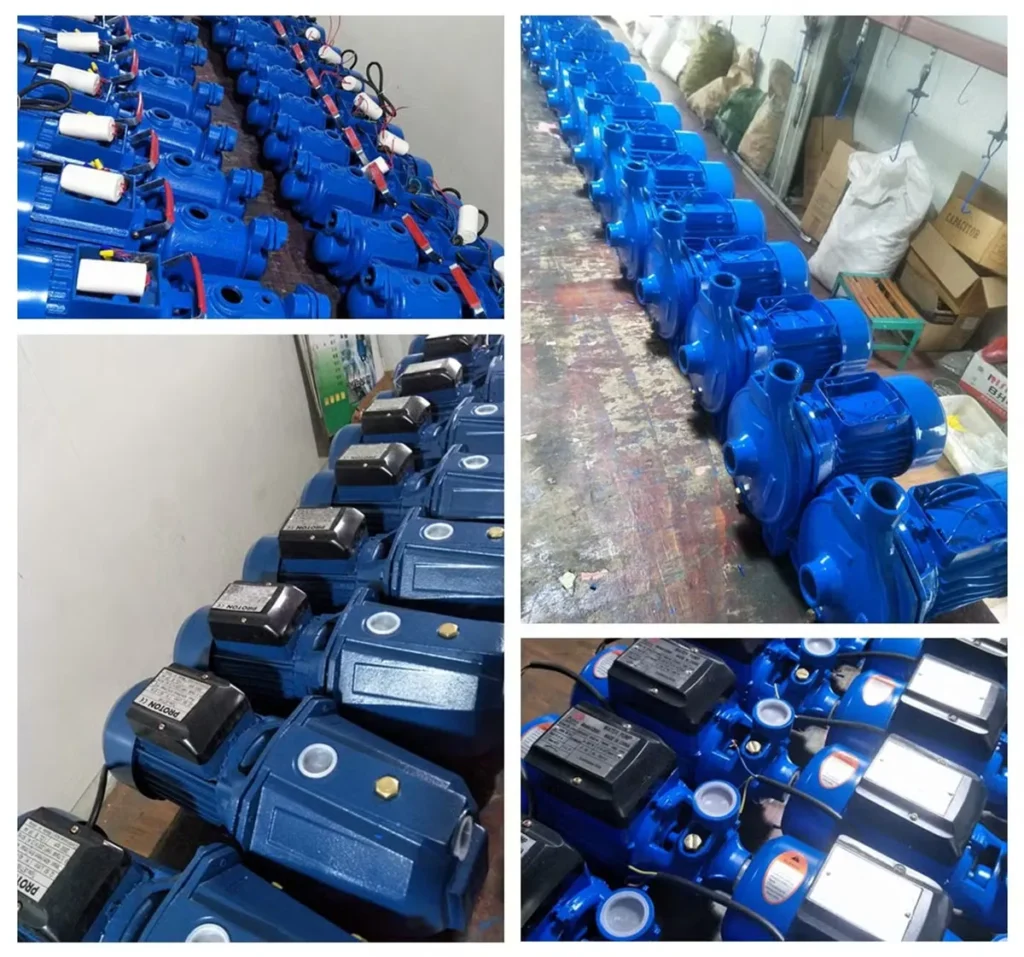
We do not negate diesel/gasoline pumps. As both a Solar Booster Pump manufacturer and a diesel & gasoline pump producer, Jingong Tech takes an objective stance: the two technologies coexist, with solar as primary and diesel/gasoline as backup in most 2026 projects.
5.1 Total-Cost-of-Ownership (TCO) Comparison
| Cost Dimension (20-yr lifecycle) | Solar Booster Pump | Diesel Water Pump |
|---|---|---|
| Initial Capital | 1.71× diesel (higher upfront) | 1× baseline |
| Fuel Cost | $0 (sunlight free) | ~38.9 L/year diesel per unit |
| Unit Water Cost | $0.25 / m³ | $0.60 / m³ |
| 20-yr Total Lifecycle Cost | 1× (baseline) | 8.97× solar |
| Payback Period | ~0.67 yr (vs diesel premium) | — |
| CO₂ Emissions | ~102 kg CO₂ saved/yr/unit | Baseline |
5.2 Suitable Application Scenarios for Each Solution
✅ Solar Booster Pump Wins When:
- Long-term off-grid operation
- Abundant sunlight (>4.5 kWh/m²/day)
- Low opex priority
- Environmental compliance needed
⛽ Diesel/Gasoline Pump Wins When:
- Short-term / emergency pumping
- Cloudy regions, low irradiance
- 24/7 nonstop duty, no battery budget
- Rapid deployment, no solar design time
5.3 2026 Trend: Solar-Diesel Hybrid Combined Solution Growing
The fastest-growing architecture in 2026 is solar-primary + diesel-backup hybrid. This leverages our dual identity as a Solar Booster Pump manufacturer and diesel pump factory – we engineer the automatic transfer switch so the diesel generator kicks in only when battery + solar are insufficient. Learn more on our Hybrid Solar Pumping Solutions page.
6. Regional Market Demand Characteristics & Product Requirements 2026
| Region | Dominant Pump Type | Key Pain Point | Tech Preference | Certification Need |
|---|---|---|---|---|
| Africa | Submersible + hybrid | High sand, diesel cost | Anti-sand, solar-diesel | SONCAP, CE |
| Southeast Asia | Surface + submersible | Monsoon fluctuation | Portable, hybrid battery | CE, ISO 9001 |
| Middle East | Submersible deep well | Salinity, high head | Corrosion-resistant SS316 | SASO, CE |
| Latin America | Surface large flow | Remote farm irrigation | Modular, IoT-ready | INMETRO, CE |
These regional insights come from our direct export operations as a Solar Booster Pump manufacturer with distributors across all four continents. Matching the right Agriculture Irrigation, Livestock Water Supply and Rural Water Supply solutions to regional specs is critical for project success.
7. Challenges & Pain Points Faced by Distributors & Project Buyers in 2026
- Water quality variability – one model cannot fit all; mis-selection causes premature failure
- Inventory complexity – DC vs AC, submersible vs surface, head/flow permutations overwhelm dealers
- Spare parts & after-sales – distant projects suffer from slow component replacement
- MPPT controller counterfeits – low-quality controllers flood the market, burning motors
- System sizing difficulty – improper PV array matching reduces yield by 30%+
As a responsible Solar Booster Pump manufacturer, Jingong Tech addresses these via detailed buying guides, FAQ resources, and localized distributor stock programs. We have compiled these pain points from thousands of real overseas inquiries – not theoretical assumptions.
8. Practical Buying & Sourcing Guidance for Solar Booster Pump 2026

8.1 Key Technical Parameters To Evaluate
- Head (H) – total dynamic head in meters
- Flow Rate (Q) – m³/h or L/h
- MPPT Quality – wide voltage range, protection functions, conversion efficiency
- Motor Type – brushless PMDC vs asynchronous AC
- Protection Grade – IP rating, submersible sealing standard
- Anti-Sand Capability – impeller material, bearing type
8.2 How To Choose: Submersible or Surface Solar Booster Pump
If water source depth exceeds 15m → choose Solar Submersible Pump. If water source is at ground level or shallow (pond, river, canal) → choose Solar Surface Pump. As a professional Solar Booster Pump manufacturer, we recommend distributors stock both types to cover all end-user scenarios.
8.3 When To Choose Hybrid Solar / Diesel-Gasoline Backup
If the project location has unstable sunlight (annual average below 4.5 kWh/m²/day), requires 24/7 uninterrupted water supply, and cannot accept battery cost, then a Solar-Diesel Hybrid Solution is the answer. Our factory also produces diesel and gasoline water pumps, enabling us to deliver a fully integrated hybrid system from one source – a capability few competitors as a Solar Booster Pump manufacturer can match.
8.4 Important Certifications for Global Export
- CE – European market access
- ISO 9001 – Quality management system
- SONCAP – Nigeria
- SASO – Saudi Arabia
- INMETRO – Brazil
As a fully certified Solar Booster Pump manufacturer, Jingong Tech assists clients with target-market certification. Explore our OEM/ODM Services or Contact Us for a Quote.
9. Frequently Asked Questions (FAQ)
Q1: Are solar booster pumps reliable for 24-hour water supply in 2026?
A: Systems paired with battery storage or diesel backup can deliver 24/7 water. Pure solar setups cannot work at night or during extended cloudy periods – this must be clearly stated during selection. As an honest Solar Booster Pump manufacturer, we always match the configuration to the client’s actual duty cycle.
Q2: What is the difference between a solar booster pump and a normal solar water pump?
A: A normal solar water pump only lifts water from point A to B. A solar booster pump adds integrated pressure-boosting capability, making it suitable for irrigation networks and community water distribution systems that require stable pressure.
Q3: Can a solar submersible pump work with a diesel generator backup?
A: Yes. Hybrid controllers support automatic switching between solar + battery + diesel generator. Since our factory also produces diesel water pumps, we supply the complete hybrid package.
Q4: Surface vs submersible solar pump: which is better for farm irrigation?
A: For shallow sources (ponds, rivers) choose surface. For deep wells choose submersible. See the selection table in Section 4.3 for a full comparison.
Q5: What is the main limitation of a solar booster pump compared with a gasoline pump?
A: Higher upfront cost, sunlight dependency, and inability to run at night without storage. However, the 20-year total cost of ownership is dramatically lower. As an objective Solar Booster Pump manufacturer, we recommend choosing based on the specific project scenario rather than a one-size-fits-all replacement.
10. Conclusion & Future Outlook
The core trends of the solar booster pump industry in 2026 are hybridization, smart IoT integration, higher motor efficiency, and regional customization. Over the next 2–3 years, as battery costs decline further and IoT becomes standard, solar booster pumps will shift from an “alternative option” to the preferred first choice for off-grid water supply. For distributors and project buyers, now is the window to stock hybrid systems and build localized spare-part networks.
Jingong Tech, as a Solar Booster Pump manufacturer with deep industry expertise, will continue iterating our product technology to provide global customers with complete services from selection and system integration to after-sales support. Return to the Solar Pump Category Homepage or read more industry blog articles.
Appendices
Appendix A: Key Glossary
- MPPT – Maximum Power Point Tracking, core solar controller technology
- TDH – Total Dynamic Head, static head + friction losses
- Head (H) – Height a pump can lift water (meters)
- Flow Rate (Q) – Volume of water delivered per unit time (m³/h or L/h)
- Submersible Pump – Fully submerged underwater during operation
- Surface Pump – Installed above water level, self-priming
- PMSM – Permanent Magnet Synchronous Motor
Appendix B: Reference Industry Report Sources
- YH Research – Global Photovoltaic Pump Market Report 2026
- Kenya Borehole PV vs Diesel LCC Study (2026)
- Nigeria Rural Irrigation HOMER Simulation (2026)
- Jingong Tech Internal Export Order Data (2018–2026)
About the Author
This article was written by the Jingong Tech Pump Engineering Team. Jingong Tech is a professional Solar Booster Pump manufacturer based in Zhejiang, China, integrating R&D, manufacturing and export. Our main product lines include submersible pumps, surface pumps, solar water pumps, and gasoline/diesel pumps. We provide complete pumping system solutions to distributors, EPC contractors and end-users in over 80 countries worldwide.

0 Comments