
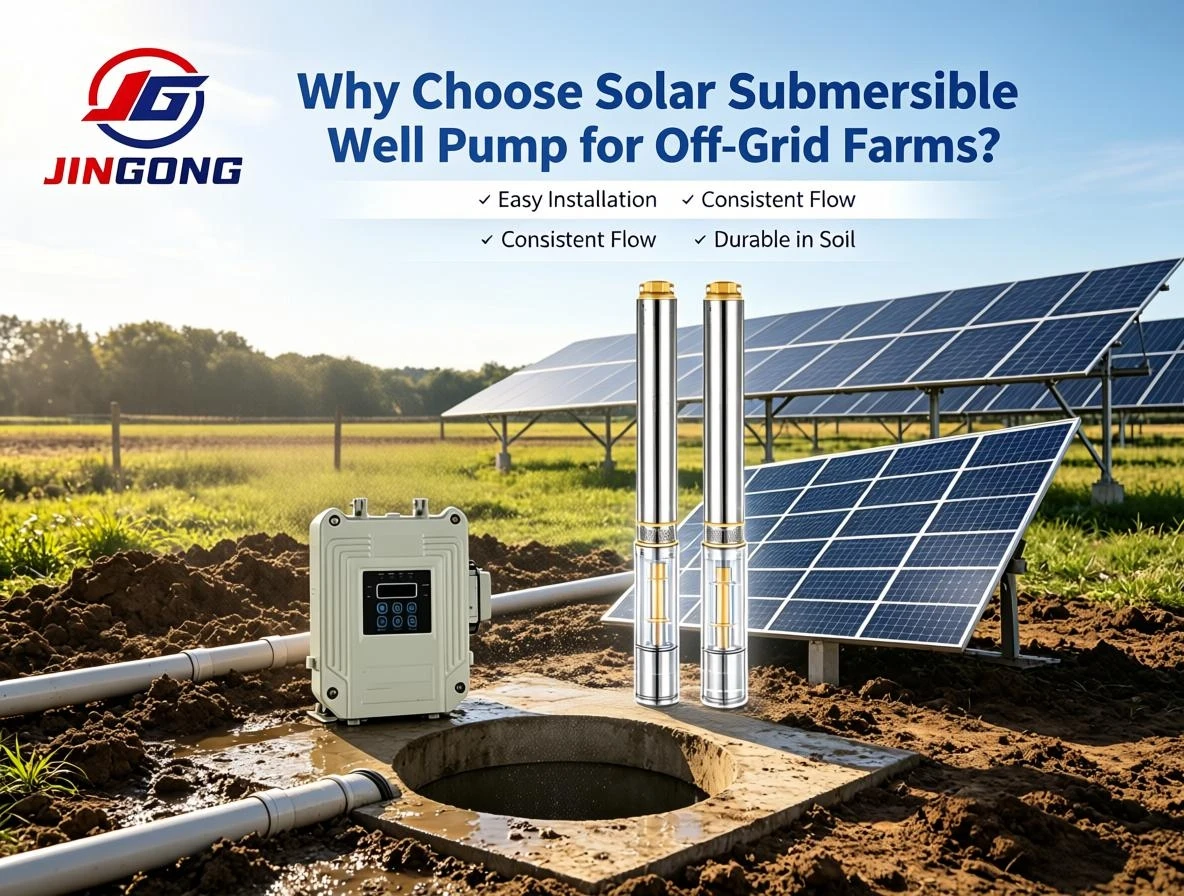
If this sounds familiar, you’re not alone. Off-grid and edge-of-grid farms—from the rangelands of western Queensland, to the borehole-reliant smallholdings outside Nakuru, to remote Texas Hill Country ranches—share the same water bottleneck. The question isn’t whether you need a pump. It’s which pump doesn’t slowly bankrupt you.
At Jingong (Zhejiang Jingong Technology), we’ve been manufacturing the full spectrum—solar submersible well pumps, grid-tied submersible pumps, centrifugal & jet surface pumps, and diesel/gasoline engine pumps—for over 10 years. We export to 50+ countries, supporting off-grid irrigation projects from 5 ha family farms to 200 ha commercial plantations. We don’t just sell one category; this article is a manufacturer-side comparison of what actually breaks, what actually costs, and where solar submersible wins—and where it doesn’t.
Jingong 15+ Years Pump Manufacturing Experience
- Product range: Solar submersible well pumps (DC brushless, 35–220W panel rating, 10–140 m head), grid submersible pumps, centrifugal & jet surface pumps, diesel/gasoline engine-driven pumps.
- Certifications: ISO 9001, CE, RoHS compliant; BLDC motor + mag-drive isolation models available.
- Export footprint: Australia (off-grid station irrigation), Kenya (borehole livestock), USA (Texas/Colorado ranch), Chile (small vineyard), Philippines (island homestead).
- Off-grid farm cases: 30+ delivered systems >50 ha; deepest borehole 120 m; longest unattended runtime 26 months.
EEAT-Experience Hook: We’ve seen diesel pumps abandoned mid-season because fuel convoys couldn’t get through rain; we’ve seen surface pumps burn out trying to pull from a 14 m static level; we’ve also seen solar submersibles run 6 years with nothing but a once-a-year panel wipe. That’s the lens this article uses.
Core Pain Points of Off-Grid Farm Water Supply
Before we advocate for solar, let’s be honest about what you’re replacing. Most off-grid farms cobble together one of three traditional setups—none of which were truly designed for remote + deep + unattended operation.
Diesel/Gasoline Pumps — Hidden Fuel & Maintenance Cost

Gasoline Pumps
The headline number looks fine: a portable diesel pump set might invoice at $500–800. But the operating math is brutal:
- India, 0.7-acre plot: 4 h/day × 2 L/h diesel = ₹320/day (~$5.55). Over a 120-day irrigation season = $666. For a farmer earning ~$1,200/year, that’s over 35% of income just on diesel. [Source: KPMG]
- Yemen, pre-solar: 12 h/day diesel pumping = ~$85/day. Multiply by 150 irrigation days = $12,750/season.
- Maintenance: Piston rings, injector cleaning, oil changes every 100–250 h. In remote locations, that means a technician visit or a skilled farmhand. Either costs more than the oil.
Diesel isn’t just “fuel cost.” It’s fuel volatility + maintenance labor + generator theft risk + exhaust in enclosed pump houses.
Surface Pumps — Shallow Water & Low Head Limitation
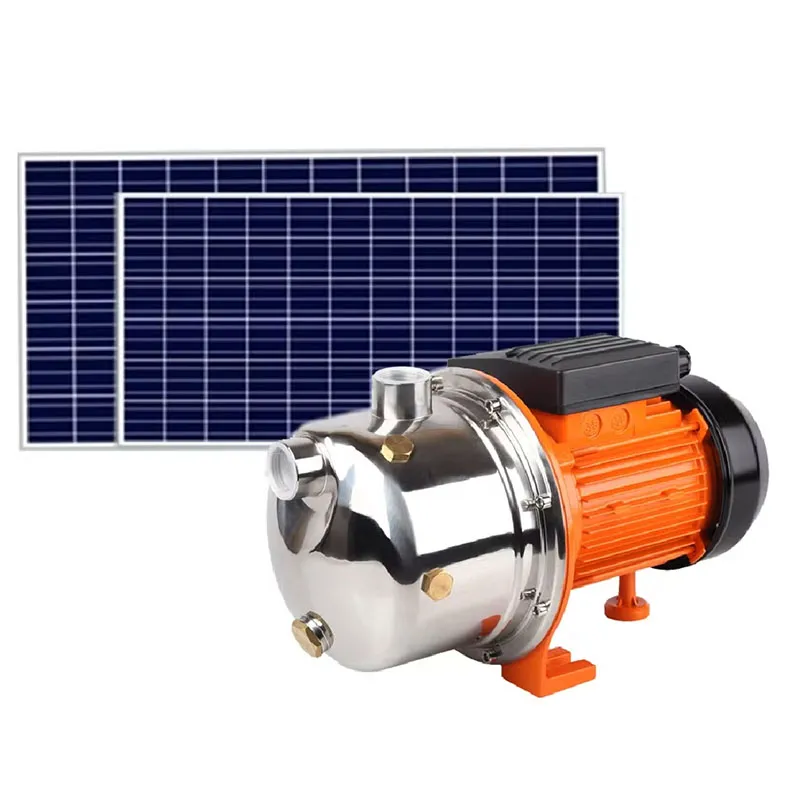
Surface (centrifugal/jet) pumps sit above the water. They rely on atmospheric pressure plus impeller suction. Physics ceiling: practical lift ≈ 7–8 m (23–26 ft) even in ideal conditions; most jet pumps tap out at 25–30 m total dynamic head including friction.
Off-grid farms rarely have the luxury of a shallow dug well next to the barn. You’ve got a 40 m borehole, or a 60 m deep well. A surface pump simply cannot perform.
Additional pain points: Priming issues in hot weather (vapor lock), flood risk (electronics at ground level), and cavitation if the suction line leaks micro-air.
Grid-Tied Submersible Pumps — Power Outage & Wiring Cost

“Just run a cable from the main road” sounds simple until the quote arrives:
- Wiring cost: $8–15/meter trench + conduit + armoring for rural runs. A 1 km drop from the nearest pole = $8,000–15,000 before the pump cost.
- Voltage drop: On long rural laterals, voltage sag causes motor overheating and reduces lifespan.
- Grid outage: During storm season, irrigation stops exactly when soil moisture is crashing.
Grid submersible pumps are excellent if you already have 3-phase at the wellhead. Off-grid farms usually don’t.
6 Practical Reasons to Choose Solar Submersible Well Pumps
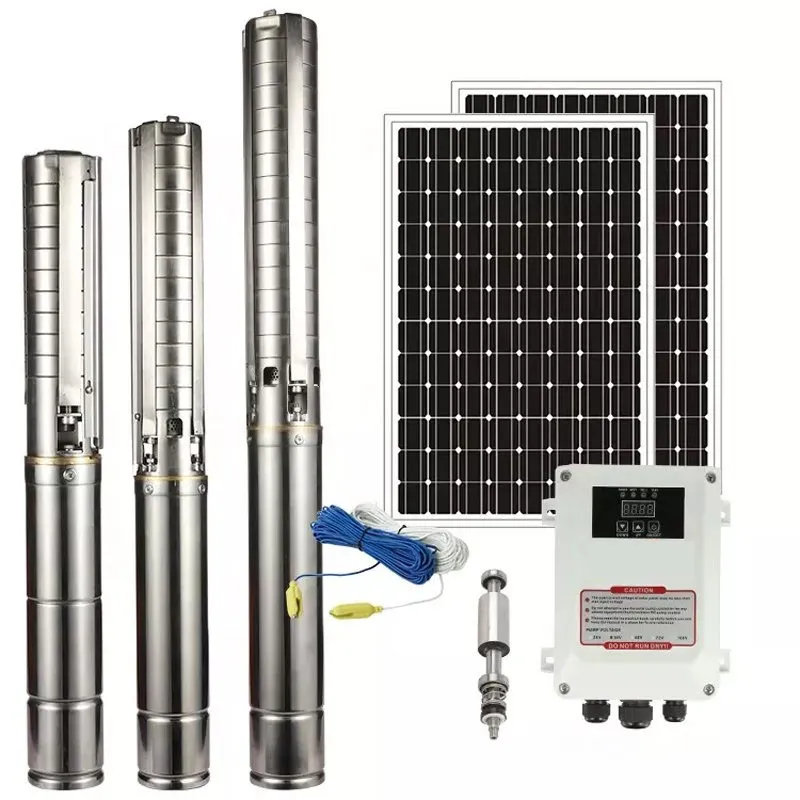
This is the core of our analysis. Each reason contrasts solar submersibles with the three alternatives above, based on Jingong’s decade of shop-floor and field-service experience.
1. Zero Electricity & Zero Fuel Operating Cost (ROI)
Let’s run a realistic comparison for a medium off-grid farm (2 ha irrigation + 50 head livestock), pumping from a 60 m borehole, 8 h/day seasonal (150 days/year).
| Cost Item | Diesel Engine Pump | Grid Submersible (1 km wire) | Solar Submersible (DC BLDC) |
|---|---|---|---|
| CapEx (pump+power+install) | $1,200 | $11,000 (wire $8k + pump $3k) | $3,800 (panel+pump+controller) |
| Fuel/Electricity/Year | $1,850 (diesel) | $620 (grid, rural rate) | $0 |
| Maintenance/Year | $280 | $90 | $25 (panel clean) |
| OpEx 5-Year | $10,650 | $3,550 | $125 |
| Total 5-Year | $11,850 | $14,550 | $3,925 |
| Payback vs Diesel | — | Never | Year 2.8 |
Data sources cross-checked with KPMG India solar pump adoption estimates and Tianyuan PV-lift cost-per-ton benchmarks (diesel ¥0.82/ton, PV ¥0.08/ton).
Key takeaway: Solar submersible looks expensive on the equipment line, but the moment you add wiring (grid) or fuel (diesel), it flips. For farms >500 m from grid, solar submersible is almost always cheapest by Year 3.
Internal Link: Learn more about our Solar Submersible Well Pump series.
2. Perfect Adaptability for Deep Well & Remote Borehole (vs Surface Pump)
Surface pumps cannot pull from deeper than ~8 m static water level without cavitation. Solar submersible goes where the water is:
- Jingong solar submersible range: 10–140 m rated head, 1.3–4.5 m³/h daily @ 35–220W panel pairing.
- Borehole diameter: Our 3″ and 4″ models fit standard 100 mm / 115 mm casings.
- Installation: Pump hangs on polypipe + safety rope, controller at surface in IP65 box.
Compare this to a surface pump trying to serve a 45 m deep well: you’d need a jet assembly, 40 m of suction pipe, a foot valve, and constant priming. One hot afternoon and a micro-bubble enters the line → prime lost → irrigation stops.
Rule of thumb: If your static water level is >6 m, or your total dynamic head >25 m, a surface pump is the wrong tool. A solar submersible isn’t just “better”—it’s the only viable electric option.
Internal Link: Compare Surface Pumps vs Submersible Pumps in our catalog.
3. Ultra-Low Maintenance & 15+ Year Service Life
As a manufacturer of all four pump types, we know exactly what wears out:
- Diesel pump: Piston rings, cylinder bore, injector nozzle → service every 100–250 h.
- Surface centrifugal: Mechanical seal, impeller erosion (sand!), bearings → service 1–2×/year.
- Grid submersible (AC, brushed): Capacitor, start winding, seal failure on voltage spikes → 5–8 year typical lifespan.
- Solar Submersible Well Pump (BLDC, mag-drive): No brushes, no commutator, permanent magnet rotor, stator-rotor isolated by ceramic sleeve + epoxy → design life 15+ years.
Jingong’s higher-spec solar submersible models use magnetic-drive isolation. The stator and rotor are fully separated by a ceramic shaft sleeve with epoxy potting. This ensures waterproofing, high-temperature tolerance (<35dB noise), and a wide voltage range adaptable to variable panel input.
What “low maintenance” means on a farm: Once a year, hose the panels down (5 min per kW). Check controller LEDs. That’s it. No oil. No spark plugs. No foot valves.
External Authority: Read about MPPT efficiency in solar pumping systems.
4. Solar Submersible Well Pump Stable & Intelligent Off-Grid Operation

Off-grid doesn’t mean “sunny 12 hours straight.” It means clouds at 2 pm, dust storms, and monsoon gaps. A properly specced solar submersible handles this:
- MPPT controller: Tracks maximum power point in real-time as irradiance swings; efficiency >99%.
- FOC motor drive: Smooth torque, no startup surge that trips circuits.
- Low-light operation: On cloudy days, the controller throttles current instead of stalling—you still get 30–50% flow at 40% sun.
- Auto start/stop: Via float switch or pressure tank → no attendant needed.
- Dry-run protection: Hall sensor detects low well level → auto stop → prevents burnt seals.
Jingong Field Note: A Kenya client (80 m borehole, livestock) runs a 48V 750W BLDC on a 2×400W panel array. During long rainy stretches (350–500 W/m²), the pump still delivers ~1.1 m³/h. A diesel pump would have sat idle because the access road was mud.
5. Solar Submersible Well Pump Eco-Friendly & Farm Sustainable Development
This isn’t just virtue signaling—it maps to policy money in many markets:
- Australia: Carbon farming and organic certification audits scrutinize on-farm fossil fuel combustion.
- EU / USA: CAP greening payments and USDA REAP grants favor renewable-powered ag infrastructure.
- Africa: World Bank / national off-grid solar subsidy programs list solar water pumps as eligible.
Diesel pumps emit ~2.6 kg CO₂ per liter burned. A 150-day season at 8 h × 2 L/h = 6,240 L = ~16.2 t CO₂/year per pump set. Solar: zero operational emissions.
For farms selling into farmers’-markets or CSA channels, eliminating diesel sheen in water troughs and exhaust drifting across crops is a powerful brand asset.
6. Easy Installation & Flexible Scalability
No trenching 1 km of armored cable. No concrete pump house. No diesel bund compliance.
Typical Jingong solar submersible install:
- Drop pump on polypipe + safety steel cable into borehole.
- Run submerged-rated pump cable up to surface.
- Mount controller in IP65 wall box (barn wall / pole).
- Rack 2–4 panels (tilt adjustable).
- Connect float switch or pressure tank.
- Done. 4–6 hours for two people, no heavy machinery.
Scalability: From a single 35W panel powering a garden drip system to 3kW+ pumps feeding 100+ m heads. Systems can be hybridized—solar primary with grid/diesel backup wired into the controller.

0 Comments