
Off-grid water access is accelerating across Africa, Southeast Asia, Latin America and remote rural zones worldwide — deep-well drinking water, smallholder irrigation, livestock watering, and standalone photovoltaic (PV) water supply systems are all driving demand for solar submersible water pumps. Yet one component decides whether a system runs for 2 years or 10: the motor.
Traditional brushed DC motors are cheaper up-front but suffer from carbon-brush wear, poor PV-voltage tolerance, and frequent failures in deep-well, sandy or corrosive water. Brushless DC (BLDC) motors — paired with MPPT controllers — have become the de-facto standard in professional solar submersible pump design. At Jingong Pump (Zhejiang, China), we’ve been manufacturing submersible, booster, surface, solar and gasoline-diesel pumps for 15+ years, exporting to 40+ countries, and our field data consistently shows BLDC units outlast brushed units by 4–6× in real irrigation and village water projects.
This guide breaks down the technical, economic and application logic behind choosing BLDC motors for solar submersible pumps — written for irrigation contractors, PV distributors, EPC buyers, and agricultural procurement teams.
Related: Solar Submersible Pump Series · Off-Grid Solar Water System Solutions
Brushed DC vs Brushless DC: Technical Baseline
Before comparing advantages, you need solar submersible water pumps the structural difference — because the motor type dictates everything downstream: lifespan, efficiency, controller compatibility, and maintenance intervals.
How a Brushed DC Motor Works (and Why It Struggles in Solar)
A brushed DC motor uses carbon brushes pressing against a commutator to mechanically switch current direction in the armature windings. It’s simple, cheap to manufacture, and Solar Submersible Water Pumps needs no external controller beyond a basic PWM regulator.
But in a solar submersible context, the weaknesses pile up fast:
- Carbon-brush physical wear: every rotation creates friction; brushes typically need replacement every 3,000–6,000 running hours (often sooner in dusty/hot climates).
- Sealing risk: brush housings break waterproof integrity over time; deep-well retrieval for brush change is expensive.
- Poor PV-voltage tolerance: solar irradiance swings 0→full→0 across a day; brushed motors have no intelligent current limiting, so stalling/overcurrent is common.
- Lower efficiency: 60–75% typical, meaning more PV panels needed for the same flow.
How a BLDC Motor Works (Electronic Commutation)
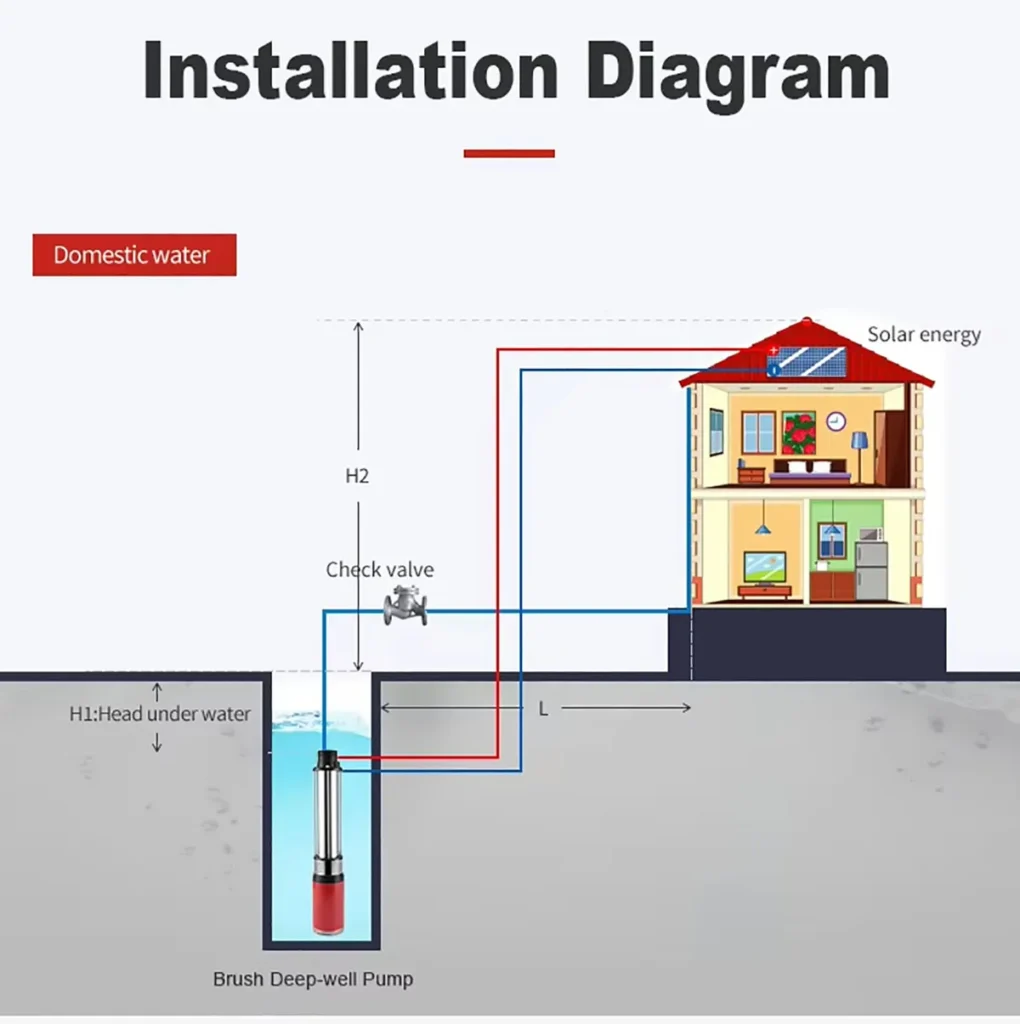
A brushless DC motor removes the brushes entirely. The permanent magnets sit on the rotor; the stator carries the windings, and an external controller (usually MPPT-based) electronically switches phase current using Hall sensors or sensorless FOC algorithms.
| Component | Brushed DC | BLDC |
|---|---|---|
| Commutation | Mechanical (carbon brushes + commutator) | Electronic (controller + sensors/FOC) |
| Wear parts | Brushes, commutator | None (magnetic coupling possible) |
| Sealing | Harder (brush access) | Easier (fully potted / magnetic-isolated) |
| Efficiency | 60–75% | 85–92%+ |
| Typical lifespan | 3,000–5,000 h | 20,000–30,000+ h |
| PV compatibility | Poor (needs stable voltage) | Excellent (MPPT, wide V-range) |
Source: Jingong Pump in-house test bench data + industry references.
Magnetic-Isolation BLDC (the Premium Submersible Variant)
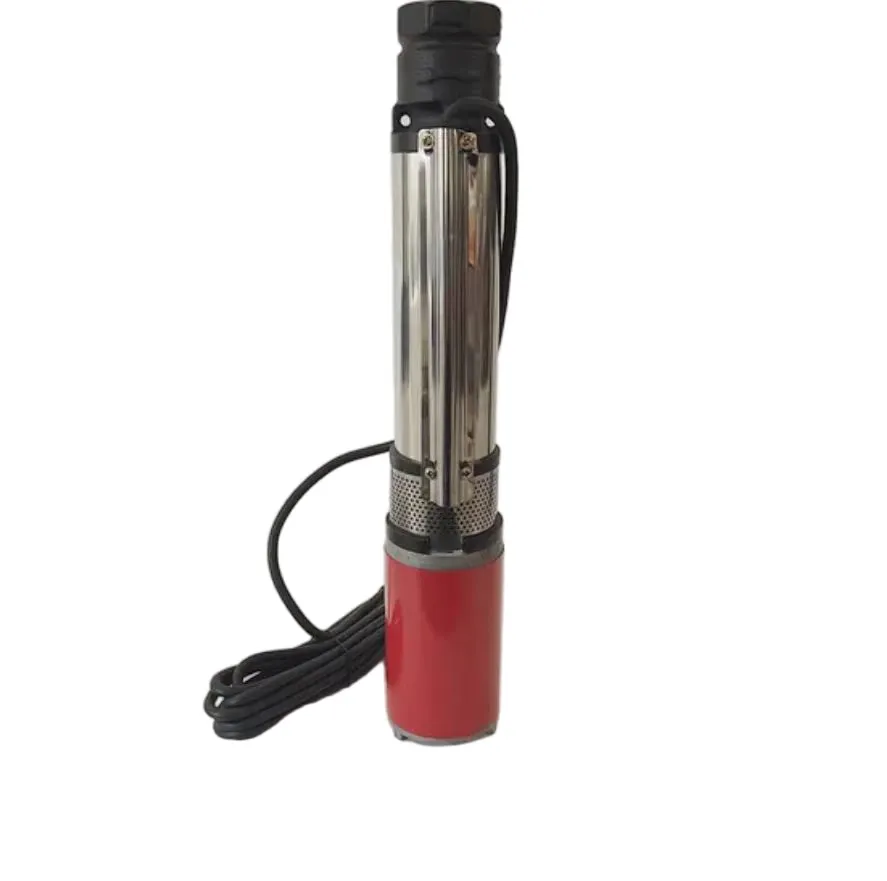
Not all BLDCs are equal. For submersible duty, the best designs use magnetic isolation (cantilever / coupled):
- Stator + PCB potted in epoxy, 100% waterproof
- Rotor driven by permanent magnet coupling, no shaft penetration
- Ceramic shaft + ceramic sleeve (wear-resistant, sand-tolerant)
- Can be fully submerged long-term, even in hot-water or mildly corrosive water
This is what Jingong specifies for our 2SS/3SS DC solar submersible series, and it’s why BLDC dominates professional solar pump catalogs globally.
Related: Pump Motor Technology Column · Solar Pump Controller & MPPT Explained
Core Advantages of BLDC Motors for Solar Submersible Water Pumps
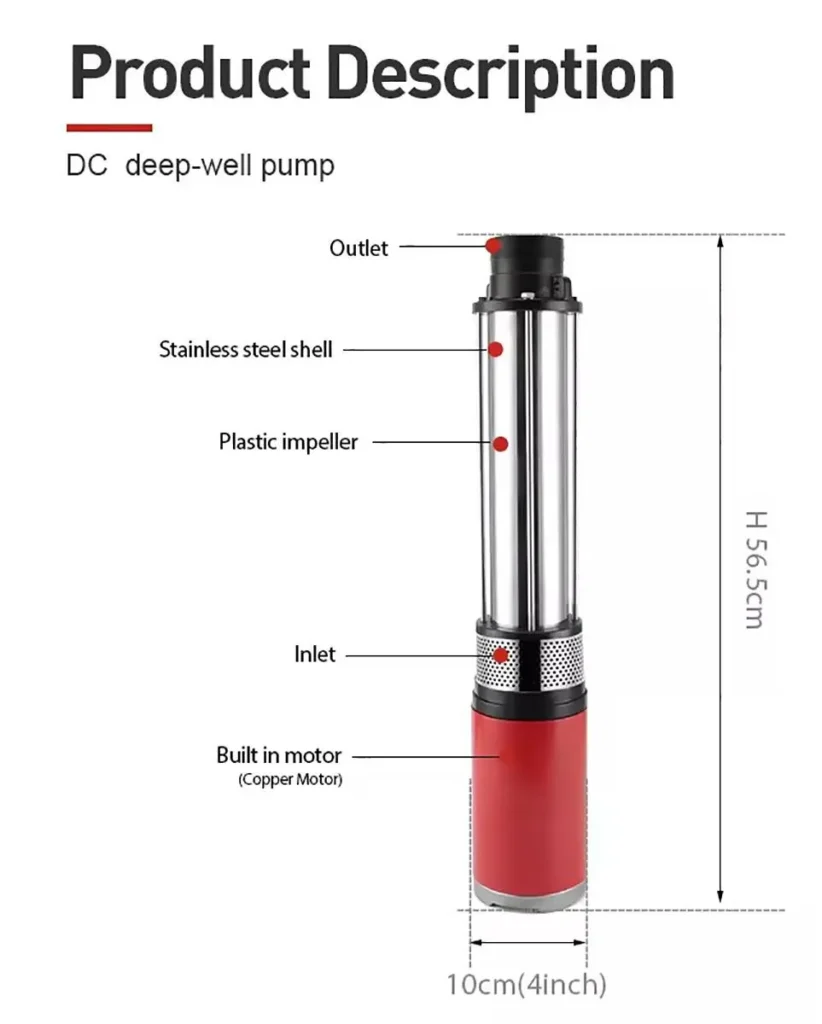
3.1 Ultra-Long Service Life & Low Wear
No carbon brushes = no mechanical commutation wear. In a deep-well solar pump, this is decisive:
- Brushed motor: 3,000–5,000 running hours before brush replacement; deep-well retrieval cost (labour + rig) often exceeds motor value.
- BLDC motor: 20,000–30,000+ hours typical; Jingong field returns show ≥10,000 h as conservative baseline for continuously running units.
- Fully potted / magnetic-isolated designs eliminate shaft-seal friction points.
- Fewer stoppages = fewer pump-down events = less sediment disturbance in the well.
Jingong field note: In a Kenya rural water project (120 m static level, 4″ well, 1.5 kW BLDC solar submersible), the same unit ran 3 consecutive dry seasons without opening the well. A brushed equivalent in the neighbouring village was pulled twice/year for brush service.
3.2 Higher Energy Efficiency & Solar-Power Adaptability
Solar is variable by definition. A motor that can’t handle voltage swing wastes PV capacity.
BLDC advantages here:
- Efficiency 85–92% vs 60–75% brushed
- Low starting current — reduces PV array sizing by ~15–25% versus AC + inverter routes
- Weak-light start: modern MPPT controllers track max power point even at 30–50% irradiance; BLDC responds smoothly
- Direct-DC drive: no inverter needed → eliminates 15–20% inverter loss
| Item | Brushed DC (72% eff) | BLDC (88% eff) |
|---|---|---|
| PV array needed for same flow | ~1,900 Wp | ~1,550 Wp |
| Panels saved | — | ~2 × 400 Wp modules |
| PV cost saved (ex-factory) | — | ~USD 180–240 |
| 5-yr electricity-equivalent saved* | baseline | ~12% less PV degradation impact |
*No grid electricity in off-grid scenario; saving = deferred panel expansion + better low-light yield.
Related: Solar Panel Matching Guide
3.3 Low Noise & Vibration Underwater
Solar submersible water pumps Brushed motors produce audible brush friction + commutator arcing. BLDC (especially magnetic-isolated) runs purely electronic:
- Typical ≤35–45 dB at 1 m in air; underwater even quieter
- No brush chatter → less vibration → less well-casing wear, less settling of sediment
- Important for: residential boreholes, eco-lodges, livestock troughs, school/health-post water
3.4 Intelligent Control & Stable Operation
BLDC motors don’t run without a controller — but solar submersible water pumps that’s the advantage, not a drawback. Modern solar pump controllers bundle:
- MPPT (Maximum Power Point Tracking) — maximizes PV harvest hour-by-hour
- Dry-run protection — auto-stop when well/tank low; auto-restart when recovered
- Overload / overvoltage / reverse-polarity protection
- Constant-pressure / constant-flow algorithms (DSP-chip controllers)
- Wide input voltage — e.g. DC 12/24/48/60/72 V, or 100–1,500 W PV input
In outdoor, unattended installs (90% of solar submersible use-cases), solar submersible water pumps these protections are what keep a pump alive through cloudy weeks and seasonal water-level drops.
See: Smart Pump Control Systems
3.5 Low Maintenance & Lower OPEX
This is the B2B clincher. Breakdown for a 50 m deep-well pump in sub-Saharan Africa:
| Cost item | Brushed (annualised) | BLDC (annualised) |
|---|---|---|
| Brush replacement (parts) | USD 15–30 | USD 0 |
| Pull/reinstall labour & rig | USD 120–200 / event | USD 0 (no scheduled pull) |
| Unplanned downtime (irrigation loss) | variable, often >USD 500/season | near-zero |
| Expected motor replacement | Year 2–3 | Year 8–12 |
Over a 7-year project horizon, BLDC typically saves 2.5–4× in total OPEX despite 20–40% higher CAPEX.
3.6 Solar submersible Water Pumps Better Waterproof & Corrosion Resistance
Submersible means permanently underwater — sometimes sandy, sometimes slightly acidic (pH 4–10 common in agricultural runoff), sometimes saline at low levels.
BLDC structural wins:
- Stator + PCB epoxy-potted, IP68 class
- Magnetic isolation: rotor and stator fluid-separated; no dynamic seal = no leak path
- Ceramic shaft/sleeve: far better than stainless in sandy water (Jingong specifies this on 2SS/3SS)
- SS304 / SS316 pump body + engineering-plastic impeller options
- Anti-rust, anti-sand certification on pro models
Related: Outdoor Waterproof Pump Series
Scenario Applications: Where BLDC Solar Submersible Pumps Work Best
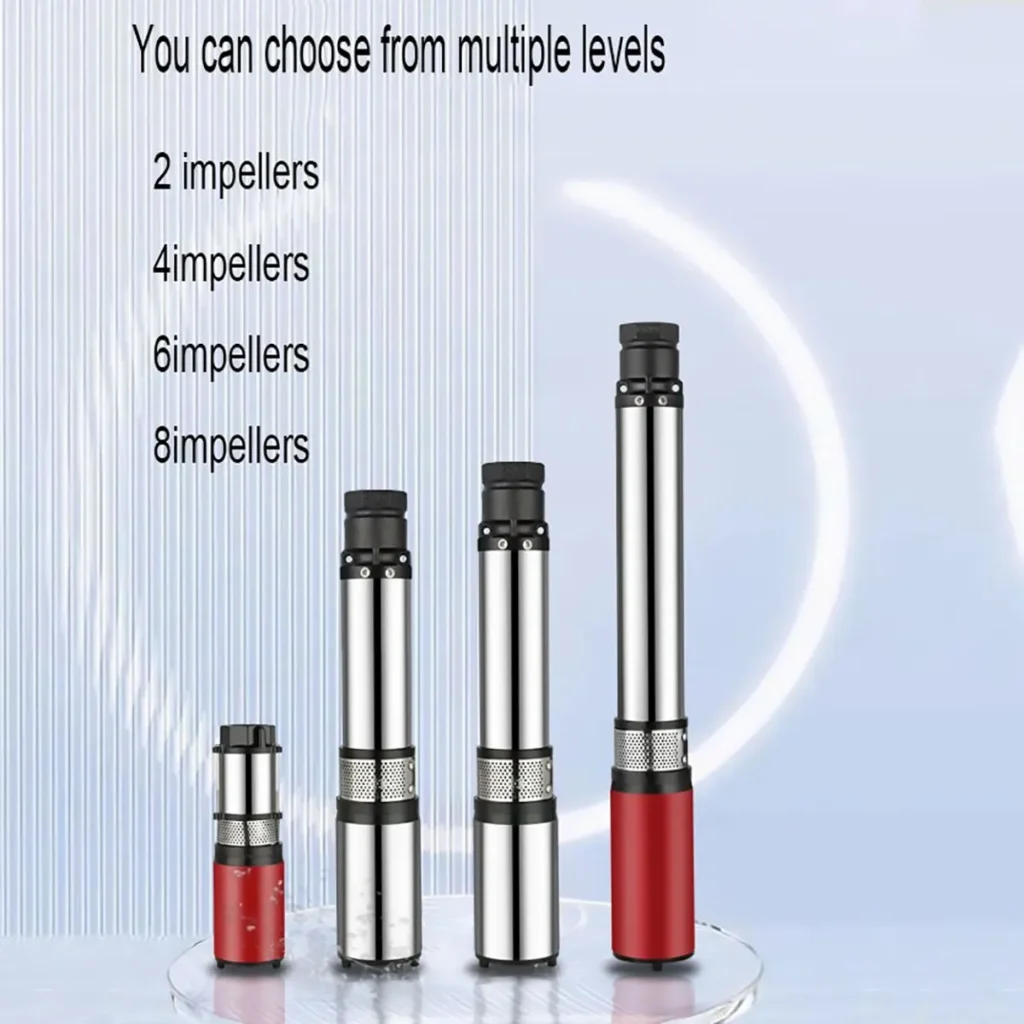
Real-world B2B scenarios (EEAT “Experience” signal):
- Rural off-grid drinking water — village boreholes, 50–150 m depth, 0.5–2.5 kW BLDC (Africa Sahel, Indonesia outer islands, Andes villages)
- Farm / orchard irrigation — seasonal, solar-aligned (pump when sun shines, store in tank)
- Livestock & ranch watering — trough fill from well / river; low-noise matters for cattle
- Remote deep-well (>80 m) — BLDC + MPPT handles higher head curves better than brushed
- Small PV water infrastructure — NGO / government tenders, 10–200 pump clusters
Note: Brushed motors still exist in very low-budget, shallow-well (<20 m), intermittent-use niches — but anything tender-grade or OPEX-sensitive should default BLDC.
Related solutions: Farm Irrigation Solution · Deep Well Solar Solution
Cost & ROI Analysis (B2B Conversion Core)
CAPEX Reality Check
BLDC solar submersible pump (complete with controller) typically prices 20–40% above a brushed equivalent at ex-factory level, 10–25% at distributor landed price (because brushed still needs separate regulator, shorter warranty).
Hidden Cost Map (5–7 Year Horizon)
- Brushed: brush kits + 1–2 pulls + downtime + earlier full-motor replacement
- BLDC: controller may need swap at year 7–9 (cheaper than motor); motor itself often outlives pump hydraulics
When solar submersible water pumps BLDC Pays Back
Rule of thumb from Jingong distributor feedback:
- Irrigation / daily-use → payback 18–30 months via PV-panel savings + zero pull-costs
- Intermittent / backup only → payback 36–48 months (still positive)
- Tender / NGO bulk → BLDC wins on lifecycle scoring, not just ticket price
Next steps: Request Quotation · Bulk Purchase Advantage
JINGONG FAQs (Targeting Google Featured Snippets)
Are brushless DC motors better for solar submersible water pumps?
Yes — for off-grid/submersible duty they outperform brushed motors on lifespan (20,000+ h vs 3,000–5,000 h), efficiency (85–92% vs 60–75%), PV-voltage tolerance (MPPT-ready), and maintenance (no carbon brushes). Brushed only wins on lowest up-front ticket.
How long does a BLDC solar submersible pump last?
Typical 20,000–30,000 running hours; Jingong field data shows ≥10,000 h as conservative baseline. Deep-well retrieval is rarely needed for motor reasons.
Why use a brushless motor in a submersible pump specifically?
Because submersible duty demands 100% sealing + sand/corrosion tolerance + unattended operation. BLDC (especially magnetic-isolated) eliminates brush-access breaches, uses ceramic shafts, and epoxy-pots electronics — none of which brushed can match.
Do BLDC solar submersible water pumps save more power?
Yes — 85–92% motor efficiency + MPPT controller + direct-DC (no inverter) typically yields 15–25% more water per watt vs AC+inverter routes, and 20–30% vs brushed DC at same PV input.
Is a BLDC solar pump suitable for deep wells?
Yes — BLDC + MPPT handles wide voltage swing and can be specified to 100 m+ depth (Jingong 2SS/3SS rated to 100 m; custom SKUs beyond). Weak-light start also helps deep wells where PV tilt isn’t perfect.
Conclusion
BLDC motors solar submersible water pumps aren’t a “premium upgrade” any more — they’re the baseline for any serious solar submersible pump project: longer life, better PV harvest, lower OPEX, MPPT-ready, and genuinely maintenance-light in remote installs. For irrigation contractors, PV distributors, and EPC teams tendering rural water, specifying BLDC is usually the difference between a 2-year headache and a 10-year asset.
At Jingong Pump (Zhejiang, China — 15+ years, booster / submersible / surface / solar / gasoline-diesel pump manufacturer, exported 40+ countries), our 2SS/3SS DC solar submersible series and custom deep-well BLDC builds are designed exactly around these six advantages. If you’re shortlisting motors or building a tender spec, talk to our engineering team — we’ll match PV array, head, flow and water quality into a BLDC config that pays back.
Explore: Solar Submersible Pump Product Page
Written by Jingong Pump Engineering Team | Zhejiang, China | 20+ years pump manufacturer, 40+ export countries.

0 Comments