
1. JinGong Solar Water Pumps Introduction — Why Solar Water Pumps Are No Longer “Optional” for Global Agriculture
1.1 The Three Pain Points Reshaping Agricultural Irrigation
Walk onto almost any farm in sub-Saharan Africa, a remote orchard in Spain’s Extremadura, or a rice paddy in Eastern Indonesia, and you’ll hear the same three complaints from growers:
- Water scarcity is accelerating. According to FAO’s 2025 climate-finance briefing, over 40% of smallholder farmers in the Global South now face seasonal water stress that directly cuts yields.
- Energy costs are eating margins. Diesel prices spiked 30–60% in multiple emerging markets between 2022–2024; even grid-connected farms in Southeast Asia saw electricity tariffs climb 8–15% annually.
- Grid unreliability blocks scale. Remote farms—whether in the Sahel, the Andean foothills, or island provinces of the Philippines—can’t run electric pumps reliably, if at all.
Traditional diesel or grid-tied electric pumps were “good enough” for the 20th century. They’re not for the 2030s. Diesel pumps emit ~2.6 kg CO₂ per litre burned, need weekly maintenance, and lock farmers into fuel-price volatility. Grid pumps? Useless where poles don’t reach.
Solar water pumps (SWPs) have moved from a niche “off-grid curiosity” to a core pillar of sustainable agriculture policy. The UN FAO, via its Food Systems Integrated Programme (FSIP) backed by a US$282 million GEF grant covering 32 countries, explicitly lists solar-powered irrigation as a priority technology for climate-resilient smallholder transitions. That’s not a trend piece—that’s multilateral financing telling you where the money (and the tender opportunities) is going.
1.2 Solar Water Pumps The Core Thesis: More Than “Energy Substitution”
Here’s the mistake most suppliers still make in their content: they frame solar pumps as “diesel replacement.” That undersells what’s happening.
The real revolution is five-layered:
- Irrigation-mode — from flood/batch pumping to precision drip/sprinkler timed to crop ET (evapotranspiration) rates.
- Cost-structure — OPEX drops to near-zero; CAPEX pays back in 6–18 months for smallholders, 1–2 years for mid-scale farms.
- Geography — farms can exist where grids don’t (desert edges, island interiors, mountain slopes).
- Policy-alignment — SWPs sit at the intersection of “carbon neutrality” + “food security” + “rural electrification,” which means subsidies, tenders, and IFI (World Bank, AfDB, ADB) co-financing.
- Data-layer upgrade — IoT-enabled SWPs feed remote telemetry that smart-farm platforms consume.
This article unpacks all five, then walks through market data, regional buyer personas, case studies, challenges, and a tactical layout for exporters—especially factories like Jingong that already manufacture submersible, surface, gasoline, and diesel pumps and are expanding into solar lines.
1.3 Who This Article Is For
If you’re any of these, this guide is built for you:
- Smallholder collectives / cooperatives evaluating whether a 0.5–3 HP solar pump beats a diesel unit.
- Commercial farms (50–500 ha) in Europe, Australia, Chile, California pricing out smart solar + drip systems.
- Agricultural equipment distributors in Africa, MENA, LATAM, SEA looking for a factory partner with certification + after-sales.
- Procurement officers in government ag ministries / IFI-funded projects.
- EPC / irrigation service providers bundling PV + pump + drip.
2. Core Primer: What a Solar Water Pump Actually Is
2.1 Definition & Typology (What Jingong Ships, What Buyers Ask)
A solar water pump converts photovoltaic (PV) DC output into mechanical energy that drives a pump unit—either directly (DC pump) or via an inverter to AC (AC pump). In agricultural contexts, you’re typically choosing across two axes:
By mounting / hydraulics:
- Submersible solar pumps — dropped into boreholes/wells; dominate deep-well applications (20 m–300 m+ head). Jingong’s existing submersible pump line ports over cleanly here: brushless DC or VFD-controlled 3-phase AC motors, stainless or cast-iron housing.
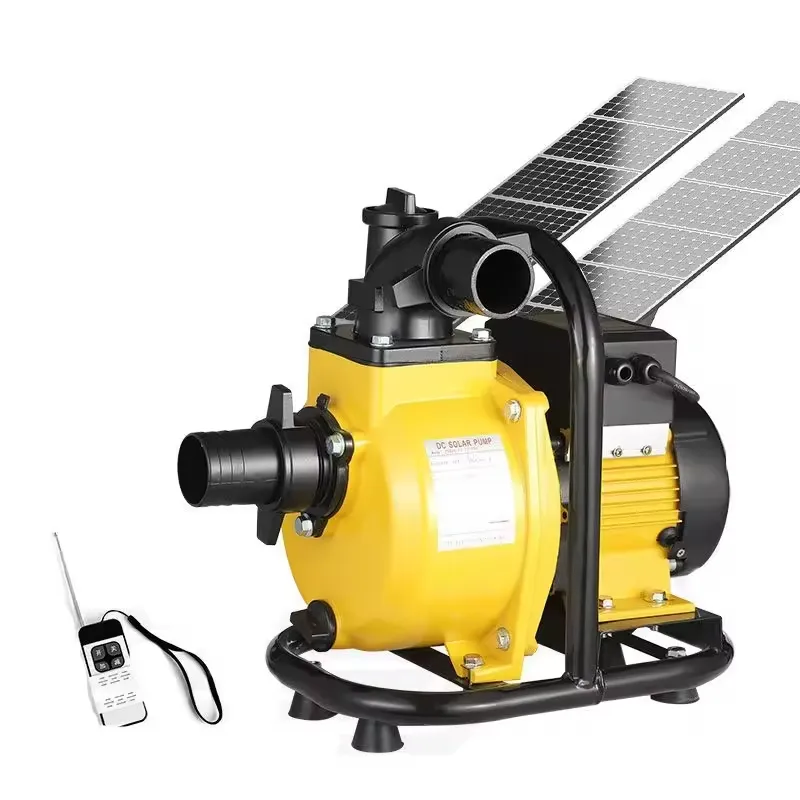
- Surface / centrifugal solar pumps — installed at pond, canal, river, or shallow well edge; easier service; ideal for flood irrigation retrofits and livestock watering. Explore our surface pump catalog.
- Floating solar pumps — less common in ag, more for aquaculture/pond management.
By power class (export-relevant):
- Micro (0.1–0.75 HP) — household garden + 0.5–2 ha vegetable plots.
- Small (1–3 HP) — cooperative plots, orchard blocks, livestock.
- Medium (3–10 HP) — 10–50 ha commercial farms.
- Large (10–50+ HP) — plantation scale, government tender projects.
2.2 Solar Water Pumps Working Principle & Why It Works (Technical but Not Overengineered)
Simplified signal chain:
PV Array → MPPT Controller (or VFD-inverter) → Motor → Pump Hydraulics → Water (tank / drip / sprinkler)
Two technical points worth emphasizing because overseas buyers ask them constantly:
- MPPT (Maximum Power Point Tracking) — Good controllers hold >99% tracking efficiency across irradiance swings. This is why a decent SWP still pumps on cloudy afternoons while a cheap PWM unit stalls.
- Motor choice — Brushless DC (BLDC) for <2 kW gives 85–92% motor efficiency; 3-phase induction with VFD for >2 kW scales better and shares spare parts with standard AC pumps (Jingong’s existing land-pump motor lines = inventory synergy).
Durability numbers Jingong routinely quotes to export clients:
- Pump set lifespan: 15–20 years (motor + hydraulics).
- PV module degradation: <0.5%/year (Tier-1 mono PERC).
- Annual maintenance cost: ~30% lower than diesel equivalents.
2.3 Solar Water Pumps Export-Critical Specs & Compliance (Where Many Factories Lose Orders)
Overseas buyers—especially distributors and government tenders—don’t buy “a pump.” They buy a compliance package. Your product page and this blog both need to surface:
| Parameter | What buyers actually check |
|---|---|
| Power (HP / kW) | 0.5 / 1 / 1.5 / 2 / 3 / 5 / 7.5 / 10 HP tiers. |
| Head (max / rated) | 20 m / 60 m / 120 m / 200 m / 300 m brackets. |
| Flow rate | m³/h at rated head; also L/min for smallholder specs. |
| PV input | Vmp range, max array power, MPPT window. |
| Motor | BLDC vs 3-phase AC; insulation class F or H; IP68 for submersible. |
| Controller | MPPT efficiency, dry-run protection, soft start. |
| Certifications | CE (Europe), ISO 9001 (factory), SASO (KSA), SONCAP (Nigeria), RoHS / REACH (EU eco-compliance). View our full certification list. |
| Warranty | 1–2 years standard; extendable via distributor agreement. |
3. Five Ways Solar Water Pumps Are Revolutionizing Agriculture (Core Value)
3.1 Solving Water-Use Efficiency: Precision Over Flood
Traditional smallholder irrigation in many emerging markets = “turn pump on, flood furrow, hope for rain.” Application efficiency: 30–45%. The rest runs off, evaporates, or leaches nutrients.
Solar pumps + drip / micro-sprinkler flip this because:
- Solar output peaks at midday = when ET is highest = when crops need water most.
- DC pumps throttle smoothly via controller → matches drip emitter pressure (1–2.5 bar).
- Add a soil-moisture sensor + simple relay, and the pump auto-starts only when threshold hits.
Example from field reporting: Smallholder vegetable plots in Kenya’s Machakos County using 1–2 HP DC solar + drip saw ~30% water savings and ~25% yield uplift (tomato + kale).
Target Keywords: solar water pump water saving, precision irrigation with solar pumps, solar drip irrigation system, solar pump irrigation efficiency, agricultural water conservation.
3.2 Lowering OPEX & Unlocking Smallholder Scale
Let’s run a back-of-envelope that procurement officers in Africa/LATAM/SEA actually run:
| Cost item | Diesel pump (3 HP equiv) | Solar pump (3 HP DC) |
|---|---|---|
| CAPEX (pump+engine+PV) | ~US$1,200 | ~US$2,800–3,400 |
| Fuel / electricity / yr | ~US$900–1,400 | ~US$0 |
| Maintenance / yr | ~US$250 | ~US$70 |
| Payback | — | ~14–22 months |
For a 1–2 HP unit (vegetable plot scale), payback can compress to 6–12 months. This is why India’s PM-KUSUM scheme targeted 2 million standalone 7.5 HP solar pumps by 2025–2026 with 60% subsidy on installed cost.
3.3 Breaking Geography: Off-Grid Farming Becomes Viable
This is the “revolution” part that photos sell best.
- Sahel / Sudano-Sahelian belt — Millet/sorghum plots 5–20 km from nearest pole. Solar pump + 5–10 PV modules + 2″ HDPE line = irrigated perimeter where none existed.
- MENA desert edges — Morocco’s Tafilalt oasis expansions, Egypt’s West Nubariya new lands. High-head submersible solar (150–300 m) pulling from deep aquifers.
- Island SEA — Eastern Indonesia (NTT, Maluku). No grid extension coming before 2030; solar pump is the only viable mechanized option.
Portability matters here: 0.5–1.5 HP DC units can be man-carried between plots; 3–5 HP skids fit a pickup. No concrete pad, no electrician license, no fuel logistics.
3.4 Aligning With Global Policy: Carbon + Food Security + Rural Electrification
SWPs tick three policy boxes simultaneously—which is rare and explains why donor money flows here:
- Carbon / NDCs — EU Green Deal, US IRA rural provisions, China’s “double carbon.”
- Food security — G20 agriculture ministers 2023–2025 repeatedly flagged “irrigation resilience” as yield stabilizer.
- Rural electrification / SDG 7 — World Bank’s “Lighting Global” counts solar ag pumps as productive-use loads.
For Jingong’s export customers, this means government tenders (India PM-KUSUM, Kenya Last Mile Connectivity) and IFI co-financed projects (World Bank, AfDB).
3.5 Smart Upgrade: IoT + Remote Management for Commercial Farms
Europe (Spain, Italy) and North America don’t buy “just a pump.” They buy telemetry:
- Remote start/stop via GSM/LoRaWAN/app.
- Water-level sensing (well + tank) → auto-shutoff.
- Fault codes pushed to distributor/service company.
For a factory like Jingong, the smart play isn’t building the IoT stack in-house—it’s controller-level integration with 3rd-party telemetry modules that distributors already use. That keeps your BOM competitive while hitting the “smart solar pump” keyword bucket.
4. Global Market Snapshot & Export Opportunity (Operator Perspective)
4.1 Market Size & Growth
- Global solar water pump system market 2024 revenue: US$1.48 billion; projected 2031: US$2.256 billion, CAGR 6.3% (2025–2031).
- Agriculture is the fastest-growing application slice inside that total. Drivers: rural electrification programs, off-grid necessity, water-scarcity policy, and rising diesel costs.
Regional demand character (export-relevant):
- Africa (SSA): 0.5–3 HP, price-sensitive, cooperatives + gov tenders.
- MENA: 3–10 HP, high-head desert, gov-backed.
- SEA: 1–5 HP, tropical humidity, rice + orchard.
- LATAM: 1–7.5 HP, drip-heavy (Chile/Peru).
- Europe: 3–15 HP, smart/IoT expected, premium.
4.2 Solar Water Pumps Regional Buyer Personas & Pain Points
Africa — the volume frontier
Buyer: Ministry ag tenders, IFI co-financed EPCs.
Pain: after-sales distance, counterfeit parts, PV-module theft.
Jingong angle: CE + SASO/SONCAP ready, container-load SKD packing.
MENA — high-head + gov
Buyer: Saudi/Emirati ag holding companies.
Pain: sand abrasion on seals, 50°C+ ambient.
Jingong angle: Submersible line handles 200m+; silicon-carbide seals.
Europe — premium + smart
Buyer: Spanish/Italian orchard operators.
Pain: CE/RoHS/REACH paperwork, telemetry integration.
Jingong angle: ISO 9001 factory, CE dossier ready.
4.3 Solar Water Pumps Export Compliance Checklist (Trustworthiness Anchor)
Nothing kills a distributor deal faster than missing paperwork. Quick checklist:
- ✅ CE (LVD + EMC) — Europe + emerging markets baseline.
- ✅ ISO 9001:2015 — Factory system cert.
- ✅ SASO (Saudi) — KSA ag tenders mandatory.
- ✅ SONCAP (Nigeria) — Biggest SSA market.
- ✅ PVoC (Kenya, Tanzania) — East Africa.
- ✅ RoHS / REACH — EU eco-compliance.
View our detailed Compliance Documentation.
5. Case Evidence
5.1 Kenya — Smallholder Cooperative, 1–2 HP DC Solar + Drip
Context: Machakos County, 14-household cooperative, previously sharing a single 5 HP diesel pump.
Solution: 2 × 1.5 HP DC submersible solar pumps, 10 kWp PV, drip lines to 3.2 ha tomato + kale.
Results: Diesel spend eliminated (~KES 18k/month saved). Yield +30% vs previous rainfed. Payback on CAPEX: ~13 months.
Lesson: This is the archetype cooperative pitch across SSA. Your distributor deck should show a 1–2 HP SKU with SONCAP + PVoC ready.
5.2 Spain (Extremadura) — Orchard + Smart Solar + Drip
Context: 48 ha olive + almond, previous grid + diesel hybrid.
Solution: 4 × 7.5 HP AC solar pumps (VFD) + 32 kWp PV, GSM telemetry.
Results: Grid + diesel energy cost down ~€4,200/month. Water application efficiency 42% → 78%.
Lesson: Europe isn’t volume—it’s margin + reference. A Spanish case with telemetry screenshots = gold for your “smart solar pump” keyword cluster.
5.3 Indonesia (NTT) — Off-Grid Rice + Vegetable, Surface Pump
Context: Flores Island, no grid extension planned before 2028.
Solution: 3 × 2 HP DC surface pump + 1.5 HP sub, 8 kWp PV (salt-mist coastal rating).
Results: Dry-season rice now possible (2 crops/year). Cabbage surplus sold to Maumere market.
Lesson: Surface-pump solar SKUs are underweighted in most factories’ catalogs. Jingong’s existing surface/centrifugal line = easy port.
5.4 Industry Voice & Authority Anchors
Linking institutional voice strengthens EAT:
- FAO (2025): FSIP + GEF US$282M, 32 countries, solar irrigation listed as priority tech.
- IEA (Renewables 2025): Agrivoltaics + solar water pumping called out as “productive-use anchor.”
- World Bank / IFC: Multiple SSA + SA solar pump EPC write-ups.
6. Conclusion & Action Paths
6.1 Recap
Solar water pumps aren’t a “green nice-to-have” anymore—they’re reshaping where farms can exist, how much water/yield they get per drop, and who can afford mechanized irrigation. For Jingong as a pump manufacturer based in Zhejiang with deep expertise in submersible, surface, gasoline, and diesel lines, solar is not a pivot—it’s a product-line extension where motor, hydraulics, and VFD expertise already sit in-house.

0 Comments