
This is the definitive guide to sizing a solar water pump for farm irrigation. Written by the engineers at Jingong Technology, a leading ISO 9001 certified pump factory in Zhejiang, China, this article moves beyond marketing fluff into the technical realities of Total Dynamic Head (TDH), PV deration, and crop water requirements based on FAO-56 standards.
| Parameter | Definition | Impact on Failure |
|---|---|---|
| Flow Rate (Q) | Volume per hour (m³/h) | Undersize = Unfinished irrigation cycles |
| TDH | Total Dynamic Head (m) | Ignore friction = Sprinklers won’t pop |
| Daily Demand (V) | Crop x Area x ET₀ | Forget peak month = Crop stress |
1. Why Solar Water Pump for Farm Irrigation Sizing Matters More Than You Think
Most solar pump failures aren’t caused by faulty hardware; they stem from incorrect sizing. At Jingong, our technical support logs (spanning 30+ countries) reveal a consistent pattern: farmers buy a pump based on horsepower alone, ignoring the hydraulic environment.
- Energy Waste: Oversized pumps short-cycling, killing MPPT controllers.
- Cavitation: Undersized pumps struggling against ignored friction losses.
- ROI Collapse: Solar systems too small, forcing a 40% reliance on diesel backups.
This guide provides a professional framework. We will cover the 6-step calculation process, compare our Solar Submersible Pumps against Solar Surface Pumps, and evaluate when our Diesel or Gasoline Pumps serve as better alternatives.
2. Basic Principles of Solar Farm Water Pump Sizing
The Three Non-Negotiables
Before touching a calculator, you must master these three variables:
- Flow Rate (Q): How much water do you need per hour?
- Total Dynamic Head (TDH): How high and how far must the water travel?
- Daily Water Demand (V): What is the peak consumption during the hottest month?
Solar-Specific Losses (The Hidden Factors)
A solar pump is not a grid pump. You must account for system inefficiencies:
- Dust & Soiling: Reduces panel output by 5–12% in agricultural settings.
- Temperature Derating: For every degree Celsius above 25°C (STC), panel efficiency drops ~0.4%. In summer, expect a 10–15% loss.
- Wiring & MPPT Loss: Expect an 8–12% loss between the panels and the motor.
3. Step-by-Step Solar Water Pump for Farm Irrigation Sizing Calculation
Step 1: Calculate Daily Farm Irrigation Water Demand
We use the FAO-56 Penman-Monteith equation as a baseline. The formula is:
V (m³/day) = (ETo × Kc × Area_m²) / 1000- ETo: Reference Evapotranspiration (mm/day). Check local weather stations or use indicative values (Arid: 7–10 mm/d).
- Kc: Crop Coefficient (Tomatoes: 1.15, Wheat: 1.15, Maize: 1.15).
Step 2: Calculate Effective Solar Sun Hours
Do not use “daylight hours.” Use Peak Sun Hours (PSH) from the NREL NSRDB database. Use the lowest month of your irrigation season.
| Region | Peak Sun Hours (Avg) | Winter Low |
|---|---|---|
| Tropical Dry | 5.5 – 7.0 h | 4.5 h |
| Subtropical | 4.5 – 5.5 h | 3.5 h |
| Temperate | 3.5 – 4.5 h | 2.0 h |
Step 3: Confirm Total Dynamic Head (TDH)
This is where 70% of DIY sizing fails. TDH is calculated as:
TDH = Static Head + Friction Loss (Hf) + Pressure Head (Hp)- Static Head: Vertical distance from water source to highest outlet.
- Friction Loss (Hf): Use the Hazen-Williams equation. Keep water velocity below 1.5 m/s to minimize loss.
- Pressure Head (Hp): Convert PSI to meters (1 PSI ≈ 0.70 m head).
Step 4: Calculate Required Flow Rate
Divide your daily volume by your effective pumping hours.
Q (m³/h) = Daily Volume / (Peak Sun Hours × System Efficiency)Step 5: Calculate Pump Rated Power
Hydraulic Power (Ph) = (ρ × g × Q × TDH) / 3600. Apply a 25–30% safety margin to account for voltage sags and aging.
Step 6: Size Solar Panel & Controller System
PV Wattage should be 1.3x to 1.5x the nominal pump electrical input. Always ensure the MPPT controller’s Voc rating exceeds the panel array’s open-circuit voltage in the coldest local temperatures.
4. Solar Pump Type Selection: Submersible vs Surface Pump
As a manufacturer of both types, Jingong recommends selecting based on the water source, not just price.
Solar Submersible Pump

- Best For: Deep wells, boreholes, high-head applications.
- Head Range: 30–300 m.
- Pros: Silent operation, no priming required, protected from UV.
- View Product: Jingong Solar Submersible Series
Solar Surface Pump
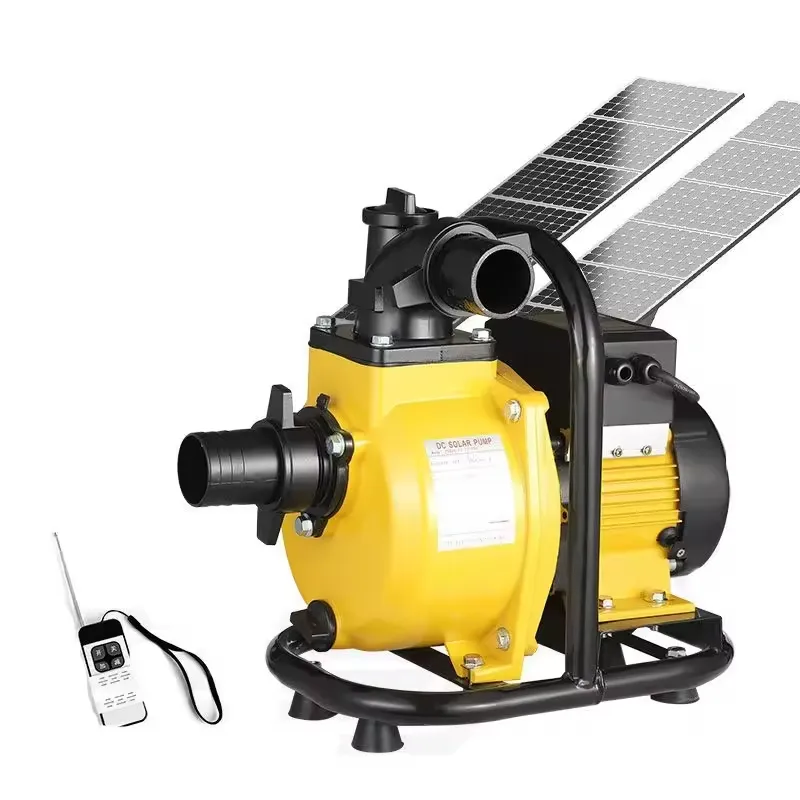
- Best For: Ponds, rivers, canals, shallow wells (<8m).
- Flow Range: 5–120 m³/h.
- Pros: Lower cost, easy maintenance, simple installation.
- View Product: Jingong Solar Surface Series
5. Solar Pump vs Gasoline/Diesel Pump for Farm Irrigation
While solar is ideal for sustainability, Jingong’s Diesel and Gasoline pumps remain vital for specific scenarios.
| Dimension | Solar Pump | Diesel/Gasoline Pump |
|---|---|---|
| CAPEX | Higher | Lower |
| OPEX (Fuel) | $0 | High & Volatile |
| Maintenance | Low (Electronics) | High (Engine parts) |
| Runtime | Sun-hours only | 24/7 Capable |
| Lifespan | 8–15 Years | 2–6 Years |
Jingong Recommendation: For areas with unreliable sunlight or high peak demands, consider a Hybrid System. Use solar as the primary driver and a diesel/gasoline pump as a backup. Our dual-input controllers allow seamless switching.
6. Solar Water Pump for Farm Irrigation Scenario-Based Sizing Cases (EEAT Experience)
Case 1: Small Farm (1–10 Mu), Surface Water
Location: Northern Thailand. Crop: Leafy Vegetables. Source: Pond.
Sizing: 17.3 m³/day demand. 3.75h effective sun. Result: Jingong 0.75kW Solar Surface Pump + 900Wp Panels. Payback: 18 months.
Case 2: Medium Farm (10–50 Mu), Deep Well
Location: Kenya. Crop: Tomatoes. Source: 42m Borehole.
Sizing: 149.5 m³/day demand. 57.4m TDH. Result: Jingong 7.5kW Solar Submersible + 3.6kWp Array + Diesel Backup.
7. Common Sizing Mistakes & Troubleshooting
- Ignoring Friction Loss: Assuming TDH equals well depth.
- Using Annual Average Sun: Not accounting for rainy/cloudy seasons.
- Wrong Pump Type: Using a surface pump on a suction lift >8m.
- Undersized Pipes: Creating excessive velocity and friction.
- No Safety Margin: Sizing PV exactly to motor specs without deration.
8. Solar Water Pump for Farm Irrigation Maintenance & System Optimization
To maximize the lifespan of your Jingong pump:
- Pre-Season: Clean panels, check terminals, verify well static level.
- Mid-Season: Wipe panels every 3–4 weeks in dusty regions.
- Post-Season: Inspect submersible pumps for sand/silt damage.
- Backup Engines: Run gasoline/diesel pumps for 30 mins monthly to prevent gumming.
9. Conclusion & Custom Solution
Sizing a solar water pump for farm irrigation requires balancing water budgets, solar resources, and hydraulic physics. As a direct factory, Jingong provides more than just hardware; we provide engineered solutions.
10. Solar Water Pump for Farm Irrigation FAQ — Solar Farm Pump Sizing
Can I run a solar pump at night?
Standard direct-DC solar pumps cannot run at night unless paired with batteries. However, batteries significantly increase CAPEX and maintenance. For most farm irrigation, it is more cost-effective to size the PV array and water storage tanks to hold enough water pumped during the day.
What happens if my well runs dry?
Jingong solar submersible pumps come standard with dry-run protection sensors and controller logic. If the water level drops below the pump intake, the controller will shut off the pump to prevent irreversible damage to the mechanical seals and motor.
How many solar panels do I need for a 1 HP pump?
A 1 HP (0.75kW) pump typically requires approximately 1.1kW to 1.3kW of solar panel wattage to account for system losses and temperature deration. This usually translates to 3 x 400W panels or 4 x 350W panels, depending on the voltage configuration (24V, 48V, or 96V DC).
Is a solar pump cheaper than a diesel pump?
Initially, the CAPEX (Capital Expenditure) for a solar pump is higher. However, the OPEX (Operational Expenditure) is near zero (no fuel costs). In most agricultural scenarios, a solar pump pays for itself within 2–4 years compared to a diesel pump, after which it provides free water for 10+ years.
Do I need a battery for my solar irrigation pump?
For irrigation, batteries are generally not recommended. They add significant cost and maintenance. Instead, Jingong recommends using a “tank-and-pump” strategy: pump water into a storage tank during sunny hours and use gravity or a small booster pump to irrigate anytime.

0 Comments