
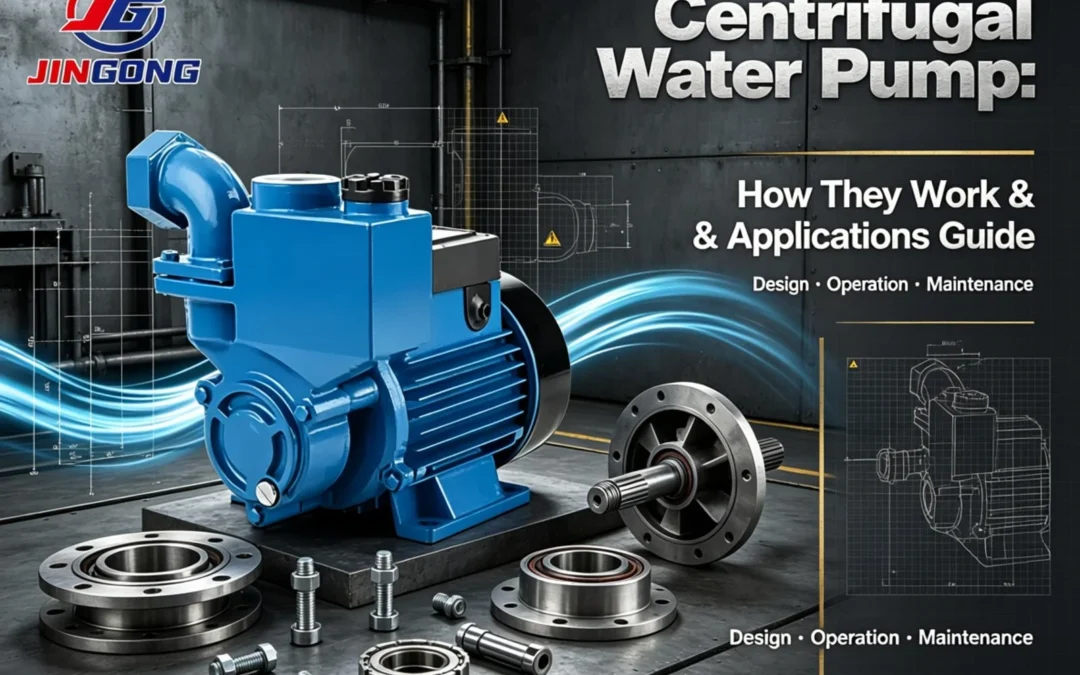
A centrifugal water pump converts rotational kinetic energy from an impeller into hydrodynamic energy (velocity → pressure), moving fluid via a four-step cycle: suction → acceleration → pressure conversion → discharge. It dominates ~71% of the global pump market thanks to simple structure, stable high-flow operation, and adaptability across agriculture, industry, and off-grid scenarios.
What Is a Centrifugal Water Pump? Definition & Industry Overview
1.1 Industry-standard definition
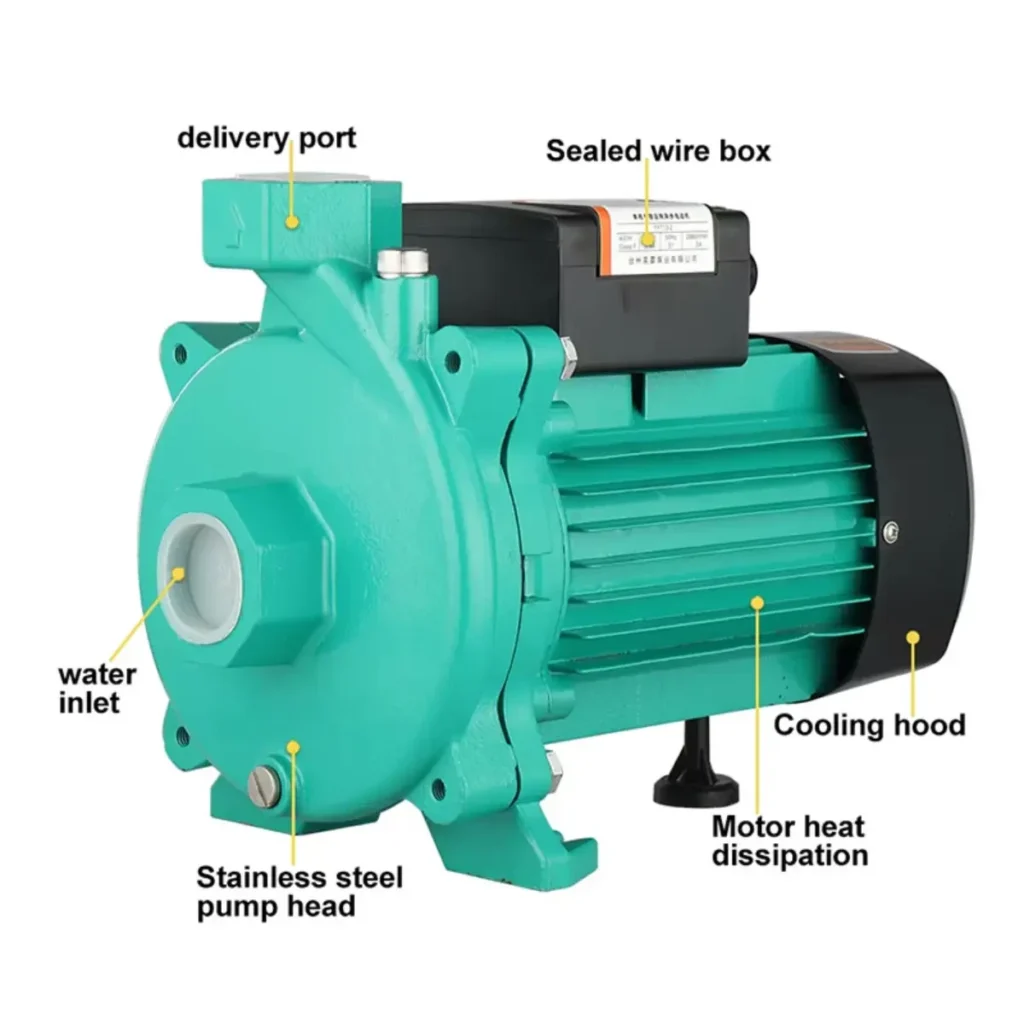
A centrifugal water pump is a rotodynamic pump that transfers mechanical energy from a rotating impeller to the fluid, converting kinetic energy into pressure energy via a volute or diffuser casing. Unlike positive displacement (PD) pumps, which trap and force a fixed volume of fluid per cycle, a centrifugal water pump delivers continuous flow whose pressure varies with system resistance.
1.2 Market position
Centrifugal designs account for roughly 71% of the global fluid-transfer pump market (valve & pump industry reports). In Jingong Tech’s export portfolio alone, centrifugal architectures cover four of our five core product lines – proof of how broadly the concept stretches across real-world projects.
1.3 Centrifugal vs Positive Displacement – why B2B buyers ask
- Flow behavior: Centrifugal = continuous, variable-pressure; PD = pulsed, constant-pressure.
- Viscosity limit: Centrifugal prefers low-viscosity (water-like); PD handles slurries/gels.
- Maintenance: Centrifugal simpler; PD more seals/valves to service.
- Export buyer pattern: 80% of Jingong’s agricultural & municipal RFQs start with “centrifugal water pump” then narrow to submersible/surface/solar/fuel.
1.4 Jingong’s centrifugal product matrix
- Submersible centrifugal pump – underwater borehole & drainage
- Surface / land centrifugal pump – fixed civil & industrial water supply
- Solar powered centrifugal pump – off-grid farm & irrigation
- Gasoline / diesel pump – construction sites & remote areas
How a Centrifugal Water Pump Works – Principle & 4-Step Cycle
2.1 Core anatomy in motion
A centrifugal water pump revolves around three cooperative parts:
- Impeller (backward-curved vanes, open / semi-open / closed) – imparts velocity to fluid
- Pump casing (volute) – captures high-speed fluid, expands cross-section to convert velocity → pressure
- Shaft & bearing assembly – transmits motor/driver torque to impeller
In electric models, the motor’s rotor spins the shaft; in coupled designs (common on diesel pump units), a mechanical coupling joins engine crankshaft to pump shaft via a bearing housing.
2.2 Four-step operating cycle
- Suction (prime): Before start, the casing & suction line must be filled (primed). As the impeller spins, fluid at the eye is thrown outward, creating a low-pressure zone that draws more fluid in through the suction port.
- Acceleration: Fluid trapped between impeller vanes gains velocity radially outward – kinetic energy peaks at the impeller OD.
- Pressure conversion: Fluid enters the volute; the expanding flow channel slows velocity, converting kinetic energy into static pressure (Bernoulli principle).
- Discharge: Pressurized fluid exits through the discharge flange into the piping system.
2.3 NPSH & cavitation – the professional differentiator
This is where a real manufacturer’s content diverges from generic blogs. Two parameters matter:
- NPSHₐ (Available) – energy actually present at pump suction, calculated from atmospheric pressure, static lift, friction loss, and vapor pressure of the liquid.
- NPSHᵣ (Required) – minimum suction energy the pump needs to avoid cavitation, determined experimentally per ISO 9906 / API 610 test protocols.
Rule Jingong engineers quote to overseas clients: NPSHₐ must exceed NPSHᵣ by at least 0.5 m (preferably 1 m) margin. Below that, vapor bubbles form at impeller inlet, collapse in high-pressure zones, and cause pitting, noise, vibration, and premature failure.
Cavitation is the #1 cause of “premature impeller damage” claims we see from first-time buyers who size purely on head & flow without checking NPSH. Module 8 covers the选型避坑.
2.4 Drive-type variations (electric / solar / fuel)
- Electric motor: IEC/NEMA frame, 2-pole (2900 rpm) or 4-pole (1450 rpm) – most submersible & surface units.
- Solar PV + VFD: MPPT controller matches pump curve to irradiance – solar centrifugal pump runs slower at dawn/dusk, longer lifespan.
- Gasoline / diesel engine: No grid needed, throttle-controlled RPM – fuel-driven centrifugal pump for construction & flood response.
Main Components & Structure of a Centrifugal Water Pump
3.1 Primary components
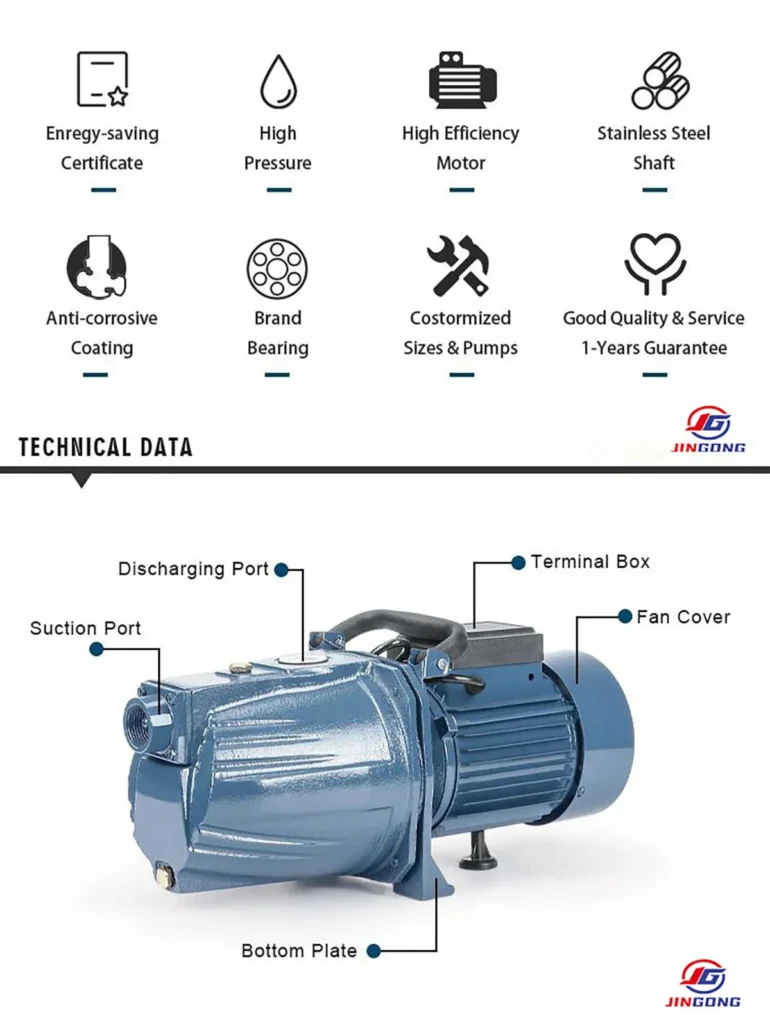
| Component | Function | Jingong material practice |
|---|---|---|
| Impeller | Transfers kinetic energy; flow/head set here | Cast iron / SS304 / SS316 (corrosion duty) |
| Casing (volute) | Converts velocity → pressure; directs flow | Close-grained cast iron, anti-abrasion paint |
| Shaft | Transmits torque from driver to impeller | SS420 or 45# steel, quenched & tempered |
| Mechanical seal | Prevents leakage at shaft passage | SiC / Carbon / Viton (submersible: oil-chamber seal) |
| Bearing (2x) | Supports radial & axial loads, reduces noise | NSK / SKF / C&U, grease-lubricated |
| Suction / Discharge flange | Pipeline interface | PN16 / Class 150 standard |
3.2 Structural differences across Jingong’s 4 centrifugal lines
- Submersible: Oil-filled chamber + double mechanical seal, waterproof cable gland, chrome-plated shaft – all for underwater duty.
- Surface / land: Foot-mounted or flange-mounted, coupling-driven, foot-valve optional – easy service access.
- Solar: Brushless DC motor or 3-phase AC + VFD, MPPT controller, stainless fasteners for outdoor corrosion.
- Fuel-driven: Engine skid + anti-vibration pad + close-coupled pump-end, sometimes trailer-mounted for portability.
Types of Centrifugal Water Pumps – Mapping to Jingong’s Product Line
4.1 Submersible centrifugal pump
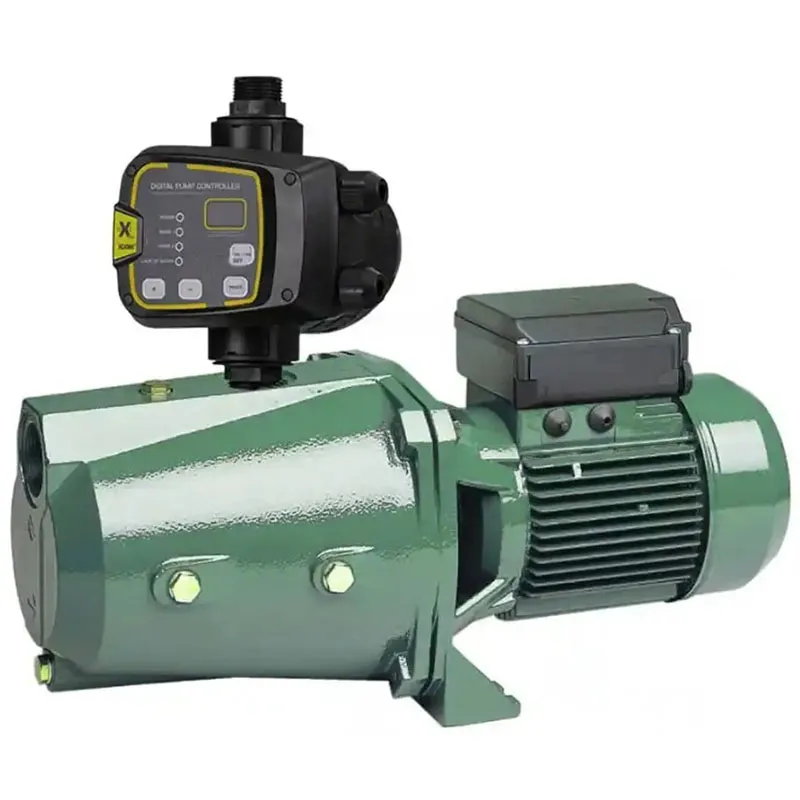
A centrifugal water pump designed to operate fully submerged. The motor is below water, cooling itself passively – no priming needed, quiet operation.
- Use cases: Borehole extraction, pond drainage, sewage bypass, deep-well farm irrigation.
- Pros: No priming, silent, compact above-ground footprint.
- Cons: Harder to inspect, requires reliable sealing, not for shallow suction (<1 m) economically.
👉 Explore Jingong submersible centrifugal pumps →
4.2 Surface / land centrifugal pump
The classic “above-ground” centrifugal water pump, foot-mounted near the water source. Requires priming (manual or self-priming design).
- Use cases: Municipal water boost, building pressure systems, factory circulation, sprinkler systems.
- Pros: Easy maintenance, visible service points, lower unit cost than submersible of equal power.
- Cons: Needs suction lift limit (~8 m max theoretical, ~6 m practical), vulnerable to priming loss if foot valve fails.
👉 Explore Jingong surface / land centrifugal pumps →
4.3 Solar powered centrifugal pump
A centrifugal water pump driven by PV array + VFD/MPPT. No grid, no fuel cost, low OPEX.
- Use cases: Off-grid ranch, remote village water supply, solar farm irrigation, livestock watering.
- Pros: Zero electricity bill, aligns output with sunny irrigation windows, 10–15 year ROI typical in Jingong’s Africa/Middle East projects.
- Cons: Night output needs battery or hybrid backup; initial CAPEX higher than AC counterpart.
👉 Explore Jingong solar centrifugal pumps →
4.4 Gasoline / diesel driven centrifugal pump
A centrifugal water pump close-coupled to an internal combustion engine – the “no-grid workhorse.”
- Use cases: Construction site dewatering, flood emergency, rural festival temporary supply, mining camps.
- Pros: Independent of grid, portable (wheel/trailer kit), high-power options (up to 4″–6″ discharge common).
- Cons: Fuel cost, noise, emissions, shorter continuous-run rating vs electric.
👉 Explore Jingong gasoline/diesel centrifugal pumps →
5: Key Performance Parameters & Technical Specifications
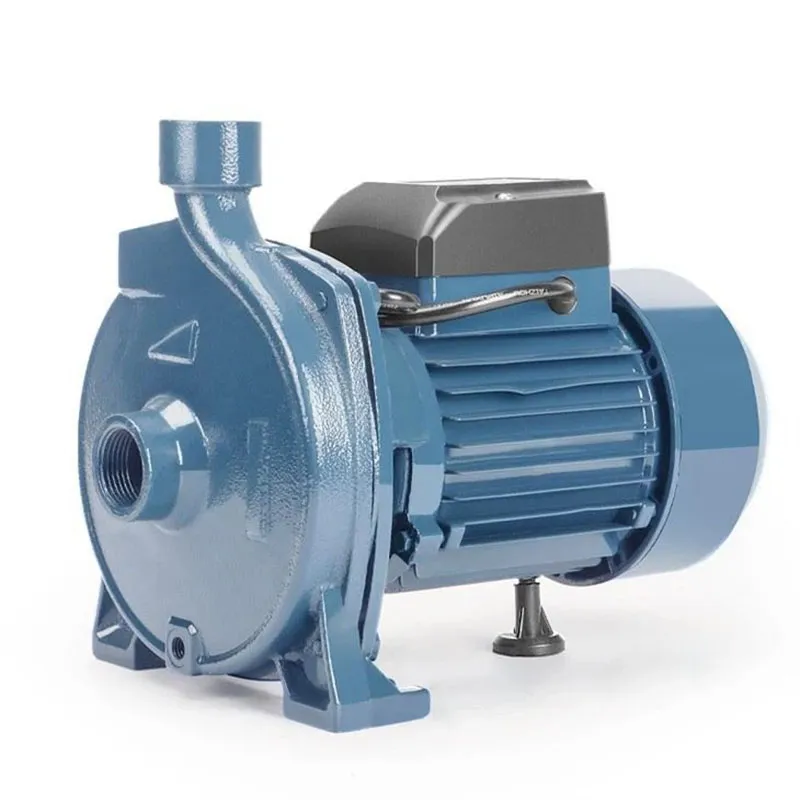
5.1 The 7 parameters every B2B buyer must check
- Flow rate (Q) – m³/h or GPM. The horizontal axis of any pump curve.
- Head (H) – meters or ft. Vertical axis. Note: “total head” ≠ vertical lift; includes friction loss.
- Power (P) – shaft power (kW/HP). Electric: motor rated power; Fuel: engine HP.
- Efficiency (η) – BEP (best efficiency point) is where you want to operate. Off-BEP = higher energy waste + faster wear.
- NPSHᵣ – see Module 2. Critical for suction-side safety.
- Speed (n) – rpm. 2-pole (2900) vs 4-pole (1450) changes noise, NPSH, bearing life.
- Working temperature & media – clean water? slurry? seawater? determines seal & material spec.
5.2 Parameter differences by drive type (Jingong production data)
- Solar centrifugal pump: Typically 0.37–3 kW PV input, VFD-limited max RPM, soft-start protects impeller.
- Fuel centrifugal pump: 5.5–15 HP gasoline or 10–30 HP diesel common; discharge 2″–6″; head 20–60 m range.
- Submersible: 0.37–45 kW, multi-stage for deep well (head 50–400 m in Jingong range).
- Surface: 0.75–75 kW, single-stage for pressure boost, multi-stage for high-rise supply.
All Jingong centrifugal pump nameplates reference ISO 9906 Grade 1 accuracy. Overseas EPC buyers often request EN 12262 or API 610 alignment for industrial lots – we support both.
6: Industrial & Daily Applications – Scenario-Based Matching
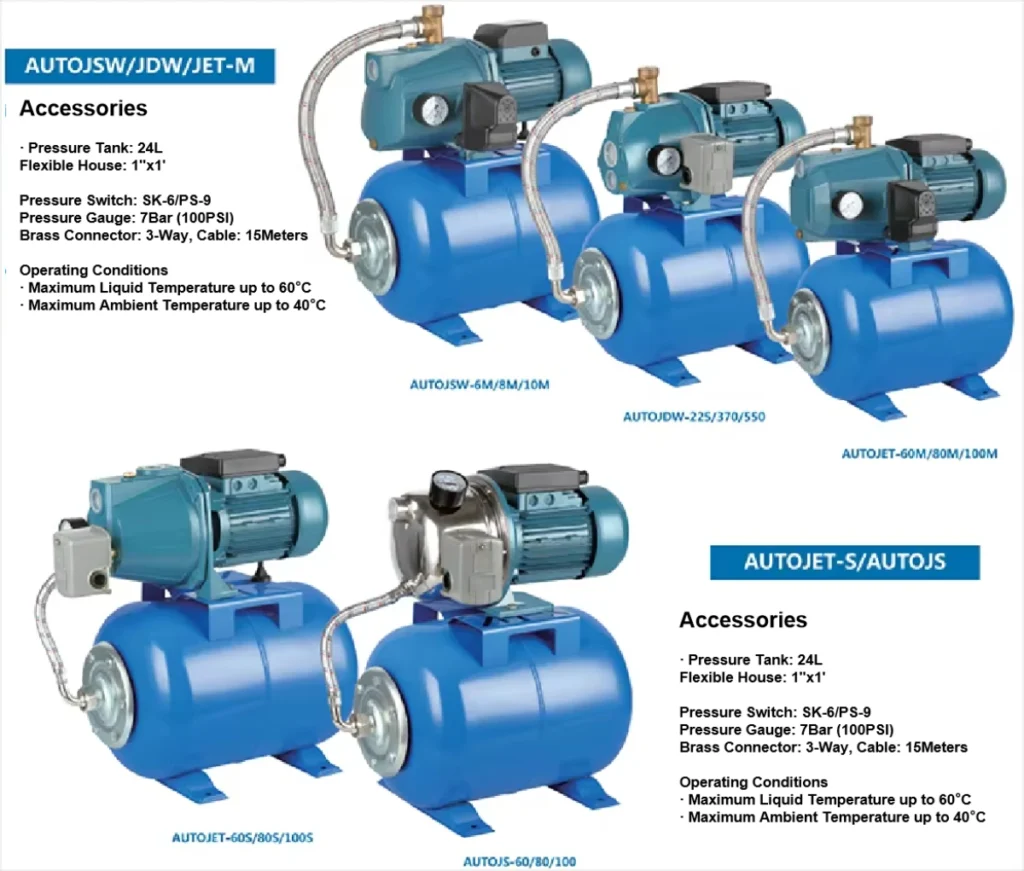
A centrifugal water pump is only as good as its scenario fit. Below is how Jingong’s export team maps inquiries to product lines:
6.1 Agriculture & irrigation
- Drip irrigation → solar centrifugal pump (daytime sync) or diesel pump (no-grid plots)
- Orchard / vineyard → submersible from pond + surface boost
- Rice paddy drainage → fuel-driven portable (flood-response)
6.2 Civil & residential
- Building water pressure boost → surface multi-stage centrifugal water pump
- Basement dewatering → submersible
- Rainwater harvesting → surface + inverter for variable demand
6.3 Industrial & municipal
- Factory cooling circulation → close-coupled surface centrifugal
- Wastewater transfer (non-sewage) → vortex-impeller submersible
- Fire-fighting ring mains → diesel-driven (NFPA alignment on request)
6.4 Off-grid & remote
- Solar farm → PV + VFD centrifugal
- Mining camp → diesel skid-mounted
- Disaster relief → trailer-mounted fuel + quick-connect hoses
7: Advantages & Disadvantages – Objective Comparison
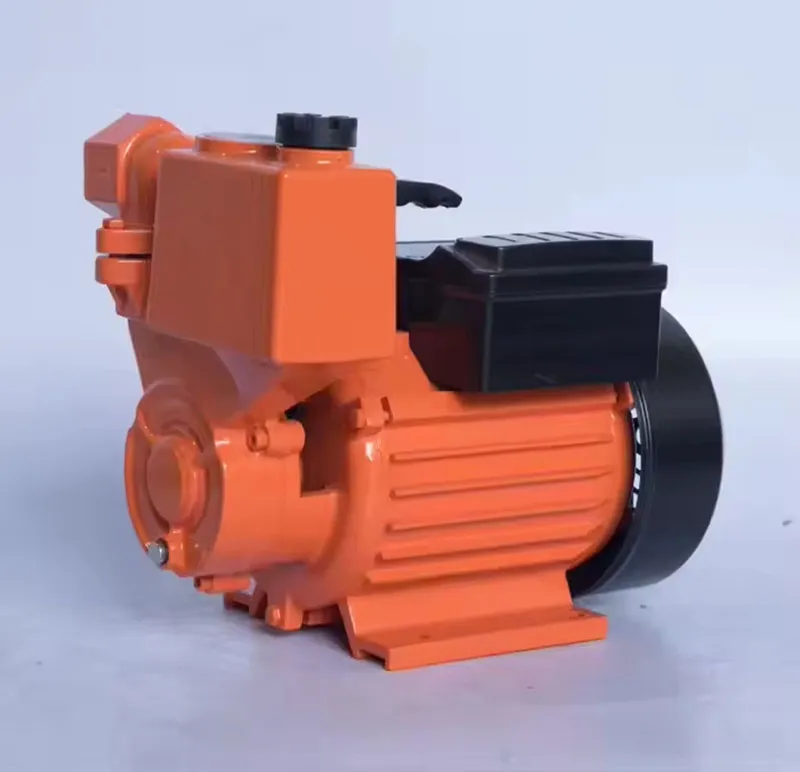
7.1 General pros of centrifugal water pump design
- Simple structure → low CAPEX, easy spare parts
- Continuous high-flow output, smooth pressure (no pulsation like PD)
- Compact footprint, especially close-coupled
- Scales from 0.1 kW garden pump to 500+ kW industrial units
- Wide media compatibility (with material change: SS, bronze, cast iron)
7.2 General cons & limits
- Cannot run dry – mechanical seal overheats within minutes
- Not for high-viscosity (sludge >500 cP kills efficiency)
- Cavitation risk if NPSH undersized
- Single-stage limited to ~120 m head; beyond that → multi-stage or PD
- Priming required on most surface designs (unless self-priming variant)
7.3 Jingong 4-line
| Line | Key advantage | Watch-out |
|---|---|---|
| Submersible centrifugal | No priming, quiet, compact topside | Seal reliability in sandy water; retrieval for service |
| Surface centrifugal | Easy service, lowest $/m³ | Suction lift limit; freeze risk outdoors |
| Solar centrifugal | OPEX ≈ $0, aligns with sun-irrigation | Night/cloud need hybrid or tank; CAPEX higher |
| Fuel-driven centrifugal | Grid-independent, portable, high power density | Fuel OPEX, noise, emissions, runtime limited by tank |
8: How to Select the Right Centrifugal Water Pump – Jingong’s Field Formula
This is where centrifugal water pump content converts to inquiry. Below is Jingong’s internal pre-quotation checklist, rewritten for public readership.
8.1 Five-dimension sizing framework
- Scenario & media – clean water? slurry? seawater? temperature?
- Source & discharge point – above or below water? suction lift? total pipe length & diameter?
- Power availability – grid 1-phase/3-phase? no grid → solar or fuel?
- Flow & head requirement – peak demand? continuous vs intermittent?
- Budget & OPEX preference – CAPEX-sensitive → surface electric; OPEX-sensitive long-term → solar.
8.2 Jingong’s “decision tree” (public version)
- Underwater source + permanent install → Submersible centrifugal pump
- Above water + fixed building/municipal → Surface centrifugal pump
- No grid + irrigation/farm → Solar centrifugal pump (sunny region) or Diesel centrifugal pump (high-power / cloudy)
- Portable / emergency / construction → Gasoline or diesel centrifugal pump
8.3 3Jingong export team sees weekly
- “Head on nameplate = vertical lift” – No. Head is total developed head (vertical + friction + fittings). A 30 m head pump may only lift 22 m if you have 40 m of 2″ hose.
- Ignoring NPSH on surface pumps – Leads to cavitation within weeks. Always de-rate suction side by 1 m safety margin.
- Over-spec “just to be safe” – Oversized pump operates left of BEP → vibration, seal fail, wasted energy. Better to VFD-trim a right-sized unit.
👉 Download Jingong’s centrifugal pump sizing worksheet (PDF) →
9: Common Faults, Troubleshooting & Maintenance
A centrifugal water pump is robust, but B2B uptime matters. This section mirrors Jingong’s after-sales cheat-sheet.
9.1 Top 6 faults & quick diagnosis
| Fault | Likely cause | First check |
|---|---|---|
| No water output | Loss of prime / clogged inlet / reversed phase | Foot valve? suction leak? rotation direction? |
| Low flow / pressure | Worn impeller, air leak, wrong RPM | Impeller clearance? VFD setting? |
| Loud noise / vibration | Cavitation, misalignment, bearing worn | NPSH? coupling alignment? bearing temp? |
| Seal leakage | Dry run, abrasive media, old O-ring | Run-dry protection installed? |
| Motor overload / trip | Closed discharge valve at start, binding | Verify valve sequence; amperage check |
| Short cycle / frequent start | Pressure switch / VFD param / tank size | System curve vs pump curve mismatch |
9.2 Line-specific notes
- Submersible: Most “failures” are sand-abrasion on mechanical seal → specify SiC/SiC + vortex impeller in sandy boreholes.
- Solar: Controller fault codes first; check PV voltage at noon before blaming pump.
- Fuel-driven: 80% of “pump no start” is actually engine (spark plug / fuel filter / oil level), not pump-end.
- Surface: Packing/gland drip rate ~ 40–60 drops/min when new; tighten gradually, don’t over-tighten.
9.3 Seasonal maintenance (Jingong workshop standard)
- Before storage (winter): Drain casing, loosen packing, grease bearings, store indoors if possible.
- Spring restart: Manual prime, check rotation, 30-sec no-load spin before valve open.
- Submersible: Megger test insulation >1 MΩ before re-deploy; check cable jacket for rodent/rub damage.
👉 Full centrifugal pump troubleshooting flowchart (Jingong support) →
10: FAQ – Buyer Questions Jingong Answers Weekly
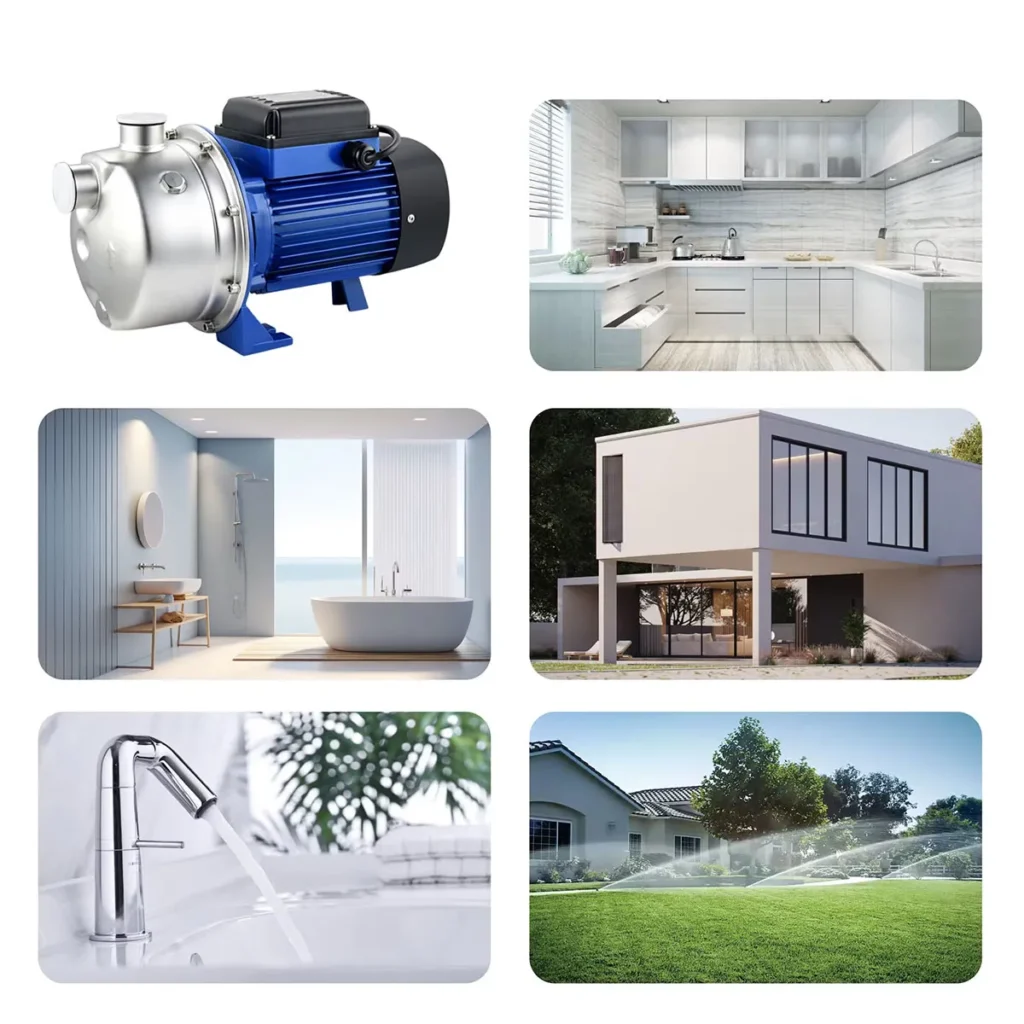
- Q: Are centrifugal pumps self-priming?
- Standard models are NOT. You must prime (fill suction side) before start. Self-priming variants exist (built-in priming chamber) – ask Jingong if your application can’t guarantee flooded suction.
- Q: Can a centrifugal water pump run dry?
- Not safely. Mechanical seal overheats within 2–5 minutes on most designs. Always pair with dry-run protection (float switch, VFD fault, or controller alarm).
- Q: Submersible vs surface centrifugal pump – which?
- Source underwater + permanent → submersible. Source accessible + serviceability priority → surface. Budget tight + shallow lift → surface wins CAPEX.
- Q: Solar pump or diesel pump for agriculture?
- Sunny region, OPEX-sensitive, 10+ year horizon → solar centrifugal pump. High-power (>15 m³/h) + cloudy season + portable → diesel. Many Jingong clients run hybrid: solar primary + diesel backup.
- Q: How long does a centrifugal water pump last?
- Jingong warranty 12–24 months. Real-world: electric surface 8–12 years with annual service; submersible 5–8 years (seal change mid-life); solar 10–15 years (no motor overheating); fuel-driven 3,000–5,000 engine hours before overhaul.
- Q: What’s the difference between single-stage and multi-stage centrifugal pump?
- Single-stage: 1 impeller, head typically ≤120 m, high flow. Multi-stage: series impellers in one casing, head 120–400+ m, thinner flow. Deep-well & high-rise → multi-stage.
Conclusion – Why This Guide Exists
A centrifugal water pump manufacturer looks simple from the outside – a motor, a casing, a pipe in and out. But the difference between a 3-month failure and a 10-year install lives in the details: NPSH margin, impeller material, seal grade, drive matching to scenario. That’s why Jingong Tech doesn’t sell “a pump” – we sell a matched centrifugal solution (submersible / surface / solar / fuel) with the sizing sheet, the spare kit, and the after-sales path.
If your project brief has flow, head, power source, and media – send it. Our engineering team returns a sized recommendation within 24 hours, with performance curve and EXW/FOB quote.
👉 Get a centrifugal pump quotation →
👉 Browse Jingong centrifugal pump catalog →