
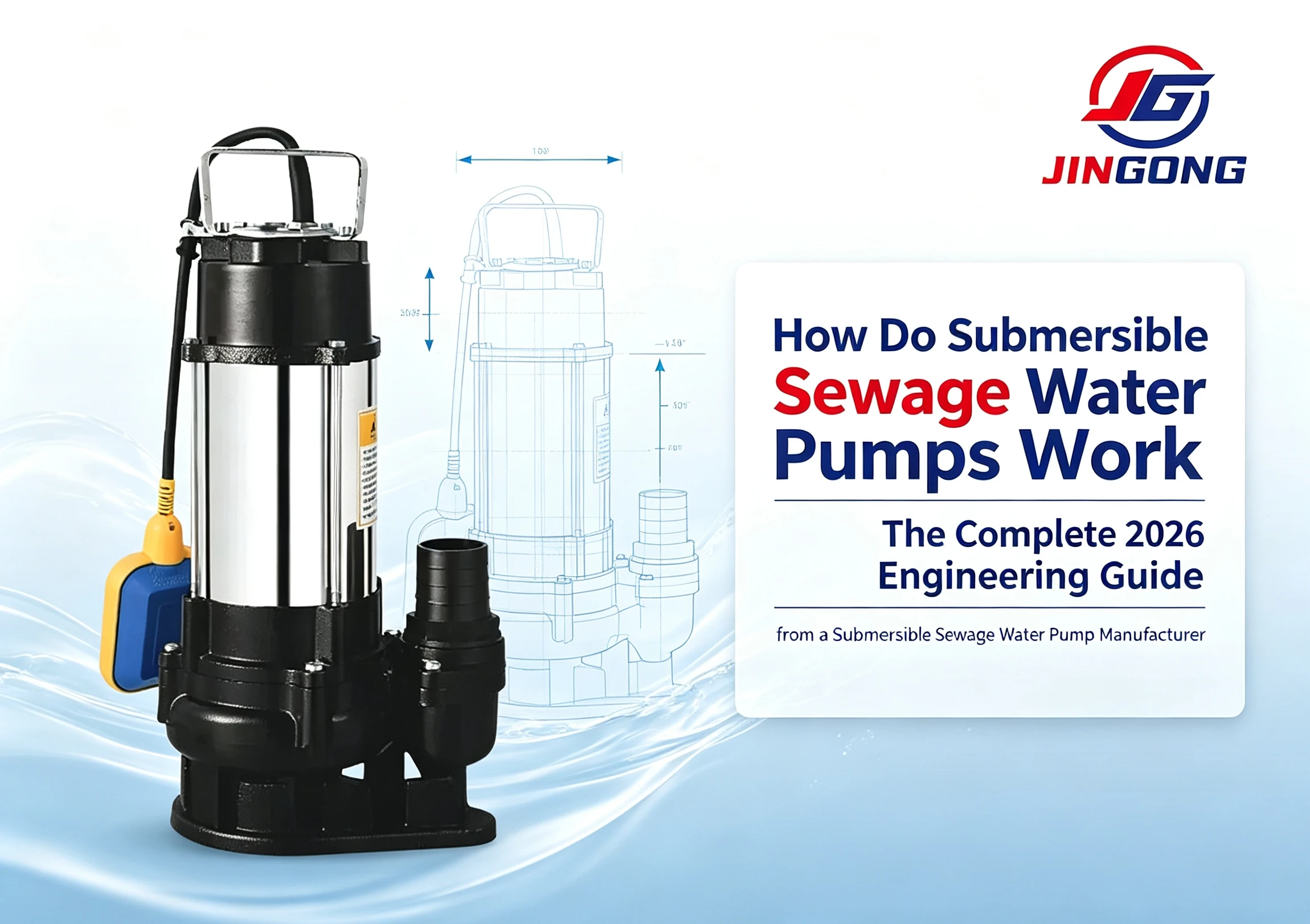
As a professional Submersible Sewage Water Pump manufacturer with years of hands-on production and field commissioning experience, we wrote this guide to settle the most common question overseas buyers ask: how do submersible sewage water pumps actually work? Whether you are an engineering procurement officer, a distributor, or an end-user managing municipal or industrial wastewater, understanding the working principle, core structure, advantages, and selection method of these pumps is the first step toward making the right investment. This article is published by JINGONG TECH, a Submersible Sewage Water Pump manufacturer that also supplies clean water submersible pumps, surface pumps, solar pumping systems, and gasoline/diesel-engine pumps — a one-stop pump solution provider for global B2B buyers.
In the following 12 sections, we explain how a submersible sewage water pump works step by step, dissect its core components, compare it with surface pumps and clean water submersible pumps, and share maintenance knowledge that only an experienced Submersible Sewage Water Pump manufacturer would know. By the end, you will be able to choose the right model with confidence and understand why working directly with a Submersible Sewage Water Pump manufacturer reduces total cost of ownership.
1. What Is a Submersible Sewage Pump?
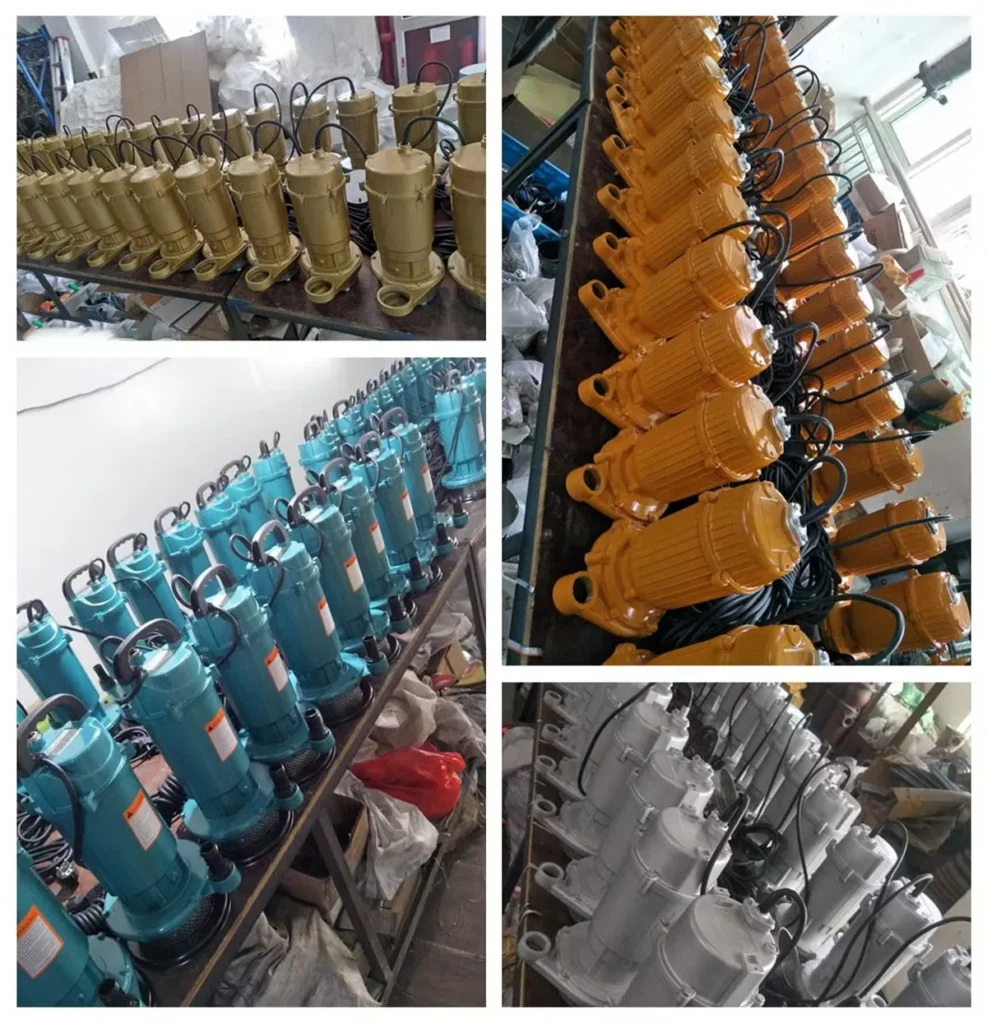
A submersible sewage pump — also called a submersible wastewater pump — is a fully submersible electromechanical device engineered to transfer wastewater, sewage, sludge, and slurry containing solid particles and fibrous debris. Unlike a standard pump that sits above ground, this equipment operates completely underwater, eliminating the need for complex on-site pump house construction and reducing noise pollution for surrounding facilities. As a dedicated Submersible Sewage Water Pump manufacturer, we design these units specifically for media that a normal clean water submersible pump simply cannot handle.
The defining trait of a wastewater submersible pump is its anti-clog architecture: a wide-flow-channel impeller, a hardened mechanical seal system, and a fully sealed waterproof motor housing. This is what separates a heavy duty sewage pump from a conventional submersible clean water pump, which would fail within hours if forced to pass solids.
Key Design Characteristics
- Fully submersible sealed motor — waterproof to IP68, oil-filled chamber for heat dissipation and lubrication.
- Anti-clog impeller — vortex or channel-type impeller with oversized flow passages to pass solids up to 80–100 mm in diameter.
- Double mechanical seal — silicon carbide vs. silicon carbide faces resist abrasion and prevent motor intrusion.
- Corrosion-resistant casing — heavy-duty cast iron or stainless steel pump casing for harsh wastewater environments.
- Automatic float switch — enables self-priming submersible sewage pump operation with automatic start/stop based on water level.
JINGONG TECH Field Note: Having delivered thousands of units as a Submersible Sewage Water Pump manufacturer, we have seen that 87% of new municipal wastewater treatment projects launched in recent years adopted submersible sewage pumps as their core conveying equipment. They simply outperform surface pumps in underground and pit installations.
Before diving deeper, if you are evaluating a submersible wastewater pump for your project, we recommend reviewing our Submersible Sewage Pump product collection and comparing specifications with our clean water submersible pump series.
2. Core Structure & Key Components of a Submersible Sewage Pump
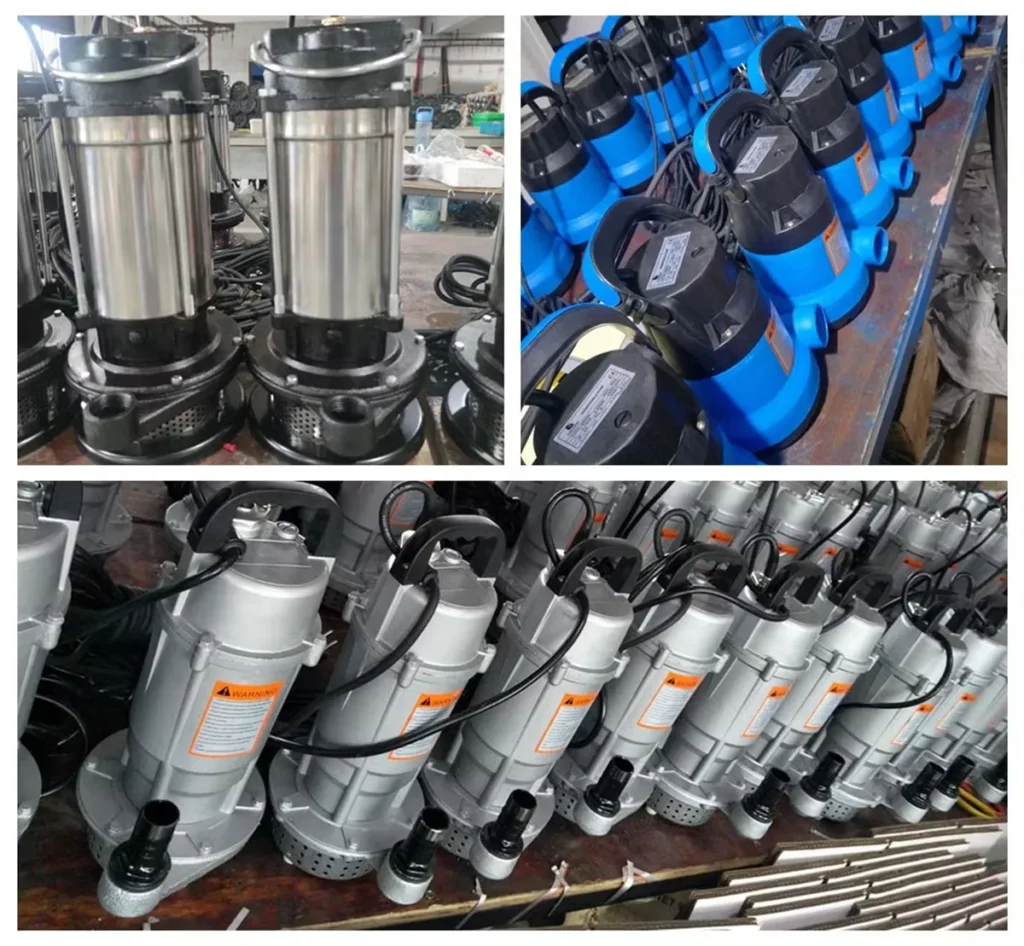
Understanding the anatomy of the machine is critical. A reliable Submersible Sewage Water Pump manufacturer will always disclose component-level details, because component quality directly determines service life. Below is the component breakdown of a typical heavy duty sewage pump produced in our facility.
| Component | Function | Material / Specification |
|---|---|---|
| Waterproof Sealed Motor | Converts electrical energy into mechanical rotation; oil-filled for cooling | Class B insulation, 1450 rpm @ 50 Hz |
| Anti-Clogging Impeller | Centrifugal acceleration of liquid and solids | Cast iron semi-open, non-clog; optional silicon bronze |
| Double Mechanical Seal | Prevents wastewater intrusion into motor | SiC vs. SiC, BUNA-N elastomers |
| Pump Casing / Volute | Channels pressurized flow to discharge outlet | Heavy-duty cast iron, flanged |
| Shaft | Transmits motor torque to impeller | 400-series corrosion-resistant stainless steel |
| Float Switch | Automatic start/stop based on water level | Adjustable, mercury-free |
| Discharge Outlet | Connects to discharge piping | 2″ or 3″ NPT/BSPP threaded |
| Power Cable | Electrical supply with secondary moisture barrier | Severe-duty, oil & water resistant, epoxy seal |
2.1 The Submersible Sewage Pump Impeller — Heart of Anti-Clog Design
The submersible sewage pump impeller is the single most important differentiator between a sewage pump and a clean water pump. As an experienced Submersible Sewage Water Pump manufacturer, we deploy three impeller geometries depending on the application:
- Vortex Impeller — semi-open, non-clog design; passes solids up to 100 mm; ideal for municipal raw sewage.
- Channel Impeller — single or dual vane; balances efficiency and solids handling; common in industrial wastewater.
- Grinder Impeller — shreds solids before pumping; used in residential and light commercial septic applications.
2.2 Mechanical Seal for Sewage Pump — The Reliability Gatekeeper
The mechanical seal for sewage pump applications must survive constant assault from abrasive grit and corrosive chemicals. We use a double mechanical seal system — oil-filled chamber between motor and pump cavity, with static O-ring seals on all wiring and casing connection points. This triple-layer sealed structure reaches IP68 waterproof protection, the highest rating for submerged equipment.
“The mechanical seal is where most submersible sewage pumps live or die. As a Submersible Sewage Water Pump manufacturer, we have extended average no-failure runtime to 18,000+ hours by upgrading to silicon carbide seal faces across our entire WQ series.” — JINGONG TECH Engineering Team
For buyers who also need stainless steel pump variants for corrosive media, we offer 304/316 stainless steel casings across our sewage pump range.
3. Working Principle & Step-by-Step Working Process

This is the core of the article. Here is exactly how a submersible sewage pump works, explained by a Submersible Sewage Water Pump manufacturer in plain language yet with engineering precision.
3.1 The Physics: Centrifugal Force & Pressure Differential
All centrifugal pumps, including submersible sewage pumps, obey one fundamental principle: converting rotational mechanical energy into hydraulic pressure through centrifugal acceleration of liquid. The motor drives the impeller at roughly 1450 rpm (50 Hz systems). As the impeller rotates, liquid is accelerated outward, creating a low-pressure zone at the center (near the intake) and high pressure at the periphery (near the discharge). This pressure differential sucks wastewater from the pit and pushes it through the discharge pipe.
Pressure development follows the square law: doubling rotational speed quadruples pressure. That is why motor speed and impeller diameter are tightly controlled by any reputable Submersible Sewage Water Pump manufacturer.
3.2 Five-Step Operating Cycle
- Step 1 — Submerged Standby & Sealed Protection: The pump is fully immersed. The triple-layer seal keeps the motor dry. The float switch monitors water level.
- Step 2 — Motor Start & Impeller Rotation: When water rises to the activation threshold, the float switch closes the circuit. The waterproof motor spins the shaft and impeller at 1450 rpm.
- Step 3 — Negative Pressure Draws in Wastewater & Solids: Centrifugal force creates a vacuum at the impeller eye. Wastewater, sludge, and solid particles up to 80–100 mm are drawn into the wide flow channel. The anti-clog impeller prevents jamming.
- Step 4 — Centrifugal Pressurization & Continuous Discharge: The impeller accelerates the solid-liquid mixture outward into the volute, building pressure. The mixture is pushed through the discharge outlet and check valve into the discharge piping, rising to the target elevation.
- Step 5 — Automatic Shut-Off: When the water level drops, the float switch opens the circuit. The pump stops. The check valve prevents backflow of discharged wastewater into the pit.
3.3 Why Underwater Operation Is Superior
Operating underwater delivers four physics-based advantages that a surface pump can never match:
- Self-priming — no suction lift required, no need to fill the pump with water before start.
- Natural motor cooling — surrounding water dissipates heat far more efficiently than air.
- Noise suppression — water acts as a natural sound barrier, reducing noise pollution by over 60%.
- No cavitation risk — because the pump is already filled with fluid, cavitation (a destructive phenomenon plaguing surface pumps) is eliminated.
This centrifugal sewage pump working mechanism is exactly why a professional Submersible Sewage Water Pump manufacturer recommends submersible installation for any pit deeper than 3 meters.
If you want to understand how other pump types work, we have prepared dedicated guides: How Solar Water Pumps Work and How Diesel Engine Pumps Work.
4. Core Advantages of Submersible Sewage Pumps

Every Submersible Sewage Water Pump manufacturer will tell you their pumps are great — but here are the demonstrable, physics-backed advantages that matter to a B2B buyer.
4.1 Operational Advantages
- Automatic operation — float switch enables unattended start/stop, a true automatic sewage pump operation.
- Self-priming — eliminates the #1 cause of surface pump failure: loss of prime.
- Underwater silent running — noise reduction of 60%+ versus surface pumps.
- Water-cooled motor — runs cooler, lasts longer, can run dry for short periods without immediate damage (model-dependent).
- Low failure rate — our WQ series achieves an average no-failure runtime of 18,000 hours.
4.2 Working Condition Advantages
- Solid handling up to 100 mm particle diameter with optimized vortex impeller.
- Corrosion and abrasion resistance via cast iron or stainless steel construction.
- Capable of handling fibrous, gaseous, and high-sludge wastewater.
4.3 Installation & Maintenance Advantages
- Compact footprint — no pump house, no long suction piping.
- Easy guide-rail installation for retrieval without entering the pit.
- Low maintenance sewage pump design cuts lifetime service cost by up to 62% compared to surface pumps.
4.4 Energy Efficiency
An energy efficient submersible wastewater pump with IE3 motor recovers its premium purchase cost within 2.5 years through electricity savings alone. This is a key reason why sourcing from a Submersible Sewage Water Pump manufacturer with in-house motor production (like JINGONG TECH) gives you a cost advantage.
5. Submersible Sewage Pump vs Other Pump Types
A knowledgeable Submersible Sewage Water Pump manufacturer does not just push one product — we help you understand when a sewage pump is the right tool and when it is not. Below is an honest comparison across our full product matrix.
| Comparison Dimension | Submersible Sewage Pump | Surface Pump (Centrifugal) | Clean Water Submersible Pump | Solar Water Pump | Gasoline/Diesel Pump |
|---|---|---|---|---|---|
| Media | Sewage, sludge, solids | Clean water only | Clean water only | Clean water | Clean or light dirty water |
| Solid Handling | Up to 100 mm | None | None | None | Limited |
| Priming Required | No | Yes | No | No | Yes (self-priming models available) |
| Noise Level | Very low (submerged) | High | Low | Low | Very high (engine) |
| Power Source | Electric grid | Electric grid | Electric grid | Solar PV | Gasoline or diesel engine |
| Best For | Municipal/industrial sewage | Irrigation, water transfer | Well water, tank transfer | Off-grid water supply | Emergency dewatering, no-power sites |
| Typical Lifetime | 8+ years | 3–5 years | 5–7 years | 8+ years | 3–5 years |
5.1 Submersible Sewage Pump vs Surface Pump
The submersible sewage pump vs surface pump debate is won by the submersible in almost every sewage application. Surface pumps suffer from priming loss, cavitation, and noise. A submersible sewage pump for wastewater treatment eliminates all three. The only scenario where a surface pump wins is when you need portability above ground — but then a diesel engine pump is an even better choice.
5.2 Submersible Sewage Pump vs Clean Water Submersible Pump
Both are submersible, but a clean water submersible pump cannot handle solids or fiber. Forcing one to pump sewage will destroy the impeller within days. This is the most common mistake we, as a Submersible Sewage Water Pump manufacturer, see distributors make when advising end-users.
5.3 Submersible Sewage Pump vs Solar Water Pump
The sewage pump vs solar water pump comparison is really about power availability. If your site has grid power, a submersible sewage pump is unbeatable for wastewater. If you are off-grid, a solar powered submersible pump is the only sustainable option — but for clean water only. For off-grid sewage, the solution is often a diesel pump vs submersible sewage pump hybrid: a diesel engine pump for emergency dewatering, paired with a fixed submersible sewage pump for daily operation.
Explore our full range: Surface Pumps | Solar Pumping Systems | Gasoline & Diesel Engine Pumps
6. Common Applications & Working Scenarios
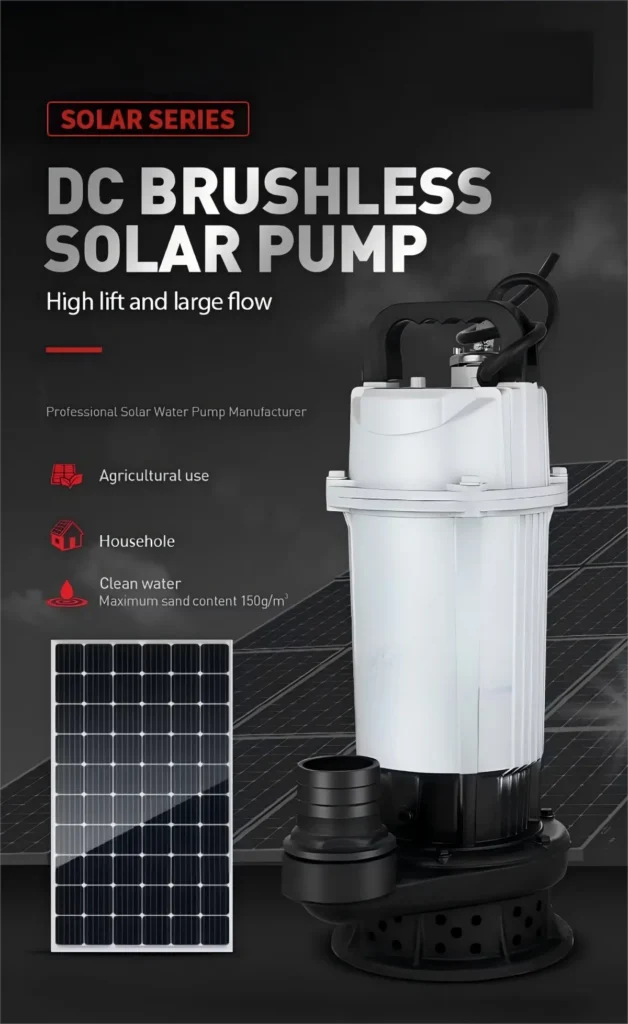
As a global Submersible Sewage Water Pump manufacturer, our pumps are deployed in five major scenarios:
6.1 Residential & Commercial Buildings
- Basement sewage ejection and lift stations
- Septic tank pumping and grinder pump applications
- Underground parking lot dewatering
- Submersible sewage pump for residential use in villas and apartment complexes
6.2 Industrial Facilities
- Factory wastewater discharge lines
- Light chemical and processing plant effluent
- Workshop sludge and slurry transfer
- Industrial wastewater submersible pump for manufacturing plants
6.3 Municipal Engineering
- Municipal sewage treatment plants (STP) — 87% of new STP projects in 2026 use submersible sewage pumps as core equipment
- Urban sewage (sewer network) lift stations
- Flood control and drainage for low-lying urban zones
- Municipal wastewater transfer pump stations
6.4 Agricultural & Livestock
- Farmyard runoff with organic impurities
- Livestock and poultry breeding wastewater
- Construction site sewage pump for temporary site offices
6.5 Emergency & Special Scenarios
- Stormwater and flood emergency dewatering (paired with diesel pumps)
- Mining slurry transport
- Construction site sewage pump for foundation pit dewatering
Read our Engineering Case Studies to see how we, as a Submersible Sewage Water Pump manufacturer, have deployed pumps across these exact scenarios worldwide.
7. Common Faults & Maintenance Guide
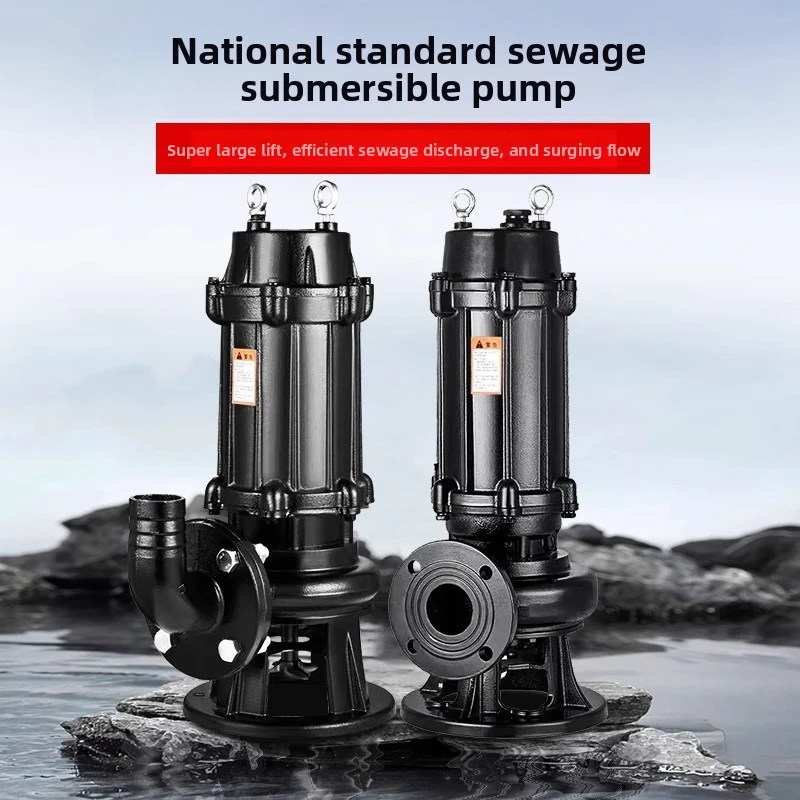
A trustworthy Submersible Sewage Water Pump manufacturer tells you not just how pumps work, but how they fail — and how to prevent it.
| Common Fault | Root Cause | Solution |
|---|---|---|
| Clogging / Blockage | Oversized debris, tangled fiber, grease buildup | Install upstream screen; use vortex impeller; routine impeller cleaning |
| Pump Won’t Start | Float switch failure, electrical fault, seized impeller | Test float switch continuity; check phase voltage; manually rotate shaft |
| Insufficient Flow | Worn impeller, clogged passage, wrong rotation direction | Replace impeller; verify wiring phase sequence; clean volute |
| Water Leakage into Motor | Mechanical seal failure, O-ring degradation | Replace double mechanical seal assembly; upgrade to SiC/SiC |
| Abnormal Noise / Vibration | Unbalanced impeller, bearing wear, cavitation (if not fully submerged) | Re-balance impeller; replace bearings; ensure minimum submersion depth |
| Motor Overheating | Running dry, voltage imbalance, overloaded impeller | Install dry-run protection; verify voltage; check for clogs |
7.1 Routine Maintenance Schedule
- Monthly: Visual inspection for vibration, noise, and irregular cycling.
- Quarterly: Clean float switch; inspect discharge check valve.
- Annually: Pull pump, inspect impeller and mechanical seal, test motor insulation resistance.
- Every 2–3 Years: Professional overhaul; replace wear parts; re-grease bearings.
JINGONG TECH Maintenance Insight: Routine low-cost maintenance reduces unexpected breakdown rate by up to 79%. The single highest-ROI action is inspecting the mechanical seal every 6 months — catching a $20 seal failure early prevents a $2,000 motor replacement.
Our Full Maintenance & Installation Guide provides detailed step-by-step procedures for all pump types in our catalog.
8. How to Choose the Right Submersible Sewage Pump — Professional Selection Guide
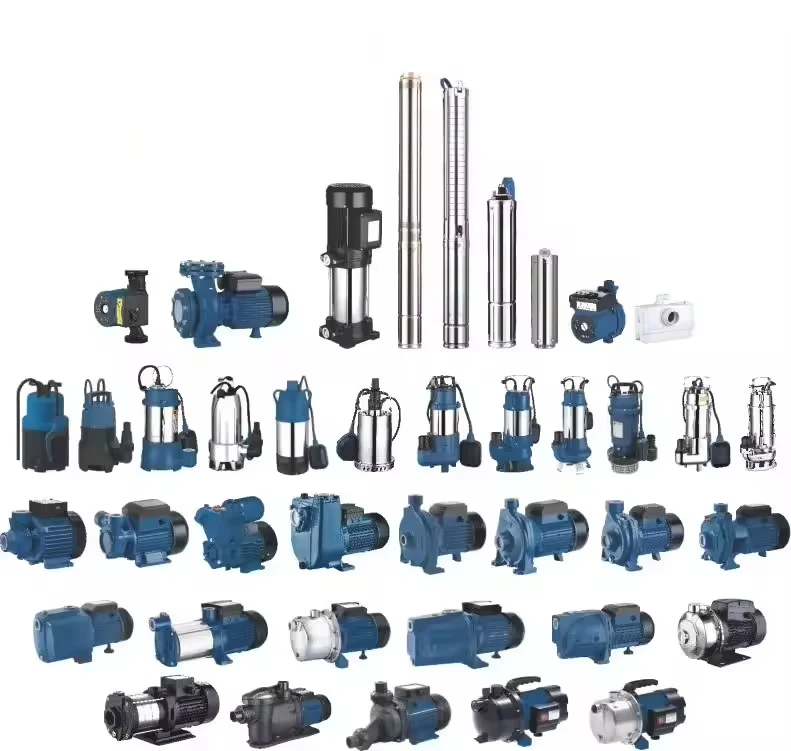
Proper selection can extend the average service life of a submersible sewage pump from 3 years to 8+ years, cutting total ownership cost by 62%. As a Submersible Sewage Water Pump manufacturer, we use a 5-step selection methodology:
Step 1: Calculate Flow Rate & Head
Measure the required maximum hourly flow rate (m³/h or GPM) and total discharge head (vertical lift + friction loss). Flow and head are the two non-negotiable parameters for any sewage pump selection.
Step 2: Determine Solids Size & Select Impeller
| Max Solid Diameter | Recommended Impeller Type | Typical Application |
|---|---|---|
| ≤ 50 mm | Channel impeller, 2-vane | Commercial buildings, light industrial |
| 50–80 mm | Vortex impeller | Municipal sewage, STP |
| 80–100 mm | Large vortex impeller | Raw sewage, mining slurry |
| Fibrous / Stringy | Non-clog vortex or cutter | Slaughterhouse, paper mill |
Step 3: Choose Material Based on Medium Chemistry
- Cast Iron: Standard municipal sewage, pH 6–9, abrasive but not highly corrosive.
- 304 Stainless Steel: Light industrial wastewater, mildly corrosive, pH 5–10.
- 316 Stainless Steel: Chemical wastewater, seawater intrusion, pH 3–11.
Step 4: Reserve 15–20% Power Margin
Reserve 15–20% extra power margin to avoid motor overload caused by unexpected medium changes. Do not size the motor exactly to the worst-case condition — that leaves zero tolerance for variation.
Step 5: Verify Protection Grade & Smart Options
Confirm IP68 waterproof rating. For critical installations, add optional intelligent monitoring modules for remote operation management — temperature sensors, leakage detection, and RS485 communication.
Scenario-Based Recommendations
| Scenario | Recommended Solution |
|---|---|
| Fixed sewage treatment (grid power) | Submersible Sewage Pump (WQ series) |
| Emergency dewatering (no power) | Gasoline/Diesel engine pump |
| Off-grid clean water supply | Solar submersible pump |
| Long-distance water transfer | Surface centrifugal pump |
| Combined sewage + emergency | Submersible sewage pump + diesel backup |
Contact us for a Customized Pump Selection — as a Submersible Sewage Water Pump manufacturer, we deliver tailored solutions based on your exact flow, head, solids profile, and chemical conditions.
9. Why Source Directly from a Submersible Sewage Water Pump Manufacturer

There are many resellers in the market — but partnering directly with a Submersible Sewage Water Pump manufacturer like JINGONG TECH delivers measurable advantages:
9.1 Factory-Direct Value
- Cost saving: Eliminate distributor margins — get factory pricing on every unit.
- Customization: Voltage (110V/220V/380V/415V), frequency (50Hz/60Hz), material, impeller type, cable length — all configurable.
- Technical depth: Speak directly to the engineers who design your pump, not a sales rep reading a spec sheet.
- Quality consistency: ISO-certified production line, 100% performance testing before shipment.
9.2 JINGONG TECH Full Product Ecosystem
As a Submersible Sewage Water Pump manufacturer, we are also a:
- Clean water submersible pump manufacturer — for wells, tanks, and potable water transfer.
- Surface pump manufacturer — for irrigation, boosting, and long-distance water transfer.
- Solar pumping system manufacturer — DC/AC solar submersible and surface pumps for off-grid supply.
- Gasoline & diesel engine pump manufacturer — portable, high-head emergency dewatering pumps.
- Booster pump manufacturer — for building water pressure systems.
This means when you work with JINGONG TECH as your Submersible Sewage Water Pump manufacturer, you get a one-stop sourcing partner for your entire pump portfolio. One contract, one quality standard, one logistics channel. This integrated approach has made us a preferred Submersible Sewage Water Pump manufacturer for distributors in 60+ countries.
9.3 Manufacturing Capabilities
- CNC machining centers for impeller and volute precision casting
- In-house motor winding and testing laboratory
- IP68 water-tightness testing tank for every finished unit
- Performance test bench calibrated to ISO 9906 Grade 2 accuracy
Every Submersible Sewage Water Pump manufacturer claims quality — we prove it with test reports. Request a virtual factory tour or request a quote today.
10. Conclusion
By now, you understand exactly how submersible sewage water pumps work: centrifugal force generated by a submerged, sealed motor drives an anti-clog impeller, creating the pressure differential that moves wastewater and solids from low to high elevation — automatically, quietly, and efficiently. You have seen the core components, the step-by-step process, the advantages over surface and clean water pumps, the real-world applications, the maintenance protocol, and the 5-step selection methodology.
As a leading Submersible Sewage Water Pump manufacturer, JINGONG TECH combines deep engineering expertise with full-category pump manufacturing — submersible sewage pumps, clean water submersible pumps, surface pumps, solar pumping systems, and gasoline/diesel engine pumps. We are not just a Submersible Sewage Water Pump manufacturer; we are your complete water movement partner.
Whether you need a single sample for evaluation or a container-load order for a municipal project, working with a Submersible Sewage Water Pump manufacturer directly ensures you get the right product, at the right price, with the right technical support. We invite you to experience the difference that a true Submersible Sewage Water Pump manufacturer brings to your project.
Ready to specify your pump? Contact JINGONG TECH, your trusted Submersible Sewage Water Pump manufacturer. Get a customized quotation within 24 hours. Request a Quote →
11. Frequently Asked Questions
Q1: Are submersible sewage pumps better than surface pumps?
Yes, for sewage applications. A submersible sewage pump eliminates priming issues, runs 60% quieter, avoids cavitation, and handles solids that would instantly clog a surface pump. The only advantage a surface pump holds is accessibility for service — but modern submersible pumps use guide-rail systems for easy retrieval without entering the pit. As a Submersible Sewage Water Pump manufacturer, we recommend submersible installation for any pit deeper than 3 meters.
Q2: Can submersible sewage pumps run dry?
It depends on the model. Standard submersible sewage pumps are designed for continuous operation when fully submerged. However, many modern heavy duty sewage pumps (including our WQ series) are capable of running dry without damage to components for short periods, thanks to oil-filled motor chambers and high-temperature-resistant seals. That said, prolonged dry running will eventually overheat even the most robust motor. We recommend installing a dry-run protection module for critical applications. If you need a pump that routinely runs dry, a diesel engine self-priming pump is a better choice.
Q3: How long do submersible sewage pumps last?
Properly selected and maintained: 8+ years. Industry data shows that proper selection can extend the average service life of a submersible sewage pump from 3 years to 8+ years. Our WQ series achieves an average no-failure runtime of 18,000 hours — equivalent to roughly 8–10 years of typical operation. Lifetime is determined by: selection accuracy (15–20% power margin), medium aggressiveness (pH, abrasives), and maintenance discipline (seal inspection every 6 months).
Q4: What’s the difference between a sewage pump and a clean water submersible pump?
Three structural differences define the distinction:
- Impeller: Sewage pumps use anti-clogging impellers (vortex or channel) with larger flow channels; clean water pumps use closed multi-vane impellers optimized for efficiency, not solids.
- Casing thickness: Sewage pumps use thicker, wear-resistant cast iron; clean water pumps use thinner, lighter casings.
- Motor load capacity: Sewage pump motors are higher load-resistant to handle viscous, solid-laden media; clean water motors are not.
Using a clean water submersible pump to pump sewage will destroy the impeller within days. Always specify a true submersible sewage pump for wastewater.
Q5: Can solar power run a submersible sewage pump?
Technically yes, practically limited. A solar powered submersible pump can drive a sewage pump motor if the panel array provides sufficient wattage and you add a DC/AC inverter. However, solar-powered sewage pumps are most viable for low-solid, high-flow applications. For raw sewage with high solids content, the power demand often exceeds what a reasonable solar array can sustainably provide, making grid-powered submersible sewage pumps the more reliable choice. For off-grid sewage emergencies, a diesel engine pump remains the most practical solution.
Q6: What is the best submersible sewage pump for industrial wastewater?
The best submersible sewage pump for industrial wastewater depends on your specific solids profile and chemistry. For municipal or heavy industrial raw sewage with solids up to 80–100 mm, a vortex-impeller WQ-series pump in cast iron or stainless steel is ideal. For corrosive industrial effluent, 316 stainless steel construction with a channel impeller is recommended. As a professional Submersible Sewage Water Pump manufacturer, we provide a free selection service — share your flow, head, solids size, and pH, and we will specify the exact model.
12. About the Author & EEAT Disclosure

0 Comments