
Solar Water Pump Irrigation has rapidly become the most cost-effective way to deliver reliable water to farms, orchards, greenhouses, and remote agricultural land without depending on grid electricity. As a professional water pump manufacturer with decades of production and export experience, Jingong Tech has deployed solar water pump irrigation systems across Africa, Southeast Asia, South America, and the Middle East. This guide explains the engineering, component matching, sizing methodology, installation, and maintenance of solar water pump irrigation — written from real field data, not vendor brochures.
In this article you’ll learn exactly how solar water pump irrigation works, how to size a system for your crop area, what components must be matched, and how to maintain it for a 15+ year service life. Every recommendation below is based on actual solar water pump irrigation projects we have manufactured, shipped, and supported.
Why Solar Water Pump Irrigation Is Replacing Diesel & Grid Pumps in 2026
The economics of solar water pump irrigation have fundamentally shifted. With PV module costs falling and motor efficiency rising, a properly designed solar water pump irrigation system now delivers the lowest cost per cubic meter of water lifted — beating diesel pumps by a wide margin over a 5-year operating period. For farms without reliable electricity, solar water pump irrigation is no longer an alternative; it is the primary solution.
Real project data supports this. In public rural drinking water and irrigation tenders, solar water pump irrigation stations have been configured with PV arrays ranging from 30 kW up to 183.6 kW, delivering daily water volumes up to 7,000 m³ at designed heads of 30–40 meters. One documented project in Hainan used 340 PV modules at 540 W each (total 183.6 kW) to drive a pump station with a designed head of 40 m and daily water supply of approximately 7,000 m³. These are not lab numbers — they are engineered, commissioned, and operating solar water pump irrigation installations.
For agricultural buyers, the value of solar water pump irrigation comes down to four measurable benefits:
- Zero fuel cost — sunlight is free; no diesel, no electricity bills.
- Off-grid independence — ideal for remote fields, mountain orchards, desert agriculture.
- Low maintenance — no engine, no fuel system, fewer moving parts than combustion pumps.
- Long service life — quality brushless DC motors and stainless steel pump bodies run 10+ years.
If you are evaluating solar water pump irrigation for your farm, the single most important step is correct system sizing. Oversizing wastes capital; undersizing fails your crop. The next section details our engineering method.
How Solar Water Pump Irrigation Systems Work
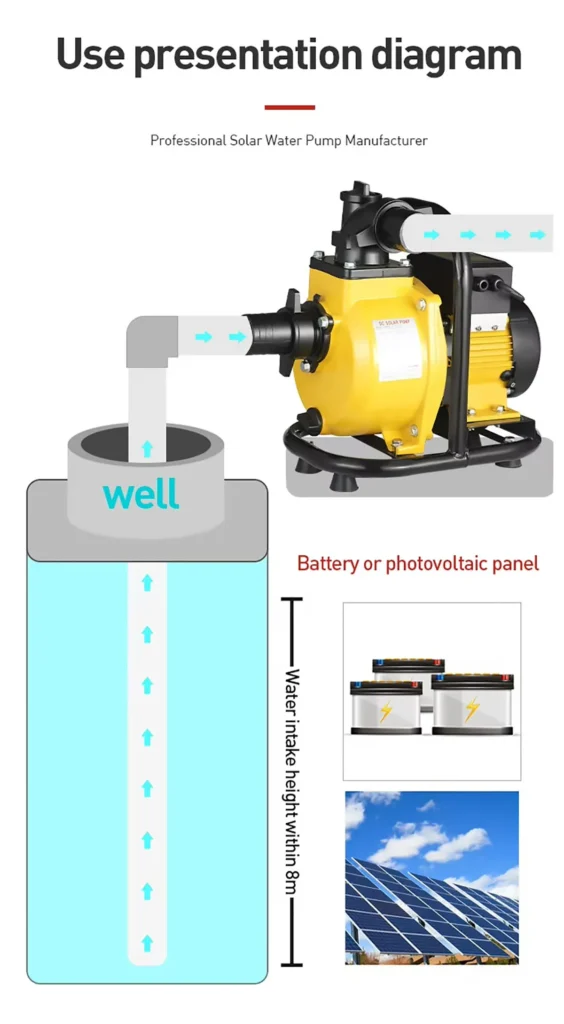
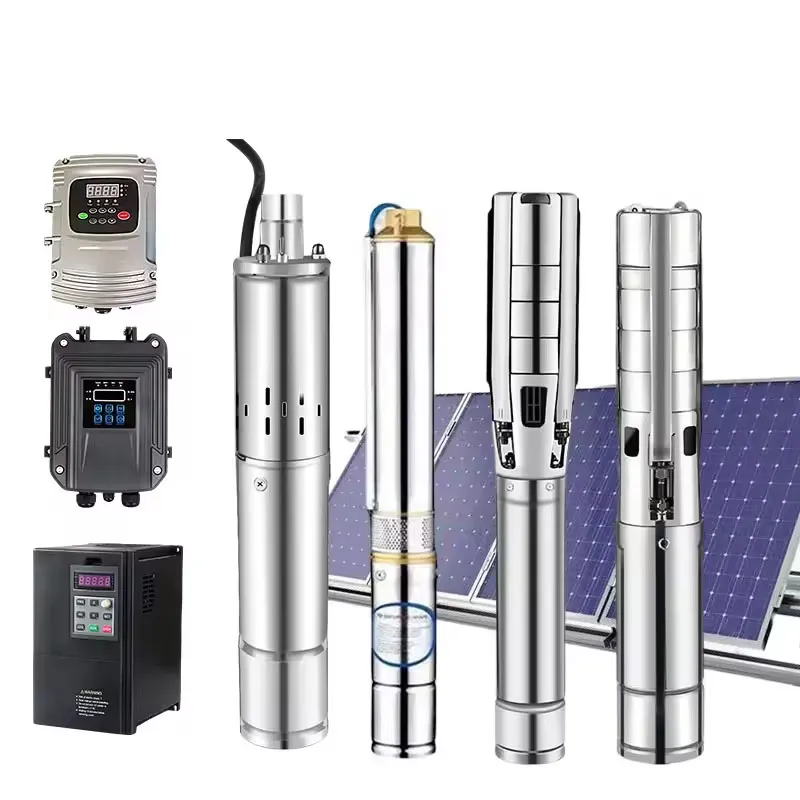
A complete solar water pump irrigation system consists of five core components that must be electrically and mechanically matched:
1. PV Array (Solar Panels)
The energy source. Polycrystalline or monocrystalline modules convert sunlight into DC electricity. In our engineered solar water pump irrigation projects, we typically specify PV capacity at 1.3–1.5× the inverter rated power to ensure full output even under real-world temperature derating. For example, a 30 kW inverter requires roughly 39–45 kW of PV modules.
2. Solar Pump Controller / Inverter
The brain of the solar water pump irrigation system. It converts DC from the PV array into the correct AC frequency and voltage for the pump motor, implements MPPT (Maximum Power Point Tracking) for optimal energy harvest, and automatically starts/stops based on sunlight, water level, and tank pressure. Controllers in modern solar water pump irrigation systems achieve conversion efficiencies above 97%.
3. Pump (Submersible, Surface, or Centrifugal)
The workhorse. For deep wells, a stainless steel submersible pump is used. For rivers, ponds, or canals, a surface pump or self-priming pump is selected. The choice depends entirely on your water source — a topic we cover in depth in our submersible water pump product page.
4. Water Storage & Distribution
Solar water pump irrigation runs when the sun shines. To buffer supply for early morning or nighttime irrigation, a storage tank is sized to cover 1–2 days of crop demand. Piping, valves, and drip/sprinkler networks distribute water across the field.
5. Mounting, Cabling & Protection
Q235 steel brackets, lightning protection, and properly sized YJV copper cabling connect everything. In high-lightning areas, a dedicated lightning rod and proper grounding are mandatory for any solar water pump irrigation installation.
Engineering note: The PV-to-inverter ratio of 1.3–1.5× and inverter-to-motor ratio of 1.1–1.3× are non-negotiable design rules in professional solar water pump irrigation projects. Deviating from these ratios causes chronic underperformance or premature controller failure.
Sizing Your Solar Water Pump Irrigation System: Step-by-Step
Correctly sizing a solar water pump irrigation system requires five inputs. Missing any one of them leads to wrong equipment selection.
Step 1: Calculate Daily Water Volume (Flow Requirement)
Multiply your irrigated area by crop water demand. Example: 100 mu (≈6.67 hectares) of corn at peak demand 4 L/m²·day with an irrigation efficiency factor of 0.8 yields a daily water requirement of approximately 333.5 m³. If you plan to irrigate over 8 hours, the required flow rate is about 42 m³/h. Always add a 20% safety margin — so you’d spec for ~50 m³/h.
This flow number directly determines which pump model in our solar water pump irrigation lineup fits your project.
Step 2: Calculate Total Head (Vertical + Friction Loss)
Total head = static head (vertical distance from water source to highest delivery point) + horizontal pipe loss (approximately 1 m of head per 10 m of horizontal pipe) + local losses (valves, elbows, filters — typically 1–2 m).
For example, a mountain orchard with a 20 m vertical drop, 300 m of pipe, plus valve losses, needs a total head of approximately 32 m. Add a 10–20% safety margin when selecting your solar water pump irrigation pump curve.
Critical warning: if actual head is 30% lower than rated head, pump efficiency drops by ~40% and mechanical seals can burn out. This is the #1 cause of premature solar water pump irrigation pump failure.
Step 3: Determine Pump Power
Based on flow (m³/h) and total head (m), calculate hydraulic power, then divide by motor efficiency (~81% for quality pumps) to get required motor power. Our high-efficiency solar-dedicated pumps achieve average efficiencies around 81% with operating frequencies ranging from 5 Hz to 50 Hz.
Step 4: Size the Controller/Inverter
Controller power = pump motor power × 1.1–1.3. A 22 kW motor needs a 30 kW-class controller (the industry-standard configuration seen in public solar water pump irrigation tenders).
Step 5: Size the PV Array
PV capacity = controller power × 1.3–1.5. For a 30 kW controller, deploy 39–45 kW of PV modules. Module specifications matter: in documented projects, 275 W polycrystalline modules with 16.8% efficiency, or 540–555 W high-power modules, are commonly deployed in solar water pump irrigation stations.
Worked Example
Client scenario: 75 mu arid-land irrigation, well depth 55 m, static head 48 m, well diameter 200 mm, growing season 6 months, total seasonal water need 27,000 m³, local peak sun hours 5 h/day.
Our engineering team calculated the required solar water pump irrigation configuration as:
- Flow: ~1.19 m³/h (based on 1,000 m³ over 300 days at 3.5 h sun, 0.8 system efficiency)
- Head: 110 m (including all losses)
- Pump: Stainless steel submersible, 22 kW motor
- Controller: 30 kW solar pump inverter
- PV Array: 30 kW (60 × 275 W modules, or equivalent high-power modules)
This is exactly how we engineer every custom solar water pump irrigation project at Jingong Tech. There is no “off-the-shelf guesswork” — only calculated, verified system design.
Solar Water Pump Irrigation for Different Scenarios
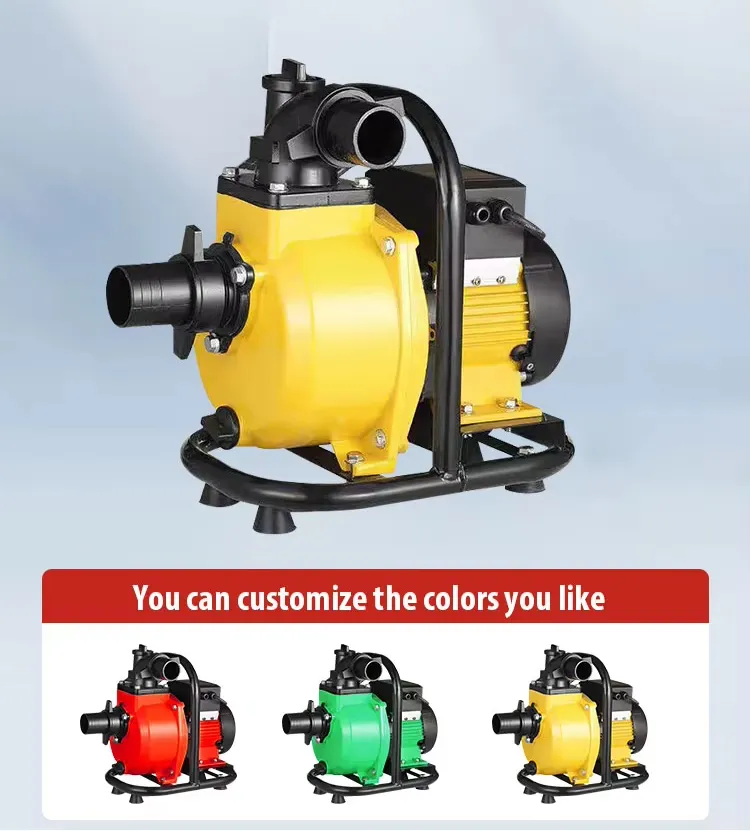
Not every field is the same. Here’s how solar water pump irrigation is adapted to the main agricultural scenarios we serve:
A. Solar Water Pump Irrigation for Deep Well & Borehole
When static head exceeds 50 m, a stainless steel submersible pump is the only correct choice. Our solar water pump irrigation deep-well configurations have been deployed at heads up to 450 m, using 22 kW motors delivering 15 m³/h at peak. The pump hangs by steel cable, suspended at sufficient height above the well bottom to prevent intake of mud and sand.
Key specification: pump body material must be 304 or 316 stainless steel for corrosion resistance and long life. In solar water pump irrigation deep-well applications, we never use cast iron below the water line.
B. Solar Water Pump Irrigation for Surface Water (River, Pond, Canal)
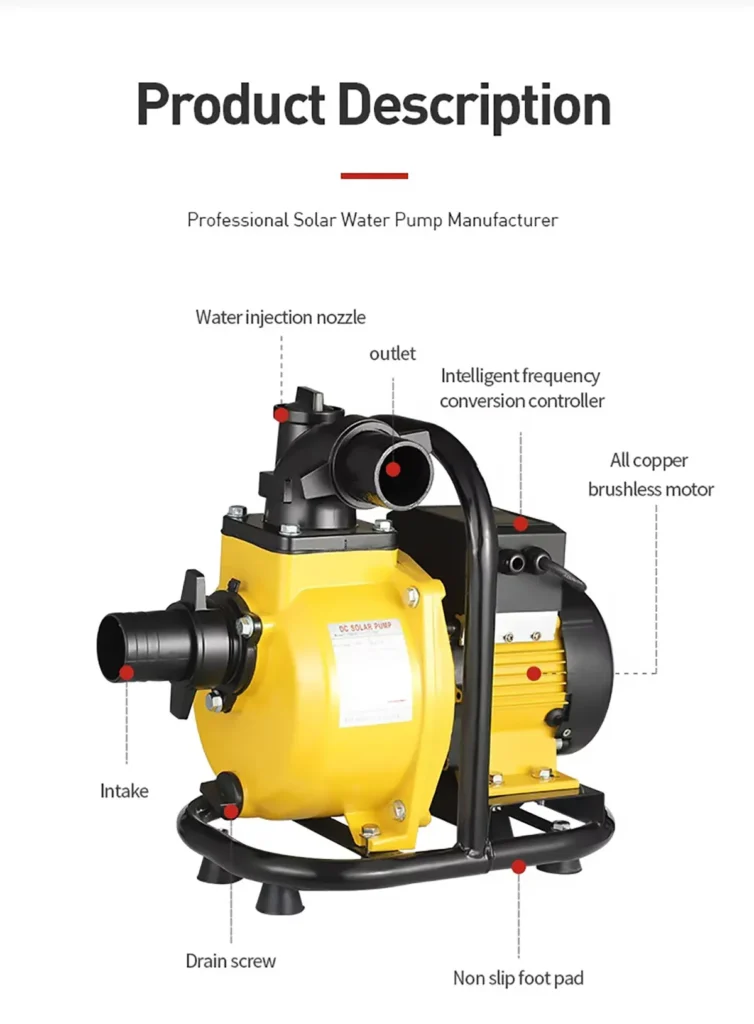
For shallow sources, a self-priming surface pump or centrifugal pump is used. Solar water pump irrigation for surface sources typically operates at heads below 30 m with flows from 10–50 m³/h. The advantage: simple installation, easy maintenance, no well required.
Our portable solar water pump irrigation units integrate folding PV modules (as few as 12 panels covering 0.3 m²), controller, pump, and battery onto a mobile cart just 1.62 m² — perfect for terraced fields, scattered plots, and rental farming.
C. Solar Water Pump Irrigation for Mountain & Terraced Fields
Multi-stage pumping is often required. A documented three-stage solar water pump irrigation project in Sichuan used nine solar submersible pumps (3 stages × 2 pumps + 1 spare) each rated at 40 m³/h flow, 400 m head, 30 kW power — fed by 690 PV modules at 555 W each. The system lifts water 1,200 m vertically across three stages to irrigate high-altitude terrain.
This proves that solar water pump irrigation can serve even the most challenging topography — no diesel truck, no grid extension needed.
D. Solar Water Pump Irrigation for Greenhouses & Drip Systems
Low flow, low head, high reliability. A solar water pump irrigation system paired with drip lines and a 1–2 day storage tank delivers precise watering. We match the pump curve to the drip system’s design pressure (typically 1–2 bar) for maximum water-use efficiency.
E. Solar Water Pump Irrigation with Energy Storage
Pure solar-direct solar water pump irrigation stops at night and slows on cloudy days. For farms needing 24-hour watering, we offer hybrid systems: PV + lithium battery bank, or PV + grid backup, or PV + small diesel generator for emergency. Battery capacity is sized to cover 1–2 days of low-sun operation.
Clarification for buyers: a pure solar-direct solar water pump irrigation system will stop working at night. If your crop requires continuous watering, you must choose a PV + storage configuration. We explain this transparently to every client — no hidden limitations.
Component Matching Rules for Solar Water Pump Irrigation
The difference between a solar water pump irrigation system that lasts 10 years and one that fails in 2 years is component matching. Follow these non-negotiable rules
| Parameter | Rule | Consequence if Violated |
|---|---|---|
| PV : Inverter Power | 1.3 – 1.5 × | Chronic underperformance, controller stress |
| Inverter : Motor Power | 1.1 – 1.3 × | Startup failure, motor overheating |
| Module Voltage | Match controller MPPT range | MPPT cannot lock, energy waste |
| Cable Specification | YJV copper, sized per distance | Voltage drop, power loss |
| Pump Material | 304 SS for corrosive water | Rapid corrosion, seal failure |
These rules apply to every solar water pump irrigation project we manufacture at Jingong Tech. They are derived from field failures we have diagnosed and corrected over decades of production.
Installation Best Practices for Solar Water Pump Irrigation
Proper installation is as critical as proper sizing. Below are the field-tested procedures our engineering team uses for every solar water pump irrigation deployment:
PV Array Installation
- Orient panels true south (northern hemisphere) or true north (southern hemisphere).
- Set tilt angle ≈ local latitude for year-round optimization, or latitude ±15° for seasonal bias.
- Use Q235 steel brackets with concrete foundation piers (typical 60×60×80 cm).
- Install lightning protection: a ≥φ50×6000 mm galvanized steel rod with proper grounding.
- Tighten all bracket bolts to specified torque; inspect after first 3 months and annually.
Pump Installation
- For submersible pumps: lower by steel cable, never by the electrical conduit or water pipe. Suspend at least 1 m above the well bottom.
- Install a foam filter (FI) before the pump intake to block sand and debris.
- For new wells: wait until water runs clear before commissioning the pump — never pump muddy water.
- For surface pumps: mount on a solid concrete base, align coupling precisely, prime the pump before startup.
Electrical Connection
- Use YJV copper cable, correctly sized for the distance between controller and pump.
- All outdoor junctions must be IP65-rated waterproof enclosures.
- Ground the entire system: PV array frame, controller chassis, pump body.
- Verify rotation direction before final connection (for 3-phase AC pumps).
Field lesson: In one solar water pump irrigation project we serviced, the original installer had hung the submersible pump by its electrical cable. Within 8 months the cable stretched, the joint failed, and the pump dropped to the bottom of a 120 m well. Correct installation procedure is not optional — it is the difference between a 10-year system and a catastrophic failure.
Maintenance Schedule for Solar Water Pump Irrigation
A well-maintained solar water pump irrigation system runs 10+ years. Neglected, it fails in 2–3. Here is the exact maintenance schedule our after-sales team prescribes:
Monthly (or every 1–2 months)
- Clean PV panel surface with soft cloth and water; remove dust, bird droppings, leaves.
- Check panel angle and bracket bolt tightness.
- Inspect pump intake filter; clean if clogged with sand or debris.
- Verify controller indicators show normal operation.
Quarterly
- Run pump at least once even in non-irrigation season to prevent internal rust and seal adhesion.
- Inspect all electrical cables for animal damage, aging, or water ingress.
- Check water storage tank for algae or sediment; clean if needed.
- Inspect pipeline joints for leaks.
Annually
- Full inspection of pump: lubricate bearings, replace shaft seals if leaking.
- Complete pump teardown: clean impeller, inspect wear rings, check mechanical seal.
- Calibrate sensors (water level, pressure, soil moisture).
- Update controller software if applicable.
- Anti-rust repaint of pump body surfaces.
Seasonal
- Winter: In freezing climates, drain all pipes and pump housing to prevent frost cracking. Remove and store portable solar water pump irrigation units indoors.
- Rainy season: Verify lightning protection and grounding; check all waterproof seals.
Following this schedule, our clients report solar water pump irrigation systems achieving 95%+ uptime across 8+ year operational lifetimes.
Common Solar Water Pump Irrigation Failures & Solutions
From our after-sales database across thousands of installed solar water pump irrigation units, here are the top 5 failure modes and their fixes:
| Failure | Cause | Solution |
|---|---|---|
| Pump stops at midday | PV array undersized; MPPT cannot maintain voltage | Add PV modules to reach 1.3–1.5× inverter ratio |
| Low flow output | Intake filter clogged with sand | Clean or replace foam filter; pre-settle new wells |
| Pump vibrates loudly | Air intake causing cavitation, or bearing failure | Check for air leaks; replace bearings if worn |
| Controller fault code | Over-voltage from wrong PV string configuration | Reconfigure PV string to match controller input range |
| Seal leakage after 2–3 years | Corrosive water; cast iron components | Replace with 304/316 stainless steel pump body |
Every one of these failures is preventable with correct solar water pump irrigation system design and proactive maintenance. This is why we provide free system design consultation for every B2B buyer — before you purchase, not after you fail.
Case Study: 183.6 kW Solar Water Pump Irrigation Station for High-Standard Farmland
To demonstrate what professional solar water pump irrigation looks like at scale, here is a summarized public project reference:
- Location: Hainan Province, China
- Project scope: Two irrigation districts (Malong & E’long)
- Malong station: 183.6 kW PV (340 modules × 540 W), designed head 40 m, daily water supply ~7,000 m³
- E’long station: 113.4 kW PV (210 modules × 540 W), designed head 30 m, daily water supply ~4,000 m³
- Infrastructure: YJV-3×70 mm² cable, PEΦ280 pipeline (1,937 m), concrete pump house, galvanized steel brackets
- Outcome: Fully off-grid irrigation of high-standard farmland; zero diesel consumption; projected 20+ year service life
This is the caliber of solar water pump irrigation engineering Jingong Tech brings to every agricultural project — whether it’s a 750 W portable unit for a smallholder or a 200+ kW station for an agricultural cooperative.
See more real deployments in our Project Case gallery, including overseas installations across Africa, Southeast Asia, and Latin America.
Why Choose Jingong Tech for Your Solar Water Pump Irrigation Project

As a vertically integrated manufacturer (not a trading company), Jingong Tech controls every aspect of your solar water pump irrigation system:
- 20+ years of water pump R&D and manufacturing experience
- Full product range: solar water pumps, submersible pumps, surface pumps, diesel & gasoline pumps, and booster pumps
- ISO 9001, CE, RoHS certified production (view all certificates)
- Engineer-led system design — no guesswork, only calculated specs
- Global shipping & remote technical support via WhatsApp, email, video call
- Comprehensive after-sales service with spare parts supply guarantee
- Custom voltage, frequency, material, and branding (OEM/ODM) available
Our solar water pump irrigation systems are already operating reliably in over 40 countries. We know what works in sub-Saharan Africa, what survives Southeast Asian monsoons, and what performs in South American highland conditions.
Frequently Asked Questions about Solar Water Pump Irrigation
Q1: How much does a solar water pump irrigation system cost?
A: System cost depends on flow, head, and PV capacity. A typical 750 W portable unit starts from a few hundred USD; a 30 kW deep-well station runs into tens of thousands USD. Over a 5-year operating period, solar water pump irrigation typically delivers 40–60% lower total cost of ownership vs. diesel pumps due to zero fuel cost. Contact us with your flow & head data for a precise quote.
Q2: Will my solar water pump irrigation system work on cloudy days or at night?
A: Pure solar-direct systems slow down significantly on heavy overcast and stop at night. For 24-hour operation, select a PV + battery storage configuration. We transparently explain these limitations before you buy — no surprises.
Q3: How long does a solar water pump irrigation system last?
A: With proper maintenance, the PV array lasts 25+ years, the controller 8–10 years, and a quality stainless steel submersible pump 8–12 years. Brushless DC motors significantly outlast brushed motors. Full maintenance schedule is in our technical manual (PDF download).
Q4: Can I expand my solar water pump irrigation system later?
A: Yes. We design with expansion in mind — oversized controllers and modular PV arrays allow adding panels or a second pump in the future. Tell us your 5-year growth plan during initial consultation.
Q5: What certifications do your solar water pump irrigation products have?
A: All products are CE, ISO 9001, and RoHS certified. Specific certifications for your target market (e.g., SONCAP for Nigeria, SASO for Saudi Arabia) can be arranged. See our certifications page for details.
Q6: How do I select the right solar water pump irrigation system for my farm?
A: Provide us with: ① irrigated area & crop type; ② water source (well depth, or surface water); ③ required daily water volume; ④ local peak sun hours; ⑤ desired operating hours per day. Our engineers return a complete system design within 48 hours. No charge, no obligation.
Get Your Custom Solar Water Pump Irrigation Design
Every farm is different. Every solar water pump irrigation project deserves a custom-engineered solution — not a boxed guess. Jingong Tech’s engineering team is ready to design your system for free.
Next steps:
- Download our Solar Water Pump Selection Guide (PDF) for self-assessment.
- Read our Solar vs Diesel Pump Comparison to understand the ROI math.
- Contact our engineering team via WhatsApp, email, or the inquiry form with your field data.
- Receive your free solar water pump irrigation system design within 48 hours.
We don’t just sell pumps. We deliver water security for your farm — engineered right, built to last, supported for life.

0 Comments