
1. Executive Introduction & Industry Overview
As a Solar Water Pump manufacturer based in Zhejiang, China, with 20+ years of pump production and export experience, Jingong has delivered solar, submersible, surface, gasoline, and diesel pumps to farms, construction sites, and off-grid communities across Africa, Southeast Asia, Latin America, and the Middle East. This guide is written from a factory engineer’s perspective—not generic blog content—to help B2B buyers, distributors, and project contractors understand types of solar water pumps and their applications, compare them with traditional fuel pumps, and make confident procurement decisions.
1.1 Why Solar Water Pumps Are Replacing Traditional Pumps Globally
Three pain points drive the shift:
- No grid or unstable power: Remote farmland, Sahel region, island villages—grid either absent or unavailable 8+ hours/day.
- Rising fuel costs: Diesel prices rose 40–60% in multiple markets over the past 3 years; fuel alone consumes ~70% of a diesel pump’s 5-year TCO.
- High maintenance labor: Diesel engines need oil, filters, belts—hard to staff in remote farms.
A solar water pump swaps recurring OPEX for one-time CAPEX: zero fuel, minimal maintenance, 12–15 year service life. At Jingong, our solar series grew from 18% to 37% of export mix between 2023–2025. As a Solar Water Pump manufacturer, we see diesel-to-solar replacement orders as the fastest-growing segment.
Jingong product matrix referenced in this article:
- Energy-saving core: Solar Submersible Pump | Solar Surface/Land Pump
- Mobile backup: Gasoline Water Pump | Diesel Water Pump
- Cost-effective conventional: Ordinary Submersible & Land Pumps
2. Core Classification of Solar Water Pumps
2.1 Classification by Installation & Working Environment
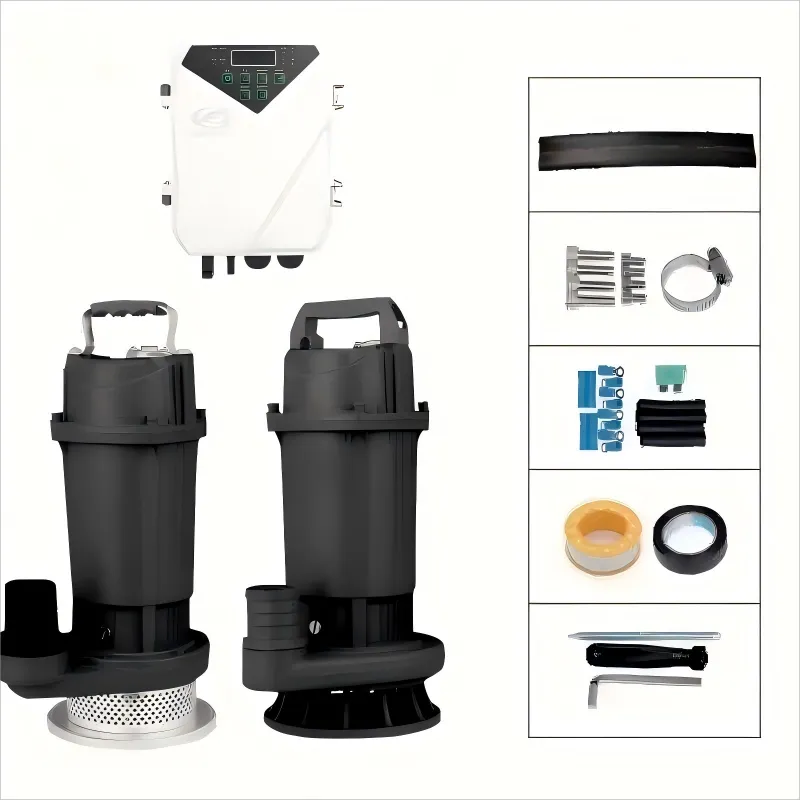
2.1.1 Solar Submersible Water Pump
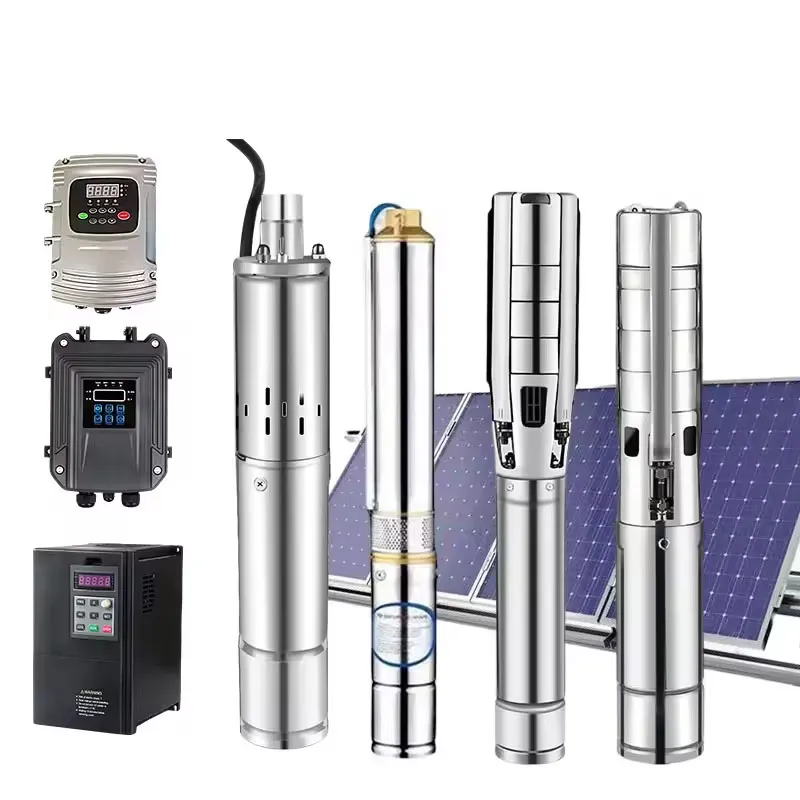
Structure: Motor + pump integrated, fully underwater operation, IP68 waterproof, 304/316 stainless steel housing, explosion-proof design.
Applications: Deep wells (30–240 m head at Jingong’s range), borewell irrigation, pond/reservoir deep intake, no cavitation advantage.
| Parameter | Typical Range (Jingong) |
|---|---|
| Power | 0.37 kW – 5.5 kW (DC / AC-DC hybrid) |
| Head | 20 m – 240 m |
| Flow | 0.5 – 12 m³/h |
| Controller | MPPT built-in, dry-run / overload / under-voltage protection |
| Solar panel match | 400 W – 5500 W array per unit |
⚠️ Common spec mistake: head must include static water level + dynamic drawdown + pipe loss + outlet pressure—not just well depth. As a Solar Water Pump manufacturer, Jingong requires a 3-field form (well depth / casing diameter / daily water demand) before confirming model.
→ Explore Jingong Solar Submersible Pump series
2.1.2 Solar Surface / Land Water Pump
Structure: Ground-mounted, self-priming or centrifugal, no underwater cabling, easy maintenance.
Applications: Rivers, canals, reservoirs (suction ≤8 m, self-priming up to 9 m), large-area flood irrigation, portable versions with wheels.
| Parameter | Typical Range |
|---|---|
| Power | 0.55 kW – 7.5 kW |
| Head | 6 m – 55 m |
| Flow | 3 – 28 m³/h |
| Suction lift | 6–9 m (self-priming) |
→ Explore Jingong Solar Surface/Land Pump series
2.2 Classification by Power Type
| Type | Feature | Use Case |
|---|---|---|
| DC Solar Pump | PV direct-drive, MPPT, highest efficiency | Small home, single well |
| AC Solar Pump | PV → inverter → AC motor | Retrofit existing AC pump |
| AC/DC Hybrid | PV priority + grid/gen backup | Cloudy/rainy regions (top seller) |
| Battery Backup | PV + storage, night operation | Livestock, 24h supply |
| Direct Drive | No battery, no inverter | Daytime-only irrigation |
💡 Jingong’s best-selling combo for Africa/ South Asia farms: AC/DC hybrid + battery backup—day PV, night battery, rainy season grid/gen switchover. No water gap.
2.3 Classification by Pump Structure
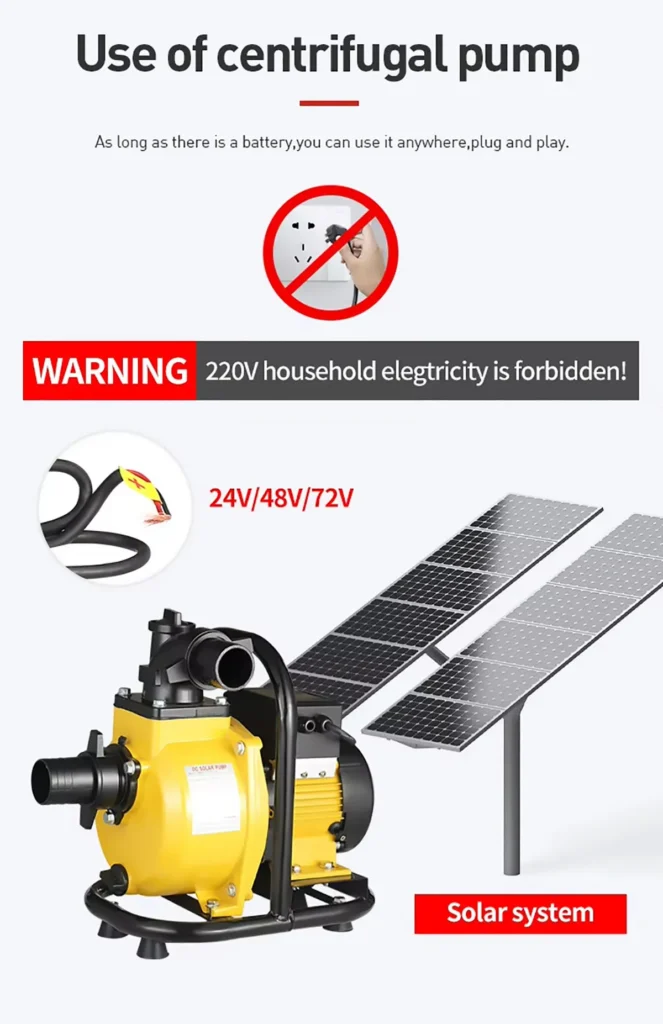
- Centrifugal solar pump: High flow, medium head, clean water → main irrigation workhorse.
- Screw solar pump: High head, small flow, tolerates slight sand → deep well
- Vortex solar pump: Anti-cavitation, shallow well / self-priming scenarios.
3. Full Comparison: Solar Pump vs Traditional Pumps
This is the highest-converting section for B2B visitors comparing TCO. Data below reflects Jingong field cases + industry benchmarks.
3.1 Solar Pump vs Diesel Water Pump
| Dimension | Solar Pump | Diesel Pump |
|---|---|---|
| Fuel cost | $0 | High (60–70% of 5-yr TCO) |
| Maintenance | 1–2 times/year | Monthly (oil, filter, belt) |
| Service life | 12–15 years | 5–8 years |
| Noise | Silent | 85 dB+ |
| Upfront CAPEX | +30–50% vs diesel | Lower |
| Best fit | Fixed long-term water need | Mobile / emergency |
Case: A 30-acre orchard in Kenya replaced a 5.5 kW diesel pump ($2,100/yr fuel) with a Jingong 5.5 kW AC/DC hybrid solar submersible + 4 kW PV. CAPEX $3,100, payback month 18, then 10 years zero fuel. As a Solar Water Pump manufacturer, these case numbers are what close distributors.
→ Compare Jingong Diesel Water Pump series
3.2 Solar Pump vs Gasoline Water Pump
Gasoline pumps dominate temporary dewatering, construction drainage, post-flood emergency—high flow but expensive fuel & shorter life (3–5 yr). Solar pumps replace them in fixed long-term scenarios.
→ Compare Jingong Gasoline Water Pump series
3.3 Solar Submersible vs Ordinary Electric Submersible
Ordinary electric submersibles need grid + starter panel—unusable off-grid. Solar submersibles ship with MPPT controller, PV-direct or AC/DC switchable, run where grid doesn’t exist.
3.4 Solar Surface vs Ordinary Land Pump
Same logic: ordinary land pumps need grid; solar surface pumps serve fields and canal intakes without wiring to the grid.
4. Scenario-Based Applications of Solar Water Pumps
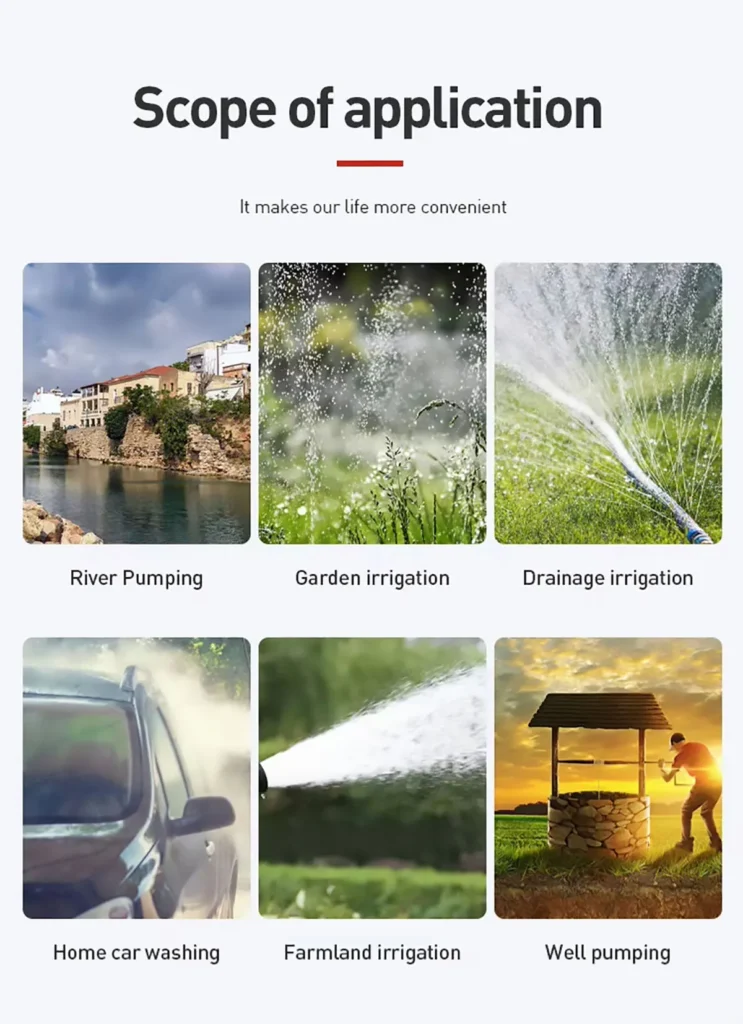
4.1 Agricultural Irrigation (core B2B)
- Deep well + drip: Solar submersible (high head, pair with drip kit)
- Large area flood/sprinkler: Solar surface (high flow, connect sprinkler tape)
- Orchard/cash crop: AC/DC hybrid + timer controller
4.2 Domestic Off-Grid Water Supply
Remote villages, islands, pastoral settlements: small solar submersible (0.37–0.75 kW) + 3–4 roof panels solves drinking water.
4.3 Livestock & Aquaculture
- Pasture livestock watering: 24 h auto-refill, float valve link
- Fish pond circulation/aeration: solar surface + air diffuser
- Aquaculture water exchange: timed submersible drain/fill
4.4 Industrial & Water Transfer
Construction site intake, reservoir replenishment, mine dust suppression, long-distance transfer (with booster). Jingong shipped 7.5 kW solar surface units (portable wheeled) to Middle East job sites.
4.5 Landscape & Civil Engineering
Garden fountain, riverway replenishment, estate water feature. Low-power DC (12 V/24 V) + small panel, silent & aesthetic.
5. Core Technical Parameters & Selection Guide
5.1 Key Parameters (procurement checklist)
- Lift Height: static + dynamic + pipe loss + outlet pressure
- Flow Rate: reverse-calc from acreage / livestock heads / daily demand
- Power: Head × Flow ÷ coefficient ÷ η
- Working Depth: immersion depth for submersible
- Voltage: DC 12/24/48/96 V; AC 220/380 V
- Waterproof: IP68 (submersible)
- PV Match: Rated pump power ÷ 0.75 (sunlight factor)
5.2 Quick Selection Logic
| Demand | Recommendation |
|---|---|
| Deep well + high head | Solar submersible (screw structure) |
| Shallow + high flow + easy service | Solar surface/land pump |
| Short-term mobile + tight budget | Gasoline / Diesel pump |
| Long-term fixed + energy saving | Solar pump (AC/DC hybrid) |
📌 As a Solar Water Pump manufacturer, Jingong issues a pre-shipment “Selection Confirmation Sheet” per order: well depth / casing diameter / daily water demand / peak sun hours / backup power need. Five parameters locked before model confirmed—our return rate stays <1.2%.
6. Installation, Maintenance & Fault Solutions

6.1 Installation Tips
- PV array orientation: true south (NH), tilt ≈ local latitude
- Controller wall-mounted ≥1.5 m, away from moisture
- Insulation test before submersible goes down well
- Inlet strainer on surface pump (debris guard)
6.2 Routine Maintenance
- Check PV terminals quarterly
- Pull submersible for impeller check every 12 months
- Dust off controller heat sink
6.3 Common Faults
| Fault | Cause | Fix |
|---|---|---|
| No water output | Dry well / low voltage / blocked impeller | Check water level / PV wattage / disassemble |
| Low flow | Undersized head / pipe leak | Recalc head / check joints |
| Start failure | Controller protection / PV open | Reset / check string |
7. Jingong Product Matrix & Custom Solution (Conversion Closer)

How Jingong’s four series interact around the solar pump topic:
- Solar Series (energy-saving core): solar submersible / solar surface → long-term fixed scenarios
- Traditional Series (mobile backup): gasoline / diesel → emergency + no-sun complement
- Conventional Series (cost-effective): ordinary submersible / land pump → grid-connected low-price markets
As an experienced Solar Water Pump manufacturer, Jingong supports:
- OEM/ODM (logo, spec, packaging customization)
- Full kits: PV panel + pump + controller + cable (plug-and-pump on arrival)
- 2-year warranty + EN manuals + full export docs
- 40HQ monthly capacity 2000+ units
This page itself is designed as a pillar resource that a Solar Water Pump manufacturer can use to attract backlinks from agri-equipment, renewable-energy, and off-grid energy sites—strengthening domain authority for the whole Jingong site.
→ Request a Quote / Selection Sheet | → About Jingong Factory
8. FAQ – Long-tail Capture (Featured Snippet Target)

8.1 Which is better, solar submersible pump or surface pump?
Deep well / high head → submersible. Shallow source / high flow / easy maintenance → surface. Many farms buy both: sub for well, surface for canal/pond.
8.2 How long does a solar water pump last?
Quality units (Jingong grade) 12–15 years; controller 5–8 years, replaceable separately. Choosing a reliable Solar Water Pump manufacturer matters more than the brand tier.
8.3 Can solar pumps work on cloudy days?
Yes, output drops to 30–60% of sunny-day rating. AC/DC hybrid or battery backup keeps full-day operation.
8.4 Solar pump vs diesel pump: which is cheaper for farm irrigation?
If you can carry CAPEX: solar pays back in 18–30 months then ~10 years zero fuel. Diesel is cheaper upfront but 3-year fuel exceeds pump price.

0 Comments