
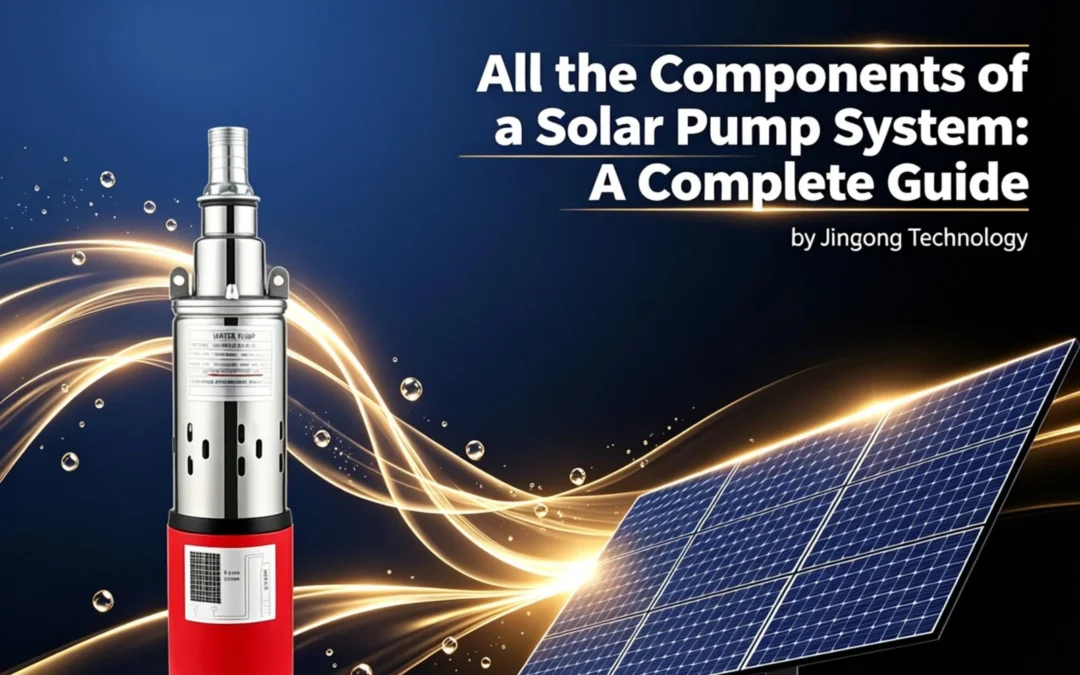
If you’re specifying, procuring, or distributing a solar pump system for agriculture, rural water supply, livestock, or off-grid projects, there’s one truth every engineer learns fast: the system is only as reliable as its weakest component. At Jingong Technology (Zhejiang Jingong), we’ve been manufacturing pumps—centrifugal, submersible, booster, gasoline/diesel, and solar-powered—for two decades, and exporting solar pump systems to the Middle East, Africa, and Southeast Asia for over 12 years. This guide breaks down every component of a solar pump system from the perspective of real field projects, not textbook theory.
Why the Component Breakdown Matters for Your Solar Pump System
A solar pump system looks simple from the outside: panels, an inverter, a pump. In reality, it’s a tightly coupled electromechanical chain where mismatch in any single link—panel voltage drift, inverter MPPT band, pump motor curve, cable resistance, water level logic—can cut daily yield by 20–40%. For distributors and EPCs, that means warranty claims. For farmers, that means crop stress. That’s why understanding each component matters before you buy.
Meet Jingong – Solar Pump System Manufacturer with 15+ Years of Pump Expertise
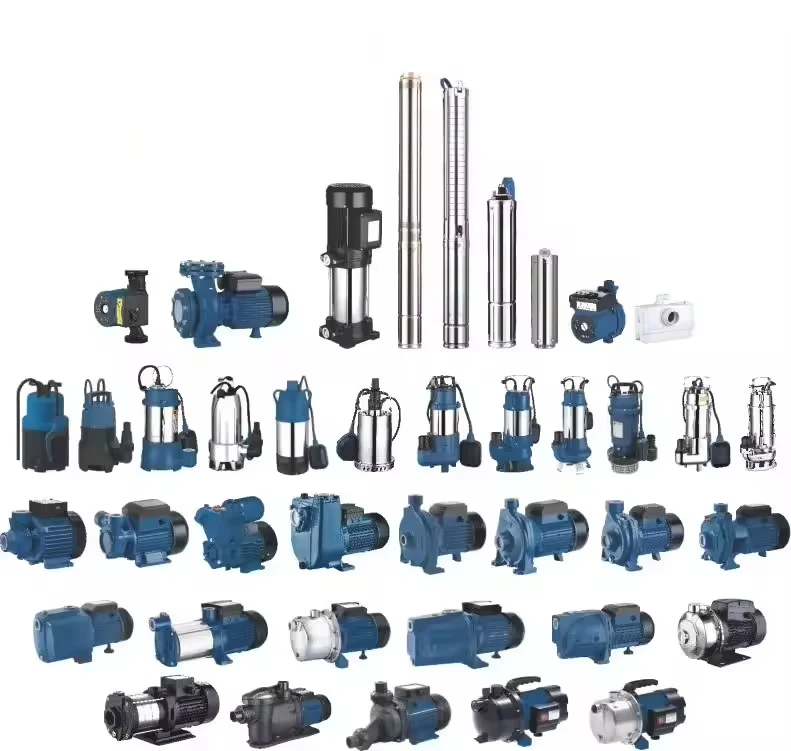
Jingong Technology is a Zhejiang-based industrial pump factory (civil & industrial), integrated manufacturer-trader . Our product range covers:
- Booster pumps (domestic & building)
- Submersible pumps (deep well / borehole)
- Surface / land pumps
- Solar pump systems (DC & AC, 0.37 kW – 400 kW)
- Gasoline & diesel engine-driven pumps
Our solar pump system division has shipped to 30+ countries, with reference projects in Nigerian irrigation schemes, Saudi remote village water supply, and Indonesian palm plantation drainage. All content below draws on those field cases.
Core Components of a Solar Pump System (Deep Dive)
2.1 PV Array (Solar Panels) – The Power Source
The PV array typically accounts for 60–80% of total CAPEX in a solar pump system. Its job: convert irradiance into DC electricity matched to the inverter’s MPPT window.
Key Parameters
- Peak Power (Wp): 550 Wp+ mono PERC mainstream for 2025 projects
- Voc / Vmp: Must align with inverter DC input range across ambient temp swing (−10°C to +70°C)
- Efficiency: ≥21.5% for utility-grade arrays
- Durability: PID-resistant, salt mist & ammonia certified for coastal/agri use
Jingong Advantage
- Low-irradiance optimization (Thailand/Indonesia monsoon zones)
- Tier-1 cell sourcing, 25-year linear power warranty
- IEC 61215 / IEC 61730 certified panels standard
- Custom string sizing per project latitude (we run PVsyst cross-check on request)
Installation & Maintenance Tips
- Tilt = latitude ±5°, azimuth true south (NH) / north (SH)
- Allow 10%+ Voc headroom for cold snaps
- Wash schedule: dusty sites (Sahel, MENA) every 3–4 weeks
- Use MC4-EVO2 for field reliability
2.2 Solar Pump Inverter (with MPPT) – The Brain
The inverter converts PV DC → AC (or drives BLDC directly in DC-pump configs), runs MPPT 99%+ tracking, and protects the pump. In any solar pump system, this is the intelligence layer.
Key Parameters
- Conversion efficiency: ≥98%
- MPPT voltage range: wide-band preferred (e.g. 200–850 VDC)
- Protection: over/under voltage, overcurrent, dry-run, tank-full
- Hybrid ready: PV + grid or PV + diesel bypass
Jingong Advantage
- 0.37 kW – 400 kW coverage, single/three-phase
- Hybrid mode: auto-switch diesel/gen during 3+ cloudy days
- GPRS/4G remote monitoring dashboard (SLA-level for distributors)
- IEC 61800 / UL 1741 compliant SKUs for export
Commissioning Checklist
- Verify DC polarity pre-close (reverse = instant warranty)
- Set dry-run threshold per pump curve (not factory default)
- Log MPPT sweep at 11:00 & 14:00 local for first 3 days
2.3 Solar Water Pump – The Execution Core
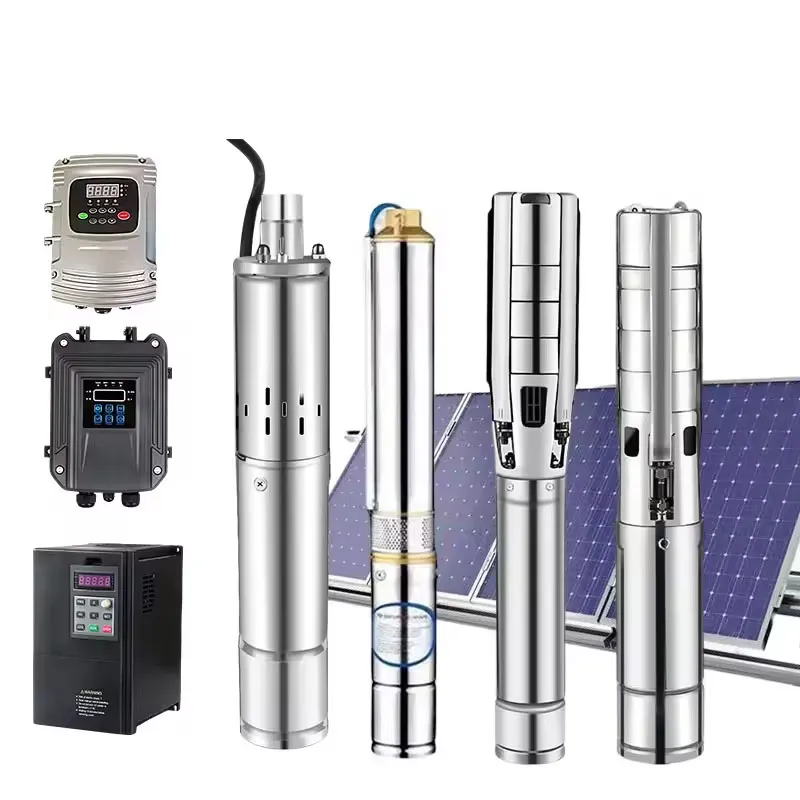
This is Jingong’s home ground. A solar pump system lives or dies by the pump’s hydraulic match to the borehole / canal and the motor’s tolerance for variable frequency drive (VFD) input.
Submersible vs Surface vs Floating
| Type | Use Case | Share (global, approx) |
|---|---|---|
| Submersible (borehole) | Deep well (>15 m), drinking / irrigation | ~58% |
| Surface | Pond, river, canal, <8 m suction | ~27% |
| Floating | Lake, reservoir, fish farm | ~15% |
DC vs AC Solar Pumps
- DC (BLDC): ≤4 kW, higher efficiency, simpler (no inverter AC stage), popular for household kits
- AC (IM/PM motor): 150 W – 105 kW+, replaces grid/diesel pumps directly, needs solar pump inverter
Jingong Advantage
- Custom flow/Q & head/H per borehole log
- Ceramic shaft sleeve (wear life 2–3× standard)
- Saline/alkaline water material options (304/316 SS, duplex on request)
- AC models drop-in replace existing grid/diesel pumps (retrofit market)
Sizing & Installation Notes
- Matching: Q-H curve must intersect PV+I inverter output envelope at typical midday irradiance
- Never oversize pump “just in case” — VFD minimum frequency = stall risk
- Submersible: install 1–2 m above static sediment line
2.4 Solar Pump Controller – Protection & Regulation
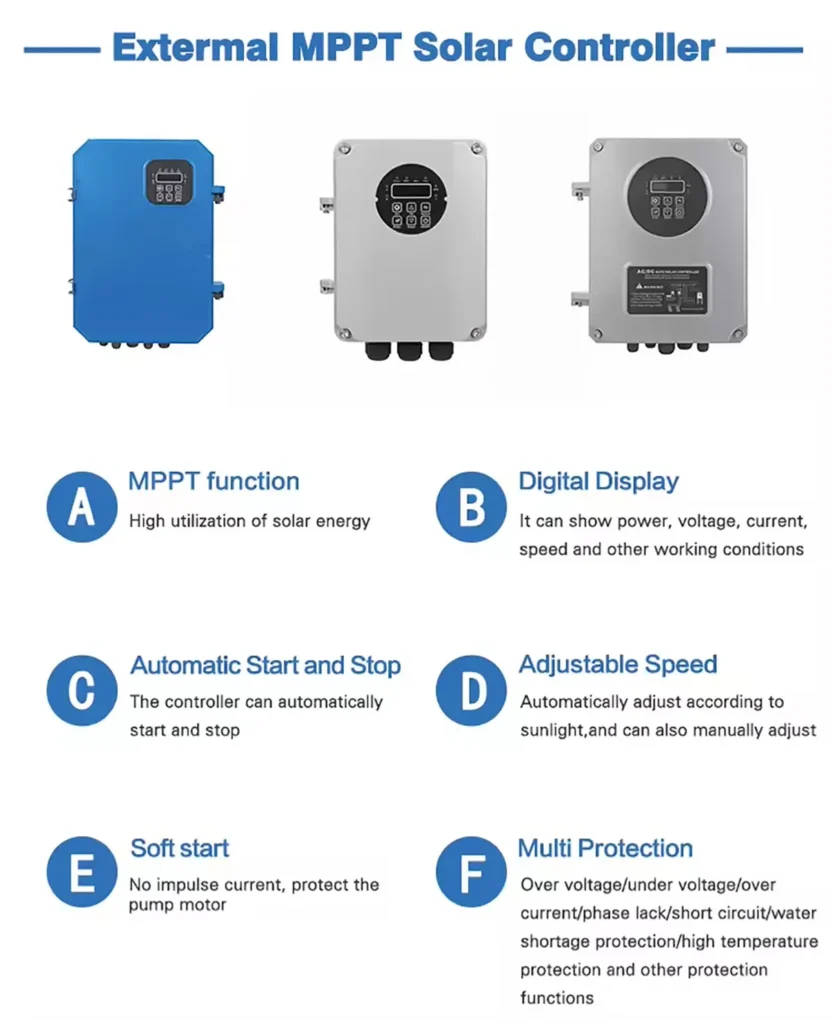
In many catalogs, “controller” and “inverter” are merged. In larger solar pump systems, a standalone controller handles water-level logic, comms, and IoT, while the inverter handles MPPT+drive.
Key Parameters
- Inputs: PV DC, battery (optional), gen, grid
- Sensors: tank-full float, well-low probe, flow meter
- Comms: RS485 / Modbus, optional LoRa/Wi-Fi
Jingong Advantage
- Dry-run + overflow dual logic, adjustable hysteresis
- Dust/heat housing (IP65, 50°C ambient rated for MENA)
- Cloud dashboard white-label for distributors
2.5 Ancillary Components – Stability Assurance
Battery Bank (Optional)
Not always needed—a solar pump system can run daylight-only. But for clinic/ school water or dairy, LiFePO4 1–2 day autonomy is common. Size: 1.2× daily pump kWh / DoD 0.8.
Water Pipes & Cabling
- HDPE PN16 for buried mains, UV-PVC above ground
- DC cabling: double-insulated, UV-stable, sized for <2% volt drop @ max current
Mounting Brackets
Hot-dip galvanized, tilt-adjustable, 150 km/h wind rating (coastal Africa spec).
Protection Devices
DC breakers, surge protector (Type 2, PV-side), fuse box. Non-negotiable for IEC compliance.
Sensors
Ultrasonic tank level > float (less maintenance). Well-probe: stainless dual-electrode.
How the Components Work Together – System Workflow
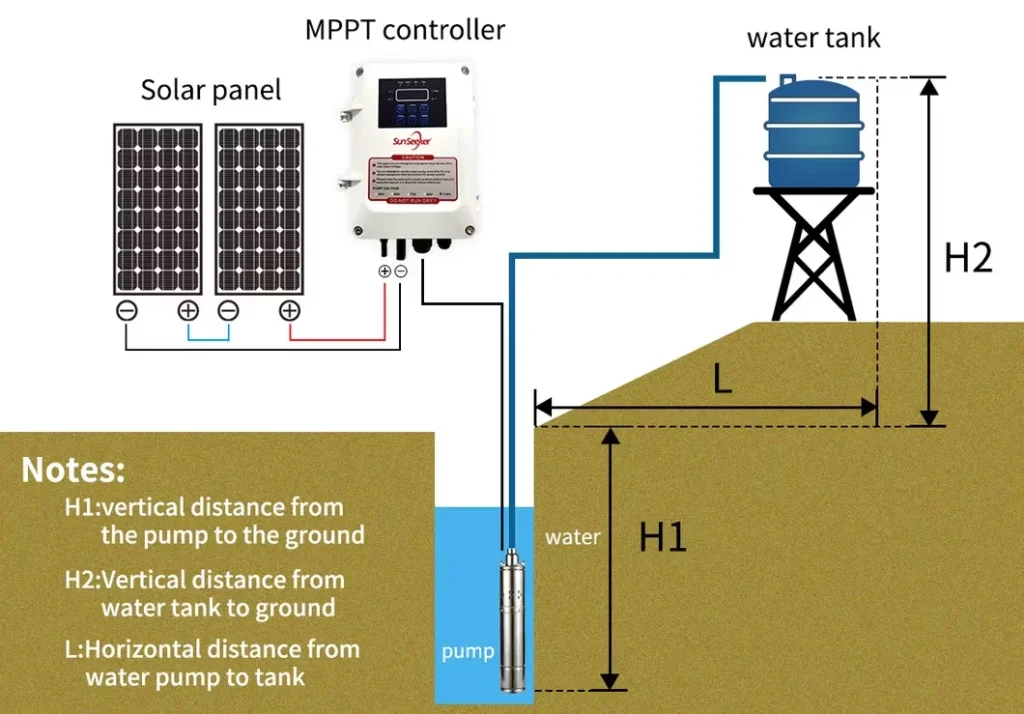
Simplified sequence in a solar pump system:
- Sunrise → PV array outputs rising DC
- Inverter MPPT locks to max-power point, converts to pump-drive waveform
- Controller checks well level + tank level → OK → release run command
- Pump spins, delivers Q@H through piping to reservoir / drip line
- Tank full or well low → controller throttles / stops inverter (dry-run prevention)
- Cloudy / night → hybrid genset auto-starts (if equipped), or system sleeps until dawn
Case note (Nigeria, 45 kW AC solar pump system, 180 m bore, 12 ha irrig): We upsized PV by 15% vs. PVsyst calc to cover Harmattan dust losses, and set dry-run at 18 Hz min instead of factory 20 Hz — yield improved 11% vs. neighbor site on same hardware.
Solar Pump System Component Selection Guide (By Scenario)
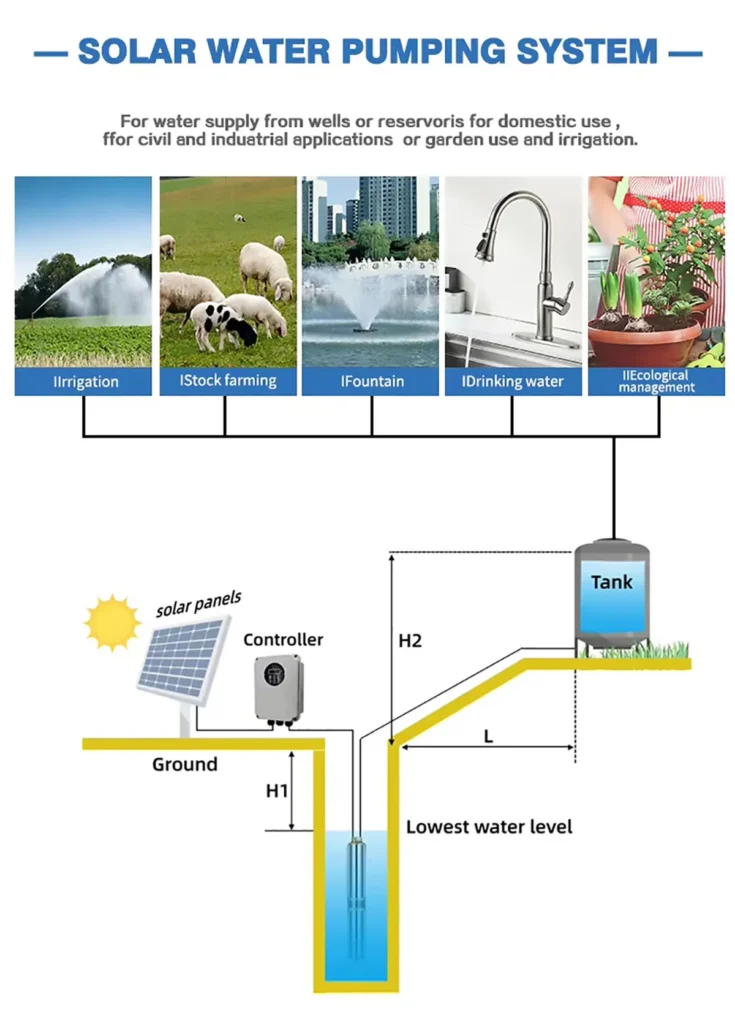
Selection Inputs
- Peak sun hours (PSH) – NOT just “sunny days”
- Dynamic head: static lift + friction loss + pressure at outlet
- Daily volume target (m³/day)
- Water chemistry (TDS, sand, pH)
- Local extremes: dust, salt, −5°C nights
Scenario Quick-Pick
| Scenario | PV | Pump | Inverter | Notes |
|---|---|---|---|---|
| Low-light (monsoon / high lat) | +20% oversize, bifacial | DC BLDC ≤3 kW | Ultra-low start MPPT | Consider battery buffer |
| Deep bore (>100 m) | High Voc string | Submersible, 4″–10″ | HV-input inverter | Ceramic sleeve mandatory |
| Large irrigation (>50 ha) | Central inverter 75 kW+ | AC multi-stage | Hybrid ready | Diesel bypass for clouds |
Jingong offers free sizing: send us PSH, static head, daily m³, water TDS — we return a component bill + yield sim in 24 h.
Quality Standards & Certifications – Built for Export Markets
- PV modules: IEC 61215, IEC 61730
- Inverters: IEC 61800, UL 1741 (select SKUs)
- Pumps: ISO 9001, CE, some models WRAS/ACS on request
- QC: 100% Hi-Pot + load test on pumps, flash test on panels
- Warranty: Panel 25 yr / Inverter 5 yr / Pump 18–24 mo
Common Faults & Maintenance by Component
- PV: Soiling (most common) → scheduled wash; hot-spot → IR cam check
- Inverter: E13 dry-run code → check sensor wiring; E07 overcurr → sand in pump?
- Pump: Sand wear → ceramic sleeve swap; cable splice failure → re-do gel+tape
- Controller: Float stuck → ultrasonic upgrade
Jingong overseas stock points (UAE, Nigeria, Thailand) carry fast-move spares: sensors, fuses, seal kits, MPPT boards.
Jingong Solar Pump System: Overseas Project Cases
- Nigeria, Kebbi State – 45 kW AC solar pump system, 12 ha rice irrigation, 180 m bore, running 3rd season
- Saudi Arabia, Najran – 7.5 kW DC + battery hybrid, remote bedouin village, 10 m³/day drinking
- Indonesia, Kalimantan – 22 kW AC surface pump, palm plantation drainage, retrofitted from diesel
FAQ – Solar Pump System Components
- What components are needed for a solar pump system in low-light areas?
- Oversized bifacial PV, ultra-low-start MPPT inverter, optionally LiFePO4 buffer, and a DC pump if ≤3 kW.
- How to choose PV array power for a solar borehole pump?
- Rule of thumb: Panel STC Wp ≈ Pump rated W × 1.3–1.5 (dust/temp loss), then validate via MPPT voltage band vs. bore depth.
- Certifications for EU export?
- CE + ISO 9001 baseline; panels need IEC 61215/61730; pumps may need WRAS/ACS if potable.
- Does Jingong provide overseas after-sales?
- Yes — remote diagnostics via GPRS dashboard, spare stock in UAE/Nigeria/Thailand, on-site partner engineers in 8 countries.
Conclusion & Next Steps
A solar pump system is a chain of interdependent components — PV, inverter, pump, controller, and the ancillaries that hold it together. At Jingong, we don’t just ship boxes; we size, simulate, and support. Whether you’re a distributor in Nairobi, an EPC in Riyadh, or a farmer in Java, the right component match determines whether your solar pump system runs 10 years or 10 months.
Contact Jingong’s solar pump team for a free sizing sheet, or explore our solar pump system series.