Written by Jingong Technology Engineering & Export Team | 15+ Years as a Leading Electric Water Pump manufacturer
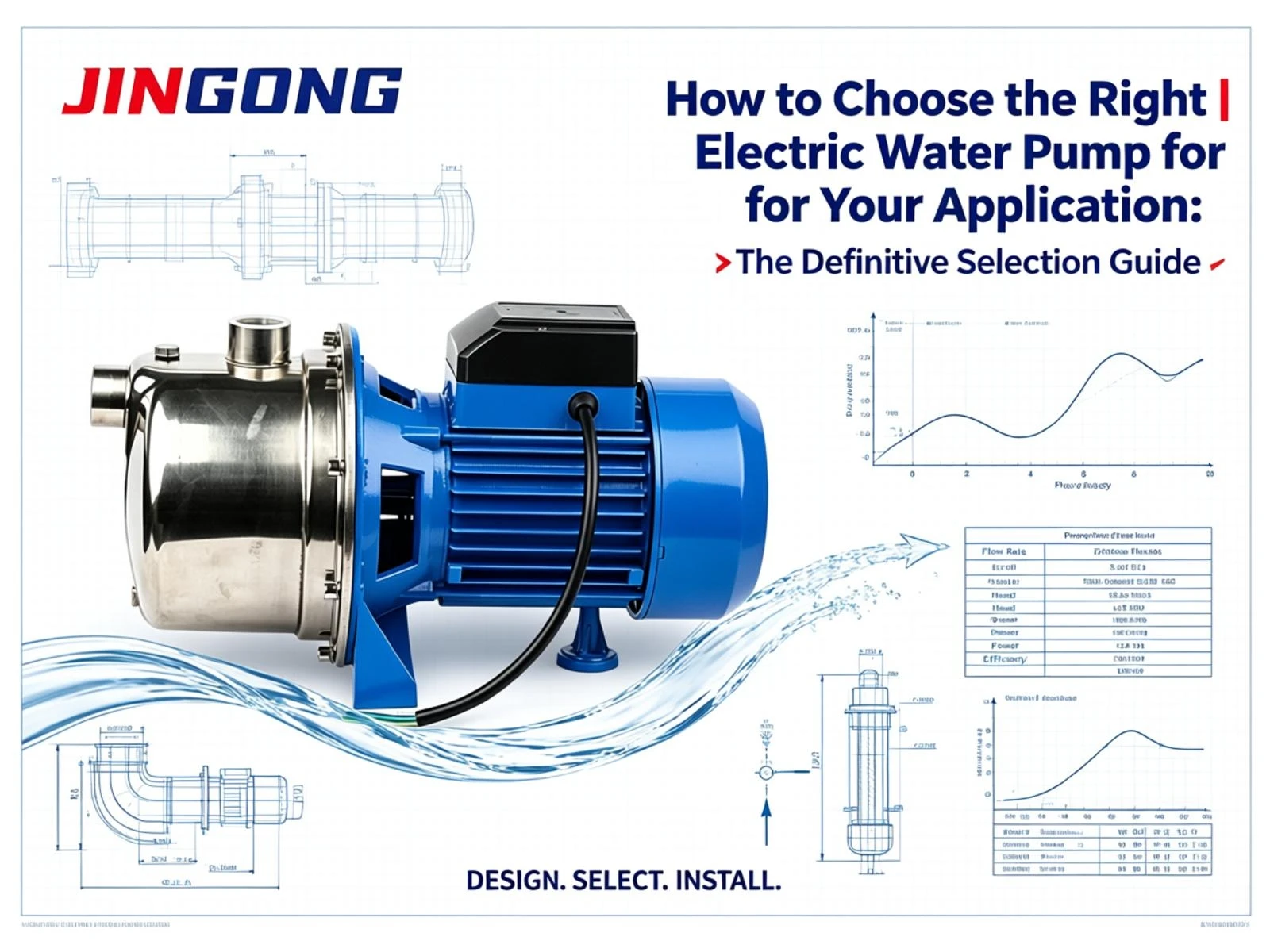
Selecting the wrong water pump costs overseas B2B buyers an average of 30–50% in wasted energy, premature equipment failure, and costly re-procurement. As a seasoned Electric Water Pump manufacturer, Jingong Technology has successfully deployed pumping solutions across 60+ countries in agriculture, municipal infrastructure, heavy industry, and residential sectors. This comprehensive guide distills over a decade of hands-on export engineering experience into a systematic, engineer-level framework. We cover the critical nuances of Submersible Pumps, Surface (Land) Pumps, Solar Pumps, and Gasoline/Diesel Pumps to ensure your next procurement decision is technically sound and commercially viable.
1. Why Proper Pump Selection Is Critical for Global Buyers
When sourcing from an Electric Water Pump manufacturer, the greatest financial risk is rarely the unit price—it is the catastrophic mismatch of the duty point. Specifying a pump based solely on “horsepower” or “price” invariably leads to performance gaps. Two pumps with identical power ratings can exhibit vastly different performance curves, impeller geometries, and maximum head capabilities depending on their hydraulic design.
Throughout our tenure as a dedicated Electric Water Pump manufacturer, Jingong’s technical team has identified recurring pain points among international clients:
| Common Selection Error | Operational Consequence | Financial Impact |
|---|---|---|
| Undersized Flow / Head | Insufficient pressure, slow irrigation cycles | Crop yield loss, mandatory re-order |
| Oversized Pump Capacity | Rapid cycling, excessive energy consumption | 30–50% increase in OpEx (Energy) |
| Power Source Mismatch | Incompatibility with local grid / off-grid sites | Total asset replacement cost |
| Ignored Water Quality | Mechanical seal failure, impeller abrasion | Lifespan reduction by 2–3x |
| Incorrect Material Selection | Corrosion in saline or chemical-rich environments | Environmental penalties, downtime |
A reputable Electric Water Pump manufacturer does not merely sell hardware; they engineer the duty point in collaboration with the client. This guide provides the exact technical methodology Jingong applies to every export order to mitigate these risks.
2. Basic Classification & Working Principles of Water Pumps
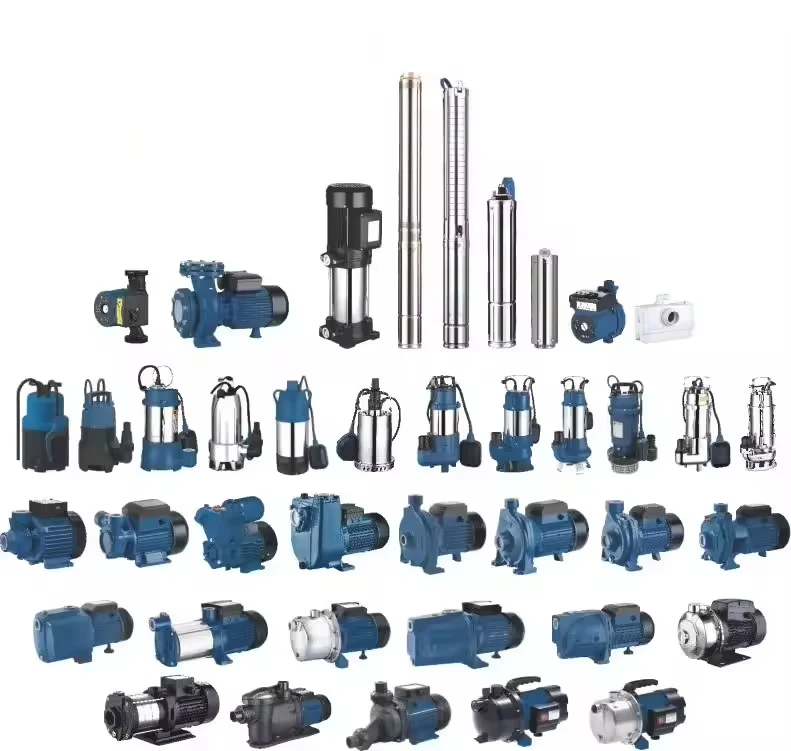
Every globally recognized Electric Water Pump manufacturer structures its catalog around four fundamental categories defined by drive mechanism and installation location. Mastery of these distinctions is the prerequisite for all subsequent technical selection.
2.1 Submersible Water Pump
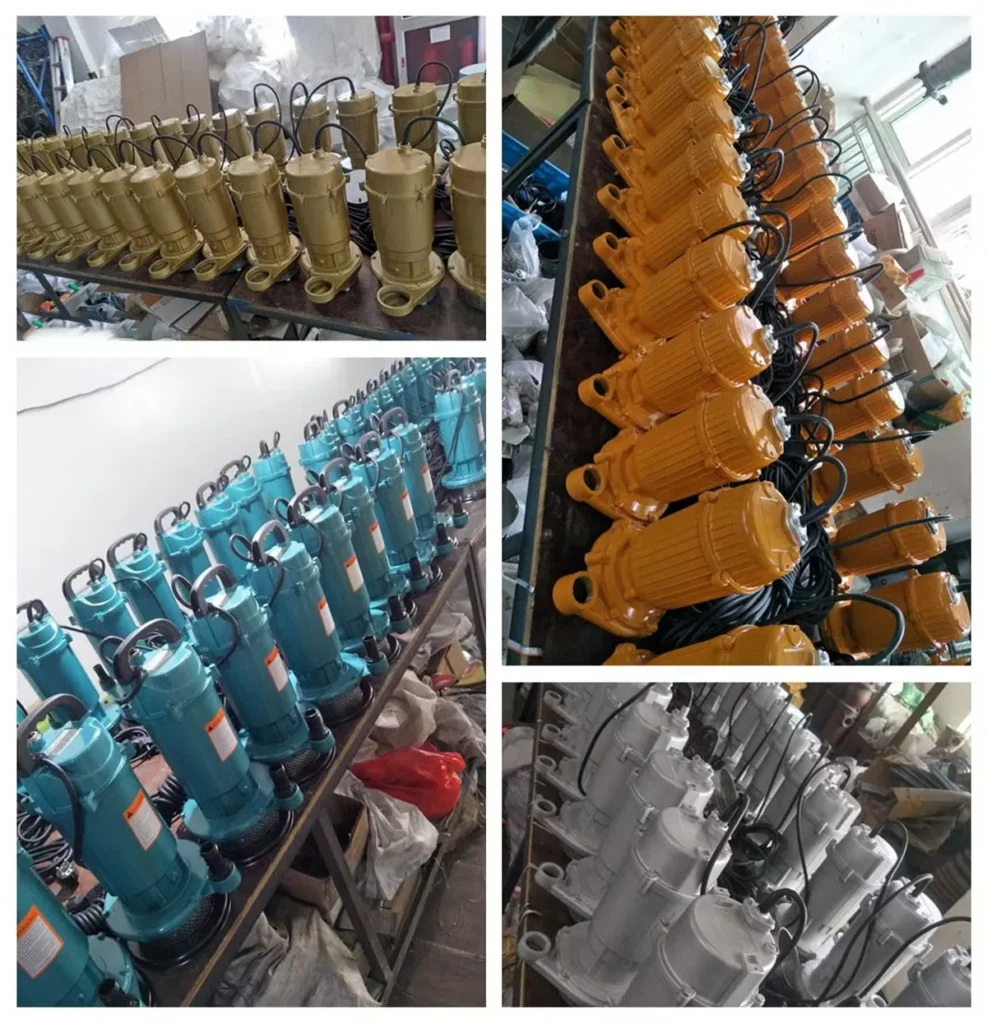
A submersible pump operates entirely underwater, with the pump casing and motor fully submerged below the hydraulic level. It functions by pushing water upward through a discharge riser pipe rather than relying on atmospheric pressure to suck water. This design is essential for deep wells, boreholes, and underground reservoirs where the water table exceeds 10–15 meters.
- Operating Principle: A hermetically sealed motor coupled with a multi-stage diffuser/impeller assembly. Water enters via a bottom intake screen, receives kinetic energy from the rotating impeller, and is pressurized sequentially through stages before exiting via the discharge column.
- Core Advantages: No suction lift limitations (theoretical max ~10.3m), near-silent operation due to water insulation, self-priming capability, and efficient motor cooling via ambient water.
- Technical Limitations: Requires specialized lifting equipment for inspection; absolute reliance on high-grade cable sealing (potting); generally lower cost-efficiency for shallow water sources (<10m depth).
👉 Explore Jingong Submersible Pump Series → Engineered by a specialist Electric Water Pump manufacturer with IP68 ingress protection and IE3+ motor efficiency standards.
2.2 Surface / Land Water Pump

Surface pumps are installed above the water level. They utilize a connected suction pipe to draw water from an open source such as a pond, lake, river, or shallow well. It is crucial to understand that practical suction lift is always less than the theoretical 10.3-meter atmospheric limit; factors like high altitude, elevated water temperature, and lengthy suction lines significantly reduce this capacity.
- Ideal Applications: Open wells, surface water transfer, tank filling, garden irrigation, and domestic boosting where the water source is less than 7–9 meters vertically below the pump.
- Key Variants: End-suction centrifugal pumps, self-priming pumps (with integrated ejectors), multistage boosters, and jet pumps.
- Engineering Imperative: Maintain a short, airtight suction line with adequate diameter (minimizing velocity) to prevent NPSH (Net Positive Suction Head) issues and cavitation.
👉 Explore Jingong Surface & Booster Pump Series →
2.3 Solar Water Pump

Solar pumps convert photovoltaic (PV) electrical energy directly into hydraulic energy. They are categorized along two axes: (A) Submersible vs. Surface (installation depth); (B) DC vs. AC (motor configuration). DC-powered solar pumps typically achieve 20–40% higher system efficiency than AC counterparts because they eliminate inverter conversion losses, utilizing raw DC output from the PV array.
- Operating Principle: PV Array → MPPT (Maximum Power Point Tracking) Solar Controller → DC/AC Motor Pump Set. Direct operation during daylight hours requires no battery storage.
- Sustainability Advantage: Zero fuel expenditure, zero operational carbon emissions, autonomous off-grid functionality, and a design lifespan of 7–10 years under standard operating conditions.
- Hybrid Capability: Advanced solar pump controllers allow automatic switching to grid AC or diesel generators during low irradiance or nighttime, offering redundancy expected from a top-tier Electric Water Pump manufacturer.
👉 Explore Jingong AC/DC Hybrid Solar Pump Series →
2.4 Gasoline & Diesel Water Pump
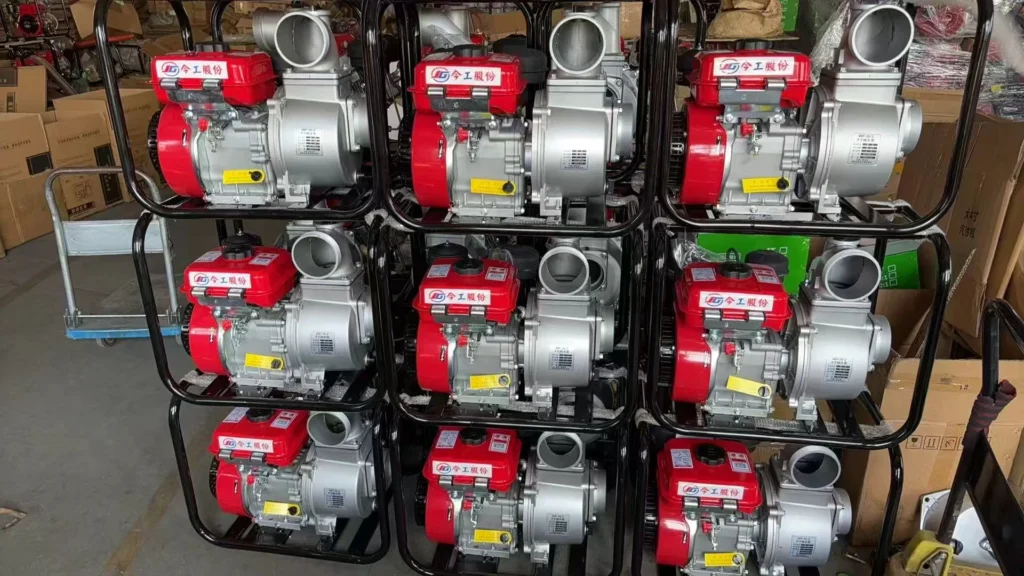
Fuel-driven pumps decouple water conveyance from electrical grid dependency. Gasoline pumps offer portability, low noise profiles, and economic pricing—ideal for residential irrigation, small-scale farming, and light construction dewatering. Diesel pumps deliver superior power density and durability, designed for prolonged, high-flow operations: large-scale center-pivot irrigation, mining dewatering, municipal water supply, fire suppression backup, and emergency flood control.
- Gasoline Characteristics: Lower CAPEX, lightweight chassis, quieter operation, simplified recoil/electric start; optimal for intermittent, mobile duty cycles.
- Diesel Characteristics: Enhanced fuel efficiency under load, 24/7 operational endurance, robust construction capable of passing spherical solids up to 76 mm (3 inches) in dedicated trash pump models; indispensable for industrial and emergency scenarios.
👉 Explore Jingong Gasoline & Diesel Engine Pump Series →
| Pump Category | Prime Mover | Max Depth / Suction | Typical Flow Range |
|---|---|---|---|
| Submersible | Electric AC/DC | Up to 300m+ (Borewell) | Medium–High (1–500 m³/h) |
| Surface/Land | Electric AC | ≤ 7–10m (Suction Lift) | High (1–1200 m³/h) |
| Solar | PV Array (DC/AC) | Surface to 150m+ Submersible | Variable (Irradiance Dependent) |
| Gasoline | Internal Combustion | Self-Priming ≤ 8m | Medium (1–80 m³/h) |
| Diesel | Internal Combustion | Trailer Mounted, Solids up to 76mm | Very High (10–1500 m³/h) |
3. Core Selection Criteria — Engineer-Level Framework

Any Electric Water Pump manufacturer engaged in international exports adheres to a rigorous six-parameter engineering discipline. Proficiency in these criteria ensures you procure equipment optimized for performance and longevity.
3.1 Flow Rate (Q) & Head (H) — The Non-Negotiable Parameters
Flow (Q) quantifies the volume of fluid moved per unit time (m³/h, L/s, or GPM). Head (H) measures the energy imparted by the pump to the fluid, expressed in meters (or feet). These variables share an inverse relationship: as head increases, flow decreases. The intersection of your required Q and Total Dynamic Head (TDH) on the pump performance curve defines the duty point.
Total Dynamic Head (TDH) Calculation Formula:
• Hstatic = Vertical distance from source water level to highest discharge point.
• Hpressure = Required residual pressure at discharge (1 bar ≈ 10.2 m head; 1 PSI ≈ 0.703 m).
• Hfriction = Sum of losses in piping, elbows, valves, filters, and end-use equipment.
Practical Case Study (Residential Booster): A domestic system drawing from a ground tank (1m below pump) to supply a rooftop shower (9m above pump) presents a static head of ~10m. If the shower requires 2.5 bar pressure (~25.5m head) and friction losses approximate 3m, the TDH ≈ 38.5m. Applying a 15% safety margin yields a specification target of ~44m head at the desired flow rate.
When requesting a quotation from any Electric Water Pump manufacturer, provide the following data with precision:
- Required Flow (m³/h or GPM) + 10% margin (or +25% if estimated).
- Total Dynamic Head (m) + 10–15% margin.
- Pipe Diameter, Total Length, and Major Fittings count.
- Source Water Level (Static & Dynamic/Pumped down).
- Destination Pressure Requirements.
| Parameter | Unit | Typical Residential | Typical Agricultural | Typical Industrial |
|---|---|---|---|---|
| Flow (Q) | m³/h | 1 – 5 | 10 – 200 | 50 – 1000+ |
| Head (H) | m | 20 – 50 | 30 – 150 | 10 – 1000 |
| Power | kW | 0.37 – 1.5 | 2.2 – 45 | 7.5 – 250 |
| NPSHr | m | 2.0 – 4.0 | 2.5 – 6.0 | 3.0 – 10.0 |
3.2 Working Environment & Site Conditions
- Installation Context: Underwater (submersible) vs. On-Land (surface). If water depth > 10–15m → Submersible. If < 10m and source is open → Surface. This heuristic resolves ~70% of inquiries for any Electric Water Pump manufacturer.
- Thermal Limits: Standard pumps tolerate fluids up to 40°C. High-temperature variants (essential for Middle East markets) necessitate specialized mechanical seals, F-class insulation, and high-temp grease.
- Fluid Characteristics: Clean Water → Standard Bronze/SS Impellers. Sandy Water → Tungsten Carbide mechanical seals. Sewage/Solids → Vortex or Non-Clog impellers with passage ≥ 70mm.
- NPSH (Net Positive Suction Head): Available NPSH (NPSHa) must exceed Required NPSH (NPSHr) by at least 0.5–1.0m to preclude cavitation. This is the primary latent cause of pump failure in tropical, high-altitude, or high-temperature environments.
3.3 Power Supply & Energy Architecture
| Power Source | Optimal Scenario | System Efficiency | Technical Notes |
|---|---|---|---|
| Grid Electric (AC) | Stable Grid, Permanent Install | High (IE3/IE4 Motors) | EU ErP Directive mandates IE3+ for most ratings. |
| Solar DC | Off-grid, High Irradiance | 20–40% > AC Solar | Eliminates inverter losses; no batteries needed for diurnal use. |
| Solar AC / Hybrid | Off-grid + Grid Redundancy | High | Auto-switching controllers ensure 24/7 supply. |
| Gasoline | Portable, Emergency, Light Duty | Medium | Lower CAPEX; requires fuel logistics. |
| Diesel | High Power, 24/7, Disaster Response | Medium-High | Handles solids up to 76mm; robust for harsh sites. |
3.4 Application Specifics
Whether for Agricultural Irrigation, Industrial Drainage & Sewage, Residential Boosters, Emergency Flood Control, Off-Grid Remote Supply, or Commercial Project Water Supply, the application dictates the hydraulic and material specification. Detailed mapping follows in Section 4.
3.5 Lifecycle Energy & Maintenance Costs
Energy consumption constitutes 85–95% of a pump’s Total Cost of Ownership (TCO). High-efficiency pumps equipped with IE3/IE4 motors and optimized hydraulics typically amortize their price premium within 12 months through energy savings alone. As an export-focused Electric Water Pump manufacturer, Jingong complies rigorously with the EU Ecodesign (ErP) Directive (EU) No 547/2012, ensuring our rotary pumps meet stringent Minimum Efficiency Index (MEI) thresholds.
3.6 Regulatory Compliance & Durability Standards
A qualified Electric Water Pump manufacturer must furnish region-specific compliance documentation. Jingong maintains the following certification matrix for global exports:
| Target Market | Key Certifications | Governing Standards |
|---|---|---|
| European Union | CE (MD, LVD, EMC, ErP), EN 60335-2-41, EN ISO 9906, EN 16480 | MD 2006/42/EC, LVD 2014/35/EU, EMC 2014/30/EU, ErP (EU) 547/2012 |
| North America | UL 778, UL 1081, CSA C22.2 No. 108, NSF/ANSI 61 (Potable Water) | UL 778 6th Ed., NSF/ANSI/CAN 50 & 61 |
| India / South Asia | BIS (Solar Pumps), IS 17018 (Part 1):2022 | IS 17018, IEC 61215, IEC 61730 |
| Global / General | ISO 9001, ISO 14001, IEC 60335-1, EN ISO 9906 | ISO 9906 Performance Grades 1/2/3 |
During vendor due diligence, insist on test reports from accredited third-party laboratories (e.g., UL Solutions, TÜV SÜD, SGS). A transparent Electric Water Pump manufacturer will provide these documents proactively.
4. Pump Type Selection by Application Scenario

This section maps specific use cases directly to Jingong’s product families. As your strategic Electric Water Pump manufacturer, we have engineered each series to excel in distinct operational theaters:
4.1 Agricultural Irrigation → Solar Pump / Submersible Pump
For agricultural operations in sun-rich but grid-deficient regions, solar submersible or solar surface pumps represent the optimal capital investment. A 0.75–7.5 kW PV system (conforming to IS 17018 standards) can effectively irrigate 2–20 hectares contingent on hydraulic head. Conversely, for grid-tied farms utilizing deep borewells, electric submersible pumps featuring IE3 motors deliver the lowest Levelized Cost of Water (LCOW).
4.2 Industrial Drainage & Sewage → Heavy-Duty Submersible / Land Surface Pump
Industrial effluent management, construction site dewatering, and municipal stormwater removal demand pumps equipped with non-clog impellers (minimum 70mm free passage), IP68-rated motor enclosures, and F-class thermal insulation. Jingong’s industrial submersible series handles suspended solids up to 76mm—matching the specifications of our trailer-mounted diesel pumps utilized in flood mitigation.
4.3 Residential & Domestic Water Supply → Small Electric Land Pump / Domestic Submersible
Single-family homes, villas, and low-rise apartments typically require flow rates of 1–5 m³/h against heads of 20–50 meters. A variable-frequency drive (VFD) equipped booster surface pump or a shallow-well submersible ensures constant pressure regulation. Integrating an IE4 motor minimizes long-term energy expenditure.
4.4 Off-Grid & Remote Area Water Supply → Solar Pump / Gasoline Diesel Pump
Remote villages, nomadic pastoral camps, and island installations lack reliable grid infrastructure. Solar AC/DC hybrid pumps harness daylight for zero-cost operation and seamlessly transition to battery storage or diesel generators nocturnally. In scenarios with negligible solar irradiance, gasoline pumps provide immediate, portable water access.
4.5 Emergency Flood Drainage → Gasoline/Diesel Pump / High-Power Submersible
Disaster response necessitates high-volume water evacuation within minutes. Trailer-mounted diesel pumps, rated up to 1000 m³/h at 20m head, are integral assets for municipal emergency services across flood-prone Southeast Asia. Self-priming gasoline pumps address smaller-scale basement or facility dewatering requirements.
4.6 Commercial Project Water Supply → High-Flow Land Pump / Industrial Solar Pump
Hotels, resorts, commercial complexes, and controlled-environment agriculture (greenhouses) demand high-flow, continuous-duty pumping systems. Multistage centrifugal land pumps paired with IE4 motors reliably deliver 50–350 m³/h. Coupling these systems with on-site photovoltaic arrays can offset 60–80% of energy consumption in high-irradiance geographies.
📌 Jingong Engineering Quick-Select Rule: If your water source lies deeper than 10–15 meters vertically → select a Submersible Pump. If the water level is within 10 meters of the pump datum and the source is open (pond, river, shallow well) → select a Surface/Land Pump. This empirical rule, utilized by every veteran Electric Water Pump manufacturer, resolves 70% of selection ambiguity instantly.
5. Four Core Product Series — Comparative Advantage Matrix
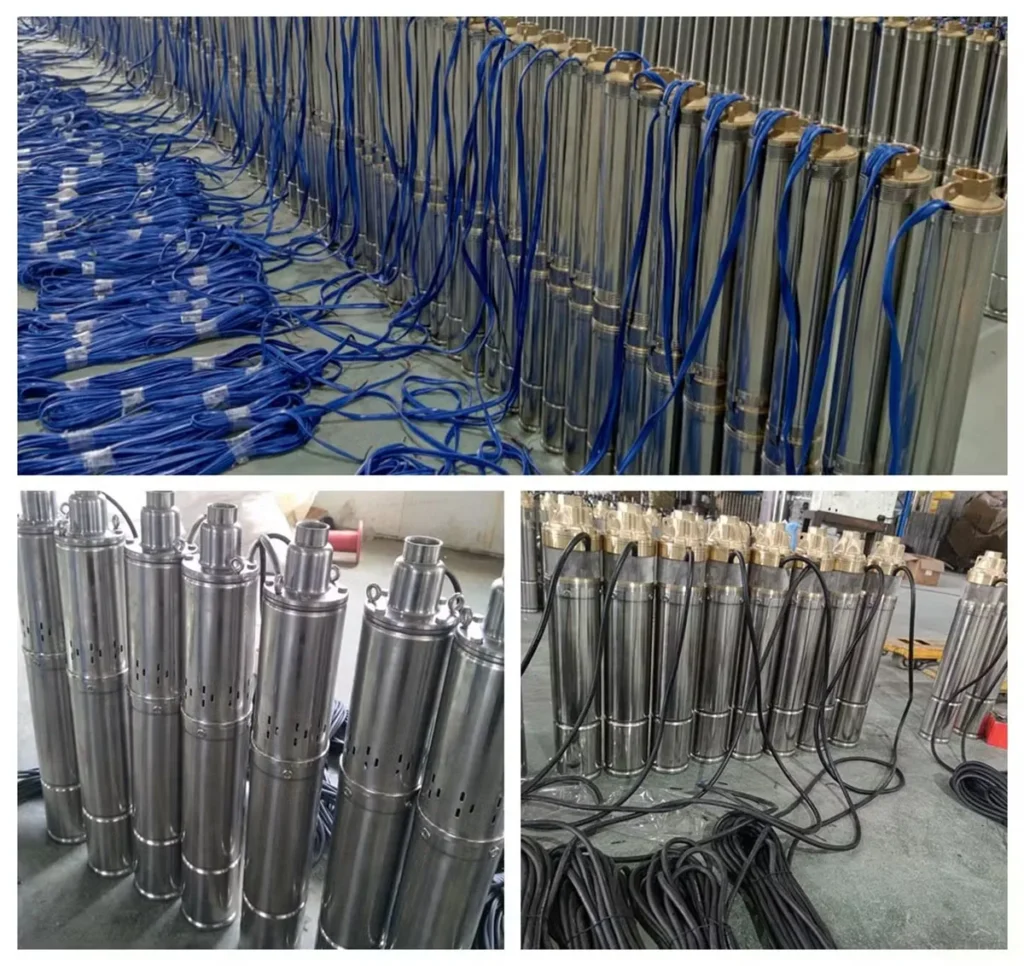
Jingong Technology, functioning as a vertically integrated Electric Water Pump manufacturer, produces all four core families within a single ISO-certified facility. This integration guarantees consistent metallurgical quality, unified warranty protocols, and cross-series component compatibility.
| Evaluation Dimension | Submersible Pumps | Surface/Land Pumps | Solar Pumps | Gasoline/Diesel Pumps |
|---|---|---|---|---|
| Primary Environment | Deep Wells, Boreholes, Underground Tanks | Open Wells, Ponds, Rivers, Boosting | Off-grid, High Solar Irradiance Regions | No Grid Access, Emergency, Remote Sites |
| Operational Energy Cost | Low (Grid) / Zero (Solar) | Low–Medium | Zero Fuel, Zero Electricity | Medium (Ongoing Fuel Expense) |
| Installation Complexity | Moderate (Requires Lowering/Rigging) | Easy (Above-Ground) | Moderate (PV Array + Controller) | Very Easy (Portable/Framed) |
| Design Service Life | 7–15 Years (Sealed Motor) | 8–12 Years | 7–10 Years (PV 25+ Years) | 5–8 Years (Engine Rebuild Cycles) |
| Application Spectrum | Domestic, Agricultural, Industrial Deep Wells | Boosting, Irrigation, Transfer, Circulation | Off-grid Irrigation, Livestock, Community Supply | Emergency, Flood Control, Construction, Agri |
| Capital Expenditure (CAPEX) | Medium–High | Low–Medium | High (Includes PV Infrastructure) | Low–Medium |
| Target Geographies | Global (Deep Water Tables) | Global (Clean Water Transfer) | Africa, MENA, South Asia, Latin America | Disaster Zones, Off-grid, Industrial Sites |
Selecting the appropriate Electric Water Pump manufacturer entails partnering with an entity capable of delivering all four families under uniform engineering rigor. Jingong fulfills this role as your integrated Electric Water Pump manufacturer.
6. Common Selection Mistakes & Professional Mitigation Strategies

Drawing from extensive field data accumulated as an export-oriented Electric Water Pump manufacturer, Jingong’s engineering task force has codified the top five errors precipitating premature pump failure in overseas deployments:
❌ Mistake #1: Disregarding Actual Head Loss and Flow Attenuation
Procurement officers frequently specify pumps using only static head, neglecting friction losses accrued from elongated pipe runs, elbows, valves, and filtration media. Friction can constitute 20–50% of total head. Always compute TDH = Static Head + Pressure Head + Friction Losses. Failure to do so is the #1 cause of “low flow” complaints.
❌ Mistake #2: Power Supply and Pump Type Mismatch
A European-standard 230V/50Hz pump deployed in a 220V/60Hz North American environment will incur insulation breakdown and bearing failure within weeks. Voltage, frequency, and phase sequence must align precisely. A diligent Electric Water Pump manufacturer verifies these parameters on every export invoice.
❌ Mistake #3: Blindly Pursuing High Power Without Hydraulic Matching
The “bigger is better” fallacy is particularly destructive in fluid dynamics. An oversized pump operating far to the left of its Best Efficiency Point (BEP) induces recirculation, vibration, overheating, and cavitation. Optimal efficiency resides within 80–110% of BEP. A correctly sized unit from a competent Electric Water Pump manufacturer outperforms an oversized counterpart by 20–40% in reliability metrics.
❌ Mistake #4: Neglecting Fluid Chemistry and Solids Handling
Deploying a standard cast iron pump in brackish or saline environments accelerates electrochemical corrosion. Utilizing a clear-water pump in sandy borewells destroys mechanical seals and abrades impellers within months. Specify SS304/SS316 construction or ceramic coatings for corrosive/high-solids environments.
❌ Mistake #5: Overlooking Regional Maintenance Ecosystems
Failing to consider local spare parts availability, voltage fluctuation tolerance (common in South Asia/Africa), and climatic extremes (tropical humidity vs. desert aridity) compromises uptime. Partner with an Electric Water Pump manufacturer offering global technical support and regionally adapted designs.
7. Global Regional Adaptability Guide (Export Specialization)

This module represents proprietary intelligence developed by Jingong as a globally deployed Electric Water Pump manufacturer. It addresses nuanced regional challenges often omitted in generic supplier literature:
7.1 Southeast Asia — Monsoon Resilience & Thermal Management
In response to protracted monsoon seasons and frequent pluvial flooding, we reinforce submersible pump sealing interfaces and optimize diesel pump trailer mobility. For tropical heat, motors incorporate F-class insulation and high-temperature lithium-complex grease to prevent bearing seizure.
7.2 Africa — Off-Grid Solar Irrigation & Robustness
To address vast off-grid agricultural expanses, we engineered high-reliance DC solar submersible series featuring advanced MPPT algorithms ensuring stable operation despite fluctuating irradiance. Reinforced stainless steel shafts and sand slingers protect against abrasive well conditions prevalent across the Sahel and Sub-Saharan regions.
7.3 Middle East — Extreme Heat & Abrasion Resistance
Confronting ambient temperatures exceeding 50°C and pervasive airborne silica, our motors employ specialized cooling shrouds and IP68 protection. Bearings are packed with high-temperature synthetic grease, and impellers utilize wear-resistant alloys to extend service intervals in desalination pre-treatment and district cooling applications.
7.4 Europe — Energy Efficiency & Regulatory Compliance
Aligning with stringent EU Ecodesign (ErP) mandates, Jingong upgraded entire production lines to IE4 Super Premium Efficiency motors. All wetted components comply with RoHS and REACH regulations regarding hazardous substance restrictions. Full technical files supporting CE marking (Machinery, Low Voltage, EMC Directives) are furnished with every shipment.
7.5 Americas — Agricultural Scale & Voltage Tolerance
For North American center-pivot irrigation systems, we developed high-flow turbine and multistage pumps compliant with NEMA standards. Addressing South America’s erratic grid stability, motor windings are designed for wide voltage tolerance (e.g., 220V–440V) and incorporate surge suppression technology.
8. Frequently Asked Questions (FAQ)
Curated from thousands of technical consultations handled by Jingong’s Electric Water Pump manufacturer support desk:
Q1: Which is better, a submersible pump or a surface pump?
A: The determinant is source depth. If the water level is deeper than 10–15 meters, a submersible pump is mandatory. If the water is within 10 meters and sourced from an open body (pond/river), a surface pump is more economical and accessible for maintenance. Submersibles are silent and frost-protected; surface pumps are easier to service but limited by suction lift physics.
Q2: Are solar water pumps a worthwhile investment?
A: For off-grid applications, unequivocally yes. While initial CAPEX is higher, the Levelized Cost of Water (LCOW) over a 10-year lifecycle is typically 60–80% lower than diesel alternatives. In high-irradiance regions (Africa, MENA), ROI periods of 2–4 years are common. As your dedicated Electric Water Pump manufacturer, we provide TCO modeling to justify the investment.
Q3: What size water pump do I need for my irrigation system?
A: You require the aggregate flow rate of your emitters (GPM or m³/h) and the dynamic head at the furthest/uppermost emitter. Provide us with your plot size, crop type, irrigation method (drip/sprinkler), and pipe layout. Our engineers will perform a complimentary hydraulic calculation.
Q4: Can diesel water pumps operate in high-temperature environments?
A: Yes. Jingong diesel pumps integrate reinforced cooling fins, high-flow radiators, and thermostatically controlled fans. For sustained operations above 50°C, we recommend derating the engine by 10–15% and utilizing high-viscosity index lubricants to maintain oil film strength.
Q5: What is the typical lifespan of electric water pumps?
A: With correct sizing and maintenance, Jingong electric pumps offer a design life of 8–12 years. Premium bearings typically endure 20,000–30,000 hours of operation. Proactive replacement of mechanical seals (every 2–3 years) and oil changes (for oil-filled motors) significantly extends service life.
Q6: Why is my new pump delivering low flow?
A: Common causes include: Air leaks in the suction line (loss of prime), clogged inlet strainers, excessive suction lift beyond NPSHa limits, or incorrect voltage (low voltage reduces RPM and thus flow). Verify TDH calculations and ensure the pump operates near its BEP.
9. Conclusion & Free Engineering Consultation
Optimal pump selection transcends mere parameter matching; it is a holistic evaluation of Total Cost of Ownership (TCO), environmental resilience, and after-sales support viability. Jingong Technology, leveraging 10+ years as a premier Electric Water Pump manufacturer, is committed to delivering not just hardware, but validated hydraulic solutions tailored to your geopolitical and operational context.
If uncertainties persist regarding your selection, or if you require a bespoke solution for complex projects, our engineering consortium is at your disposal:
Request Your Free Hydraulic Assessment
Submit your site parameters (Flow, Head, Water Chemistry, Voltage) via email or initiate a live consultation.
Our Service Level Commitment: All technical inquiries receive a comprehensive response from a Senior Applications Engineer within 24 business hours.

0 Comments