
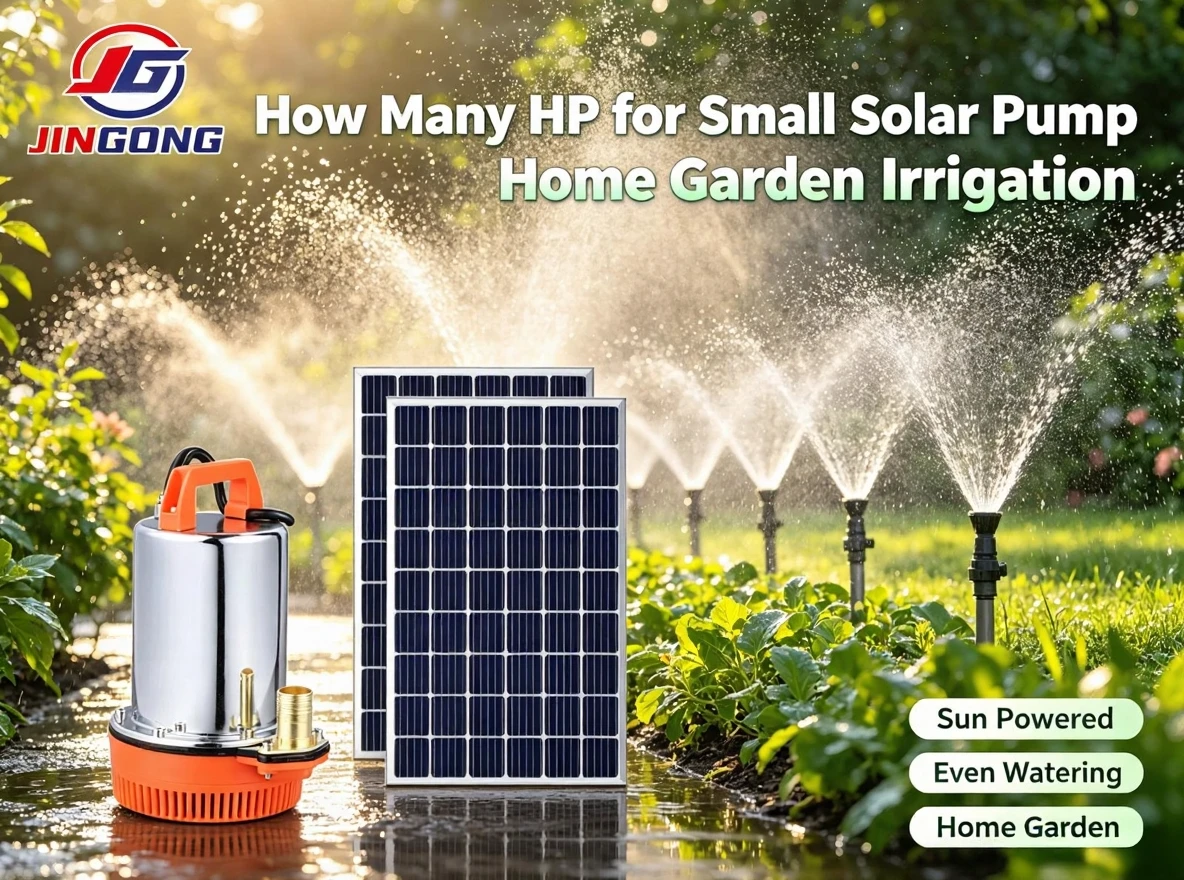
How Many HP for Small Solar Pump Home Garden Irrigation? The Complete 2026 Sizing Guide from a Trusted Solar Pump Home Garden Irrigation Manufacturer
Choosing the wrong horsepower for your backyard irrigation is the #1 reason overseas home gardeners complain about “not enough water pressure,” “solar panel overload,” or “pump burning out too soon.” As a professional Solar Pump Home Garden Irrigation manufacturer, JINGONG Technology has shipped thousands of submersible pumps, surface pumps, solar pumps, and gasoline/diesel pumps to residential customers across Europe, North America, Africa, and Southeast Asia. In this guide, we answer the exact question every gardener asks: “How many HP does my small solar pump for home garden irrigation actually need?” — and we back it with standardized sizing charts, real-world solar matching formulas, and a category-by-category comparison of all four pump types we produce.
📌 Quick Answer: For most home gardens (50-200㎡), a 0.5 HP solar pump is the sweet spot. Small balconies & potted plants need only 0.1-0.3 HP, while large yards (200㎡+) with deep wells require 0.75-1 HP. As your dedicated Solar Pump Home Garden Irrigation manufacturer, we always match HP to area, head height, water source, and solar panel capacity — never HP alone.
1. What Does “HP” Mean for a Irrigation Solar Pump? (Basic Knowledge)
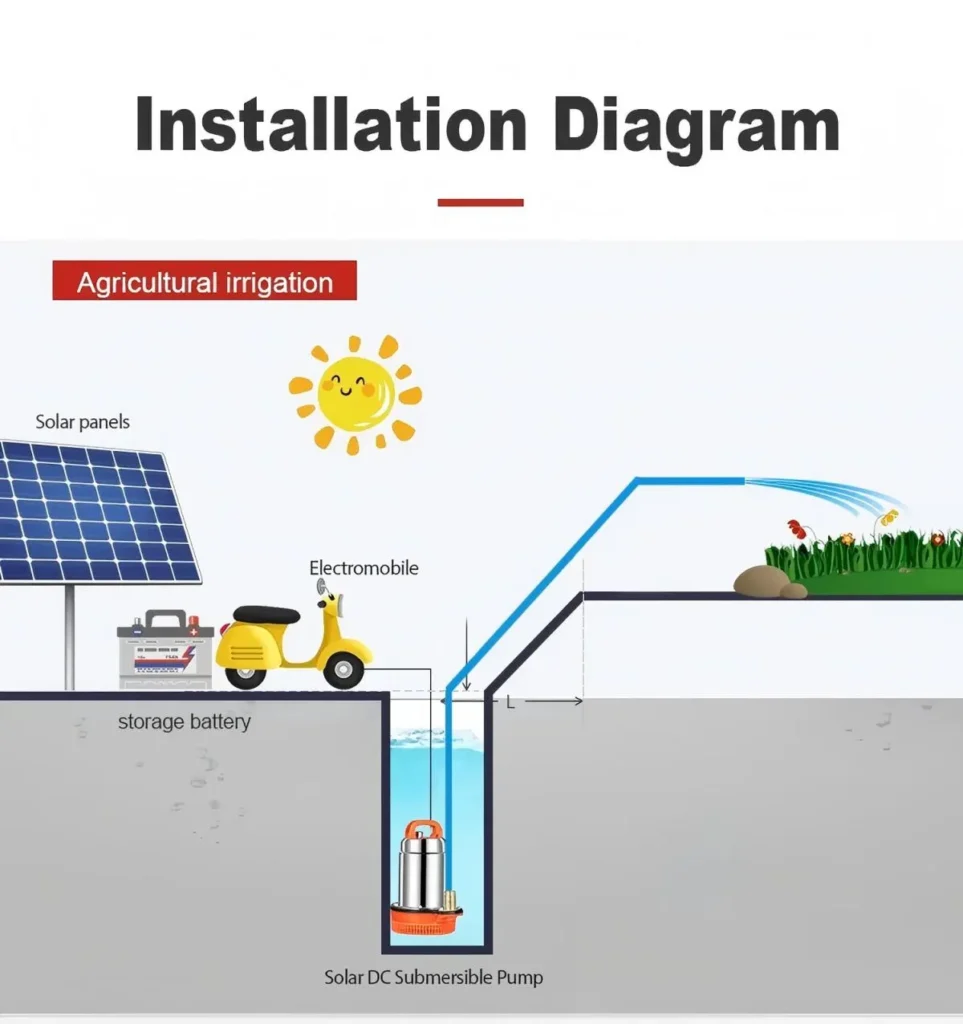
HP (horsepower) measures the mechanical power output of a pump motor. But here is what most overseas buyers — and even some resellers — get wrong: 1 HP ≠ exactly 746 watts of solar panel. The standard conversion is 1 HP = 745.7 W of mechanical output, but a real pump’s electrical consumption is higher due to a “service factor” (typically 1.4-1.5). A 1 HP pump may actually draw ~1,100 W, and some models up to 2,100 W. This is why a credible Home Garden Irrigation Solar Pump manufacturer never sizes solar panels based on HP alone.
1.1 HP to Watt Conversion Table (Industry Standard)
| Pump Rated HP | Mechanical Watts (HP × 745.7) | Actual Electrical Draw (with service factor) | Required Solar Panel Power |
|---|---|---|---|
| 0.1 HP (micro) | ~75 W | ~110 W | 15-25 W panel |
| 0.25 HP | ~186 W | ~260 W | 300-400 W panel |
| 0.5 HP | ~373 W | ~520 W | 600-800 W panel |
| 0.75 HP | ~559 W | ~780 W | 900-1,000 W panel |
| 1 HP | ~746 W | ~1,100 W | 800-1,200 W panel (3 × 400W) |
Source: Industry-standard conversion 1 HP = 745.7 W; actual electrical draw and solar panel requirements are based on typical DC solar pump efficiency data. A responsible Solar Pump Home Garden Irrigation manufacturer will always recommend adding a 20% buffer to the solar array to account for heat, dust, wiring loss, and controller inefficiency.
Common misconception corrected: “Bigger HP = better irrigation.” Wrong. Oversizing HP for a small garden wastes solar panel money, causes the pump to cycle on/off rapidly (shortening lifespan), and may even damage delicate drip irrigation lines. A specialized Home Garden Irrigation Solar Pump manufacturer sizes for just right — not maximum.
2. Key Factors That Decide Your Solar Pump HP for Garden Irrigation
Every reputable Solar Pump Home Garden Irrigation manufacturer evaluates six dimensions before recommending HP. Ignoring any one of them leads to the classic post-purchase complaints: low pressure, incomplete coverage, or solar panel overload.
2.1 Irrigation Area (Garden Size)
| Garden / Lawn Size | Recommended HP | Typical Flow Rate |
|---|---|---|
| Small balcony, potted plants (<10㎡) | 0.1-0.3 HP | 0.5-2 m³/h |
| Small garden / vegetable patch (10-50㎡) | 0.25-0.5 HP | 1-3 m³/h |
| Standard backyard (50-200㎡) | 0.5 HP | 2-5 m³/h |
| Large garden / multi-zone (200-500㎡) | 0.75-1 HP | 4-8 m³/h |
| Estate / orchard (>500㎡) | 1-1.5 HP+ | 6-12 m³/h |
2.2 Total Dynamic Head (TDH) — Vertical Lift + Pipe Friction
TDH = static vertical lift + friction loss (multiply static lift by 1.15-1.20 for safety). If your water source is a deep well at 30m and you need to lift it another 5m to reach the garden, your TDH is ~35-40m. Higher head = higher HP required. Every qualified Home Garden Irrigation Solar Pump manufacturer asks for your TDH before quoting — not just your garden size.
⚠️ Rule of thumb: For every additional 10m of head, plan to step up one HP class. A 0.5 HP pump can typically handle 10-30m head; beyond 50m, go to 1 HP or higher. This is standard engineering advice from any experienced Home Garden Irrigation Solar Pump Manufacturer
2.3 Water Source Type — Determines Pump Structure
| Water Source | Depth | Recommended Pump Type |
|---|---|---|
| Deep well / borehole | >8m (up to 200m+) | Solar Submersible Pump |
| Shallow well / pond / river / tank | <7-8m | Solar Surface Pump |
2.4 Irrigation Method — Drip vs. Sprinkler vs. Flood
Drip irrigation is the most efficient for solar pumps (low flow, low pressure — 0.25-0.5 HP is plenty). Sprinklers need higher pressure and flow (0.5-0.75 HP). Flood irrigation demands the highest flow (0.75-1 HP). A knowledgeable Home Garden Irrigation Solar Pump manufacturer will always ask: “What irrigation method are you using?”
2.5 Solar Panel & Battery Matching
The golden formula from every engineering-focused Home Garden Irrigation Solar Pump Manufacturer: Panel Watts = Pump Electrical Watts × 1.5 (to handle cloudy days, dust, and heat loss). For battery backup, add at least 5-10 kWh storage. DC pumps are 20-40% more efficient than AC pumps because they skip the inverter conversion step — a key reason why DC solar pumps dominate the home garden segment.
2.6 Climate — Peak Sun Hours in Your Region
Arizona gets 6.5 peak sun hours; Germany only 3.0. If you live in a low-sun region, you must either oversize panels by 25-40% or add battery storage. This is exactly why a local-aware Solar Pump Home Garden Irrigation manufacturer requests your GPS coordinates before finalizing the system design.
3. Standard HP Sizing Chart: Small Solar Pump for Home Garden Irrigation
This is the core reference chart used by JINGONG Technology, a leading Home Garden Irrigation Solar Pump manufacturer . Bookmark it. Share it. It covers 95% of residential scenarios.
| HP Class | Typical Scenario | Flow (m³/h) | Max Head | Solar Panel | Pump Type |
|---|---|---|---|---|---|
| 0.1-0.3 HP (Micro) | Balcony pots, small fountain, tiny vegetable box, bird bath | 0.5-2 | 5-15m | 1-2 × 100W | Mini Submersible |
| 0.5 HP (Most Popular) | Standard home garden 50-200㎡, mixed drip + sprinkler, small greenhouse | 2-5 | 10-30m | 2-3 × 300W | Solar Submersible or Surface |
| 0.75 HP | Large backyard 200-350㎡, raised beds + orchard trees, deeper wells | 3-6 | 20-50m | 3 × 400W | Solar Submersible |
| 1 HP | Estate 350-500㎡, multi-zone irrigation, 50m+ deep well, high-pressure sprinklers | 4-8 | 30-70m | 3 × 400W (or 4 × 300W) | Solar Submersible (deep well) |
| 1.5 HP+ | Estate >500㎡, orchard, small farm, very deep borehole (>100m) | 8-15 | 50-150m | 6-8 × 400W | High-head Solar Submersible |
Data compiled from JINGONG field testing and industry benchmarks. A professional Solar Pump Home Garden Irrigation manufacturer will validate these numbers against your exact site conditions before finalizing an order.
4. Solar Pump vs. Diesel / Gasoline vs. Electric Pump — Full Comparison

As a comprehensive Solar Pump Home Garden Irrigation manufacturer and pump factory, JINGONG produces all four categories: solar pumps, submersible (electric) pumps, land/surface (electric) pumps, and gasoline/diesel pumps. This vendor-neutral comparison reflects real engineering data, not marketing bias.
| Dimension | Solar Pump | Electric Submersible | Electric Surface | Gasoline / Diesel |
|---|---|---|---|---|
| Operating Cost | Near zero (free sunlight) | Electricity bill applies | Electricity bill applies | High — fuel + oil + maintenance |
| Off-Grid Capable | ✅ Full independent | ❌ Requires grid | ❌ Requires grid | ✅ Independent |
| Maintenance Frequency | Low (panel cleaning, annual check) | Medium | Medium | High (engine servicing, oil changes) |
| Lifespan | 10-25 years | 8-15 years | 8-15 years | 3-7 years |
| Initial Investment | Higher | Medium | Lower | Lower |
| Environmental Impact | Zero emission | Grid-dependent | Grid-dependent | High emission, noisy |
| Best Use Case | Home garden, off-grid, sustainable irrigation | Deep wells with stable grid | Shallow water, flat farmland | Emergency, backup, short-term, no-sun scenarios |
| JINGONG Product Link | View Series | View Series | View Series | View Series |
Our recommendation as your Home Garden Irrigation Solar Pump manufacturer : For 90% of residential backyard irrigation, a 0.5 HP solar pump is the optimal choice — zero fuel cost, 10+ year lifespan, silent operation, and full off-grid independence. Keep a gasoline or diesel pump as emergency backup only if you live in a region with prolonged cloudy seasons or need 24/7 irrigation guarantees.
5. Common HP Selection Mistakes (From 10+ Years of Overseas After-Sales Data)

As a seasoned Home Garden Irrigation Solar Pump manufacturer serving global markets, we’ve compiled the top mistakes home gardeners make when selecting HP:
| Mistake | Consequence | Correct Approach |
|---|---|---|
| Buying “biggest HP” assuming better performance | Solar panel overload, rapid pump cycling, wasted money | Size to actual flow + head needs |
| Undersizing HP to save cost | Incomplete coverage, low pressure, uneven watering | Step up one HP class if head > 30m |
| Looking only at HP, ignoring TDH | Pump can’t lift water high enough | Calculate TDH = lift × 1.15-1.20 |
| Wrong pump type for water source | Low efficiency, potential motor burnout | Deep well → Submersible; Surface water → Surface pump |
| Solar panel & pump HP mismatch | System can’t run at full capacity during daytime | Follow formula: Panel W = Pump W × 1.5 |
| Using grid-pump logic for solar pumps | Severe under-sizing of solar array | Consult a professional Solar Pump Home Garden Irrigation manufacturer for custom design |
6. Tips to Maximize Small Solar Pump Irrigation Efficiency

- Optimize pipe layout: Use larger diameter PVC pipes and minimize elbows to reduce friction loss — can improve effective head by 15%+.
- Seasonal panel angle adjustment: Flatter in summer (~10-15°), steeper in winter (~45-60°) for optimal sun capture.
- Routine maintenance: Clean solar panels monthly, check pump filters quarterly, lubricate mechanical seals annually. JINGONG submersible pumps and surface pumps feature easy-detach filter designs.
- Zoned irrigation: Split high-head and low-head areas; use one 0.5 HP main pump with gravity-fed branches to cover complex yards.
- Battery buffering: Add a 48V lithium battery bank to store excess midday energy for flexible 24-hour watering.
7. FAQ — Matching Google People Also Ask
Q1: How many HP solar pump do I need for my home garden?
A: For most 50-200㎡ home gardens, 0.5 HP is ideal. Balconies need 0.1-0.3 HP, while large yards (200㎡+) or deep wells need 0.75-1 HP. Refer to the sizing chart above.
Q2: Is 0.5 HP solar pump enough for garden irrigation?
A: Absolutely. A 0.5 HP solar pump covers 50-200㎡ standard backyards with mixed drip and sprinkler irrigation. As a trusted Home Garden Irrigation Solar Pump manufacturer , JINGONG sells more 0.5 HP units than any other size for residential use.
Q3: What is the smallest HP solar pump for potted plants?
A: A 0.1-0.3 HP micro solar submersible pump is perfect, delivering 0.5-2 m³/h flow and pairing with just a 15-25W panel.
Q4: Can 1HP solar pump irrigate a large backyard?
A: Yes. A 1 HP solar pump handles 350-500㎡ estates, reaches up to 70m head, and is excellent for deep wells and high-pressure sprinklers.
Q5: Solar submersible pump or surface pump, which HP is better for garden?
A: It depends on water depth. Deep wells (>8m) require a solar submersible pump; surface water (<7m) like ponds or rivers use a solar surface pump. Both are equally efficient at 0.5 HP.
Q6: Do I need a diesel pump backup for small solar garden pump?
A: If your area gets >4 peak sun hours daily, solar alone is sufficient. For regions with frequent cloudy stretches over 3 days, a diesel or gasoline water pump backup is wise. As your Solar Pump Home Garden Irrigation manufacturer, we recommend a 2-3 inch petrol/diesel pump as a cost-effective emergency solution.
8. Conclusion & Product Recommendation — Why Choose JINGONG?
Correct HP sizing is the foundation of a successful home garden solar irrigation system. To recap: 0.1-0.3 HP for small spaces, 0.5 HP for standard gardens, 0.75-1 HP for large estates. As your reliable Home Garden Irrigation Solar Pump manufacturer , Zhejiang JINGONG Technology offers 10+ years of R&D and manufacturing excellence, factory-direct pricing, OEM/ODM customization, CE & ISO certifications, and global shipping to 80+ countries.
Recommended product combinations:
- Home Garden First Choice: 0.5 HP Solar Submersible / Surface Pump — perfect for 50-200㎡ backyards.
- Deep Well Specialist: 1 HP High-Head Solar Submersible Pump — designed for deep boreholes and large gardens.
- Emergency Backup: 2-3 Inch Gasoline / Diesel Water Pump — ensures irrigation during no-sun periods.
Whether you need a standard unit from a Home Garden Irrigation Solar Pump manufacturer or a fully customized solution for special water quality, voltage, or flow requirements, JINGONG is your long-term technical partner for garden irrigation success.
🚀 Get Your Free Custom Sizing Report
Tell us your garden size, water source depth, and irrigation method. Our engineers will send you a free HP recommendation and solar panel configuration list within 12 hours.
👉 : Homepage → | About JINGONG Factory → | Request a Quote →
Disclaimer: Data in this article is based on industry standards and JINGONG laboratory tests. Actual performance may vary depending on installation environment, sunlight conditions, and pipe materials. Always consult a qualified Solar Pump Home Garden Irrigation manufacturer before purchasing.

0 Comments