
Introduction: The Real Question Behind Solar Pump Longevity
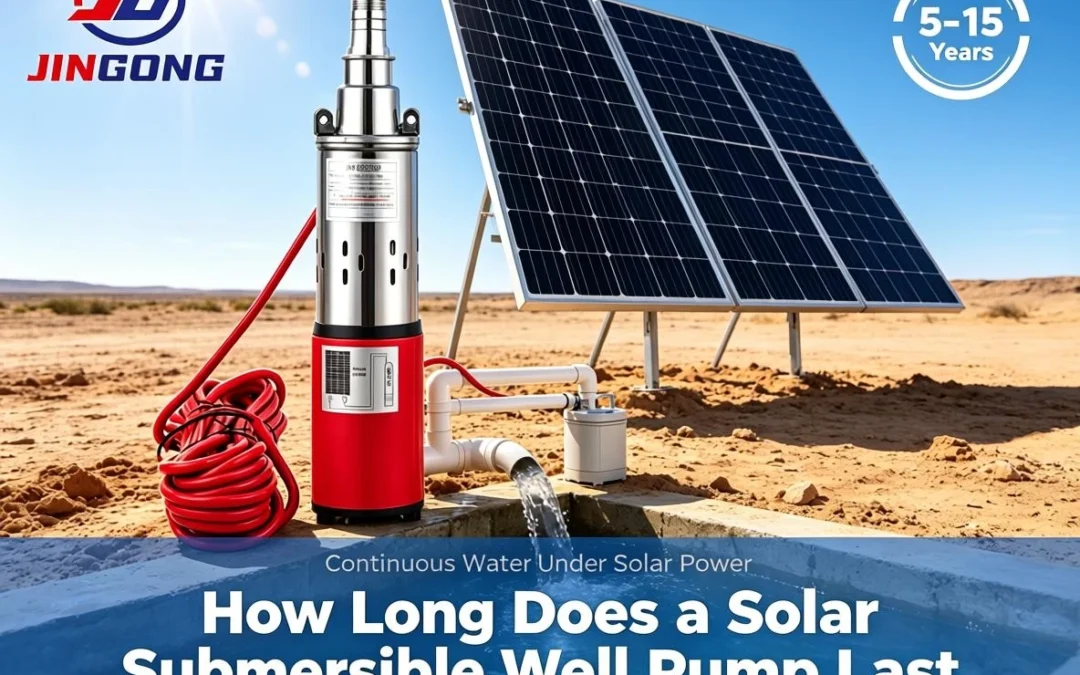
How long does a solar submersible well pump last? It’s the first question every off-grid farmer, ranch owner, remote homesteader, and drilling contractor asks before signing off on a system that often costs 2–3× a conventional AC pump.
At Jingong Pumps (Zhejiang Jingong Technology), we’ve been manufacturing water pumps for over a decade across four core lines—solar submersible well pumps, ordinary deep-well submersibles, surface/land pumps, and gasoline/diesel engine-driven pumps. We’ve tracked real-world service records from 8,000+ installations in agriculture, livestock, rural households, and remote infrastructure projects.
Here’s the short answer: A well-specified solar submersible well pump lasts 10–15 years in standard freshwater conditions, and 15–20 years when you step up to SS316 + premium BLDC + proper water-quality matching. The PV array alongside it? 25–30 years design life, with only ~0.5% annual degradation. The controller and electronics sit in the middle at 10–15 years before a refresh.
In this guide, we’ll break down industry benchmarks, 5 critical factors that affect durability, and a side-by-side comparison of solar vs. diesel vs. land pumps to help you calculate your true ROI.
Average Lifespan of Solar Submersible Well Pumps — Industry Benchmarks
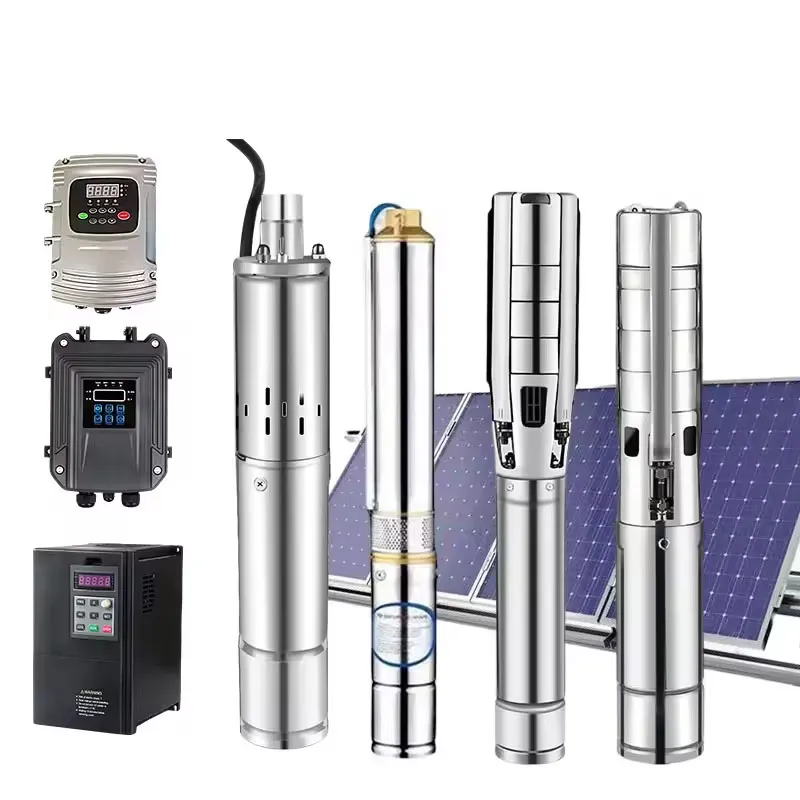
Solar submersible well pump “lifespan” is really four overlapping lifespans—the pump body, the motor, the PV array, and the balance-of-system (controller + cabling). Treat them separately, and you’ll size the system right.
Pump Body (BLDC Submersible) — 10–15 Years Standard, 15–20 Years Premium
A decent solar submersible in freshwater, sized correctly, runs 8–12 years minimum. Step up to a BLDC stainless steel model from a manufacturer that does its own winding (like Jingong’s solar sub line), and you’re looking at 10–15 years as the realistic working window. Go SS316 in corrosive or coastal environments, and 15–20 years is on the table.
Why the spread? Two things:
- Motor type: BLDC (brushless DC) eliminates commutator wear. Our 5 HP class BLDC units run at ~92% efficiency vs ~80–85% for induction AC—less heat, less winding stress.
- Material grade: SS304 gets you 5–8 years in ag irrigation; SS316 pushes 8–12 years even in brackish; duplex SS goes 10–15 in marine. Field Rule: Within 5 km of the coastline, SS304 will corrode in 2–3 years—SS316 is mandatory.
PV Modules — 25–30 Years Design Life
Mainstream monocrystalline panels carry a 25-year power warranty—guaranteed to hold ≥80% of nameplate at year 25, then keep running another 5–10 years at reduced output. Annual degradation is 0.5–0.7% after Year 1.
Real-world proof: The Qinghai photovoltaic water-lifting project (12 years in operation) shows only 2 pumps changed due to sand erosion; the PV array remains at 82% of initial output.
BLDC Motor Rated Hours — 20,000+ Hours Continuous Duty
BLDC motors used in solar submersibles are S1 continuous-duty rated. A pump running 8 hours/day equals ~3,000 hrs/year. 20,000 hours = ~6.5 years of daily cycling before rated life exhausts. However, most BLDC windings outlive the mechanical seals and bearings if water quality is clean. Using NSK/NTN bearings (Jingong standard spec) adds another 3–5 years over generic brands.
Controller & Electronics — 10–15 Years
The MPPT controller is the system’s weakest electrical link. Inverter/controller rated life is 10–15 years in dry climates, shorter in high-heat or lightning-prone zones. Heat is the killer—an MPPT bolted inside a black box in desert conditions will age faster than one in a ventilated shade mount. Smart controllers with auto-derating and surge protection push toward the 15-year mark.
Cabling, Rope & Mounting — 8–12 Years
Often overlooked: the stuff that isn’t the pump. UV-rated DC cabling degrades in 8–12 years if exposed; stainless safety rope lasts 10+ years if 316; galvanized ground mounts go 20 years dry, less in salt spray.
Jingong Field Note: In our service logs, ~30% of “pump failures” under warranty aren’t the pump at all—they’re controller surge damage, undersized DC cabling causing voltage drop, or rope corrosion at the hang point. The pump itself was fine.
Lifespan Comparison: Solar Pump vs Diesel Pump vs Surface/Land Pump vs Ordinary Submersible
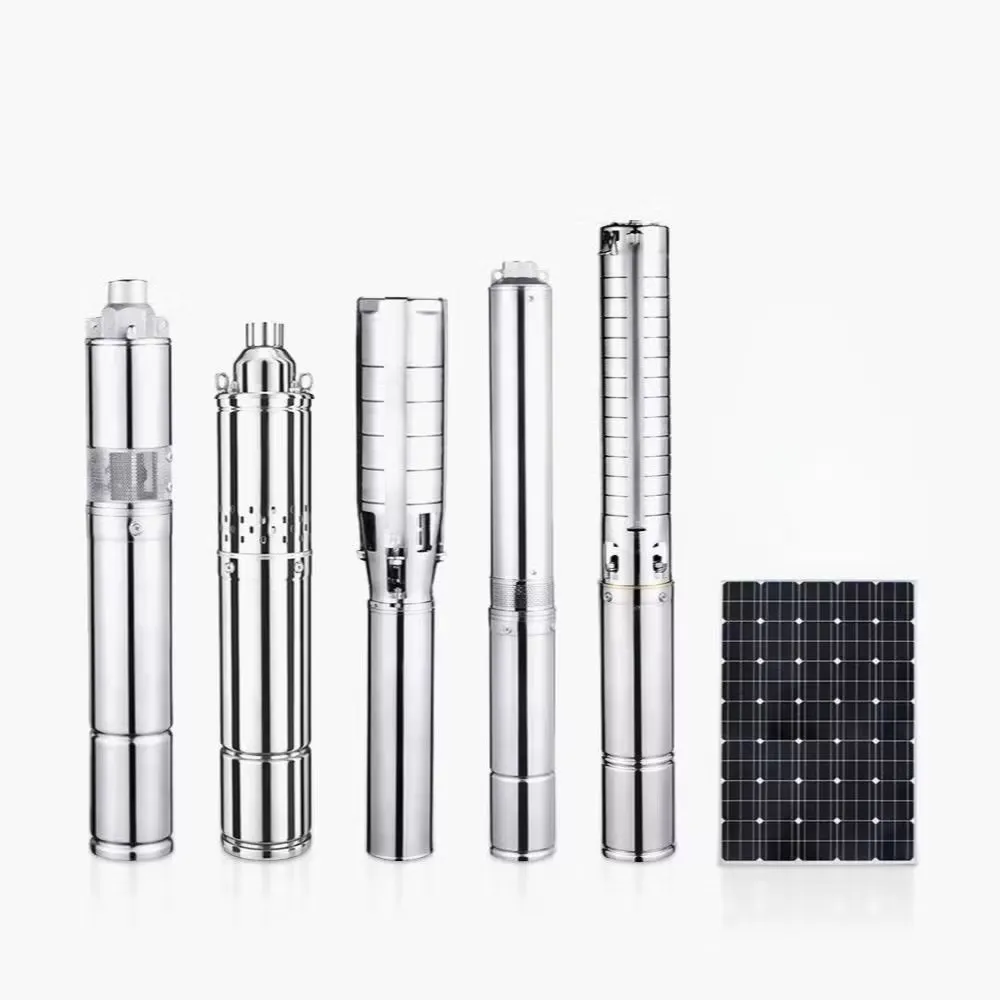
solar submersible well pump
This is where most buyers get stuck. Solar looks expensive up front, diesel is “tried and true,” land pumps are cheap, and a plain AC submersible is half the price of solar. Here’s how actual service life + OPEX stack up across the four categories Jingong manufactures.
Side-by-Side Lifespan & TCO Table
| Pump Type | Design Life | Typical Failure Mode | OPEX (% of CAPEX/yr) | Best Fit Scenario |
|---|---|---|---|---|
| Solar Submersible (BLDC) | 10–15 yr (pump); 25 yr (PV) | Controller surge, sand wear | 3–5% | Off-grid farms, remote wells |
| Ordinary AC Submersible | 8–12 yr | Winding burn, sand | 4–6% | Grid-stable deep wells |
| Surface / Land Pump | 6–10 yr | Mechanical seal, priming loss | 5–8% | Shallow wells, canal transfer |
| Gasoline / Diesel Pump | 3–5 yr (engine) | Engine rebuild, fuel system | 15–20% | Flood emergencies, portable use |
OPEX Reality Check Over 10 Years
Take a 2 HP (~1.5 kW) pumping duty:
- Diesel Set: Fuel + oil + filters + rebuilds. Industry benchmark 15–20% of initial CAPEX per year. Over 10 years, you spend nearly 2× the pump’s price just running it.
- Solar Submersible: No fuel. Maintenance = PV washing 2–4×/year, occasional seal kits. 3–5% / year territory.
- Payback Math: Solar costs ~2× a diesel set up front but breaks even at year 3–5 on fuel savings alone—then runs “free” for another 10+ years.
Best-Fit Scenarios (Jingong Product Mapping)
- Choose Solar Submersible when: Off-grid/unreliable grid, steady daily duty (farm/livestock), sunshine >4 hr/day, well depth 30–200 m. View Jingong Solar Pumps »
- Choose Diesel Engine Pump when: Emergency/flood, intermittent heavy-duty, no solar window (high latitude winter), portability needed. View Jingong Diesel Pumps »
- Choose Land/Surface Pump when: Shallow source (<8 m suction), canal/river draw, irrigation transfer. View Jingong Land Pumps »
- Choose Ordinary AC Submersible when: Grid stable, depth >20 m, CAPEX priority over OPEX. View Jingong Submersibles »
Conclusion & Jingong Pump Recommendations by Scenario
Solar submersible well pumps do last—10–15 years for the pump, 25 for the PV, and a BLDC motor that’ll turn 20,000+ hours before it complains. But “lasting” isn’t luck. It’s SS grade matched to your water, sand pre-filters if needed, a controller that won’t fry in the first storm, and a pump sized to the well, not the brochure.
At Jingong (Zhejiang, China—exporting to 30+ countries), we build all four pump types discussed above. That lets us spec honestly—if your site suits diesel better than solar, we’ll say so. Most factories can’t.
Quick-pick by scenario:
- 🌾 Off-grid farm / livestock: Jingong Solar Submersible (SS316 if coast <5 km)
- 🏠 Grid-tied deep well: Jingong Ordinary Submersible (SS304)
- 🚜 Shallow canal / transfer: Jingong Surface/Land Pump
- ⛈️ Emergency / Portable: Jingong Diesel/Gasoline Engine Pump
Need a water test + sizing sheet before you buy? Send us your well depth, static level, required GPM, and TDS. Our engineering team will tell you which line fits best and what it’ll cost over 10 years—not just on invoice day.
solar submersible well pump Frequently Asked Questions (FAQs)
1. How long does a solar submersible pump last on average?
On average, the pump mechanism lasts 10–15 years, while the accompanying solar panels are rated for 25–30 years. High-end stainless steel models in ideal water conditions can push 20 years.
2. Do solar water pumps wear out quickly?
No. When sized correctly, they often outlast diesel pumps because they have fewer moving parts and no combustion engine. Most “failures” occur in the electronic controller or due to improper water quality, not the pump motor itself.
3. Which is better: solar pump or diesel pump for long term use?
For long-term stationary use (farms, villages), solar wins on Total Cost of Ownership (TCO), breaking even around year 3–5. Diesel wins for portability, emergency response, and sites with zero sun exposure.
4. Can a solar submersible pump last 20 years?
It is rare but possible for the pump body to last 20 years if it is constructed from SS316, installed in soft, sediment-free water, and maintained meticulously. The PV panels will almost certainly last 20+ years.
5. Does salty water reduce solar pump lifespan?
Yes. Saltwater accelerates corrosion. Standard SS304 pumps may fail within 2–3 years in coastal areas (<5 km from the sea). You must use SS316 or Duplex Stainless Steel for brackish or saline environments.
6. How many hours can a BLDC solar pump work continuously?
Quality BLDC motors are S1 (continuous duty) rated for 20,000+ hours. This translates to roughly 6–8 years of running 8 hours per day, though the mechanical seals and bearings typically require servicing before the motor fails.