
Why Phase Selection Matters More Than You Think
Most buyers treat “single-phase or three-phase” Well Water Pump as a side note. In reality, for any well Water pump project—whether it’s a rural home water supply, a 50-acre farm irrigation system, or a commercial villa district—the phase choice directly decides four critical factors:
- Motor service life (wrong phase = burnt windings within months)
- Energy cost over 5–10 years (up to 15% gap)
- Installation & wiring budget (three-phase sometimes requires a utility upgrade)
- Operational stability (whether the well water pump can run 24/7 without overheating)
At Jingong (Zhejiang-based pump manufacturer, 15+ years, exporting to 40+ countries), we’ve witnessed numerous cases where a distributor or end-user selected the incorrect phase for their well pump, resulting in premature motor failure. This guide is forged from field experience—not just textbooks. If you’re comparing a single-phase well water pump versus a three-phase unit, read this before purchasing.
Quick Definition: What “Phase” Actually Means in a Well Water Pump

Before selection, understanding the electrical fundamentals is crucial. A well water pump motor is an inductive load; the phase type alters how that load behaves.
Single-Phase Well Pump (120V/240V)
- Power Supply: Residential standard in the US (120/240V), EU (230V), and many Asian regions.
- Mechanism: One AC waveform, utilizing Live and Neutral wires.
- Components: Requires an internal starting capacitor (a common wear part).
- Structure: Simpler design, lower equipment cost.
- Capacity: Typical power ceiling of ≤3 HP (2.2 kW) for most submersible and surface well pump models.
Three-Phase Well Pump (380V/415V/480V)
- Power Supply: Industrial, commercial, or agricultural three-phase grid (varies by country: 380V EU, 415V AU, 480V US).
- Mechanism: Three balanced AC waveforms, 120° apart.
- Components: No starting capacitor needed—motor self-starts smoothly.
- Efficiency: Higher efficiency, stronger overload capacity.
- Capacity: Powers well pump units from 3 HP up to 30+ HP for deep-well and high-volume irrigation.
Core Difference: It’s not just the “voltage number,” but the balance of the motor load. Three-phase provides smoother torque, less vibration, and extended bearing life for your well pump.
Side-by-Side Comparison Table (Single vs Three Phase)
Google favors comparison tables, and so do buyers. Below is the internal reference Jingong uses to advise clients choosing a well pump.
| Dimension | Single-Phase Well water Pump | Three-Phase Well water Pump |
|---|---|---|
| Supply Voltage | 120/240V Residential | 380/415/480V Industrial |
| Max Practical Power | ≤3 HP | >3 HP (Up to 30+ HP) |
| Starting Device | Capacitor (Wear Part) | None (Direct/Soft Start) |
| Start Performance | May struggle under heavy load | Smooth, high torque |
| Efficiency | Baseline | +10–15% vs Single-Phase |
| Continuous Run | Intermittent recommended | 24/7 Capable |
| Service Life | 3–6 Years | 5–8+ Years |
| Installation Cost | Low (Plug & Play) | Higher (Wiring/Utility) |
| Best Fit | Home, Shallow Well | Farm, Deep Well, Industrial |
Jingong Note: The “+10–15% efficiency” figure references IEC motor curves and Jingong’s test bench data on 1.5kW–4kW well pump motors under continuous load.
Pros & Cons: No Marketing Bias, Just Facts

Single-Phase: Where It Shines, Where It Fails
Pros:
- Compatible with nearly all residential grids—no utility upgrades.
- Lower upfront cost (pump + wiring).
- DIY-friendly installation for small well water pump setups.
- Ideal for home drinking water and small garden irrigation.
Cons:
- Power capped (~3 HP)—difficult to scale.
- Starting capacitor is a frequent failure point in hot climates.
- Poor performance during long continuous runs (overheating risk).
- Voltage drop over long cable runs can prevent startup.
Three-Phase: Industrial-Grade, but Not for Everyone
Pros:
- Stable torque, smooth start, no capacitor dependency.
- 10–15% energy savings compared to single-phase at the same duty.
- Capable of 24/7 operation (essential for farm irrigation).
- Longer motor life, superior for deep-well, high-lift well pump applications.
Cons:
- Requires three-phase supply (unavailable in some rural areas).
- Higher upfront investment (pump + starter + wiring).
- Installation must be performed by a licensed electrician.
- Often overkill for small households with minimal water needs.
Scenario Matching – Which Well Pump Fits Your Job?
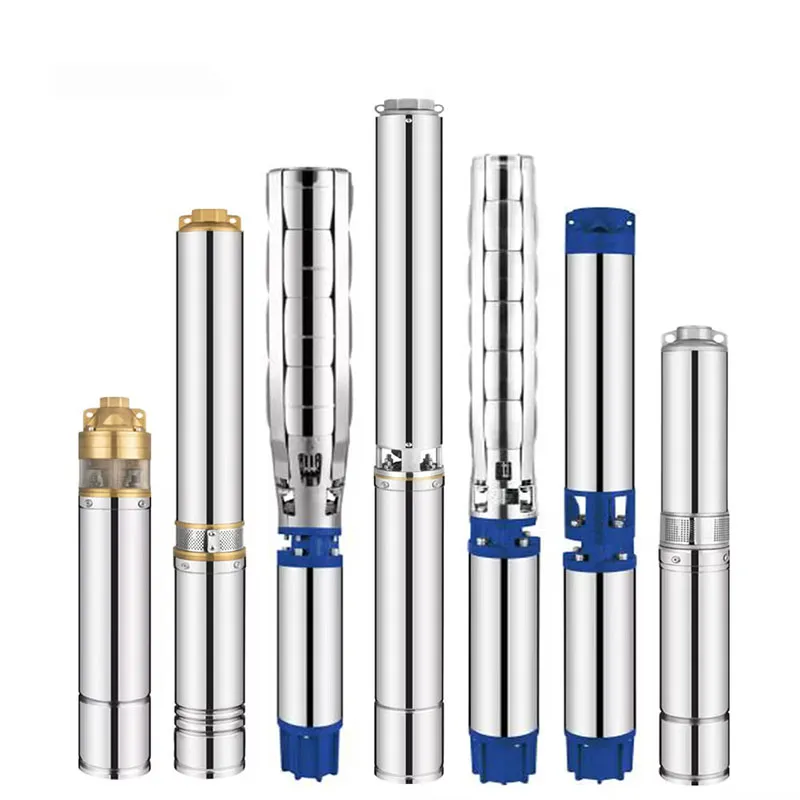
As a well pump supplier with a full product matrix—Submersible, Surface, Solar, Gasoline/Diesel—Jingong matches the right technology to the job.
Residential & Domestic Water Supply
Duty: 0.5–2 HP, 2–6 hours/day.
Recommendation: Single-phase well pump (submersible or jet surface).
Jingong Match: JG Series 0.75–2.2 kW Submersible Well Pump (304SS / 316SS options).
Farm & Irrigation (Small → Large Scale)
Small Farm (<5 acres): Single-phase 1.5–3 HP well pump acceptable.
Medium Farm (5–30 acres): Borderline—verify three-phase grid availability.
Large Farm (>30 acres): Three-phase well pump strongly recommended.
Jingong Match: 4–15 HP Three-Phase Submersible/Centrifugal Well Pumps; Solar Well Pump hybrid options.
Commercial / Villa Communities / Hotels
Duty: 24/7 or near-continuous, multi-story pressure.
Recommendation: Three-phase well pump mandatory, often paired with pressure tanks + VFD.
Jingong Match: Multistage submersible well pump, 4″–10″ casing compatibility.
Deep Well & High-Lift Applications
Condition: Depth >60 m, Lift >80 m.
Recommendation: Three-phase well pump + soft starter.
Jingong Match: 6″–12″ Deep Well Pump line, heads up to 300 m.
No-Grid Scenarios: Solar & Fuel Pump Alternatives
If grid power is unavailable, phase selection becomes irrelevant:
- Off-grid Farm: Solar Well Pump (DC or inverter-driven).
- Remote Construction/Flood Control: Gasoline/Diesel Pump (self-priming, portable).
- Hybrid: Solar + Diesel backup for dry-season continuity.
5 Practical Selection Criteria (Jingong Field-Tested)
Don’t guess. Use this 5-point checklist every time you specify a well pump:
- On-site Power Availability: 240V single-phase only → Single-phase well pump. 380V/415V three-phase → Strongly consider three-phase if duty >3 HP.
- Pump Power & Daily Demand: ≤3 HP, <4 hrs/day → Single-phase. >3 HP, >8 hrs/day → Three-phase.
- Continuous vs. Intermittent Use: Intermittent (home) → Single-phase. Continuous (irrigation/hotel) → Three-phase.
- Budget (CAPEX vs. OPEX): Single-phase wins on low initial cost. Three-phase wins on 5-year energy savings for large duties.
- Well Depth & Lift: Shallow (<30 m) → Either phase. Deep (>60 m) → Three-phase preferred.
Operation, Maintenance & Common Faults
Single-Phase Common Issues
- Capacitor Burn-out: Symptom: Humming sound, but fails to start.
- Thermal Overload: Protector trips repeatedly during long cycles.
- Voltage Drop: Failure to start at the end of long, undersized cables.
Three-Phase Common Issues
- Phase Loss: One fuse blown causes rapid overheating; requires protection relays.
- Phase Imbalance: >2% voltage differential causes excess heat.
- Wiring Degradation: Loose terminations in humid pump houses.
Maintenance Cost Comparison: Annual maintenance for a 2–4 HP single-phase well pump averages $30–60 (mostly capacitors). Three-phase averages $20–50 but requires professional labor.
Cost Breakdown: Upfront vs Long-Term (Real Numbers)
Case Study: A 2.2 kW (3 HP) well water pump, running 6 hours/day, 300 days/year.
- Single-Phase Setup: Pump ($280–400) + Install ($100–200) + Energy (~1,400 kWh/yr).
- Three-Phase Setup: Pump ($350–500) + Starter/Wiring ($250–400) + Energy (~1,200 kWh/yr).
Verdict: On large-scale operations, the three-phase well water pump often pays back its higher initial investment within 2–3 years through energy savings alone.
FAQ – Featured Snippet Targets
Which is more durable, single-phase or three-phase well pump?
Generally, the three-phase well pump. Without a starting capacitor and with lower per-hour heat buildup, a three-phase unit typically lasts 5–8+ years, whereas a single-phase unit averages 3–6 years under similar conditions.
Can a three-phase pump work with single-phase power?
Not directly. You would require a phase converter or a Variable Frequency Drive (VFD) that accepts single-phase input and outputs three-phase. For small power requirements (<2 HP), this is sometimes feasible, but efficiency suffers; it is usually better to purchase a single-phase well water pump.
Is single-phase well pump suitable for deep wells?
It is suitable for depths up to approximately 40–50 meters with a power rating of ≤2 HP. Beyond this, the combination of start torque requirements and voltage drop makes a three-phase well pump the safer, more reliable choice.
What phase is best for solar well water pump systems?
Solar well pump systems typically utilize DC motors or single-phase AC output from an inverter. Three-phase solar well pump configurations exist for large-scale irrigation (>3 HP) but necessitate a larger, more expensive inverter system.
Do farm irrigation pumps need three-phase power?
Not universally. Small farms with duty cycles under 3 HP can operate effectively on single-phase. However, medium-to-large irrigation systems (e.g., center pivots, >10 acres, continuous operation) significantly benefit from a three-phase well pump due to energy efficiency and 24/7 reliability.
Conclusion & Get a Custom Well Pump Solution
Selecting between single-phase and three-phase isn’t about which is “better”—it’s about your specific site power, duty cycle, well depth, and 5-year cost projections. At Jingong, we don’t just sell a well pump; we provide comprehensive solutions:
- 🏠 Residential single-phase submersible & surface well pump
- 🚜 Farm & irrigation three-phase well pump (4–20 HP)
- ☀️ Solar well pump for off-grid applications
- ⛽ Gasoline/diesel well pump for remote & emergency use
As your dedicated well pump supplier, we offer OEM/ODM services, free custom selection support, and global technical assistance. Send us your well depth, water demand, and power specifications for a free consultation.
👉 Need help specifying your well pump? Contact Jingong’s engineering team today.
About the Author
Jingong Pump Engineering Team – Zhejiang, China
15+ years of expertise in water pump manufacturing · ISO9001 Certified · Exported to 40+ Countries · Full Product Range: Submersible Pumps, Surface Pumps, Solar Pumps, Gasoline/Diesel Pumps · Serving Residential, Agricultural, Industrial, and Municipal Projects.