
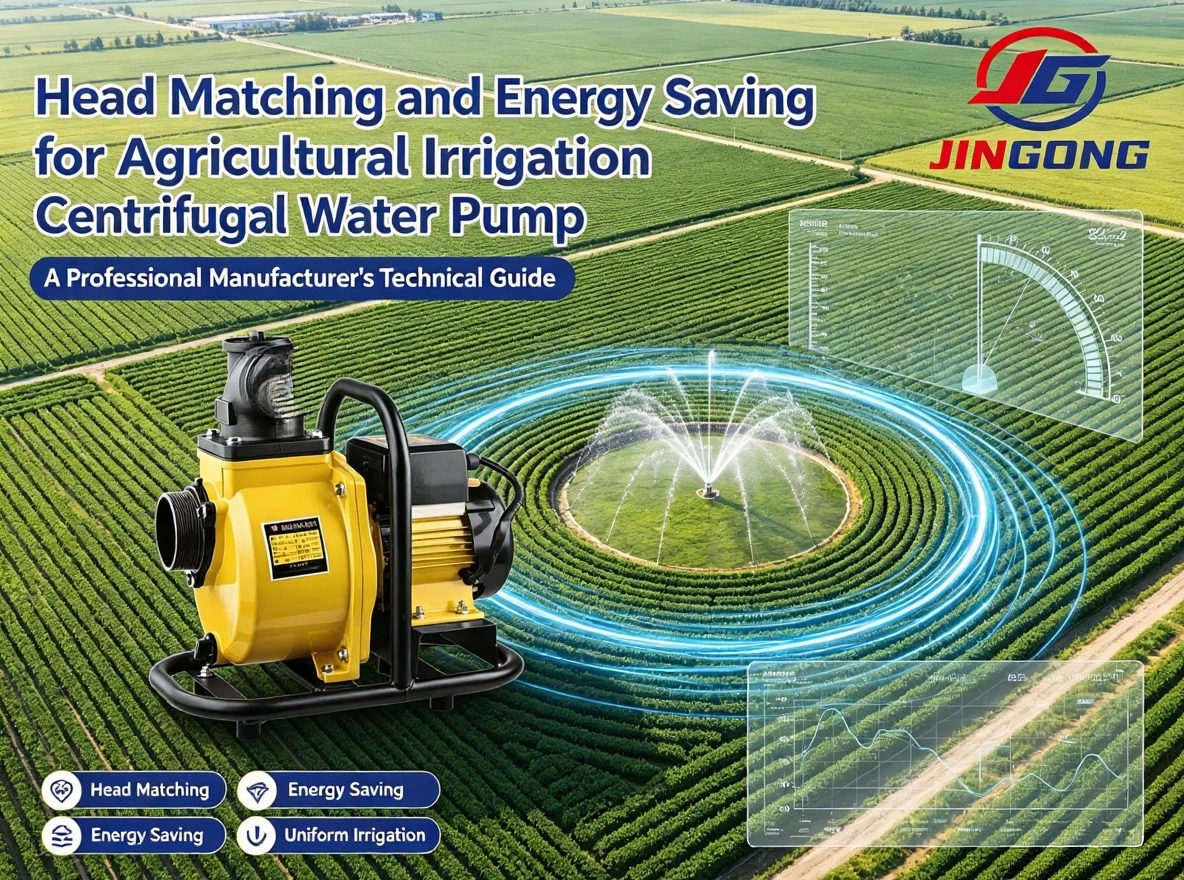
Head Matching and Energy Saving for Agricultural Irrigation Centrifugal Water Pumps: A Professional Manufacturer’s Technical Guide
Technical Author: Jingong Technology R&D & International Sales Engineering Team
Expertise: 15+ years as an Agricultural Irrigation Centrifugal Water Pump manufacturer serving farms, agricultural contractors, and irrigation engineering firms across Southeast Asia, Africa, the Middle East, and South America.
1. Introduction: Why Head Matching is the Energy-Saving Lever for Agricultural Irrigation Centrifugal Water Pumps
Across global agriculture, mis-matched pump head remains the single largest hidden cost in irrigation operations. As a leading Agricultural Irrigation Centrifugal Water Pump manufacturer, Jingong Technology has audited hundreds of overseas farm pumping stations and found that over 60% of installed centrifugal pumps operate outside their optimal efficiency zone — a direct result of incorrect head matching during the selection phase. This is the root cause of the widespread farm irrigation pump head mismatch problem that drives up operational costs for farmers worldwide.
The consequences are severe and well-documented through our agricultural pump operation experience:
- Excess head → flow overload, motor overheating, pipe stress, premature bearing failure, and up to 30–50% wasted energy.
- Insufficient head → inadequate coverage, failed high-land irrigation, uneven crop growth, and direct yield loss.
- Wrong pump type for terrain → a surface (land) pump forced into deep-well duty, or a submersible pump installed in a shallow pond, destroys both efficiency and equipment life.
This guide is written by the engineering team at Jingong Technology — your trusted Agricultural Irrigation Centrifugal Water Pump manufacturer — to deliver actionable, field-proven methodology for pump head matching and energy saving. It covers all four of our core product lines: submersible pumps, surface (land) pumps, solar-powered pumps, and gasoline/diesel engine pumps. Whether you are searching for a high energy consumption agricultural water pump solution or planning a new irrigation system from scratch, this technical deep-dive will give you the expertise to make informed decisions.
💡 Key Insight: Optimized piping and head matching alone can improve pump station efficiency by 15%–20% according to published pump-station energy retrofit data. As an experienced Agricultural Irrigation Centrifugal Water Pump manufacturer, we have verified this on numerous client projects across multiple continents.
2. Fundamentals: Understanding Centrifugal Pump Head for Agricultural Irrigation
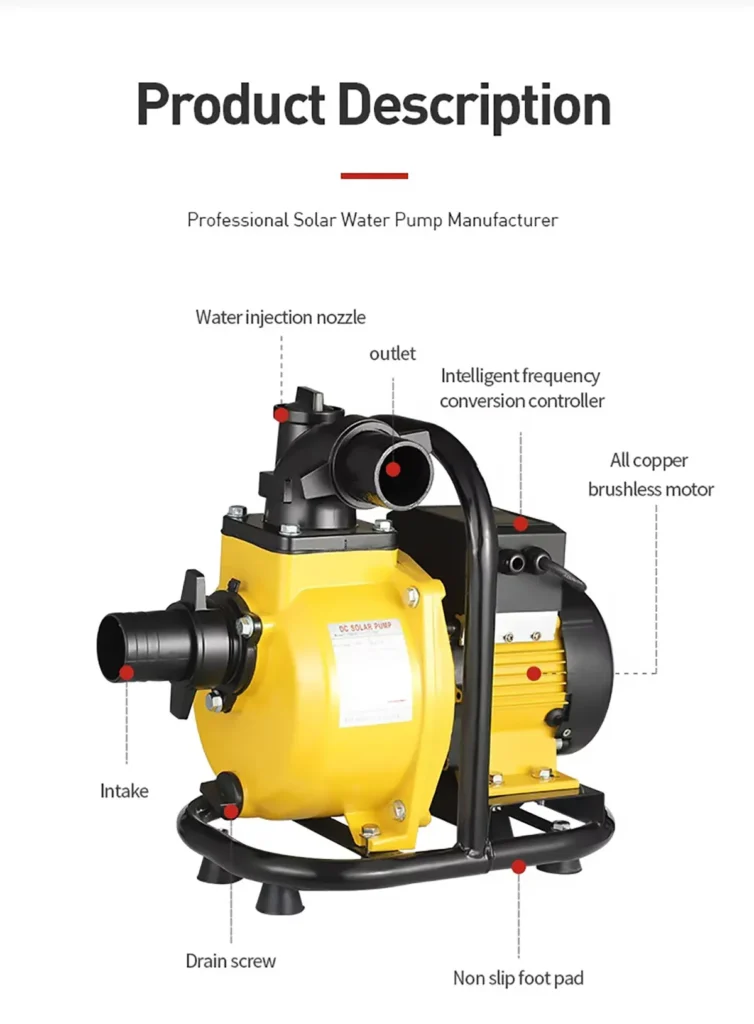
Every professional Agricultural Irrigation Centrifugal Water Pump manufacturer knows that head is not a single number but a set of interrelated parameters. Before diving into selection, let’s establish the authoritative definitions that form the foundation of irrigation system efficiency optimization.
2.1 What is Pump Head? — Centrifugal Pump Head Definition
In agricultural pump working principle, Head (H) is the height, measured in meters (m), to which a pump can raise water. For any credible Agricultural Irrigation Centrifugal Water Pump manufacturer, head must be broken down into these industry-standard components:
| Head Term (Agricultural Pump Parameter Explanation) | Definition & Calculation |
|---|---|
| Static Head (Hs) | Vertical elevation difference between the water source surface and the highest discharge point. Core component of static head vs dynamic head irrigation pump distinction. |
| Friction Head Loss (Hf) | Energy lost to pipe wall friction along the total pipeline length. Calculated via Darcy-Weisbach: Hf = f × (L/D) × (v²/2g). |
| Minor / Local Loss (Hm) | Losses from elbows, valves, filters, and couplings — calculated as ζ × (v²/2g). |
| Total Dynamic Head (TDH) | Hs + Hf + Hm + Safety Margin (typically 10%). The true centrifugal pump head definition used for final selection. |
2.2 Four Product Lines — Different Head Profiles & Energy Characteristics
As a full-line Agricultural Irrigation Centrifugal Water Pump manufacturer, Jingong designs each product category with distinct head-flow-energy characteristics:
- Submersible Pumps — Designed for deep-well and submerged operation; excel at high-head, medium-flow applications (10–300 m head range). Understanding submersible pump low energy consumption starts with proper head calibration.
- Surface / Land Pumps — Installed above ground; ideal for flat-field irrigation, river/lake intake, and mid-head ranges (5–60 m typical). Require careful suction lift calculations.
- Solar Pumps — DC/AC driven by PV arrays; head and flow dynamically matched to solar irradiance. The gold standard for solar pump energy saving for farm applications, with proven capability up to 400 m head.
- Diesel/Gasoline Pumps — Engine-driven mobility; optimal for temporary, emergency, and remote irrigation. Diesel pump fuel saving tips center on matching engine RPM to pump BEP.
3. The Real Cost of Head Mismatch: Field Evidence from an Agricultural Irrigation Centrifugal Water Pump Manufacturer
Through our extensive agricultural pump operation experience, Jingong Technology has documented the following as the most common pump head mismatch effects encountered in global farming operations:
3.1 Oversized Head — “Big Horse, Small Cart”
Selecting a pump with rated head far above actual requirement is the most common mistake we see as an Agricultural Irrigation Centrifugal Water Pump manufacturer. The pump operates at the far right of its curve — low efficiency zone — causing:
- Excessive flow → pipe pressure exceeds design rating (high head pump low flow problem in reverse)
- Motor runs at overload → bearing temperature rises → insulation ages faster
- Energy efficiency can drop below 50% of the pump’s best efficiency point (BEP)
- This is a primary driver of agricultural pump energy waste reasons
3.2 Undersized Head — Starved Irrigation
When head is insufficient, water fails to reach highland rows, sprinkler pressure drops below the nozzle threshold, and drip tape fails to emit uniformly. Crop stress and yield reduction follow immediately — a direct failure of irrigation system efficiency optimization.
3.3 Product-Specific Mismatch Scenarios
| Product Type | Typical Mismatch Failure Mode | Consequence |
|---|---|---|
| Land Pump | Ignoring suction lift limit & ground-level friction loss | Cavitation, prime loss, motor burnout — classic farm irrigation pump common mistakes |
| Submersible Pump | Submersible pump head calibration error; motor not fully underwater | Overheating, seal failure, pump service life reduction reasons |
| Solar Pump | Solar pump head matching error; PV power not matched to curve | Low daily water output, frequent shutdowns, wasted PV investment |
| Diesel/Gasoline Pump | Engine RPM mismatched to pump BEP; diesel pump fuel waste solution needed | Excessive fuel consumption — sometimes 30%+ above necessary |
Every responsible Agricultural Irrigation Centrifugal Water Pump manufacturer needs to educate buyers on these pitfalls. At Jingong, we have built our pre-sale selection protocol precisely to eliminate them through our professional irrigation pump technical support process.
4. Precise Head Matching Calculation — The Core Methodology
As a professional Agricultural Irrigation Centrifugal Water Pump manufacturer, we apply the following industry-standard formula for every quotation and agricultural irrigation pump selection guide:
Total Required Head Formula (Pump Head Matching Calculation):
H_total = H_static + H_friction + H_minor + Safety Margin (10%)
Where H_friction follows Darcy-Weisbach: Hf = f × (L/D) × (v²/2g), and minor losses use local resistance coefficients from standard hydraulic tables. This is the foundation of irrigation pipeline head loss calculation.
4.1 Practical Example — Deep Well Irrigation
Consider a farm requiring 200 m³/h flow, with 575 m of vertical lift, DN200 steel pipe, and 100 m required outlet pressure:
- Static head = 575 m
- Friction loss (DN200, 200 m³/h) = 2.1 m per 100 m → 21 m
- Required outlet pressure = 100 m
- Estimated total head requirement = ~700 m
A qualified Agricultural Irrigation Centrifugal Water Pump manufacturer will then match this to a pump whose BEP sits at 100–105% of 700 m — never at 150% or 200%. This is the essence of farm pump parameter matching standard compliance.
4.2 Terrain-Based Selection Matrix
| Terrain / Scenario (Farm Irrigation Pump Selection by Terrain) | Recommended Head Range | Best-Match Pump Type |
|---|---|---|
| Flat plain, large fields | 5–30 m | Land Pump / Diesel Pump |
| Hilly orchards | 30–80 m | Multi-stage Submersible / Solar Pump |
| Deep well (>100 m) | 100–300 m | Deep-well Submersible Pump |
| Remote mountain, off-grid | Up to 400 m | Solar Submersible Pump (proven in 300–400 m projects) |
| Emergency / mobile irrigation | 10–50 m | Gasoline / Diesel Pump |
5. Energy-Saving Solutions: From Precision Matching to Intelligent Control
Being an Agricultural Irrigation Centrifugal Water Pump manufacturer means going beyond selling hardware — it means delivering measurable farm irrigation energy efficiency improvement. Here are five proven strategies drawn from our project database:
5.1 Strategy 1: Right-Sizing During Selection
Correctly calculating required flow and head, then selecting a pump whose rated point equals or slightly exceeds the requirement, ensures operation near the BEP. Every Agricultural Irrigation Centrifugal Water Pump manufacturer should refuse to oversize — “the larger the margin, the lower the efficiency.” This is the foundation of agricultural centrifugal pump energy saving methods.
5.2 Strategy 2: Reduce Pipeline Resistance
Field data shows that optimized piping configurations improve overall system efficiency by 15%–20%. Tactics include:
- Use economic pipe diameter (larger than minimum spec) — directly reduces farm pump energy consumption principle waste
- Shorten total pipe length; minimize elbows and valves
- Choose low-resistance fittings and smooth-bore pipes
- One documented case: removing just 1 meter of pipe saved 0.21 kg of diesel over 10 operating hours
5.3 Strategy 3: Solar-Powered Pumping — The Green Game Changer
As an innovative Agricultural Irrigation Centrifugal Water Pump manufacturer, Jingong has deployed solar pump energy saving for farm systems across multiple continents. The results speak for themselves:
- A Southeast Asia plantation project: solar pumping cost $0.03 per ton vs. $0.21 per ton for diesel — an 87% cost reduction
- A mountainous orchard project: 235 m net head, 25 m³/h flow, $4,800 annual electricity savings, 68.2 tons CO₂ reduction per year
- A highland irrigation project: lifts water 700 m, irrigates 10,000 mu of orchards, saves $75,000 annually in electricity
- System lifespan: 15–25 years; MPPT efficiency >99%; zero battery requirement
🌞 Solar Advantage: When you partner with a forward-thinking Agricultural Irrigation Centrifugal Water Pump manufacturer like Jingong, a solar pumping system pays back its initial investment in 3–5 years and runs virtually free for the next two decades. This is the ultimate commercial farm energy cost saving solution.
5.4 Strategy 4: Variable Frequency Drive (VFD) Retrofitting
Installing VFDs to adjust pump speed according to real-time demand moves the duty point horizontally along the system curve, delivering dramatic power savings compared to traditional throttle-valve control. This is especially effective for land pumps in variable-demand irrigation schedules and for booster pumps maintaining constant pressure in sprinkler networks.
5.5 Strategy 5: Routine Maintenance & Calibration
- Replace worn mechanical seals and impeller rings promptly
- Clear debris from suction intake and impeller passages
- Re-measure actual head annually; recalibrate pump speed or trim impeller if conditions change
- For diesel pumps, maintain engine at optimal RPM band matching pump BEP — key to diesel pump fuel saving tips
6. Four-Product Comparative Analysis: Which Pump Delivers Best Energy Efficiency?
When evaluating best energy saving irrigation pump options, it’s critical to compare all four technologies side-by-side. As your dedicated Agricultural Irrigation Centrifugal Water Pump manufacturer, here is our unbiased assessment:
| Product (Agricultural Water Pump Comparison) | Optimal Head Range | Energy Source | Relative Operating Cost | Best Application |
|---|---|---|---|---|
| Submersible | 50–300 m | Grid electricity | Low | Deep wells, high-lift orchard irrigation |
| Land Pump | 5–60 m | Grid electricity / PTO | Low–Medium | River/lake intake, flat-field flood irrigation |
| Solar Pump | 10–400 m | Photovoltaic (free) | Near Zero | Off-grid farms, remote mountainous areas |
| Diesel/Gasoline | 10–80 m | Fossil fuel | High (fuel dependent) | Emergency irrigation, mobile operation, no grid access |
For a detailed breakdown of solar pump vs diesel pump for irrigation or submersible pump vs surface pump head efficiency, consult our technical comparison reports. As your Agricultural Irrigation Centrifugal Water Pump manufacturer, Jingong recommends a hybrid approach for many large farms: solar pumps as the primary off-grid driver supplemented by diesel pumps as backup — this combination delivers both sustainability and operational reliability, representing the most cost-effective irrigation pump for agriculture.
7. Frequently Asked Questions (Agricultural Pump Head FAQ)

Q1: What happens if pump head is too high for my irrigation system?
The pump operates at excessive flow, causing motor overload, energy waste of 30–50%, pipe over-pressure, and accelerated wear. A responsible Agricultural Irrigation Centrifugal Water Pump manufacturer will always warn against oversizing. Remedies include impeller trimming, speed reduction via VFD, or replacing with a correctly sized model.
Q2: How do I calculate the required head for an agricultural pump?
Use the formula: H_total = H_static + H_friction + H_minor + Safety Margin. Measure vertical elevation, calculate friction loss using Darcy-Weisbach based on pipe length and diameter, add minor losses from fittings, then add 10% safety margin. Consult your Agricultural Irrigation Centrifugal Water Pump manufacturer for a free selection sheet — we provide this as part of our professional irrigation pump technical support.
Q3: Which is more energy-efficient for farm irrigation — solar or diesel pumps?
Solar pumps win decisively. Documented data shows solar pumping at $0.03/ton vs. diesel at $0.21/ton — an 87% cost saving. Over a 25-year system lifespan, the cumulative savings are transformative. That said, a complete Agricultural Irrigation Centrifugal Water Pump manufacturer like Jingong also supplies diesel pumps as reliable backup for cloudy periods or peak-demand surges.
Q4: Can a submersible pump work with insufficient head?
No. Running a submersible pump at insufficient head causes continuous over-flow, motor overload, and rapid bearing failure. Proper submersible pump head calibration is non-negotiable. Contact your Agricultural Irrigation Centrifugal Water Pump manufacturer to verify the duty point before installation — this prevents pump service life reduction reasons from manifesting prematurely.
Q5: How can I reduce centrifugal pump energy consumption in irrigation?
Five key measures: (1) Right-size during selection; (2) Optimize piping to reduce friction loss; (3) Switch to solar power where feasible; (4) Install VFD for variable demand; (5) Maintain seals, impellers, and re-calibrate head annually. As your Agricultural Irrigation Centrifugal Water Pump manufacturer, Jingong provides all five as part of our turnkey service, ensuring commercial farm pump energy cost reduction year after year.
8. Jingong Technology: Your Trusted Agricultural Irrigation Centrifugal Water Pump Manufacturer

As a vertically integrated Agricultural Irrigation Centrifugal Water Pump manufacturer, Jingong Technology operates 15,000+ m² of production facilities and serves clients in 40+ countries. We are not just a vendor — we are your long-term irrigation energy partner, delivering custom agricultural irrigation pump solutions tailored to your exact terrain and crop requirements.
8.1 Our Complete Product Portfolio
- Submersible Pumps — Deep-well, multi-stage, stainless steel options for high-head applications. A top choice for buyers seeking a farm submersible pump manufacturer with proven quality.
- Surface / Land Pumps — End-suction, self-priming, and centrifugal designs for flexible field deployment.
- Solar-Powered Pumps — AC/DC, MPPT-integrated, with proven 300–400 m head capability. Our flagship high efficiency solar irrigation pump line.
- Diesel & Gasoline Pumps — Mobile, high-torque, for emergency and off-grid irrigation. Engineered for energy saving diesel water pump operation through precision matching.
- Booster Pumps — Pressure-compensated for sprinkler and drip irrigation networks.
8.2 Proven Project Case: Southeast Asia Palm Plantation
Location: Large palm oil plantation, Southeast Asia
Challenge: Highland irrigation requiring 85 m head, unstable grid power, extremely high diesel costs.
Solution by Jingong — your expert Agricultural Irrigation Centrifugal Water Pump manufacturer: High-head solar submersible pump + diesel backup hybrid system.
Results (Agricultural Pump Project Case):
- Annual fuel cost savings exceeding $15,000 USD
- Irrigation uniformity improved to over 90%
- Zero grid dependency; system runs autonomously
- ROI achieved within 3.5 years
8.3 Why Choose Jingong as Your Agricultural Irrigation Centrifugal Water Pump Manufacturer?
- Factory-Direct Pricing: As the original Agricultural Irrigation Centrifugal Water Pump manufacturer, we eliminate middleman markups.
- Custom Engineering: Every quotation includes a free pump head matching calculation tailored to your farm’s topography.
- Global Spare Parts Network: Fast delivery of replacement parts to 40+ countries.
- Technical Training: We provide installation guides, maintenance schedules, and remote video support — true professional irrigation pump technical support.
9. Summary & Industry Trends: The Future of Sustainable Farm Irrigation
Precise centrifugal pump head matching and scientific agricultural irrigation centrifugal pump energy saving strategies are the twin pillars of modern farm profitability. As global demand for sustainable farm irrigation solutions accelerates, the role of a knowledgeable Agricultural Irrigation Centrifugal Water Pump manufacturer becomes ever more critical.
Key agricultural irrigation pump future trends to watch:
- Solar-Diesel Hybrid Systems will become the standard for off-grid farms, combining the green farm water pump technology of PV with the reliability of combustion engines.
- IoT-Enabled Monitoring will allow real-time head and flow tracking, enabling predictive maintenance and further irrigation system energy optimization.
- High-Efficiency Motor Standards (IE4/IE5) will become mandatory, pushing manufacturers toward premium efficiency designs.
- Smart VFD Integration will move from premium add-on to standard feature on all energy efficient agricultural irrigation systems.
Jingong Technology, as your forward-looking Agricultural Irrigation Centrifugal Water Pump manufacturer, is already engineering these next-generation solutions. Partner with us today to future-proof your irrigation investment.
Ready to Optimize Your Farm’s Irrigation Efficiency?
Get a free, no-obligation head calculation and product recommendation from a senior engineer at Jingong — your trusted Agricultural Irrigation Centrifugal Water Pump manufacturer.

0 Comments