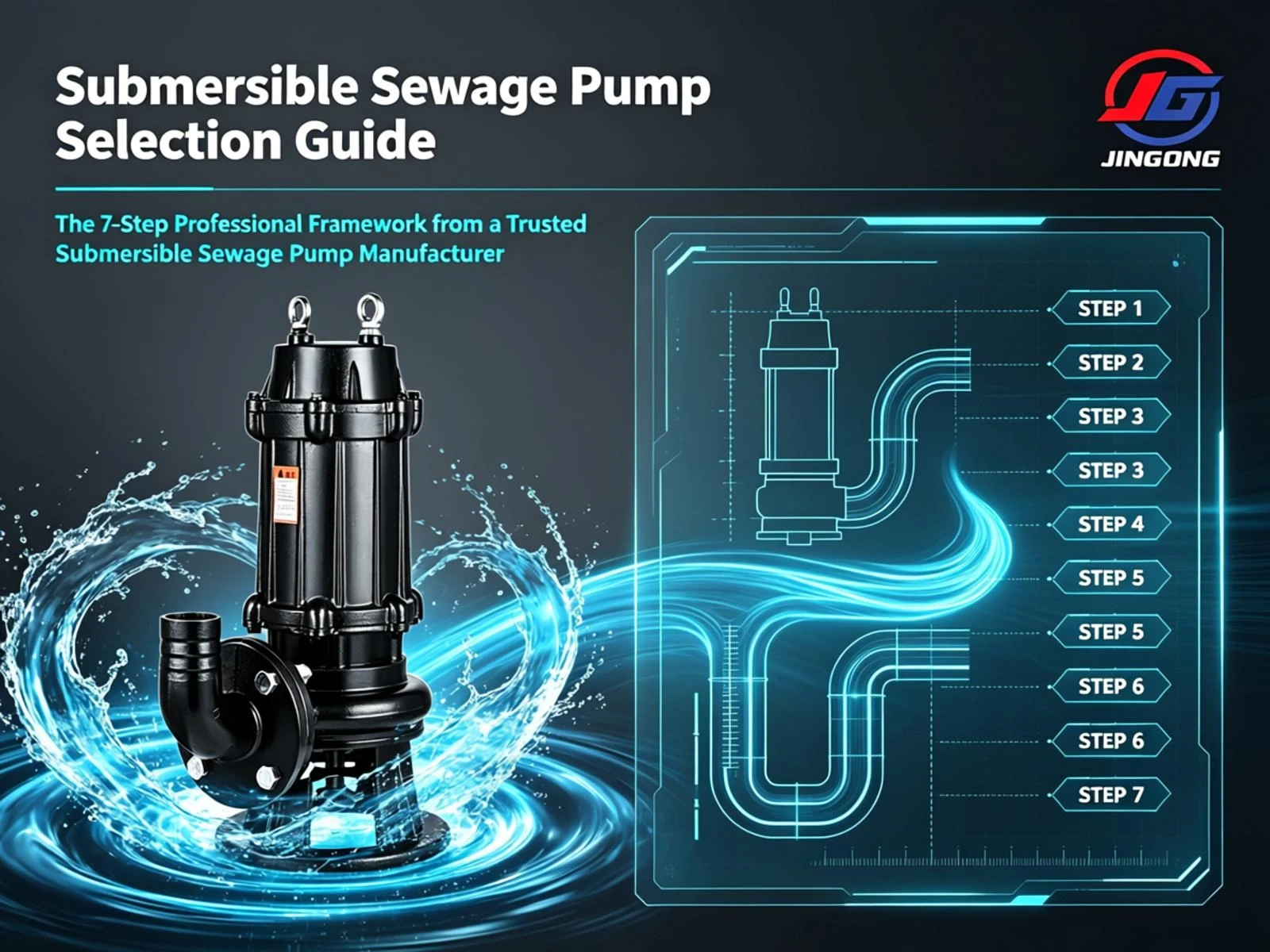
Written by the engineering team at Jingong Technology — a Submersible Sewage Pump manufacturer with vertically integrated production spanning submersible pumps, centrifugal pumps, solar pumps, and gasoline/diesel-driven pumps. This guide distills 15+ years of field experience across municipal, industrial, commercial, and off-grid projects into a repeatable 7-step selection methodology. Every recommendation below is grounded in ISO, CE, UL, and IEC standards so that specifying engineers, overseas distributors, and procurement professionals can make defensible purchasing decisions.
Why This Submersible Sewage Pump Manufacturer Wrote This Guide
As a Submersible Sewage Pump manufacturer serving B2B clients in 30+ countries, we repeatedly see the same root cause behind premature pump failure: incorrect selection at the specification stage. A pump that survives 15–20 years in a correctly matched application can fail within 3 years when mismatched to flow, head, solids, or corrosive media. This is why a professional Submersible Sewage Pump manufacturer must do more than sell hardware — it must educate the market on proper selection methodology.
According to 2026 industry field data, 62% of users choose mismatched submersible sewage pumps, leading to frequent clogging or insufficient flow. Another study indicates that selecting a submersible sewage pump with 10–20% performance redundancy will avoid 70% of overwork-related premature failures, bringing longer stable operation cycles. When you buy from a Submersible Sewage Pump manufacturer that understands these dynamics, you are not just buying iron and copper — you are buying engineered reliability.
This pillar page is designed to:
- Help specifying engineers calculate flow rate and TDH with confidence
- Help overseas distributors articulate the differences between impeller types, materials, and power modes
- Help procurement managers evaluate competing quotations with a standardized checklist
- Provide a reusable internal linking hub that connects our Submersible Pump Series, Centrifugal Pump Series, Solar Pump Series, and Diesel & Gasoline Pump Series
Step 1 — Confirm Application Scenarios & Working Conditions (Foundation of Correct Selection)
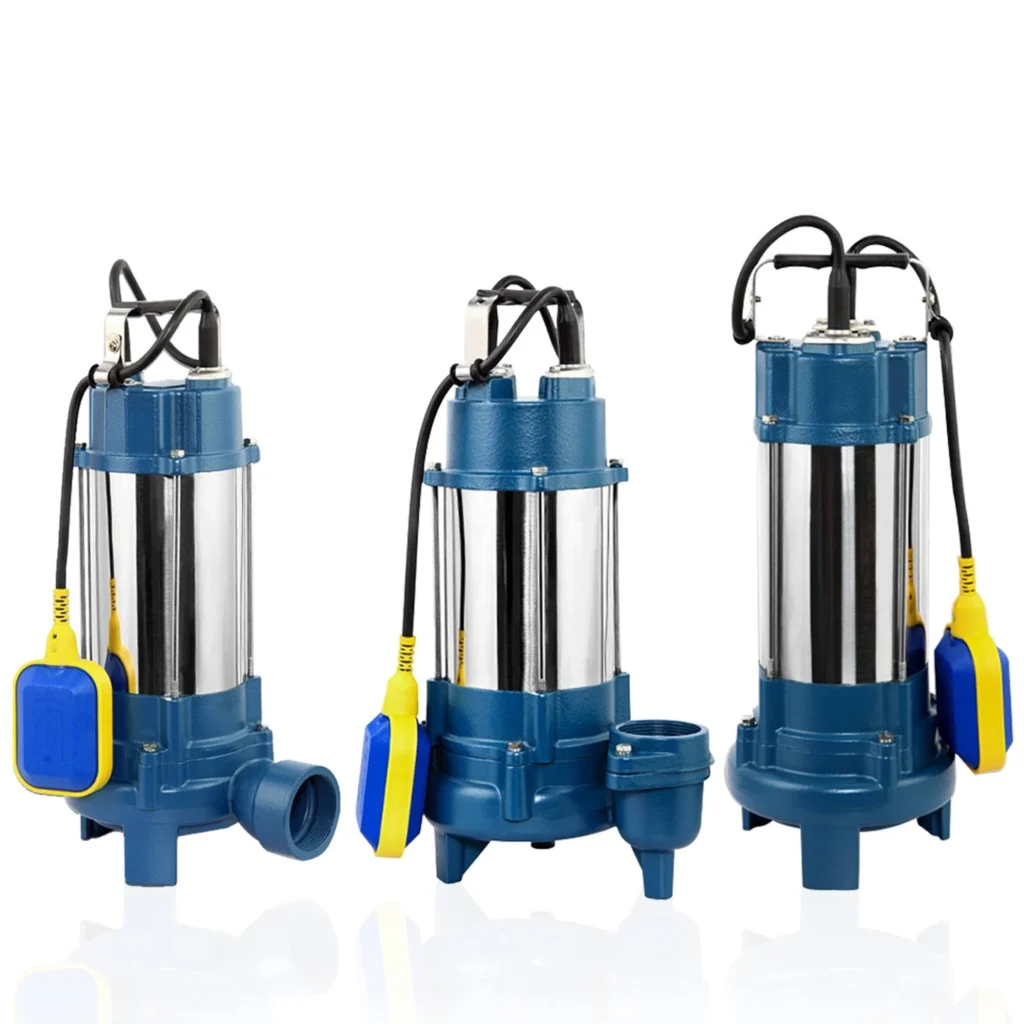
The first responsibility of any credible Submersible Sewage Pump manufacturer is to refuse one-size-fits-all answers. A domestic basement sump and a municipal lift station are fundamentally different engineering challenges. Before discussing flow, head, or impeller type, we must classify the application scenario and the working medium.
1.1 Six Primary Application Scenarios
| Scenario | Typical Flow Demand | Recommended Pump Type | Power Mode |
|---|---|---|---|
| Domestic sewage (basement, villa) | Low–Moderate | Submersible sewage pump, cutting impeller optional | Electric (single/three-phase) |
| Commercial sewage (hotel, mall, office tower) | Moderate | Clog-resistant submersible sewage pump | Electric three-phase |
| Industrial wastewater (factory, chemical park) | High | Heavy-duty submersible / centrifugal pump | Electric three-phase |
| Municipal sewage (lift station, WWTP) | Very High | Large-channel submersible sewage pump | Electric three-phase |
| Construction dewatering | Variable | Portable submersible / diesel pump | Electric or diesel |
| Off-grid / agricultural drainage | Moderate | Solar submersible sewage pump | Solar PV + battery |
A Submersible Sewage Pump manufacturer that sells into all six scenarios — as Jingong does — must maintain parallel product lines. This is precisely why our catalogue spans electric submersible models, solar-powered variants, and portable gasoline/diesel units: the scenario dictates the architecture, not the reverse.
1.2 Characterizing the Working Medium
Before a Submersible Sewage Pump manufacturer can recommend a model, the following medium parameters must be quantified:
- Solid content & particle size: Fine sand? Gravel? Organic solids? Maximum spherical diameter?
- Fibrous material: Rags, wipes, hair, agricultural straw — these demand a cutter or vortex impeller
- Temperature: Standard submersible sewage pumps handle 0–40 °C; higher temperatures require specialized seals and motor insulation
- pH & corrosiveness: Neutral municipal waste vs. acidic/alkaline industrial effluent
- FOG (Fats, Oils, Grease): Common in food processing; demands scheduled flushing
- Abrasion: Sand and grit accelerate wear on impeller and mechanical seal faces
Common misconception a professional Submersible Sewage Pump manufacturer must correct: Using a general-purpose drainage pump to handle industrial sewage. Drainage pumps lack the solids-handling passage and sealing robustness; they clog within weeks. Similarly, deploying an electric submersible pump in an off-grid location without power assessment guarantees failure. Scenario-first thinking prevents both mistakes.
1.3 Jingong’s Scenario-to-Product Mapping (Internal Linking Hub)
- Fixed, powered, high-volume → Submersible Sewage Pump Series
- Long horizontal runs, surface installation → Land Centrifugal Pump Series
- No grid power, sustainable operation → Solar Pump Series
- Emergency dewatering, mobile sites → Gasoline & Diesel Pump Series
Step 2 — Calculate Core Hydraulic Parameters: Flow Rate & Total Dynamic Head

No Submersible Sewage Pump manufacturer can responsibly quote a model without hydraulic calculations. This step separates professional engineering from guesswork. Two parameters dominate: Flow Rate and Total Dynamic Head (TDH).
2.1 Flow Rate (Q) Calculation
Flow rate is the volume of wastewater the pump must move per unit time, expressed in m³/h, GPM, or LPM. The cardinal rule — emphasized by every credible Submersible Sewage Pump manufacturer — is to size for PEAK flow, not average flow.
Formula:
Q_required = Peak Inflow Volume ÷ Time Window × Safety Factor (1.15–1.20)
Practical guidance:
- Residential: size to peak hourly inflow, add 15–20% margin
- Commercial: size to peak daily inflow, add 15–20% margin
- Industrial/Municipal: size to peak hourly inflow, add 10–15% margin for redundancy
Oversizing wastes energy; undersizing causes constant clogging and overflow. A balanced Submersible Sewage Pump manufacturer will tell you that the 15–20% contingency rule exists because “calculating average demand instead of peak demand, or neglecting to add contingency margin” is the #1 specification error in the industry.
2.2 Total Dynamic Head (TDH) Calculation
TDH = Static Head + Friction Loss + Minor Losses.
| Component | Definition | How to Estimate |
|---|---|---|
| Static Head | Vertical distance from lowest liquid level in the pit to highest discharge point | Direct measurement (meters or feet) |
| Friction Loss | Resistance from pipe wall, fittings, valves | Hazen-Williams or Manning equation using actual pipe diameter, length, roughness |
| Minor Losses | Losses from elbows, tees, check valves, entrance/exit | Equivalent length method or K-factor tables |
A Submersible Sewage Pump manufacturer provides pump performance curves (Q-H curves) so that specifying engineers can plot the duty point. The intersection of your required flow and TDH must fall within the pump’s efficient operating region — ideally near the Best Efficiency Point (BEP).
2.3 Common Hydraulic Mistakes
- Underestimating head — calculating only static head, ignoring friction → pump delivers insufficient pressure
- Calculating average instead of peak flow → system backup during surge events
- Ignoring pipe diameter assumptions → friction loss multiplies non-linearly with smaller diameters
- No contingency margin → 70% of overwork-related premature failures traced to this
Expert Tip from our Submersible Sewage Pump manufacturer engineering desk: Always request the pump curve from your supplier. A Submersible Sewage Pump manufacturer that cannot provide a Q-H curve for every model is a red flag. The curve is your single source of truth for matching duty point to pump capability.
Step 3 — Select Pump Structure & Solids Handling Capacity

This is where a Submersible Sewage Pump manufacturer demonstrates true domain expertise. The impeller — the heart of the pump — determines clog resistance, efficiency, and maintenance frequency.
3.1 Four Impeller Architectures
| Impeller Type | Max Solid Passage | Efficiency | Best Application | Clog Risk |
|---|---|---|---|---|
| Cutting (Grinder) | Up to 75 mm after cutting | 55–65% | Residential sewage, small commercial, long discharge runs | Low |
| Vortex (Non-clog) | Up to 120 mm unchopped | 40–50% | Industrial raw sewage, mining wastewater, fibrous material | Very Low |
| Channel (Single/Multi) | Up to 80 mm | 65–75% | Treated wastewater, municipal clear effluent | Medium |
| Agitator | Stirs settled solids | Variable | High sand/silt, slurry applications | Low–Medium |
The data above is drawn from real-world testing conducted by industrial pump manufacturers. When a Submersible Sewage Pump manufacturer presents this kind of comparison, buyers can make evidence-based decisions rather than relying on sales rhetoric.
3.2 Solids Handling Capacity — The #1 Clog Prevention Factor
Industry consensus in 2026: More than 62% of users replaced their submersible sewage pumps prematurely because they chose models with too-small allowable solid diameter, causing frequent clogging faults.
As a Submersible Sewage Pump manufacturer, Jingong’s standard industrial submersible sewage pumps can pass solid particles with diameter up to 80 mm; our customized cutting impeller models can handle fibrous waste such as rags and plastic strips without clogging. For heavy-duty industrial models, the passage can reach 100 mm.
3.3 Structural Form Factor
- Submersible (wet pit): Pump operates fully submerged, no priming needed, quiet, no cavitation risk from suction lift
- Dry-installed / centrifugal (surface): Easier maintenance access, better for high-head/low-solids clarified effluent
A versatile Submersible Sewage Pump manufacturer will offer both architectures and help you decide based on pit geometry, maintenance access, and total cost of ownership.
Step 4 — Confirm Material & Corrosion Resistance

Material selection is where a Submersible Sewage Pump manufacturer either earns long-term trust or quietly sets up a customer for premature failure. The wrong material in a corrosive environment can reduce service life from 10–15 years to 3–7 years.
4.1 Material Decision Matrix
| Material | Best Application | Characteristics |
|---|---|---|
| Standard Cast Iron | Domestic & general municipal sewage | Durable, cost-effective for standard pH and non-abrasive wastewater |
| Stainless Steel 304 | Coastal, mildly corrosive, food-grade | Excellent corrosion resistance, hygienic |
| Stainless Steel 316 | Highly corrosive, saltwater, chemical industrial | Superior pitting resistance, longer life in extreme media |
| Engineering Plastics (PP/PVDF) | Strong acid/alkali, chemical transfer | Extreme chemical resistance at lower mechanical strength |
| High-Chrome Iron | Mining, construction, sand-laden slurry | Hardened for severe abrasion |
4.2 Mechanical Seal System — The Most Critical Reliability Component
A Submersible Sewage Pump manufacturer must specify double mechanical seals as standard for continuous-duty sewage. Single mechanical seals last only 2–3 years in sewage; double mechanical seals with SiC/SiC faces provide failsafe protection — primary seal failure does not lead to motor damage.
From our case studies, submersible pumps with double-layer silicon carbide mechanical seals can avoid 92% of motor water-ingress faults. For normal working conditions, replace the double-mechanical seal every 2 years; for high-corrosive wastewater, every 12 months.
4.3 Compliance & Certification — Non-Negotiable for a Professional Submersible Sewage Pump Manufacturer
When evaluating any Submersible Sewage Pump manufacturer, verify these certifications:
- ISO 9001:2015 — Quality management system (ISO Official)
- ISO 14001 — Environmental management
- ISO 45001 — Occupational health & safety
- CE Marking — EU Safety, Health & Environmental compliance; covers Machinery Directive 2006/42/EC, Low Voltage Directive 2014/35/EU, EMC Directive 2014/30/EU (UL Certification Services)
- UL 778 / CSA C22.2 No. 108 — North American motor-operated water pump standards (UL)
- IEC 60034 — Rotating electrical machines
- IE2 / IE3 / IE4 — Motor energy efficiency ratings
- IP68 — Ingress protection for dust-tight, continuous submersion
A Submersible Sewage Pump manufacturer that cannot produce valid certification documentation for the target market is a liability. Jingong maintains ISO 9001 certification across our manufacturing facilities and provides CE, UL, and IE efficiency documentation upon request for every export order.
Step 5 — Power Mode & Electrical Configuration Matching
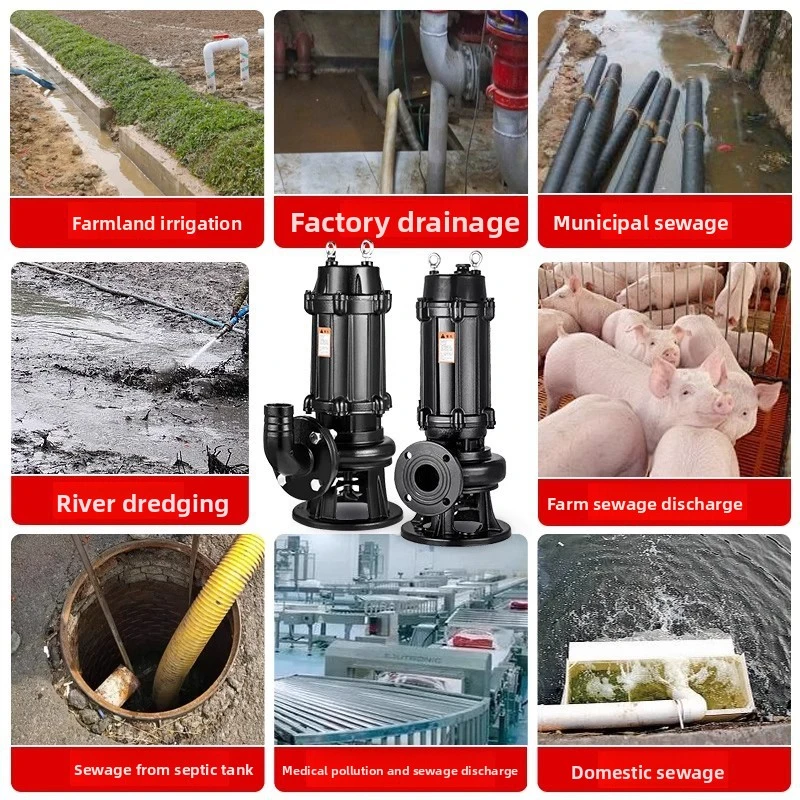
A truly full-spectrum Submersible Sewage Pump manufacturer offers multiple power trains. This step ensures the pump’s electrical architecture matches site reality.
5.1 Electric Submersible (Grid-Powered)
- Voltage options: 115 V / 230 V single-phase (residential, < 2 HP); 380 V / 400 V / 415 V three-phase (commercial & industrial)
- Frequency: 50 Hz (most of world) or 60 Hz (North America)
- Motor protection: IP68, Class F insulation, thermal overload, moisture sensors in stator windings
- Critical rule: Do not specify a 3+ HP pump on single-phase supply — the motor overheats and fails rapidly. If ≥3 HP is needed, verify three-phase availability or arrange supply upgrade.
5.2 Solar-Powered Submersible Sewage Pump
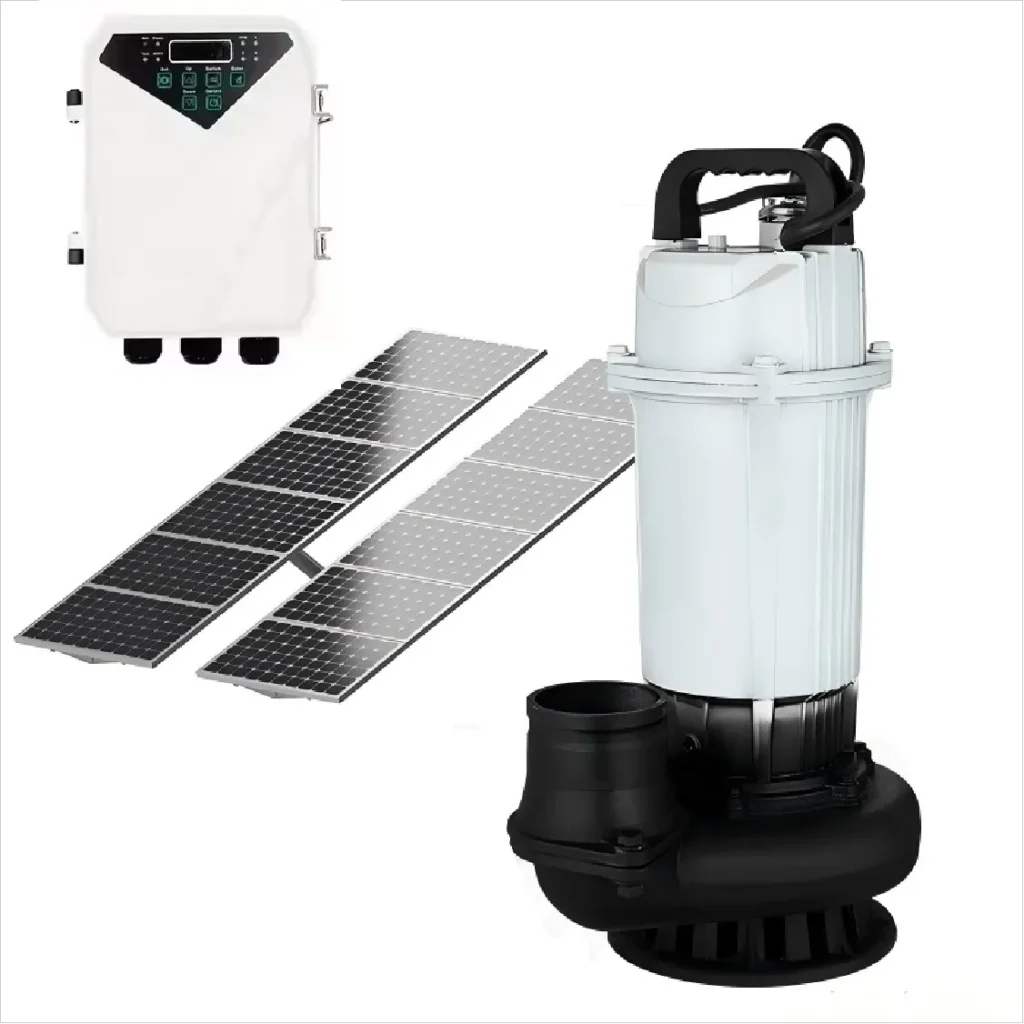
For off-grid locations — remote farms, field dewatering, wildlife reserves, disaster-relief sites — a Solar Submersible Sewage Pump eliminates dependency on grid power. As a Submersible Sewage Pump manufacturer with a dedicated solar product line, Jingong integrates PV arrays, MPPT controllers, and brushless DC motors to deliver reliable off-grid wastewater transfer.
Use cases:
- Agricultural wastewater in remote fields
- Ecological wastewater treatment in nature reserves
- Disaster relief & humanitarian water management
- Rural community sewage in developing markets
5.3 Gasoline / Diesel Driven Sewage Pump
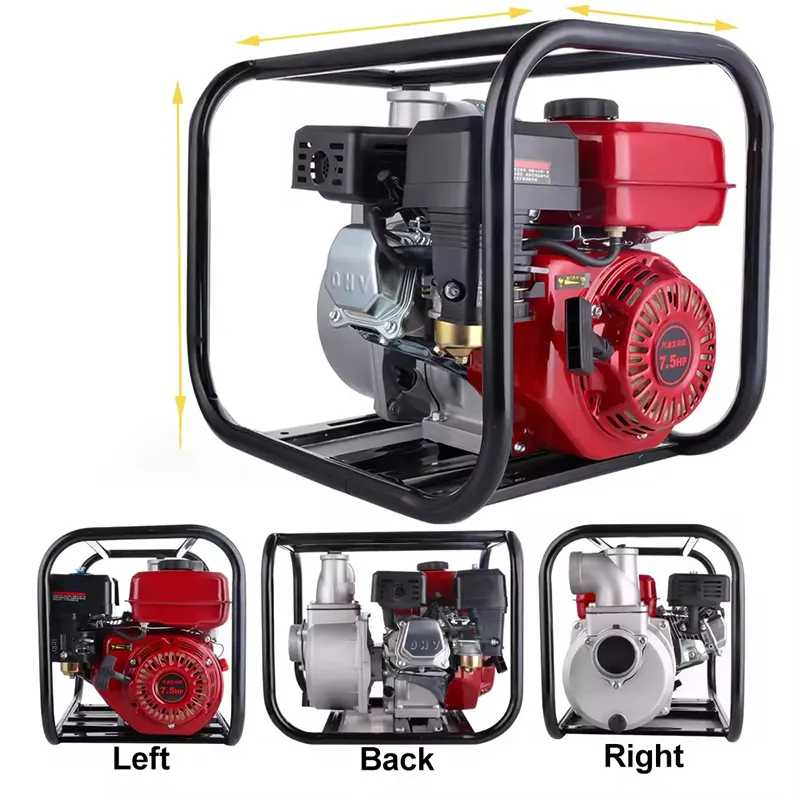
When portability and zero grid dependency are paramount, a Gasoline or Diesel Submersible Sewage Pump is the answer. These units are the weapon of choice for:
- Emergency flood & sewage dewatering
- Construction site temporary drainage
- Mine dewatering in remote locations
- Disaster response & mobile pumping stations
5.4 Intelligent Control & Automation
A modern Submersible Sewage Pump manufacturer equips pumps with:
- Float switch — automatic start/stop based on liquid level
- Overload protection — prevents motor burnout on jam
- Dry-run protection — prevents seal damage when water level drops
- Remote monitoring — IoT sensors for critical installations
Step 6 — Installation Mode & Maintenance Cost Assessment
The best pump from the best Submersible Sewage Pump manufacturer will fail prematurely if installed incorrectly. Improper installation is the top cause that shortens submersible sewage pump service life by more than 50%.
6.1 Installation Methods
| Method | Application | Key Advantage |
|---|---|---|
| Auto-coupling (guide rail) | Municipal & industrial wet wells | Pump lifts out without entering the well; safe & fast maintenance |
| Fixed submersible | Small sumps, residential | Simple, low-cost |
| Portable/mobile | Construction, emergency | Rapid deployment, no fixed infrastructure |
| Dry-installed centrifugal | Surface pump rooms | Easy access to all components |
6.2 Standardized Installation Procedure (refined from 10+ years of field practice)
- Clean the sump bottom of sharp debris and hard sediment
- Mount the auto-coupling base; ensure horizontal deviation ≤ 2 mm
- Connect guide rail and lifting chain; confirm smooth sliding to coupling position
- Verify cable insulation resistance ≥ 2 MΩ before power connection
- Never lift the pump by its electrical cable — use the lifting eye bolt
- Run 3-minute test operation; record current, vibration, and noise
- Confirm discharge piping is no smaller than pump discharge diameter; avoid unnecessary fittings
- Install a check valve (matched to solids handling) to prevent backflow
- Install a gate valve after the check valve for maintenance isolation
- Drill a 4.8 mm relief hole in discharge pipe within the wetwell, 51 mm above pump discharge but below the check valve, to prevent air lock
6.3 Preventative Maintenance Schedule
| Frequency | Task | ||
|---|---|---|---|
| Weekly | Test float switch sensitivity; check cable surface; record operating current & vibration | ||
| Monthly | Inspect impeller, bearings, seal assembly; remove scale & fiber; clean filter screen | ||
| Quarterly (continuous industrial use) | Full clean of grease and solid buildup; lubricate per OEM spec | ||
| Every 6 months | Inspect mechanical seals; check motor insulation resistance ≥ 1 MΩ |
Field data shows: submersible sewage pumps with regular monthly maintenance can extend total service life by 45% compared with units that only get repaired after failure. A responsible Submersible Sewage Pump manufacturer publishes these schedules and trains the client’s staff accordingly.
6.4 Total Cost of Ownership (TCO) Perspective
A Submersible Sewage Pump manufacturer that only competes on upfront price does a disservice to the buyer. TCO over a 10-year horizon typically breaks down as:
- ~15% — Initial purchase
- ~60% — Energy consumption
- ~20% — Maintenance & seal replacement
- ~5% — Downtime & emergency repairs
Selecting a high-efficiency model from a reputable Submersible Sewage Pump manufacturer reduces the 60% energy portion dramatically. Over 10 years, an IE3 / IE4 motor saves enough electricity to pay for the pump multiple times over.
Step 7 — Model Final Selection, Compliance & After-sales Guarantee
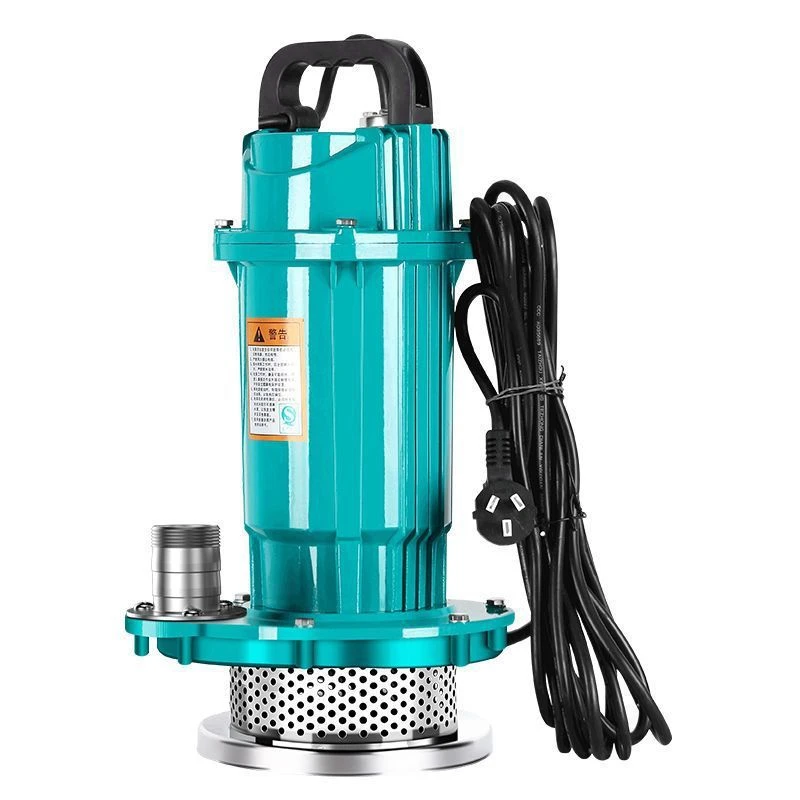
The final step of any professional Submersible Sewage Pump manufacturer’s engagement is to close the loop: confirm model match, verify compliance, and commit to after-sales support.
7.1 One-Click Selection Matrix
| Scenario | Flow | Solids | Material | Power | Jingong Model Family |
|---|---|---|---|---|---|
| Domestic basement | < 20 m³/h | < 30 mm | Cast iron | 1.5 kW electric | JG-SP 1.5 |
| Commercial building | 20–50 m³/h | < 50 mm | SS304 | 3 kW electric | JG-SP 3.0C |
| Industrial wastewater | 50–120 m³/h | < 80 mm | SS316 / Cast iron | 7.5 kW electric | JG-SP 7.5HD |
| Municipal lift station | > 120 m³/h | < 100 mm | High-chrome / SS316 | 15–75 kW electric | JG-SP HD Series |
| Off-grid agriculture | 10–40 m³/h | < 50 mm | SS304 | Solar DC | JG-SOLAR SP |
| Emergency dewatering | 30–80 m³/h | < 75 mm | Cast iron | Diesel / Gasoline | JG-DG SP |
7.2 Compliance Verification Checklist
Before shipment, a professional Submersible Sewage Pump manufacturer performs:
- 100% factory pressure and performance testing
- Electrical safety testing to IEC 60034 / EN 60529 (IP rating)
- Hydraulic performance testing to ISO 9906
- Mechanical run-in test for minimum 30 minutes
- Pre-shipment inspection report (PSI) with documented data
- Certification labels: CE, UL (optional per market), ISO 9001 registered
7.3 After-Sales & Warranty Commitment
Jingong, as your long-term Submersible Sewage Pump manufacturer partner, provides:
- 2-year full machine warranty on all standard models
- Extended motor warranty options for municipal contracts
- Global spare parts network with regional warehouses
- 24-hour response commitment for overseas distributor support
- Custom engineering: 1,000+ custom solutions delivered since 2000 across mining, chemical, and municipal projects
7.4 Top Selection Pitfalls — Avoid These
- Buying on price alone — cheap pumps from non-certified suppliers fail within 3 years; TCO skyrockets
- Parameter falsification — some suppliers inflate flow/head ratings; always request the Q-H curve
- Wrong impeller for the medium — drainage pump for sewage → immediate clogging
- Ignoring voltage compatibility — 60 Hz motor on 50 Hz grid (or vice versa) causes overload
- Single mechanical seal in sewage duty — guaranteed water ingress within 2 years
- No redundancy margin — operating at 100% of rated capacity leaves zero headroom for surge events
Frequently Asked Questions
Q1: How long does a submersible sewage pump last?
From our case studies, a high-quality properly maintained submersible sewage pump lasts 8–15 years, while low-quality untested pumps often require replacement within 3 years. Regular inspection every 6 months extends service life by 30%.
Q2: Can a submersible sewage pump run continuously?
Yes, with correct specification. Continuous duty requires: double mechanical seals, IE3/IE4 motor, proper cooling path, and thermal protection. A Submersible Sewage Pump manufacturer must confirm continuous-duty rating before application in 24/7 operations.
Q3: Which impeller is best for fibrous wastewater?
Vortex or cutting (grinder) impellers. Vortex handles up to 120 mm solids with very low clog risk; cutting impeller macerates fibrous waste into fine slurry. Standard channel impellers will clog on rags and wipes.
Q4: How do I know if I need a solar submersible sewage pump?
If your site lacks reliable grid power, or you seek sustainable operation, a solar-powered unit from a qualified Submersible Sewage Pump manufacturer like Jingong eliminates fuel costs and grid dependency. Ideal for remote agriculture, ecological projects, and disaster relief.
Q5: What certifications should I require from my Submersible Sewage Pump manufacturer?
Minimum: ISO 9001 (quality management). Market-specific: CE (Europe), UL 778 / CSA (North America), IE efficiency rating, IP68 ingress protection, IEC 60034 motor compliance. Request actual certificate copies, not just claims.
Q6: What happens if I select a pump with insufficient solids-handling capacity?
Industry data shows >62% of premature replacements trace back to too-small solids passage. The pump clogs repeatedly, the motor overheats from blocked impeller, and the mechanical seal fails from excessive load. Always size the solids passage 20–30% larger than the maximum expected particle.
Q7: How often should I service my submersible sewage pump?
Intermittent residential use: annual inspection. Continuous industrial operation: quarterly inspection and cleaning. Weekly float-switch testing is recommended for all critical applications. A Submersible Sewage Pump manufacturer should provide a customized maintenance schedule based on your duty cycle.
Conclusion: Partner with a Submersible Sewage Pump Manufacturer That Engineers for the Long Term
Selecting the right submersible sewage pump is not a commodity purchase — it is an engineering decision with 10–15 year implications. The 7-step framework outlined above — Scenario → Hydraulics → Structure → Material → Power → Installation → Final Compliance — gives specifying engineers and procurement professionals a defensible, repeatable methodology.
As a vertically integrated Submersible Sewage Pump manufacturer, Jingong Technology brings 15+ years of combined production experience across submersible pumps, centrifugal pumps, solar pumps, and gasoline/diesel pumps. We do not just sell pumps; we engineer complete wastewater transfer solutions validated against ISO, CE, UL, and IEC standards.
Whether your project requires a standard submersible model, an off-grid solar variant, or a portable diesel emergency unit, our engineering team stands ready to:
- Calculate your exact flow & TDH requirements
- Recommend the optimal impeller, material, and power configuration
- Provide a full Q-H performance curve for validation
- Deliver factory-tested, certified equipment with comprehensive documentation
- Support you with 2-year warranty and lifetime spare parts availability
Ready to specify your pump? Contact our engineering team with your application scenario, flow rate, total head, solids characteristics, and power availability. Within 24 hours, a dedicated Submersible Sewage Pump manufacturer engineer will respond with a tailored selection and quotation.
Your reliable Submersible Sewage Pump manufacturer — Jingong Technology. Engineering reliability into every pump since day one.

0 Comments