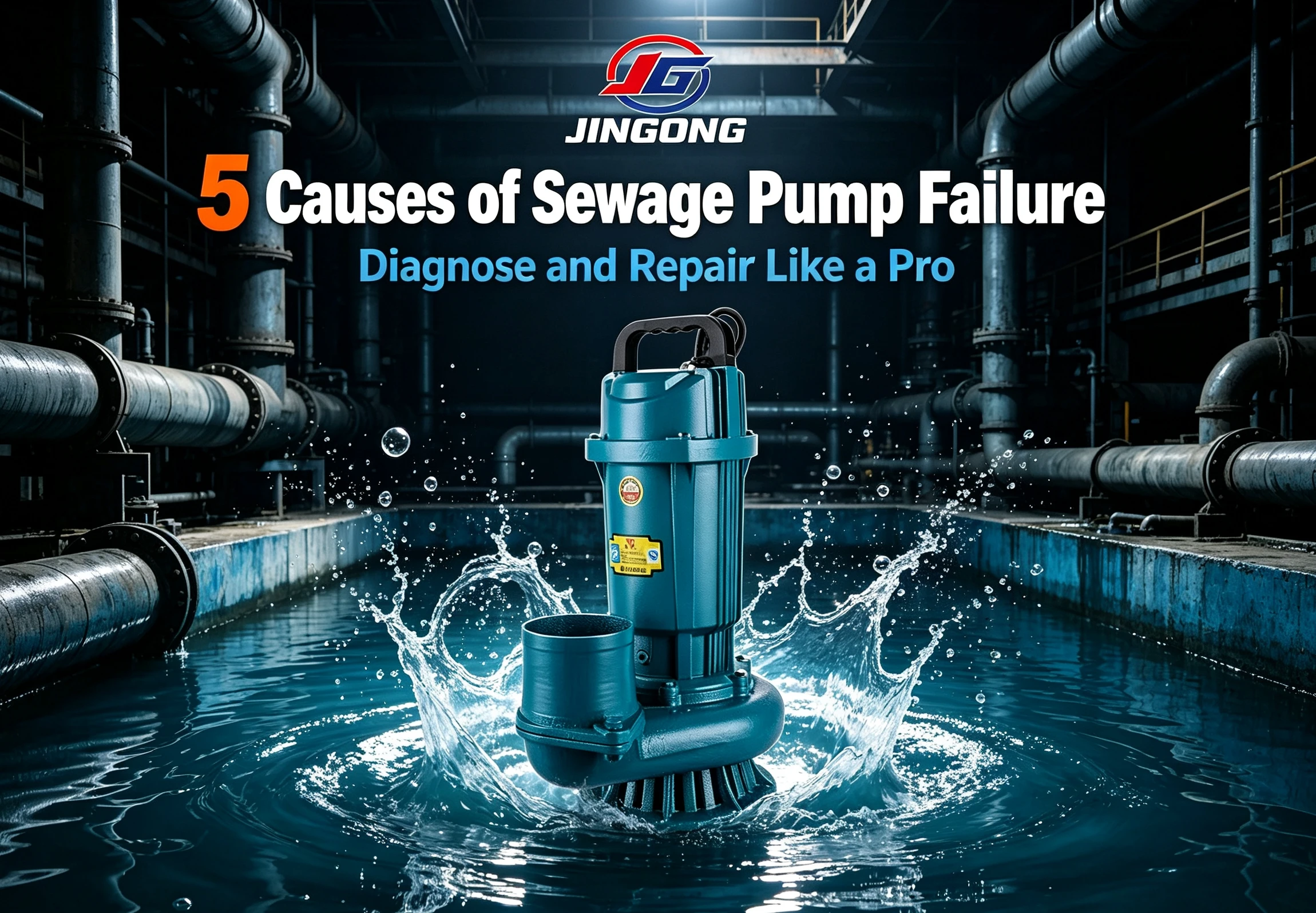
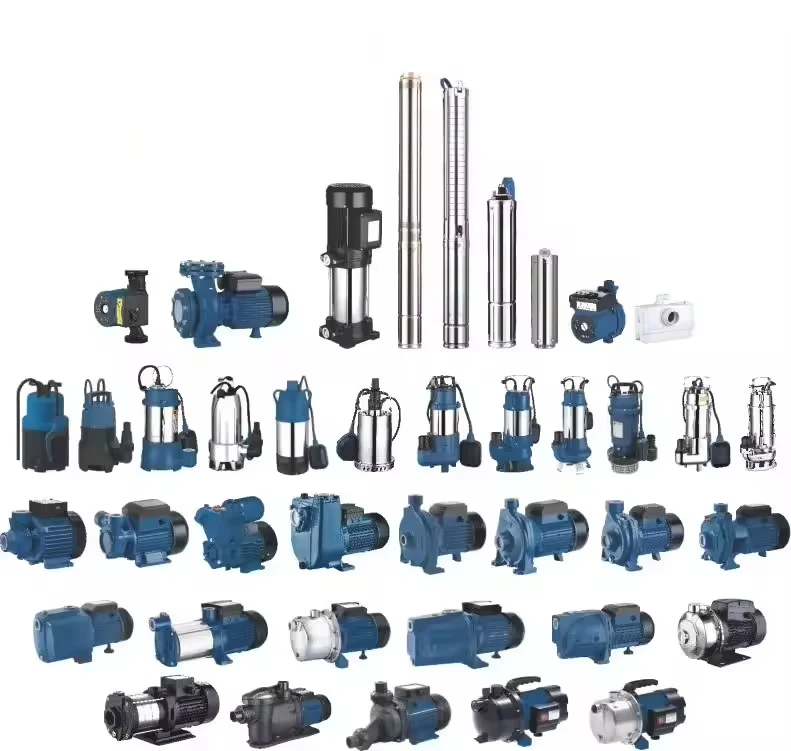
As a Submersible Sewage Pump manufacturer with over 15 years of engineering, production and export experience across the full pump portfolio—submersible pumps, land pumps, solar water pumps, gasoline and diesel pumps—Jingong Technology has field-tested thousands of units in municipal, industrial and domestic wastewater applications. This guide distils the five highest-frequency failure modes we see in the field, the engineering root causes behind each, and the standardized repair workflow our technicians use to bring pumps back online.
Whether you are an engineering contractor, maintenance supervisor, equipment distributor or plant operator, understanding these five failure patterns will help you reduce unplanned downtime, extend equipment lifespan and lower total cost of ownership. Every recommendation below reflects real-world practice from a seasoned Submersible Sewage Pump manufacturer serving clients in Europe, North America, the Middle East, Southeast Asia and Africa.
Why Submersible Sewage Pump Failures Matter to Your Business
A failing submersible sewage pump is never just a “broken pump.” It cascades into production downtime, emergency repair costs, secondary equipment damage, environmental compliance risks and project delays. For municipal stations, a single failure can mean overflow incidents and regulatory penalties. For industrial plants, it can halt an entire production line. This is why choosing a reliable Submersible Sewage Pump manufacturer and following standardized maintenance protocols is critical from day one.
In the sections below, we break down the five dominant failure categories: mechanical seal damage & water ingress, impeller clogging, electrical system failure, cavitation & abnormal vibration, and dry-running & overheating. Each follows a unified EEAT structure—Symptoms → Root Causes → Step-by-Step Fix → Long-Term Prevention—so your team can act immediately.
Core Components You Need to Know First
Before diving into failures, a quick anatomy recap. A typical submersible sewage pump consists of:
- Mechanical seal – prevents wastewater from reaching the motor housing.
- Impeller – generates flow; in sewage pumps, often a non-clog or cutting design.
- Motor winding – the electrical core; sensitive to moisture and overheating.
- Control switch / float switch – manages automatic start-stop based on water level.
- Discharge pipeline – carries effluent to the treatment system.
Understanding these five elements helps any Submersible Sewage Pump manufacturer diagnose faults systematically. With that foundation, let’s examine the top five failure modes.
Fault 1: Mechanical Seal Damage & Water Ingress
Mechanical seal failure is statistically the #1 cause of submersible sewage pump motor burnout across the industry. As an experienced Submersible Sewage Pump manufacturer, Jingong’s warranty data shows seal-related issues account for nearly 40% of returned units.
Symptoms
- Pump short-circuits or trips the breaker immediately on startup
- Motor overheats rapidly even under light load
- Oil in the oil chamber appears milky or emulsified
- Pump stops working suddenly without warning
- Leakage indicator alarm triggers on smart models
Root Causes
- Seal aging & wear – normal degradation after prolonged operation
- Abrasive sewage corrosion – sand, grit and chemical contaminants accelerate seal face wear
- Improper installation – misalignment creates uneven face pressure
- Dry-running friction damage – operating without adequate liquid destroys the seal faces within minutes
Step-by-Step Fix
- Safety first: Cut all power at the source. Lock-out/tag-out per OSHA/EN standards.
- Dismantle the pump: Remove the discharge pipe, unbolt the pump head, and lift the unit to a clean workshop area.
- Replace the mechanical seal: As a professional Submersible Sewage Pump manufacturer, we recommend replacing the complete seal assembly (both rotating and stationary faces) rather than attempting a partial repair.
- Check motor insulation: Use a megohmmeter to verify winding insulation resistance exceeds 1 MΩ. If water has entered the stator chamber, the motor must be dried and rewound or replaced.
- Refill lubricating oil: Fill the oil chamber with the specified dielectric oil to the correct level.
- Pressure test: Conduct a pneumatic test at 0.1 MPa (1 bar) for 30 minutes to confirm no leaks before reassembly.
Long-Term Prevention
- Schedule regular seal inspections every 6 months in heavy-duty applications
- Strictly avoid dry running—install dry-run protection devices
- For corrosive industrial sewage, specify corrosion-resistant seals (silicon carbide faces, FKM rubber) from your Submersible Sewage Pump manufacturer
- Train operators on proper startup/shutdown procedures
👉 Looking for genuine spare parts? Visit our Submersible Pump Spare Parts page for OEM seals, impellers and oil chambers.
Fault 2: Impeller Clogging & Blockage

This is a sewage-pump-specific failure that rarely affects clean-water pumps. As a Submersible Sewage Pump manufacturer specializing in WQ-series non-clog pumps, we see this issue most frequently in municipal and commercial applications.
Symptoms
- Pump runs but delivers no water or very low flow
- Abnormal grinding or rattling noise from the pump body
- Motor overload and elevated current draw
- Frequent thermal protector trips
Root Causes
- Fibers and debris winding – rags, plastic strips, hair wrap around the impeller vanes
- Solid particle accumulation – sand, gravel and solids settle and jam the impeller
- Grease congealing – in FOG (fat, oil, grease) applications, congealed grease blocks flow passages
- Inlet screen blockage – external debris prevents intake
Step-by-Step Fix
- Power off the pump completely and disconnect from the control panel.
- Lift the pump out of the sump using the lift chain or hoist—never pull by the cable.
- Clean the impeller and inlet: Remove visible debris manually. For cutting impeller designs, inspect whether the cutting edges remain sharp.
- Check impeller deformation: Measure radial clearance against factory specs. Replace the impeller if worn beyond tolerance.
- Test operation: Reinstall, restore power and verify flow rate and current draw are within rated parameters.
Long-Term Prevention
- Install an external filter screen or bar grate at the inlet (never inside the pump suction)
- Specify cutting impeller or non-clog impeller design from your Submersible Sewage Pump manufacturer for fibrous waste applications
- Establish a monthly cleaning routine for high-solid environments
- Consider a grinder pump variant for severely contaminated wastewater
👉 Explore our High-Efficiency Non-Clog Submersible Sewage Pump series engineered to minimize clogging downtime.
Fault 3: Electrical System Failure & Overload Operation

Electrical faults are responsible for roughly 25% of all pump failures reported to any Submersible Sewage Pump manufacturer. These are also the most dangerous, carrying risk of fire and electrocution.
Symptoms
- Pump fails to start; silent or humming sound only
- Frequent breaker trips or blown fuses
- Motor burns out completely (burning smell, discolored windings)
- Phase-loss operation in three-phase units
- Float switch fails to trigger automatic start/stop
Root Causes
- Unstable voltage – brownouts, voltage spikes, or phase imbalance in three-phase systems
- Cable damage – rodent bites, abrasion, or water infiltration into cable joints
- Float switch failure – stuck mechanism or electrical contact corrosion
- Motor winding aging – insulation breakdown from heat cycling
- Long-term overload – pump operates beyond its rated curve for extended periods
Step-by-Step Fix
- Check power supply & circuit: Verify input voltage matches nameplate rating (±10%).
- Inspect cables: Look for cracks, water stains, or burn marks. Replace damaged sections with waterproof junction boxes.
- Test the float switch: Manually activate to confirm electrical continuity; replace if faulty.
- Test motor winding resistance: Use a multimeter to measure resistance between phases and to ground. Infinite resistance to ground = good; near-zero = shorted winding.
- Repair or replace motor: If windings are compromised, return the unit to your Submersible Sewage Pump manufacturer for rewinding or motor replacement.
Long-Term Prevention
- Install overload protectors, phase-loss relays and surge arresters
- Conduct quarterly circuit inspections
- Match pump power rating precisely to the working condition—oversizing is as harmful as undersizing
- Specify IP68-rated cable glands and waterproof connectors
👉 Our Solar Pump & Diesel Pump Electrical Protection Systems share the same electrical safety architecture across all Jingong pump products.
Fault 4: Cavitation & Abnormal Vibration / Noise

Cavitation is a subtle but destructive failure mode. A credible Submersible Sewage Pump manufacturer always educates clients on recognizing the early signs, because by the time noise becomes obvious, internal components are already damaged.
Symptoms
- Loud grinding, knocking or “gravel-in-a-can” noise
- Severe vibration felt through the discharge pipe and pump body
- Unstable water output—flow fluctuates without changes in demand
- Pump body visibly shaking or “walking” on its base
Root Causes
- Improper installation depth – pump too close to the bottom draws in air pockets
- Pipeline blockage downstream – back-pressure forces cavitation at the impeller eye
- Insufficient water level – vortex formation pulls air into the suction
- Bearing wear – allows shaft misalignment, creating imbalance
- Cavitation erosion – vapor bubbles implode against metal surfaces, pitting the impeller
Step-by-Step Fix
- Adjust installation position: Raise the pump to maintain minimum submergence depth (typically ≥1 m above the bottom).
- Check and smooth the pipeline: Remove any obstructions; ensure proper pipe diameter to avoid velocity-induced cavitation.
- Replace damaged bearings: Open the motor housing, inspect bearing condition, and replace if pitted or rough.
- Supplement water volume: Ensure the wet well maintains adequate water levels at all times.
- Re-test: Run the pump and verify vibration levels are within ISO 10816 Zone A/B limits.
Long-Term Prevention
- Follow standard installation guidelines provided by your Submersible Sewage Pump manufacturer
- Implement regular bearing lubrication schedules
- Avoid low-water-level operation via level sensors and automatic shutdown
- Design sumps with anti-vortex baffles
👉 Related reading: our Land Pump Installation & Maintenance Guide covers shared installation principles applicable across pump types.
Fault 5: Dry Running & Overheating Damage
Dry running is the fastest way to destroy a submersible pump. No reputable Submersible Sewage Pump manufacturer can warranty a pump that has been operated dry, yet it remains one of the most common user-induced failures.
Symptoms
- Pump body extremely hot to the touch
- Motor burns out within minutes of dry operation
- Seal ages and cracks rapidly after a dry-run event
- Pump seizes or impeller welds to the wear ring
Root Causes
- Low water level – wet well drains faster than the pump can evacuate, exposing the pump
- Water supply interruption – upstream source fails while pump continues running
- No dry-run protection – float switches misadjusted or missing thermal sensors
- Long-term idling – pump runs against a closed discharge valve
Step-by-Step Fix
- Stop operation immediately—do not restart a hot pump.
- Cool down: Allow natural cooling for at least 2 hours before inspection.
- Detect motor & seal damage: Megger test the windings; inspect the mechanical seal for heat cracking.
- Replace damaged parts: In most dry-run scenarios, both the motor and seal require replacement. Consult your Submersible Sewage Pump manufacturer for a refurbishment quote.
Long-Term Prevention
- Equip dry-run protection devices—either built-in thermal sensors or external level controllers
- Set up water level monitoring with automatic shutoff at minimum threshold
- Standardize operator training on startup/shutdown sequences
- Specify pumps with built-in dry-run protection when ordering from your Submersible Sewage Pump manufacturer
👉 Discover our Intelligent Pump Protection System—featuring dry-run guards, leakage sensors and remote alarms.
Comprehensive Pump Maintenance Checklist
A proactive maintenance schedule is the single most effective way to prevent all five failure modes above. As your trusted Submersible Sewage Pump manufacturer, Jingong recommends the following standardized checklist, applicable across submersible, land, solar and diesel pump product lines:
Daily Inspection
- ✅ Listen for unusual noise or vibration
- ✅ Check motor temperature (infrared thermometer recommended)
- ✅ Verify flow rate and discharge pressure
- ✅ Confirm power supply stability
Monthly Maintenance
- ✅ Clean impeller and inlet strainer
- ✅ Inspect power cable and float switch
- ✅ Check oil chamber for water contamination
- ✅ Test overload protection devices
Annual Overhaul
- ✅ Replace mechanical seal and lubricating oil
- ✅ Test motor insulation resistance (≥1 MΩ)
- ✅ Measure bearing clearance and replace if worn
- ✅ Conduct overall performance testing against original curve
Document every inspection. Trend analysis over time is one of the most powerful predictive maintenance tools available to any operator working with a Submersible Sewage Pump manufacturer‘s equipment.
Frequently Asked Questions
Q1: How long does a submersible sewage pump last?
A: With proper maintenance, a quality submersible sewage pump from a reputable Submersible Sewage Pump manufacturer typically lasts 8–15 years. Mechanical seals may need replacement every 2–5 years depending on the abrasiveness of the wastewater. Motors generally survive 10+ years if never subjected to water ingress or dry running.
Q2: Can a submersible pump run continuously?
A: Yes, but only within its rated duty cycle. Continuous operation generates heat; the pump relies on the surrounding water for cooling. A responsible Submersible Sewage Pump manufacturer will specify S1 (continuous) or S2 (short-time) duty ratings on the nameplate. Exceeding these ratings leads directly to Fault 5 (dry running & overheating).
Q3: How to fix a clogged sewage pump quickly?
A: Power off, lift the pump, manually clear debris from the impeller and inlet, reinstall, and restore power. For recurring clogs, consult your Submersible Sewage Pump manufacturer about upgrading to a cutting impeller or grinder pump design. Never attempt to run the pump “through” a clog—this is the fastest path to motor burnout.
Q4: What causes a submersible pump to burn out?
A: The four leading causes are: (1) water ingress from seal failure, (2) electrical faults—voltage instability, phase loss, cable damage, (3) prolonged overload, and (4) dry running. Any Submersible Sewage Pump manufacturer will tell you that >80% of burnout cases stem from these four issues, all of which are preventable with proper maintenance and protective devices.
Q5: Is dry running harmful to submersible sewage pumps?
A: Extremely harmful. Dry running can destroy a submersible pump’s motor and mechanical seal within minutes. The seal faces require liquid film for lubrication; without it, friction generates temperatures exceeding 200°C, causing instantaneous seal failure and subsequent water ingress. This is why every Submersible Sewage Pump manufacturer, including Jingong, strongly recommends dry-run protection as a standard feature.
Conclusion: Partner with a Submersible Sewage Pump Manufacturer That Understands Failure Prevention
The five failure modes we’ve covered—mechanical seal damage, impeller clogging, electrical system failure, cavitation & vibration, and dry running & overheating—account for the vast majority of submersible sewage pump downtime worldwide. Understanding their symptoms, root causes and fixes puts your maintenance team ahead of 90% of operators.
But knowledge alone isn’t enough. Preventive maintenance always outperforms reactive repair. By partnering with a Submersible Sewage Pump manufacturer that provides not just equipment but complete lifecycle support—engineering consultation, spare parts availability, maintenance training and rapid technical response—you transform pump reliability from a cost center into a competitive advantage.
Jingong Technology is exactly such a Submersible Sewage Pump manufacturer. With over a decade of manufacturing and export experience across submersible pumps, land pumps, solar water pumps, gasoline and diesel pumps, we deliver:
- 🌍 Customized product solutions tailored to your specific wastewater characteristics
- 🔧 Full-spectrum maintenance programs and OEM spare parts supply
- 📞 24/7 technical support in English, Spanish, Arabic and Chinese
- 🏭 Factory-direct pricing with ISO 9001, CE, UL and RoHS certifications
As a globally trusted Submersible Sewage Pump manufacturer, we invite engineering contractors, distributors and industrial end-users to consult with our technical team for pump selection, failure analysis, and bulk procurement. When you choose Jingong, you’re not just buying a pump—you’re gaining a Submersible Sewage Pump manufacturer committed to your operational success for the long term.
Contact us today for a free technical consultation. Our engineers—backed by the full resources of a leading Submersible Sewage Pump manufacturer—will help you specify the right pump, design the optimal installation, and establish a maintenance protocol that minimizes failures and maximizes ROI.
👉 Contact Jingong Technology – Your Professional Submersible Sewage Pump Manufacturer

0 Comments