
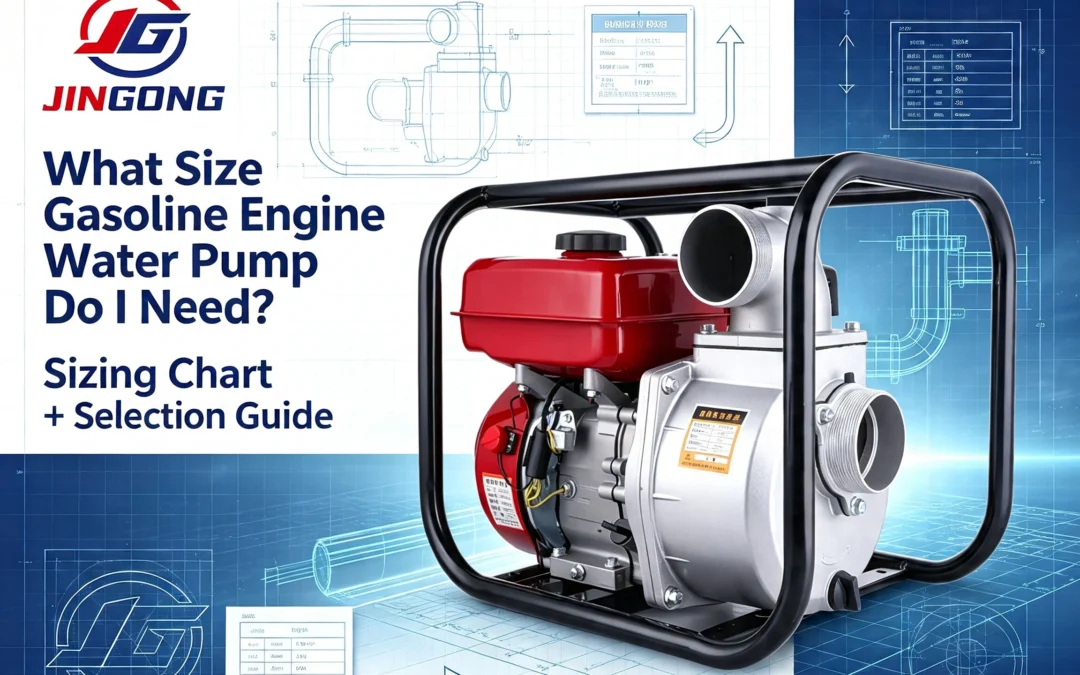
The correct size for a gasoline engine water pump depends on your required flow (GPM/LPM), total head pressure (vertical lift + friction loss), and suction lift. For most small farms and light construction, a 2-inch, 5.5 HP pump suffices. For large-scale irrigation or flood control, you’ll need a 4-6 inch, 9-13 HP unit. Read on for the detailed breakdown.
Why “Size” Matters More Than You Think
If you’ve found yourself typing “What size gasoline engine water pump do I need?” into a search bar, you understand the stakes. Selecting the wrong size leads to catastrophic inefficiency, premature equipment failure, and wasted capital. At Jingong Technology based in Zhejiang—China’s pump manufacturing hub—we have engineered and exported thousands of gasoline engine water pump units globally. We’ve seen firsthand how a mismatched pump can cripple a harvest or halt a construction project.
This guide isn’t just theory; it’s a distillation of our factory-floor expertise. We specialize in a full spectrum of pumping solutions, including booster pumps, submersible pumps, surface pumps, solar pumps, and of course, gasoline and diesel engine-driven pumps. Today, we focus specifically on the gasoline engine water pump.
By the end of this article, you will understand the four critical variables that determine size and be able to select the perfect unit for your needs.
1. Key Premise: Define Your Application Scenario First
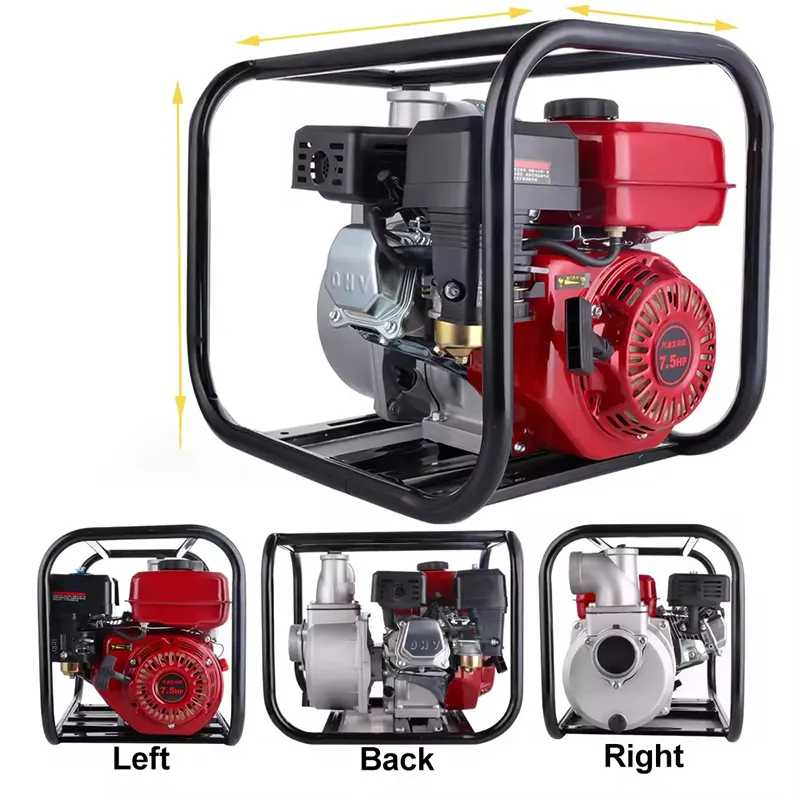
A gasoline engine water pump is not a “one-size-fits-all” tool. The physical environment dictates the engineering requirements. Below are the five most common scenarios we encounter in our B2B export business.
1.1 Agricultural Irrigation
Scenario: Moving water from rivers, wells, or ponds to crops. The water is usually clean to mildly sediment-laden.
Sizing Bias: For flood irrigation, prioritize high flow rates. For sprinklers or drip systems, prioritize stable pressure (head).
| Farm Scale | Inlet/Outlet | Target Flow | Target Head | Recommended HP |
|---|---|---|---|---|
| < 1 Acre (Small Garden) | 2″ (50mm) | 150–250 L/min | 20–26 m | 4–5.5 HP |
| 1–5 Acres (Orchard) | 3″ (80mm) | 500–850 L/min | 25–30 m | 5.5–7.5 HP |
| 5–20 Acres (Paddy Field) | 4″ (100mm) | 900–1,200 L/min | 25–30 m | 7.5–9 HP |
1.2 Construction Site Drainage
Scenario: Removing groundwater, rainwater, or sludge from trenches, basements, and foundations.
Sizing Bias: Durability and “semi-trash” capabilities. You need a gasoline engine water pump that can handle solids without clogging the impeller.
1.3 Emergency Pumping / Flood Control
Scenario: Rapid removal of large volumes of water during natural disasters or facility flooding.
Sizing Bias: Maximum flow and portability. High-volume, low-pressure is the goal here.
1.4 Industrial Water Supply / Circulation
Scenario: Providing makeup water for cooling towers, pressure washing, or remote site operations where electricity is unavailable.
Sizing Bias: High head pressure and long runtime stability.
1.5 Residential / Small Garden
Scenario: Draining pools, filling ponds, or watering a small lawn.
Sizing Bias: Compact size, lightweight, and quiet operation.
2. Core Sizing Metrics: 3 Key Parameters Determine Size
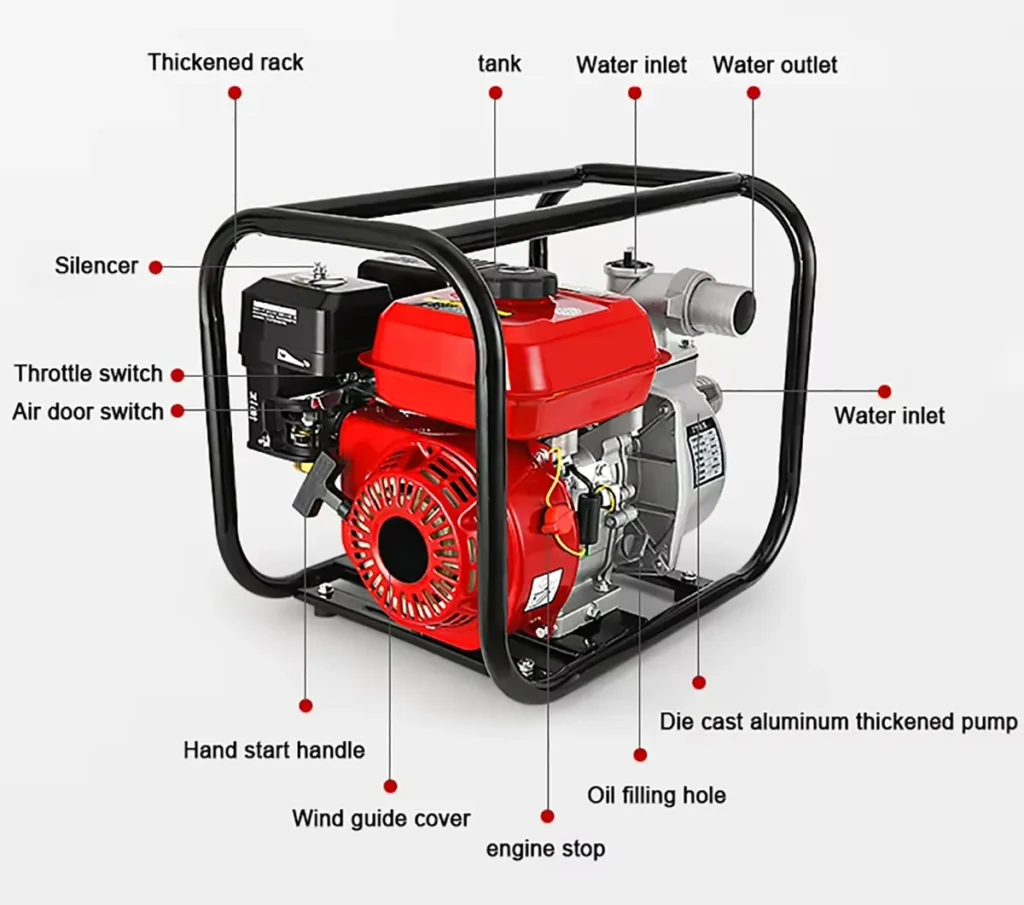
To properly size a gasoline engine water pump, you must master three hydraulic parameters. Ignore the engine HP for a moment; focus on the pump end.
2.1 Flow Rate (GPM / LPM)
Definition: The volume of water moved per minute. 1 m³/h ≈ 16.67 L/min ≈ 4.4 GPM.
Calculation:
- Agriculture: (Acres × Crop Water Need) ÷ Hours Available.
- Construction: Must exceed the inflow rate during peak rainfall.
Warning: Do not confuse “Max Flow” with “Rated Flow.” A pump rated at 1,000 L/min max flow might only deliver 600 L/min at a 20-meter head. Always check the performance curve.
2.2 Head Pressure (Total Head)
Definition: The total resistance the pump must overcome.
Formula: Total Head = Static Head (Vertical Height) + Dynamic/Friction Head (Pipe Losses) + Discharge Pressure.
Rule of Thumb: Every 10 feet of horizontal pipe adds roughly 1 foot of head due to friction. Elbows and valves add even more. Ensure your gasoline engine water pump has at least 20% more head capacity than your calculated total head.
2.3 Suction Lift
Definition: The vertical distance from the pump’s inlet down to the water source.
The Physics: Atmospheric pressure limits suction lift. At sea level, the absolute maximum is 10.3 meters. However, a standard self-priming gasoline engine water pump typically maxes out at 7–8 meters due to real-world inefficiencies and vapor pressure.
Critical Advice: If your water source is deeper than 8 meters, do not buy a standard self-priming pump. You must use a submersible pump or a jet pump.
2.4 Engine Horsepower (HP) – The Power Source
Once you know the Flow and Head, you can determine the Hydraulic Horsepower required. The engine provides the Brake Horsepower.
Rule of Thumb: A 5.5 HP engine is generally the sweet spot for a 2-inch high-performance pump. A 9 HP engine is standard for 3-inch and 4-inch units. A 13 HP engine is necessary for 6-inch high-volume applications.
At Jingong, we ensure our gasoline engine water pump engines (typically 170F, 177F, or 188F series) are perfectly matched to the pump impeller to prevent overloading.
3. Gasoline Engine Water Pump Sizing Chart

Use this chart as your primary reference. It synthesizes data from our extensive testing and international shipping records.
| Pump Class (In/Out) | Engine HP | Max Flow (L/min) | Max Head (m) | Suction Lift (m) | Best Application |
|---|---|---|---|---|---|
| 1.5″ (40mm) | 2.5 HP | 200 | 30 | 7 | Home, Small Garden |
| 2″ (50mm) | 4.0 – 5.5 HP | 600 | 32 | 8 | Irrigation, Light Dewatering |
| 3″ (80mm) | 5.5 – 7.5 HP | 1,000 | 35 | 8 | Orchards, Mid-Sized Construction |
| 4″ (100mm) | 7.5 – 9.0 HP | 1,300 | 30 | 8 | Large Farms, Heavy Duty Dewatering |
| 6″ (150mm) | 9.0 – 13.0 HP | 2,200 | 25 | 7 | Flood Control, Canal Transfer |
4. Common Sizing Mistakes (Avoid These!)
As a seasoned gasoline engine water pump supplier, I’ve seen these errors cost clients thousands:
- The “Bigger HP = More Flow” Myth: False. A 9 HP engine on a small 2-inch impeller won’t flow more than a 5.5 HP on the same impeller; it will just spin faster and break sooner.
- Ignoring Suction Limits: Trying to pull water from 10 meters down with a standard pump. It will never prime.
- Using Clear-Water Pumps for Slurry: Construction sites have mud. Without a semi-trash impeller, your pump will clog instantly.
- Forgetting Friction Loss: Underestimating how much pressure is lost over 100 meters of hose.
- Buying Based on “Max” Specs: Focusing on the maximum head at zero flow instead of the continuous duty point on the curve.
5. Jingong Product Recommendations by Size
Here is how our factory classifications align with your sizing needs. Every gasoline engine water pump leaving our Zhejiang facility undergoes a 100% performance test.
5.1 Small Gasoline Water Pump (1–3 HP)
Models: JG-GP15, JG-GP20.
Specs: 1.5–2″ outlets, 100–300 L/min, 25–30m head.
Use Case: Perfect for homeowners or small-scale gardening. Extremely portable.
5.2 Medium Gasoline Water Pump (4–8 HP)
Models: JG-GP30 (3″), JG-GP40 (4″).
Specs: 500–1,200 L/min, 25–35m head.
Use Case: The workhorse of our lineup. Ideal for 5–20 acre farms and standard construction dewatering. This is our most exported gasoline engine water pump category.
5.3 Large Gasoline Water Pump (10+ HP)
Models: JG-GP60 (6″), JG-GP-HH (High Head).
Specs: 1,500–2,200+ L/min, 20–60m head.
Use Case: Municipal flood response, large-scale industrial circulation, and high-pressure washing pre-feed.
6. Step-by-Step Sizing Process
Follow these steps to select your gasoline engine water pump like a pro:
- Measure Suction Lift: Distance from pump to water surface. If >7m, reconsider pump type.
- Calculate Total Head: Vertical rise + Hose friction + Sprinkler pressure.
- Determine Flow Needs: How many gallons per minute do you need to move?
- Consult the Chart: Find the intersection of your Flow and Head needs.
- Select HP Class: Choose the corresponding engine power.
- Factor in Debris: If moving dirty water, ensure you select a semi-trash or trash pump variant.
Case Study: A client in Nigeria needed to irrigate 5 acres. Depth to water: 3m. Height to field: 10m. Hose: 50m of 3″. Calculation: 10m static + 5m friction = 15m total head. Flow needed: 1,000 L/min. Solution: A 3-inch, 6.5 HP gasoline engine water pump. Perfect match.
7. Maintenance & Care Tips
A properly sized gasoline engine water pump still requires maintenance to hit its 1,000+ hour service life.
- Daily: Check oil level before starting. Inspect air filter.
- Weekly: Drain the sediment cup. Check hose connections for leaks.
- Monthly: Change engine oil (use SAE 10W-30). Clean spark plug.
- Storage: Drain all water from the pump casing to prevent freezing or corrosion. Run the carburetor dry to prevent gumming.
8. Frequently Asked Questions (FAQ)
Q: What is more important: Flow or Head?
A: Head is the gatekeeper. If the pump cannot reach the required height, flow is zero. Once head is satisfied, flow determines how fast the job gets done. Always size for head first.
Q: Can I use a gasoline engine water pump for drinking water?
A: Standard pumps use oil-lubricated mechanical seals. For potable water, you must specify a pump with food-grade seals and stainless-steel components.
Q: How do I size a gasoline engine water pump for a 1000 square meter farm?
A: 1000m² is approx 0.25 acres. Assuming a water requirement of 10mm/day over 4 hours, you need roughly 40-50 L/min. A small 1.5″ or 2″ gasoline engine water pump (2-4 HP) is sufficient.
Q: Do I need a higher HP gasoline water pump for high altitude?
A: Yes. Internal combustion engines lose power at altitude (approx 3.5% per 1,000 ft). If operating above 5,000 ft, consider upsizing the HP class.
Q: What’s the difference between a gasoline engine water pump and a diesel one?
A: Gasoline engines are lighter, cheaper, and easier to start in cold weather. Diesel engines are more fuel-efficient, offer higher torque, and last significantly longer, making them better for continuous industrial use.
9. Conclusion: Get the Right Size, Every Time
Choosing the right gasoline engine water pump boils down to a simple formula: Scenario + Flow + Head + Suction Lift = Correct Size. Do not fall for the trap of looking solely at engine horsepower or maximum flow ratings.
As a leading manufacturer in Zhejiang, Jingong Technology is committed to helping you find the optimal solution. Whether you need a compact 2″ pump for a garden or a massive 6″ unit for flood control, our engineering team is here to assist. We also offer complementary products such as Solar Water Pumps for sustainable agriculture and Diesel Engine Water Pumps for heavy-duty industrial applications.
Use the charts, follow the steps, and if you are ever in doubt, contact our technical support. We stand behind every gasoline engine water pump we build.
Need Help Sizing Your Pump?
Contact Jingong Technology today. Send us your requirements (Water Source Depth, Discharge Height, Pipe Length, and Water Type), and our engineers will provide a free sizing report within 4 hours.