
Best Water Pump for Agriculture Types at a Glance (Entry Guide)
Why “Best” Depends on Four Variables
Modern farm irrigation isn’t just about moving water from point A to B. The global small-to-medium agricultural pump market has shifted toward scenario-matched selection. There is no single “best” pump—only the best match for your specific conditions.
Selection starts with four variables:
- Water Source: Deep well / Shallow well / Pond / River / Rainwater tank
- Terrain: Plain / Slope / Mountain / Wetland
- Power: Grid (Single/Three-phase) / No Grid / Unstable Supply
- Crop & Scale: Paddy (high flow) / Orchard (high pressure) / Vegetable (controlled) / 2 ha vs 50 ha
The Water Pump Families Jingong Focuses On
As a leading manufacturer, we specialize in four core lines essential for modern agriculture:
- Agricultural Submersible Pump – Designed for deep boreholes and high-head applications.
- Agricultural Surface Pump (Land Pump) – Ideal for shallow sources like ponds and canals.
- Solar Water Pump (DC / AC / Hybrid) – The sustainable choice for off-grid irrigation.
- Gasoline & Diesel Agricultural Pump – Heavy-duty solutions for emergency and remote areas.
Quick Answer for Buyers
- Deep well (>7 m): Submersible Pump
- Shallow source (Pond/River): Surface (Centrifugal) Pump
- Off-grid / Sunny region: Solar Pump
- No power + Emergency: Diesel or Gasoline Pump
The Core Best Water Pump for Agriculture Agricultural Pumps (Deep Dive)
2.1 Agricultural Submersible Pump
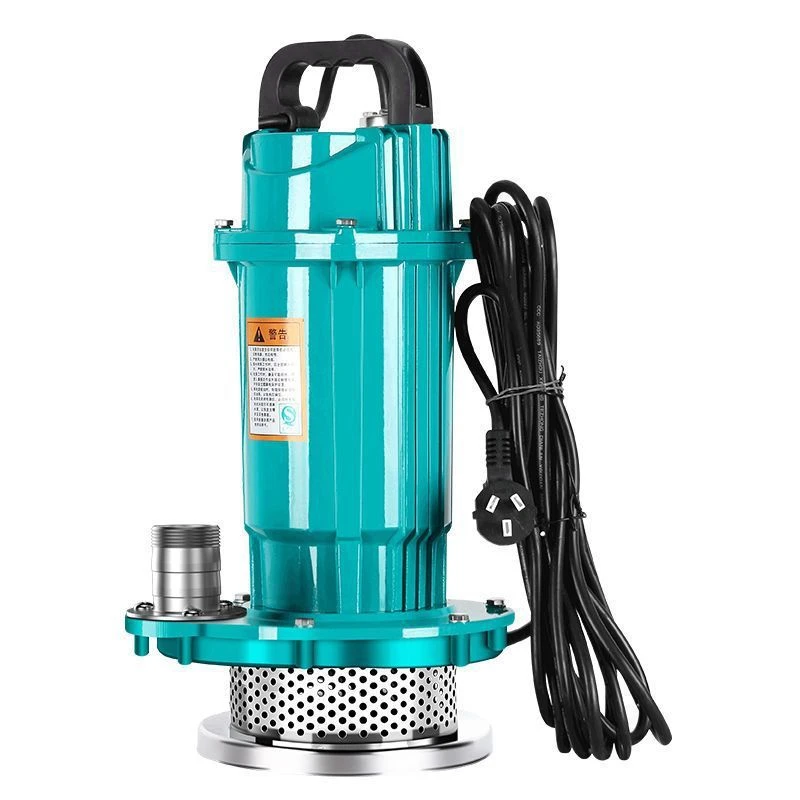
Agricultural Submersible Pump
Submersible pumps operate while fully submerged in water. The motor is hermetically sealed, and cooling is passive (conducted through the water), eliminating the issue of suction lift limitations.
Jingong Best Water Pump for Agriculture Technical Specifications
| Parameter | Specification Range |
|---|---|
| Flow Rate | 3 m³/h – 120 m³/h |
| Head Range | 20 m – 280 m (Multi-stage) |
| Power | 0.37 kW – 18.5 kW |
| Material | Cast Iron / 304 SS / 316 SS |
Pros & Cons (Transparency Report)
Pros: No suction lift limit, high efficiency, low noise, can handle high heads.
Cons: Requires retrieval for maintenance, underwater cable costs, sensitive to high sand content (>50 ppm).
Jingong Field Data: In our Thailand rice cooperative project (2022), 18 sets of 3″ submersible pumps (7.5 kW) irrigated 86 hectares. With proper sediment filters, the mean time between services reached 26 months.
View Submersible Pump Products →
2.2 Agricultural Surface Pump (Land Pump)
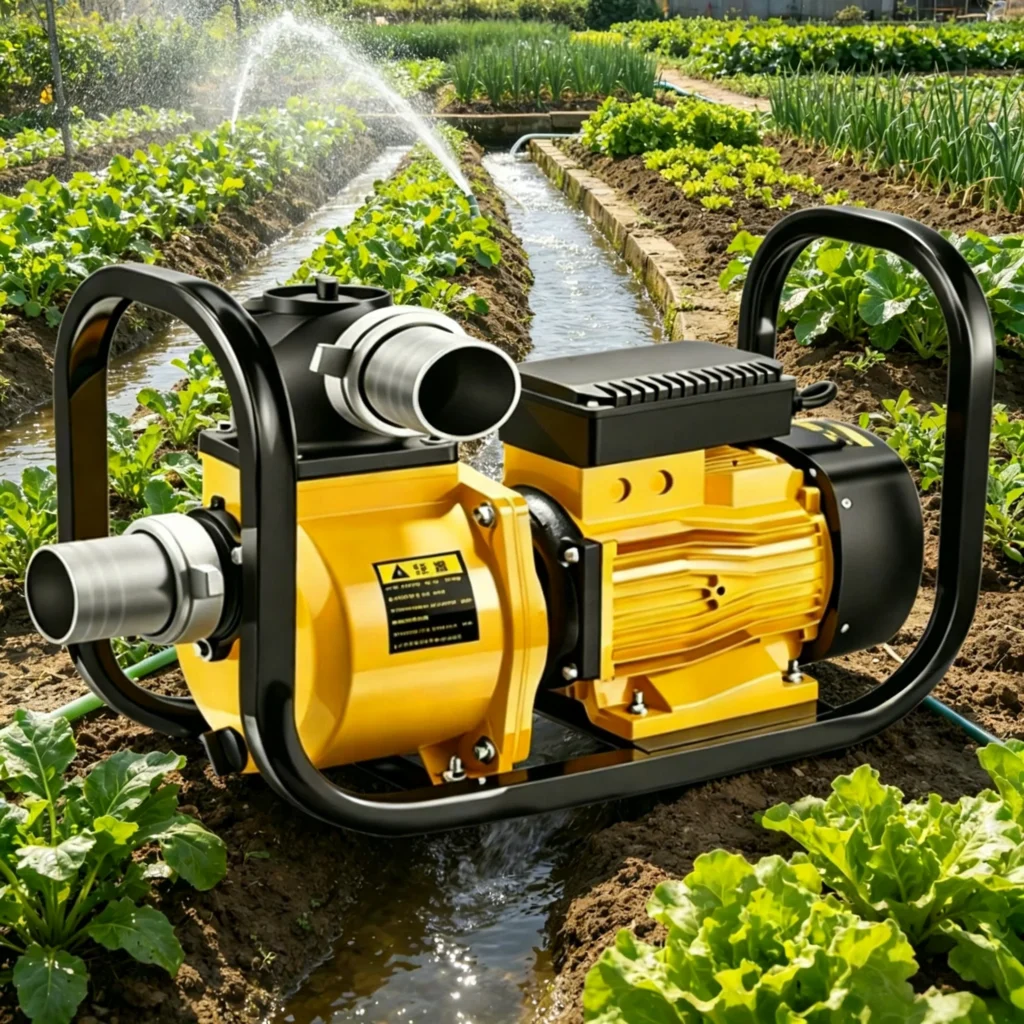
Agricultural Surface Pump
Surface pumps are mounted on the ground. They utilize centrifugal force to move water but are limited by atmospheric pressure and cannot suck water from depths greater than 7–8 meters.
Applicable Scenarios
✅ Pond to field transfer
✅ River or canal diversion
✅ Orchard drip irrigation (using multi-stage versions)
✅ Mobile irrigation between plots
Performance Insights
Based on Jingong’s sales data across Southeast Asia, 68% of surface pump orders fall within the 1.5–5.5 kW range, perfectly matching vegetable farms and small paddy fields. Maintenance costs are approximately 40% lower over three years compared to submersible counterparts due to easier access.
2.3 Agricultural Solar Water Pump

Solar pumps convert PV energy into mechanical power. We categorize them into three architectures:
- Pure DC Solar Pump: Panels → Controller → DC Pump. Highest efficiency, no batteries.
- AC Solar Pump: Panels → Inverter → AC Pump. Easier spare parts availability globally.
- AC/DC Hybrid: Solar primary + Grid/Generator backup. Essential for night irrigation.
ROI Analysis (Jingong Kenya Project)
In a 2024 Kenya maize project (8 hectares), we deployed a 3.7 kW hybrid solar system. Compared to a diesel equivalent ($185/month fuel + $35 service), the solar system resulted in $0 fuel costs. The calculated payback period was 3.8 years, followed by nearly free operation for the remaining lifespan.
2.4 Gasoline & Diesel Agricultural Pump
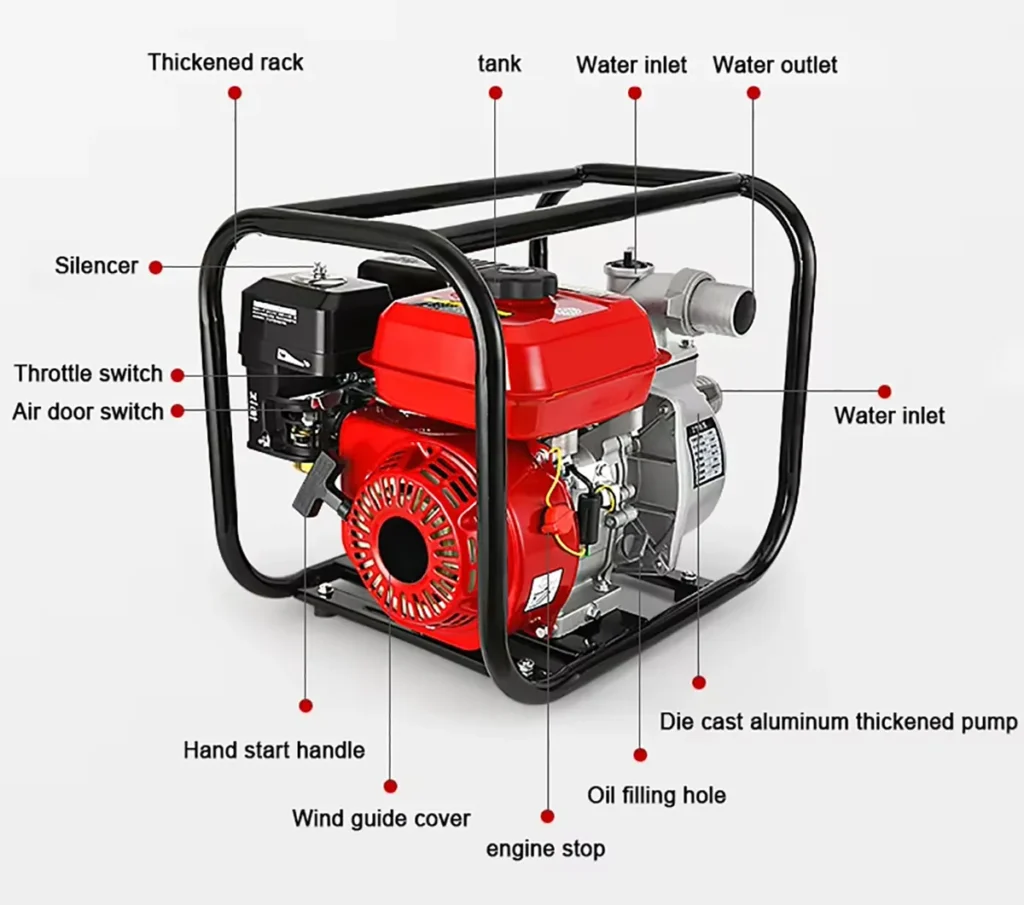
When there is no power or an emergency strikes, fuel pumps are the only answer. They offer unmatched mobility and ruggedness.
Field Stress Test Data
During a 2024 Pakistan heatwave (46°C), our 6″ diesel frame (5.5 kW) operated 12 hours daily for 21 consecutive days. The only maintenance required was an air-filter cleaning and oil top-up. Performance remained stable at 260 m³/h @ 11 m head.
Best Water Pump for Agriculture Scenario-Based Selection Guide (The Decision Matrix)
Select by Terrain
| Terrain Type | Recommended Pump | Logic |
|---|---|---|
| Plain Farm (Rice/Wheat) | Surface Centrifugal / Diesel | Shallow source, high flow requirements. |
| Mountain Orchard | Multi-stage Surface / Diesel | Requires high pressure to overcome elevation. |
| Wetland / Paddy | Submersible / Surface | Flooded fields allow flexible placement. |
| Dry Land / Sandy | Deep Well Submersible | Often reliant on deep aquifers. |
The 3-Step Sizing Shortcut (Jingong Method)
Use this formula to avoid costly mistakes:
- Flow Calculation: Flow (m³/h) ≈ Area (mu) × 0.8–1.2 (1 mu = 1/15 hectare).
- Head Calculation: Total Head (m) = Vertical Lift + (Horizontal Distance / 10) + 15% Margin.
- Power Matching: Align with available energy (Grid/Solar/Fuel).
Example: A 10-mu vegetable farm requires ~10 m³/h. If the vertical lift is 10m and pipes run 150m: 10 + (150/10) + 15% = ~27.5m head. Recommendation: 2.2–3.0 kW pump.
Best Water Pump for Agriculture Parameter & Performance Comparison Table
| Dimension | Submersible | Surface (Land) | Solar | Diesel/Gasoline |
|---|---|---|---|---|
| Power Source | Grid (1/3-ph) | Grid (1/3-ph) | Solar (DC/AC/Hybrid) | Fuel |
| Flow Range | 3–120 m³/h | 5–200 m³/h | 1–150 m³/day* | 15–220 m³/h |
| Head Range | 20–280 m | 6–85 m | 20–100 m | 8–35 m |
| Maintenance Cost | Medium-High | Low | Very Low | Medium-High |
| Service Life | 3–7 Years | 5–10 Years | Panel: 25 Yrs / Pump: 5–10 Yrs | 3–6 Years |
| Best Environment | Deep Wells | Shallow Sources | Sunny, Off-grid | No Power, Emergency |
*Solar flow is per daylight hour; nighttime irrigation requires water storage tanks or hybrid systems.
Best Water Pump for Agriculture Purchase Guide & FAQ
Professional Purchase Checklist
To get an accurate quote from Jingong or any supplier, provide these 7 data points:
- Water Source: Well depth? Pond? River?
- Water Levels: Static level & drawdown (wells)?
- Irrigation Area & Crop: Size and type?
- Elevation & Piping: Height difference and pipe length?
- Power Condition: Grid? Phase? Solar? None?
- Water Quality: Clean? Sandy? pH level?
- Runtime: Hours per day, months per year?
Frequently Asked Questions
Q: How to choose water pump for agriculture?
A: Start with your water source depth. If deeper than 8m, choose submersible. For shallow sources, choose surface. For off-grid sunny areas, choose solar. For emergencies or no-power zones, choose diesel/gasoline.
Q: What size pump do I need for farm irrigation?
A: Use the Jingong 3-step method: 1. Flow ≈ Area (mu) × 0.8–1.2. 2. Head = Vertical Lift + (Pipe Length/10) + 15%. 3. Match power source. Consult our Scenario Guide for details.
Q: Are solar pumps good for farming?
A: Yes, particularly in regions with high solar irradiance. While the initial investment is higher, the elimination of fuel costs typically results in a 3–5 year payback period. Hybrid models are recommended if night irrigation is critical.
Q: Which is better: submersible or surface pump for agriculture?
A: It depends on the water source. Submersible pumps excel in deep wells where surface pumps fail due to suction lift limits (~7–8m). Surface pumps are superior for shallow water sources, offering easier maintenance and lower initial costs.
Industry Cases & Jingong Authority
Overseas Project Snapshots
- Thailand Rice Cooperative (86 ha): Deployed 18 units of 3″ submersible pumps (7.5 kW). Operational for 3+ seasons.
- Philippines Mango Orchard (4 ha): Replaced a 5.5 kW gasoline pump with a 2.2 kW DC solar pump, reducing monthly fuel costs from $140 to $0.
- Kenya Maize Farm (8 ha): Implemented a 3.7 kW AC/DC hybrid solar system with a 4″ submersible pump.
Best Water Pump for Agriculture Certifications & Qualifications
Jingong Technology adheres to international standards, holding key certifications including:
- CE Certification (Electric Pump Lines)
- ISO 9001 Manufacturing Quality Management
- CCS (China Classification Society) Approval for Marine-Cross Models
