
Introduction — Why Understanding the Working Principle Matters Before You Buy
If you’re searching “how does a solar submersible water pump work”, chances are you’re not looking for a physics textbook. You’re likely weighing whether a solar well pump can replace your diesel set, whether it’ll actually lift water from a 60 m borehole, or whether the “zero-fuel” pitch holds up in a 3-day overcast.
At Jingong (Zhejiang Jingong Technology), we’ve been manufacturing submersible, booster, surface, solar, and engine-driven pumps for over 15 years. We’ve tested solar submersible units on our 72-hour continuous-run bench. This article isn’t theory—it’s the working logic we explain to our own OEM buyers before they sign.
Here’s what this guide covers:
- ✅ A 6-step working process (solar → water) with industry-standard terminology
- ✅ A full system diagram breakdown (photovoltaic zone / control zone / underwater zone / delivery zone)
- ✅ DC vs AC solar submersible — when each makes sense (3 kW is the real dividing line)
- ✅ Component-level detail: MPPT algorithm, BLDC motor, centrifugal impeller staging
- ✅ Working conditions, limitations, and troubleshooting
- ✅ FAQ pulled from Google PAA (night operation, battery necessity, max depth)
Internal reading path: After this guide, jump to our Solar Submersible DC Pump Series or Solar Submersible AC Pump Series for specs.
What Is a Solar Submersible Water Pump? (Definition & Core Positioning)
Distinct from Surface Solar Pumps & Grid-Connected Submersibles
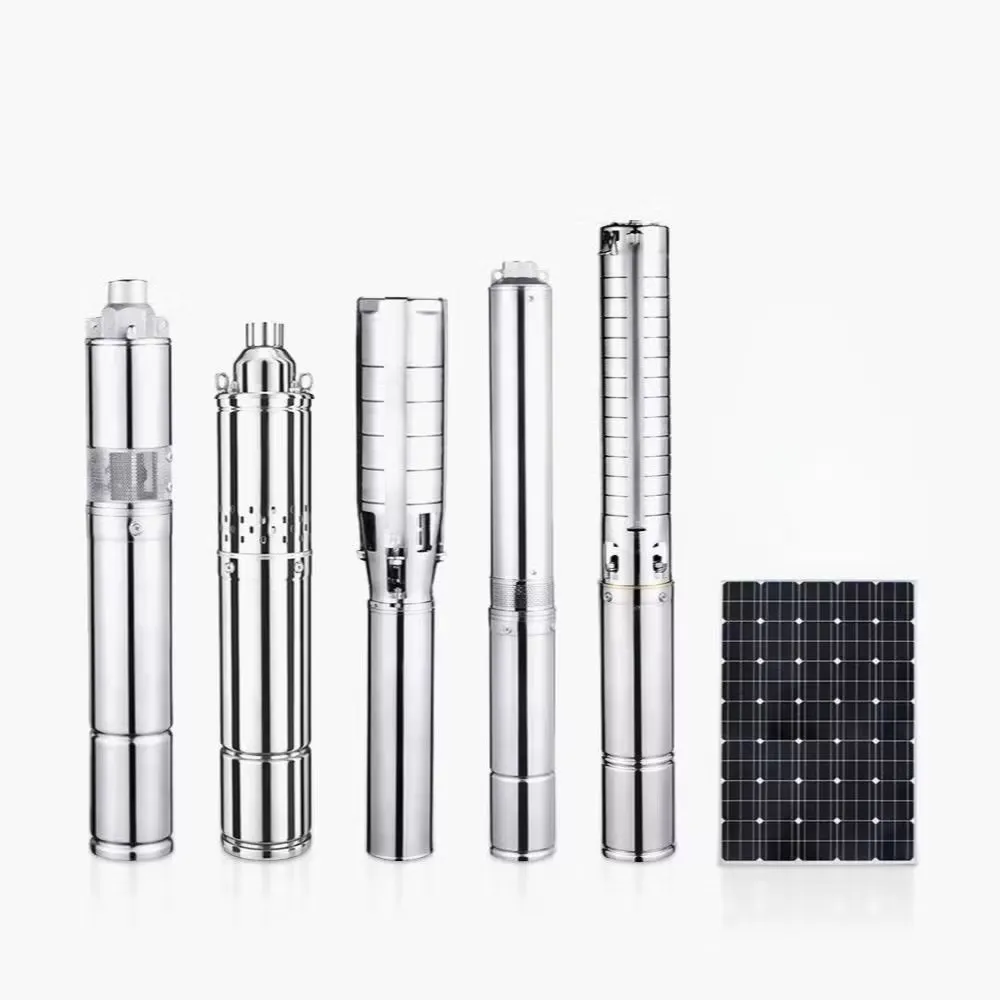
A solar submersible water pump is a fully underwater-installed pumping unit driven by photovoltaic (PV) power, designed for off-grid or weak-grid water lifting. Three attributes define it:
- Submersible by design — eliminates suction lift limits of surface pumps.
- PV-powered — energy comes from solar panels (DC), optionally buffered by battery.
- Off-grid native — replaces diesel gensets or long-distance grid cabling.
Quick differentiator: A surface solar pump relies on suction (max ~5–6 m practical). A submersible solar pump pushes from below, handling total heads of 30 m to 300 m+.
Core Energy Flow (The 4-Stage Chain)
Every solar submersible system follows the same high-level logic:
Sunlight → Photovoltaic DC → Regulated power → Mechanical lift → Pressurized water
Why Solar Submersible Water Pump Over Diesel / Grid Pump?
| Comparison | Diesel Submersible | Grid-Connected | Solar Submersible |
|---|---|---|---|
| Fuel cost | High & volatile | Low (wiring cost high) | Zero fuel |
| OPEX | Oil, filters | Grid tariff | Near-zero |
| Noise | Loud | Quiet | Silent |
| Remote Deploy | Yes (logistics pain) | No | Yes |
Core Components of a Solar Submersible Water Pump System

1. Solar PV Panels (Energy Source)
Monocrystalline panels are preferred for pump duty due to superior low-light yield. A critical Jingong workshop formula for sizing is:
Panel STC power ≈ Pump rated power × 1.2–1.4
This compensates for real-world derating (temperature coefficient, dust, and wiring loss).
2. MPPT / PWM Solar Pump Controller (The Brain)
The controller is the most misunderstood component. We differentiate:
- PWM (Pulse Width Modulation): Cheaper, efficiency ~70–80%. Only acceptable for micro-kits (<200W).
- MPPT (Maximum Power Point Tracking): Uses algorithms to track the panel’s shifting power curve. 15–30% more water per day compared to PWM.
At Jingong, we default to MPPT on every solar submersible above 150W.
3. Submersible Pump Motor & Impeller (The Muscle)
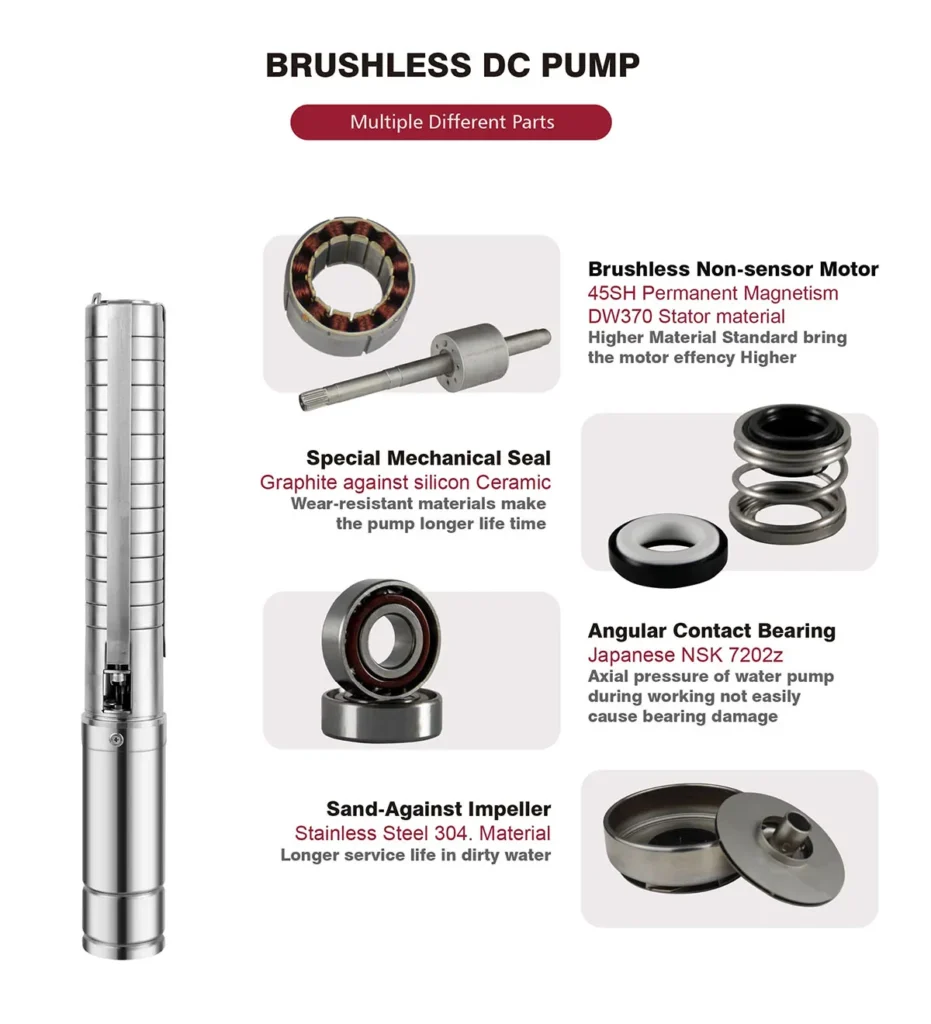
- BLDC (Brushless DC): High efficiency (85–92%), zero brush wear. Dominates the <3 kW market.
- AC Induction: Robust and scalable for >3 kW / >100 m head applications.
Impeller Staging: Each centrifugal stage adds ~10–15 m of head. A 20-stage unit can achieve 250 m+ total dynamic head.
4. Power Cable & Waterproof Connector
IP68-rated water-blocked glands and submersible-grade chloroprene rubber cables are mandatory to prevent leakage and ensure safety.
5. Delivery Pipe & Outlet System
HDPE or PVC pipes transport water to the surface. A check valve prevents backspin when the pump stops.
6. Optional: Battery Bank & Inverter (AC Systems)
Batteries extend operation into low-light periods but significantly increase CAPEX. AC systems require an inverter to convert DC from panels to AC for the motor.
Step-by-Step Working Process (6 Stages)
This section targets the core keyword: solar submersible water pump working principle.
Step 1: Solar Energy Absorption & Photovoltaic Conversion
Sunlight hits monocrystalline cells, exciting electrons in the PN junction to create Direct Current (DC). Output fluctuates based on irradiance, temperature, and soiling.
Step 2: Power Regulation & MPPT Optimization
The DC enters the controller. Using an Incremental Conductance algorithm, the MPPT controller perturbs the electrical operating point of the modules to find the Maximum Power Point (MPP), ensuring the pump receives optimal power despite cloud cover.
Step 3: Safe Power Transmission Underground
Regulated power travels down the borehole via a submersible cable. Proper wire gauging (e.g., 6mm² or 10mm² copper) mitigates voltage drop over long distances.
Step 4: Electromechanical Conversion (Motor Spins)
The motor receives power. In BLDC motors, electronic commutation spins the permanent magnet rotor at 3,000–6,000 RPM. This rotational energy is transferred directly to the impeller stack via the drive shaft.
Step 5: Water Suction & Pressurization (Centrifugal Action)
As the impeller rotates, water is thrown outward (centrifugal force), increasing pressure. Simultaneously, negative pressure forms at the impeller eye, drawing water from the source through a 304 SS inlet screen.
Step 6: Water Delivery to Surface
Pressurized water climbs the delivery pipe to a storage tank or directly into an irrigation system. A check valve prevents backflow when the pump ceases operation.
DC vs AC Solar Submersible — Which Working Mode Fits Your Project?
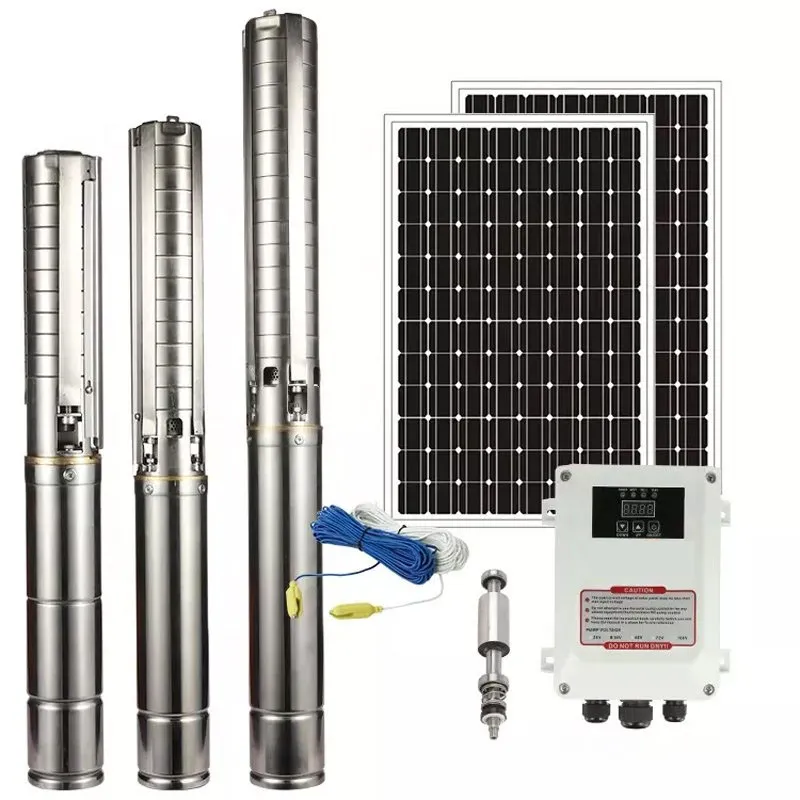
The 3 kW threshold is the industry benchmark:
- Below 3 kW: DC BLDC systems win (simplicity, no inverter loss).
- Above 3 kW / Deep Bore > 150 m: AC systems win (scalability, compatibility with existing grid pumps).
Compare Jingong DC Solar Submersible Pumps » | Compare Jingong AC Solar Submersible Pumps »
Full System Working Diagram Explanation (4-Zone Breakdown)
Zone A — Photovoltaic Array (Energy Capture)
Panels tilted to latitude, wired in series to match the pump’s voltage window.
Zone B — Control & Regulation (MPPT / Inverter)
Housed in a weatherproof enclosure, containing the DC disconnect, controller/inverter, and surge protection.
Zone C — Underwater Working Zone (Submersible Unit)
The pump must remain fully submerged to prevent overheating and ensure efficient cooling.
Zone D — Surface Delivery (Output)
Water is stored in cisterns or delivered directly to end-use points.
Key Working Principles & Technical Logic (Deep Dive)
Photovoltaic Effect — The Physics Bottom
Silicon’s bandgap (~1.12 eV) allows photons to knock electrons loose, creating a flow of electricity. The I-V curve shifts constantly, necessitating MPPT.
Centrifugal Impeller & Negative Pressure
Based on Bernoulli’s principle and Euler’s turbomachinery equation. Multistage units add energy serially to achieve high heads.
MPPT Algorithm Logic
Jingong utilizes the Incremental Conductance (IncCond) method on units ≥750W for faster convergence in rapidly changing cloud conditions.
Working Scenarios & Applicable Conditions
Optimal Working Envelope
- Daily Peak Sun Hours: ≥ 3.5 h
- Water Temp: ≤ 35°C (Standard), ≤ 60°C (Hot-well)
- pH Level: 6.5 – 8.5 (Use 316 SS for aggressive water)
- Sand Content: < 50 ppm
Best-Fit Scenarios: African Sahel boreholes, SEA paddy fields, Middle East livestock, Island water supply.
Common Working Problems & Troubleshooting
Pump Won’t Start in Morning
Cause: String voltage below threshold or dry-run lockout.
Fix: Verify panel OC voltage and reset controller.
Low Flow / Pressure Mid-Day
Cause: Well drawdown exceeding pump depth or panel soiling.
Fix: Lower pump deeper or clean panels.
Pump Stops Every 20 Minutes
Cause: Dry-run protection due to well level dropping.
Fix: Restrict flow to allow aquifer recovery.
Read our Solar Pump Maintenance Guide »
FAQ — Solar Submersible Water Pump Working Principle
Do solar submersible pumps work at night?
Only with a battery bank or hybrid grid input. Most systems use a daytime-pumping/storage-tank strategy for night supply.
How deep can a solar submersible pump work?
DC units: Up to 120 m. AC units: Up to 300 m+. Depth is limited by motor power and cable voltage drop.
Does a solar submersible pump need a battery?
Not necessarily. A storage tank is the most cost-effective solution. Batteries are reserved for clinics, schools, or sites with unreliable sunlight.
What size solar panel for my submersible pump?
Use the Jingong formula: Panel Wattage = Pump Rated W × 1.3 (Sunny) to 1.7 (Cloudy/Hot).
Conclusion & Next Steps
A solar submersible water pump is a disciplined 6-stage chain where every weak link costs water. At Jingong Technology, we engineer reliability into every PV borehole system.
What to do next:
- Download our Solar Submersible Pump Selection Worksheet.
- Browse our DC Solar Submersible Series or AC Solar Submersible Series.
- Contact Jingong Engineers for a free custom sizing report (24h response).

0 Comments