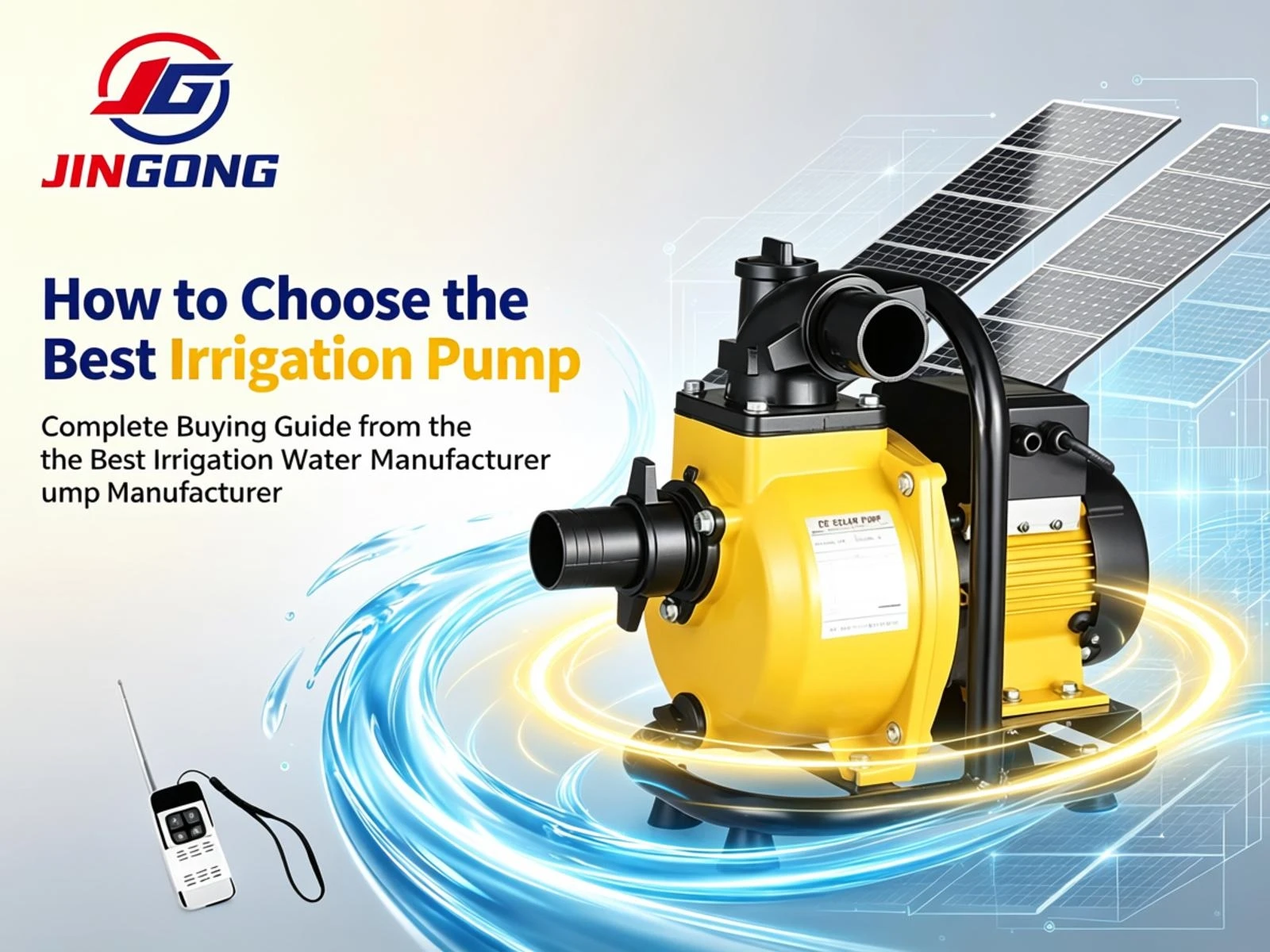
1. Introduction: Why Choosing the Right Irrigation Pump Matters
Selecting the best irrigation pump is one of the most critical decisions for any farm owner, agricultural contractor, or irrigation project manager. A poorly matched pump leads to excessive energy consumption, frequent breakdowns, inadequate water coverage, and ultimately lost crops. As a trusted Best Irrigation water Pump manufacturer, Jingong Technology has spent over a decade engineering and exporting agricultural irrigation pumps to clients worldwide — from small family farms in Southeast Asia to large-scale commercial plantations in Africa and South America.
This comprehensive guide is written by our senior pump engineers who have personally tested thousands of units in real-world conditions: deep wells, open canals, off-grid mountain fields, and drought-stricken plains. When you work with the Best Irrigation water Pump manufacturer, you gain access to this accumulated field experience translated into a practical, easy-to-follow selection framework.
Throughout this article, we will compare four mainstream categories — submersible irrigation pumps, surface irrigation pumps, solar powered irrigation pumps, and gasoline/diesel irrigation pumps — and provide you with actionable formulas, comparison tables, and expert recommendations. By the end, you’ll understand exactly which pump type fits your water source, field size, power availability, and budget.
Whether you are a distributor looking for a reliable Best Irrigation water Pump manufacturer for wholesale supply, or a farm operator seeking a single durable unit, this guide covers every scenario. Jingong Technology, as your dedicated Best Irrigation water Pump manufacturer, stands behind every technical recommendation presented here.
2. 4 Main Types of Irrigation Pumps
As a full-line Best Irrigation water Pump manufacturer, Jingong Technology produces all four major irrigation pump categories under one roof. This vertical integration allows us to maintain strict quality control and offer consistent performance across product families. Below is a detailed breakdown of each type.
2.1 Submersible Irrigation Pump
A submersible irrigation pump (also called an underwater irrigation pump or deep well submersible pump) is designed to operate completely submerged in water. The motor and pump body are sealed together in a waterproof housing, allowing the unit to push water upward from deep sources.
How It Works: The submersible motor drives an impeller that generates centrifugal force, drawing water into the pump body and discharging it through the outlet pipe. Because the pump is already below the water surface, there is no need for priming or suction — eliminating common air-lock issues.
Key Advantages:
- No priming required — operates submerged, avoiding suction failures
- Silent operation — water dampens motor noise
- Anti dry-run protection — optional sensors prevent damage
- Wide head range — QJ-type vertical multistage submersible pumps achieve heads of 50+ meters
- High efficiency — actual head typically reaches 80%–90% of nameplate value
- Space-saving & freeze-resistant — installed underground
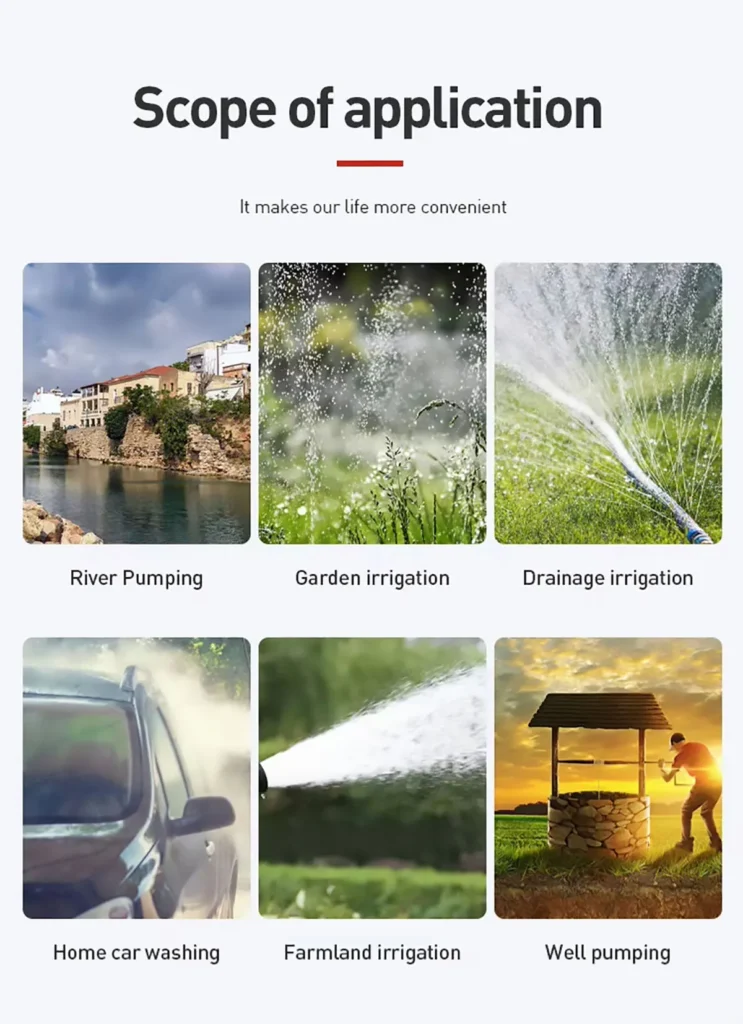
Ideal Applications: Deep well water extraction, borehole irrigation, pond and riverbed intake, low-lying field drainage, and large farmland requiring stable high-pressure water delivery.
Selection Tip from the Best Irrigation water Pump manufacturer: When sizing a submersible pump, calculate your total lift (vertical distance from water level to highest discharge point) and multiply by 1.15–1.20 to determine required rated head. Configure motor power 10% above the nominal requirement to handle voltage fluctuations and long-term wear. Jingong Technology, your professional Best Irrigation water Pump manufacturer, provides free engineering calculation sheets for distributors and project contractors.
Target Buyers: Commercial farms with deep wells (30m–300m), irrigation cooperatives, government agricultural projects, and greenhouse operations requiring pressurized drip irrigation systems.
2.2 Surface Irrigation Pump

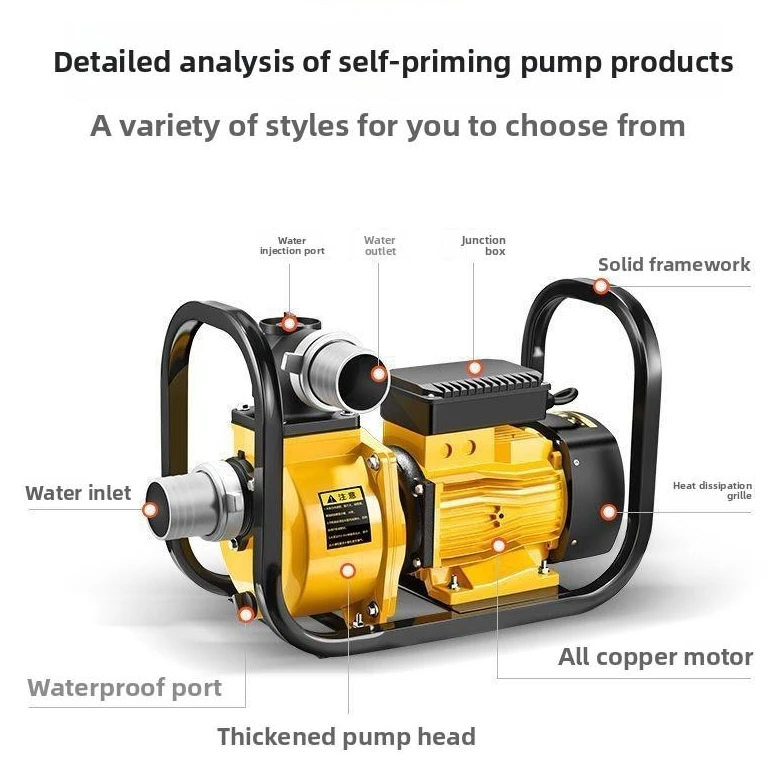
A surface irrigation pump (also referred to as a land irrigation pump or portable surface water pump) is installed above ground and draws water through suction. These pumps are the most common choice for shallow water sources and small-to-medium sized fields.
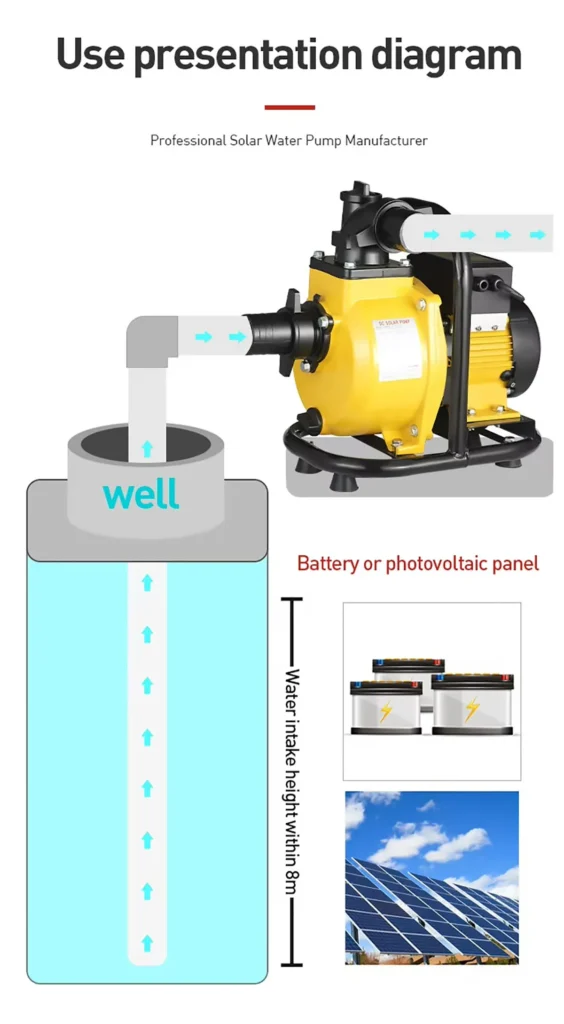
How It Works: Surface pumps use atmospheric pressure and impeller suction to lift water from a source up to 8 meters vertically. They are typically self-priming, meaning they can evacuate air from the suction line and begin pumping without manual water filling after initial setup.
Key Advantages:
- Easy installation — no need to lower equipment into wells
- Simple maintenance — motor and seals accessible above ground
- Portability — many models include handles or wheel kits
- Low cost — most affordable category among electric pumps
- Versatility — compatible with ponds, rivers, shallow wells, and storage tanks
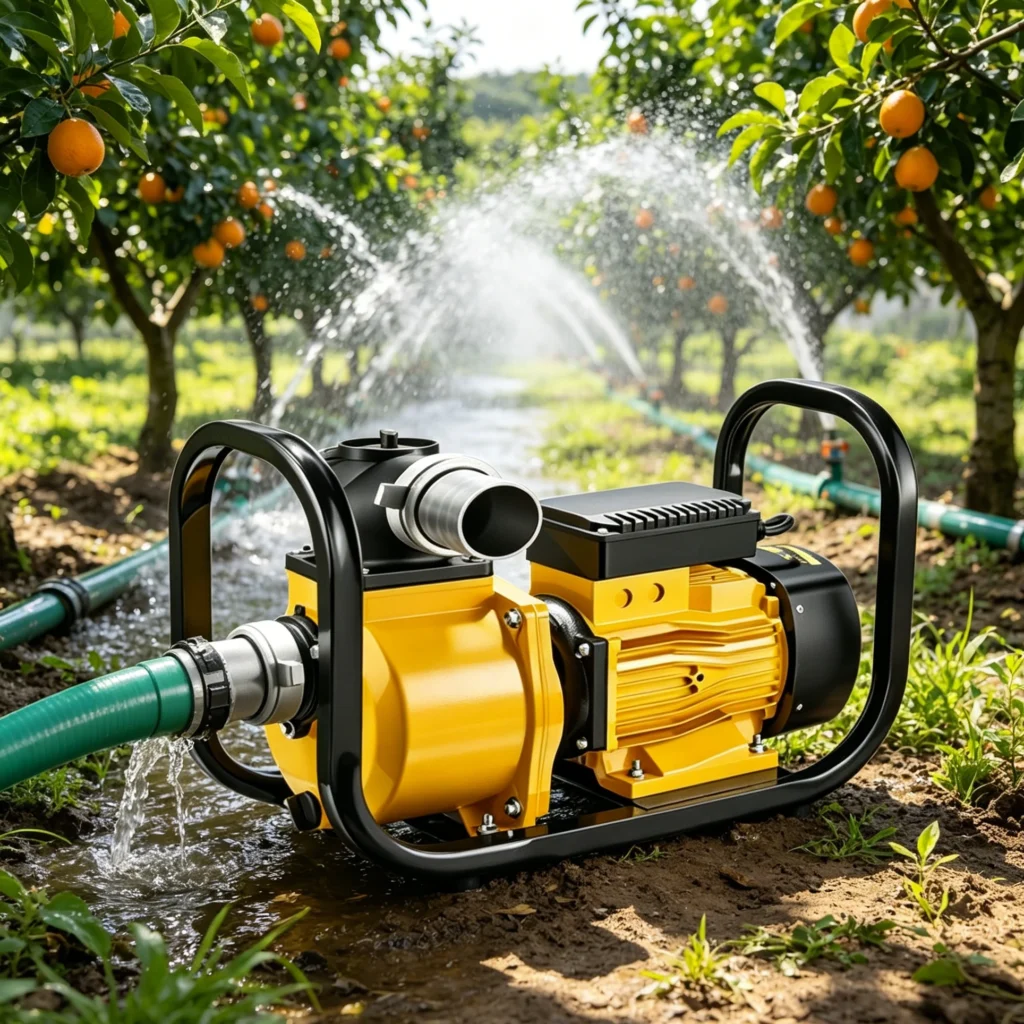
Ideal Applications: Flat farmland, orchards, vineyards, shallow wells (under 8m depth), pond-to-field transfer, and supplementary irrigation for gardens.
Installation & Maintenance Notes from your Best Irrigation water Pump manufacturer: Ensure the suction pipe is airtight and as short/straight as possible. Prime the pump before first start. Regularly inspect mechanical seals and replace worn impellers. Jingong Technology — a top-rated Best Irrigation water Pump manufacturer — provides detailed multilingual installation manuals and video guides with every shipment.
Target Buyers: Small family farms, orchard owners, landscape contractors, and distributors serving residential agricultural markets.
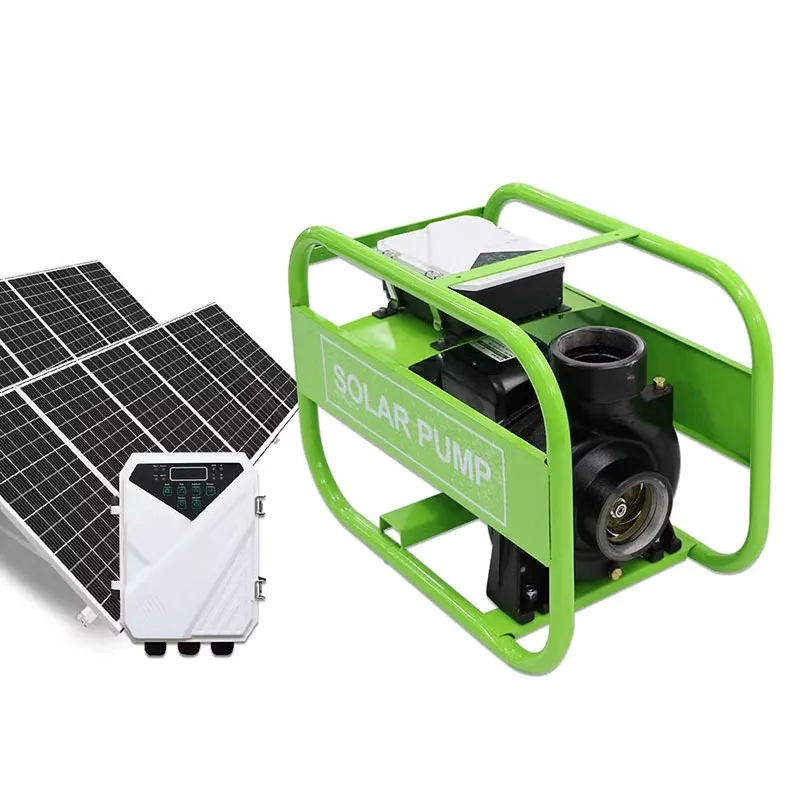
2.3 Solar Powered Irrigation Pump
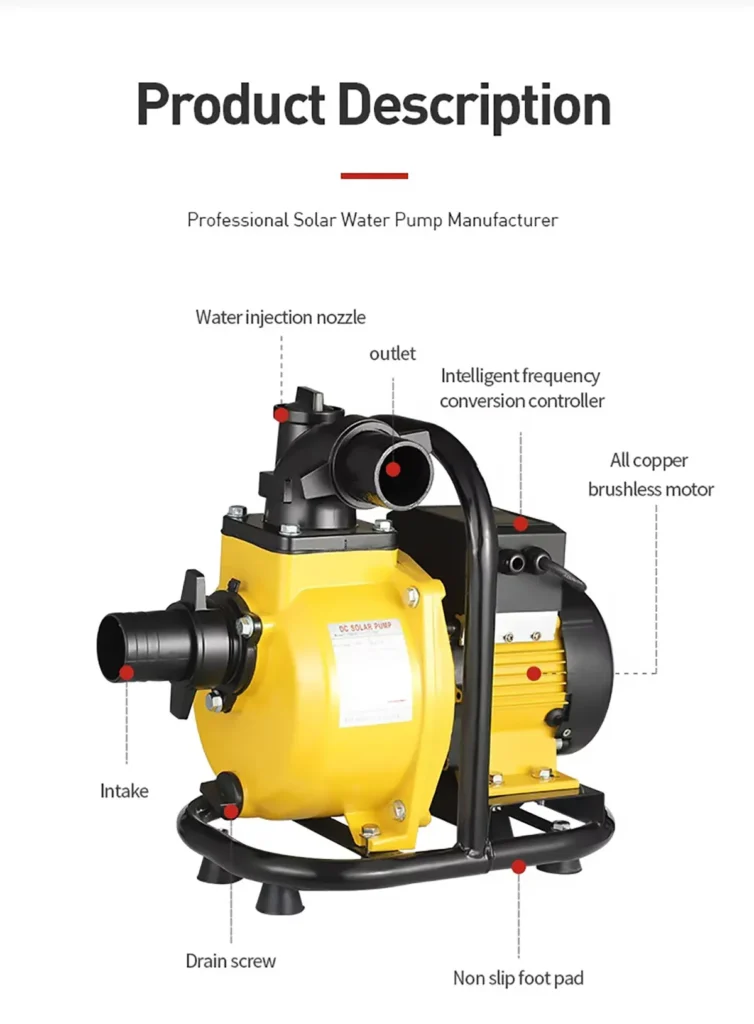
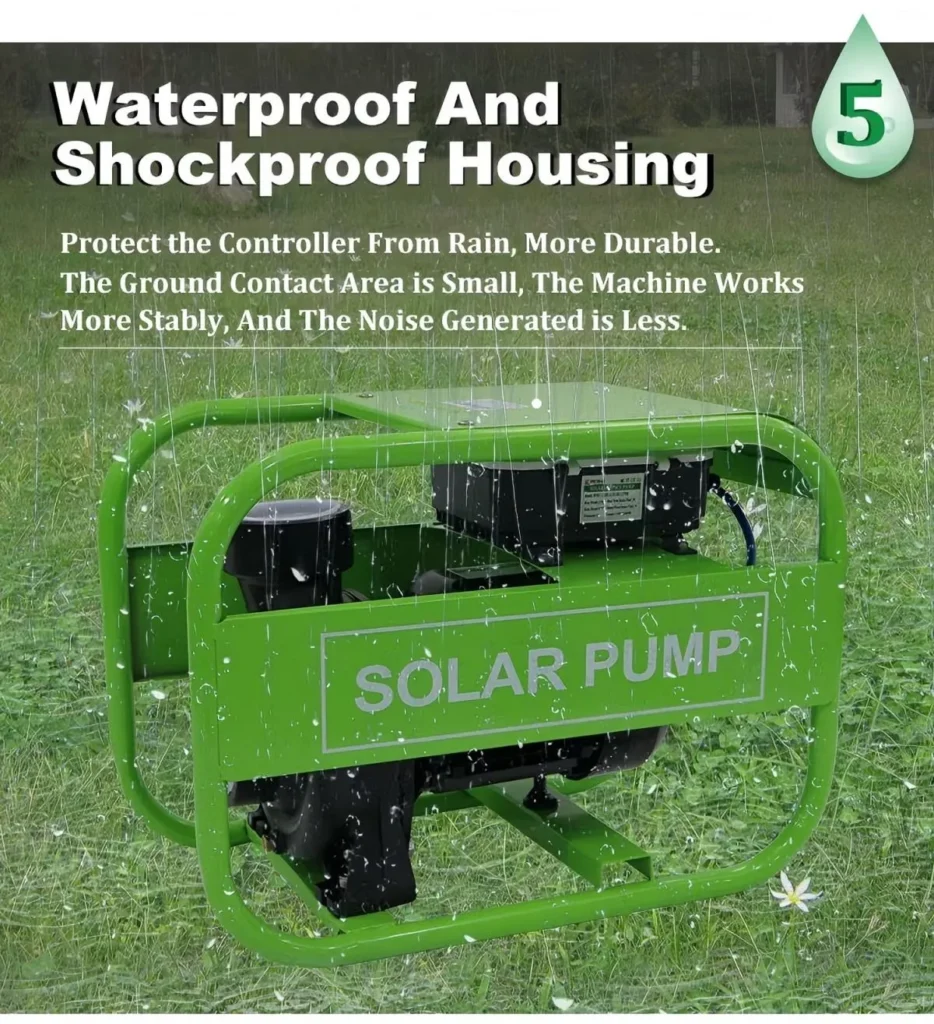
The solar irrigation pump (or solar powered water pump for farm) represents the fastest-growing segment in agricultural water management. Driven entirely by photovoltaic energy, these pumps eliminate electricity bills and operate independently of grid infrastructure.
How It Works: PV panels convert sunlight into DC electricity, which feeds directly into a controller (preferably with MPPT — Maximum Power Point Tracking — technology). The controller regulates power to the pump motor, adjusting speed based on available sunlight. Advanced systems include battery storage for dawn/dusk operation and cloud-adaptive controllers for weak-light performance.
Key Advantages:
- Zero operating cost — no fuel, no electricity bills
- Off-grid capability — perfect for remote fields without power lines
- Environmentally sustainable — zero emissions, aligns with global carbon-reduction goals
- Low maintenance — no fuel system, fewer moving parts than combustion engines
- Long lifespan — quality solar pumps operate 10+ years with minimal service
- Smart controls — automatic start/stop based on sunlight and water level
Configuration Parameters:
- PV Panel Power: Must match pump rated power × 1.3 safety factor for cloudy days
- Head & Flow: Same calculation method as submersible pumps (lift × 1.15–1.20)
- Controller Type: MPPT strongly recommended for 15–25% better energy harvest
- Battery Storage: Optional but recommended for early morning / evening irrigation
Ideal Applications: Remote farms, mountainous terrain, off-grid irrigation projects, desert agriculture, large-scale water-saving irrigation initiatives, and development-aid agricultural programs.
Market Insight from the Best Irrigation water Pump manufacturer: Solar irrigation pumps are now a top-demand product in Africa, the Middle East, and parts of Latin America where grid power is unreliable. As your dedicated Best Irrigation water Pump manufacturer, Jingong Technology offers turnkey solar pumping packages including panels, pump, controller, and mounting hardware — pre-configured for plug-and-play deployment.
Target Buyers: Government agriculture departments, NGO development projects, large commercial farms in sunny regions, and eco-conscious agricultural operators.
2.4 Gasoline & Diesel Irrigation Pump
The diesel irrigation pump and gasoline water pump for irrigation (collectively known as fuel-powered or portable fuel irrigation pumps) provide unmatched mobility and raw power for demanding field conditions.
How It Works: An internal combustion engine (gasoline or diesel) directly drives the pump impeller through a shaft coupling. No external power source is needed — simply add fuel and start the engine.
Key Advantages:
- Maximum portability — fully self-contained, move anywhere
- High power output — handles large flow rates and high heads
- Weather-independent — operates day or night, sun or cloud
- Emergency ready — ideal for drought response and disaster relief
- Durable construction — cast iron or aluminum alloy bodies withstand harsh conditions
Gasoline vs. Diesel Comparison:
- Gasoline pumps: Lighter, easier to start, lower upfront cost, suitable for medium flows and intermittent use
- Diesel pumps: Higher torque, better fuel economy for extended runtime, longer engine life, preferred for large-scale continuous operation
Ideal Applications: Large-area farms (100+ acres), drought emergency irrigation, construction site dewatering, flood response, remote fields without any infrastructure, and mobile irrigation contractors.
Engineering Note from the Best Irrigation water Pump manufacturer: For continuous duty cycles exceeding 6 hours/day, diesel engines deliver superior total cost of ownership despite higher initial investment. Jingong Technology, a globally recognized Best Irrigation water Pump manufacturer, recommends diesel platforms for agricultural co-ops and commercial plantations requiring seasonal high-volume irrigation.
Target Buyers: Large-scale farms, agricultural contractors, government emergency response agencies, mining and construction companies requiring water management.
3. Core Factors to Choose the Best Irrigation Pump
As an experienced Best Irrigation water Pump manufacturer, we’ve distilled pump selection down to six fundamental factors. Master these, and you’ll never choose the wrong pump again.
3.1 Water Source Condition
Your water source dictates pump type more than any other variable:
- Deep well (30m–300m): Submersible pump required
- Shallow well / pond / river (under 8m): Surface pump sufficient
- No grid power available: Solar or fuel pump mandatory
- Open canal / reservoir: Submersible or surface depending on lift requirements
3.2 Lift & Flow Rate — The Critical Calculations
Two numbers determine everything:
- Total Dynamic Head (TDH): Vertical lift + friction losses in pipes. Multiply static lift by 1.15–1.20 for safety margin.
- Required Flow Rate (Q): Based on field area and crop water demand. Formula:
Q (m³/h) = Field Area (m²) × Crop Water Requirement (mm/day) ÷ 24 ÷ 1000
For example: A 5,000 m² corn field requiring 8mm water per day needs approximately 1.67 m³/h flow. Add 20% buffer → select a pump rated for ~2 m³/h at your calculated head.
3.3 Power Supply Condition
- Grid available: Submersible or surface electric pumps (most economical long-term)
- No grid / unreliable grid: Solar pumps (zero running cost) or fuel pumps (maximum flexibility)
- Hybrid zones: Solar + battery systems with grid backup
3.4 Irrigation Area & Crop Type
- Small orchard / garden (< 1 acre): Portable surface pump or small submersible
- Medium farm (1–20 acres): Submersible pump with adequate head/flow
- Large plantation (20–200 acres): Multiple submersible pumps or high-power diesel units
- Mega farm (> 200 acres): Custom-engineered multi-pump stations
3.5 Portability & Installation
Fixed installations favor submersible and permanent surface pumps. Mobile operations (contractors, emergency response, rotating field sections) require portable surface, solar, or fuel pumps with wheel frames.
3.6 Budget & Operating Cost
Consider Total Cost of Ownership (TCO) over 5 years:
- Submersible electric: Moderate purchase, low operating cost, longest lifespan
- Surface electric: Lowest purchase, low operating cost, moderate lifespan
- Solar: Higher upfront, near-zero operating cost, excellent long-term ROI
- Fuel (gas/diesel): Moderate purchase, high operating cost (fuel + maintenance), versatile
Jingong Technology, your trusted Best Irrigation water Pump manufacturer, offers free TCO analysis for bulk buyers and project developers. We model 5-year costs based on local energy prices to identify the most economical solution for your specific situation.
4. Comparison Table: 4 Types of Irrigation Pumps
| Pump Type | Max Lift | Flow Range | Power Source | Purchase Cost | Operating Cost | Maintenance | Portability | Lifespan | Best For |
|---|---|---|---|---|---|---|---|---|---|
| Submersible | Up to 300m+ | 1–200 m³/h | Electric (grid/solar) | $$ | $ | Low | Fixed | 8–15 yrs | Deep wells, stable high-pressure irrigation |
| Surface | Up to 8m suction | 1–80 m³/h | Electric | $ | $ | Low | Portable | 5–10 yrs | Shallow sources, small/medium farms |
| Solar | Up to 200m | 0.5–100 m³/h | Photovoltaic | $$$ | ~$0 | Very Low | Semi-fixed | 10–20 yrs | Off-grid, remote, sustainable irrigation |
| Gas/Diesel | Up to 100m | 5–500 m³/h | Fuel | $$ | $$$ | Moderate | Fully Portable | 5–8 yrs | Large farms, emergencies, no-power zones |
This comparison reflects data compiled by the engineering team at Jingong Technology, a leading Best Irrigation water Pump manufacturer with field testing across diverse agricultural environments worldwide.
5. Common Buying Mistakes to Avoid
As a seasoned Best Irrigation water Pump manufacturer serving global clients since 2015, we’ve seen the same costly mistakes repeated countless times. Here’s what NOT to do:
Mistake #1: Choosing Power Over Head Matching
Buyers often fixate on “HP rating” while ignoring actual lift requirements. A 5HP pump sized for 20m head will catastrophically fail if asked to push water 60m vertically. Always match rated head to your calculated TDH × 1.15–1.20 factor.
Mistake #2: Installing Electric Pumps in Off-Grid Locations
We regularly receive distress calls from customers who purchased electric submersible pumps for remote fields with no power lines. The result: expensive pumps sitting unused. If grid power is unavailable, solar or fuel pumps are your only viable options.
Mistake #3: Undersizing Flow Rate for Large Fields
A pump delivering 2 m³/h cannot adequately irrigate 50 acres. Undersized pumps run continuously, overheat, and fail prematurely. Use the flow formula in Section 3.2 and always add 20% buffer.
Mistake #4: Ignoring Water Chemistry & Material Compatibility
Seawater, brackish water, or chemically fertilized irrigation water corrodes standard cast iron pumps within months. Stainless steel (304/316) or engineered plastic housings are mandatory for corrosive environments. The Best Irrigation water Pump manufacturer always asks about water chemistry before recommending materials.
Mistake #5: Sacrificing Quality for Lowest Price
Non-standard, uncertified pumps from unknown factories might save 30% upfront but cost 300% more in repairs, replacements, and downtime within two years. Choose ISO-certified manufacturers with verifiable export track records. Jingong Technology, your reliable Best Irrigation water Pump manufacturer, holds ISO 9001, CE, and RoHS certifications across its entire product range.
Mistake #6: Neglecting After-Sales Support
A pump without accessible spare parts and technical support is a liability. Before purchasing, verify the manufacturer provides: spare part inventory, multilingual technical documentation, remote troubleshooting, and local service partnerships.
6. FAQ — Frequently Asked Questions
Q1: What is the best pump for farm irrigation?
The answer depends on your specific conditions. For deep wells with grid power: submersible pump. For shallow sources and small farms: surface pump. For off-grid sustainable operation: solar irrigation pump. For large-scale emergency or mobile irrigation: diesel/gasoline pump. As a professional Best Irrigation water Pump manufacturer, we recommend conducting a site assessment before finalizing your selection.
Q2: Which is better, submersible pump or surface pump for irrigation?
Submersible pumps excel for deep water sources (30m+) and provide silent, protected operation with wider head ranges. Surface pumps are better for shallow water (under 8m), offer easier maintenance, and cost less upfront. Your water source depth is the deciding factor.
Q3: Are solar irrigation pumps worth it for large farms?
Absolutely. While solar pumps have higher upfront costs, their near-zero operating expenses make them highly cost-effective over 5–10 year horizons. For a 50-acre farm in a sunny region, a solar pump can save $3,000–$8,000 annually compared to electric or diesel alternatives. Jingong Technology, a forward-thinking Best Irrigation water Pump manufacturer, has deployed 1,200+ solar pumps in Thai sugarcane farms alone, with documented ROI within 18–24 months.
Q4: What size diesel pump do I need for my field?
Calculate your required flow rate using the formula in Section 3.2. For reference: a 5-acre field typically needs 3–5 m³/h flow; 50 acres requires 15–25 m³/h; 200+ acres demands 50+ m³/h. Match these flow requirements to a diesel pump rated for your field’s lift height. Our Best Irrigation water Pump manufacturer engineering team provides free sizing calculations — simply share your field dimensions and water source details.
Q5: How long does a solar irrigation pump last?
Quality solar pumps from a reputable Best Irrigation water Pump manufacturer last 10–20 years. The PV panels themselves carry 25-year performance warranties. Key longevity factors: MPPT controller quality, proper panel cleaning, and protection from lightning surges. Jingong Technology provides 5-year warranty on pump ends and 10-year warranty on PV panels.
Q6: Can surface pumps be used for deep well irrigation?
No. Surface pumps are limited to 8-meter suction lift due to atmospheric pressure constraints. Beyond this depth, you must use a submersible pump. Attempting to use surface pumps for deep wells results in air-locking, cavitation, and rapid pump failure.
Q7: What is the most cost-effective irrigation pump?
For grid-connected locations: submersible electric pumps offer the best long-term value. For off-grid sunny regions: solar pumps win on lifetime cost. For intermittent emergency use: gasoline portable pumps are most economical. The true Best Irrigation water Pump manufacturer evaluates your total cost of ownership across 5+ years, not just sticker price.
Q8: Do you provide OEM & customization services?
Yes. Jingong Technology — your dedicated Best Irrigation water Pump manufacturer — offers full OEM services including private labeling, customized voltage/frequency configurations (50Hz/60Hz, single/three-phase), material upgrades (stainless steel, bronze impellers), and branded packaging. We serve distributors in 80+ countries with flexible MOQ and competitive factory-direct pricing.
7. Final Buying Recommendations & Expert Tips
Based on our extensive field experience as a leading Best Irrigation water Pump manufacturer, here are scenario-specific recommendations:
Scenario A: Small Family Farm (Under 5 Acres)
Recommended: Portable surface pump (electric) or small solar pump for off-grid
Why: Low cost, easy maintenance, sufficient for modest water demands
Scenario B: Medium Commercial Farm (5–50 Acres)
Recommended: Submersible electric pump sized for your well depth and flow needs
Why: Reliable 24/7 operation, low operating cost, 10+ year lifespan
Scenario C: Large Plantation (50–200 Acres)
Recommended: Multiple submersible pumps OR high-capacity diesel pump station
Why: Scalable flow capacity, redundancy for critical irrigation periods
Scenario D: Off-Grid / Remote Farm
Recommended: Solar irrigation pump with battery storage (MPPT controller)
Why: Zero fuel/electricity cost, autonomous operation, environmentally sustainable
Scenario E: Emergency / Drought Response
Recommended: Portable diesel pump with high flow capacity
Why: Immediate deployment, independent of any infrastructure, maximum mobility
Expert Procurement Tips from the Best Irrigation water Pump manufacturer:
- Bulk Orders: Ordering 50+ units? Direct factory pricing from Jingong Technology saves 25–40% vs. local distributors
- Project Customization: For government or NGO irrigation projects, we provide engineered pump stations with integrated controls, monitoring, and remote management
- Spare Parts Strategy: Stock critical wear parts (seals, impellers, bearings) for 2-year operation to minimize downtime
- Quality Verification: Request factory audit reports, third-party testing certificates (CE, ISO), and customer references from similar climate zones
Jingong Technology has earned its reputation as the Best Irrigation water Pump manufacturer through rigorous quality control, innovative engineering, and unwavering commitment to customer success. With two decades of combined engineering expertise, our team ensures every pump leaving our Zhejiang facility meets international performance standards.
8. Conclusion & Free Consultation
Choosing the best irrigation pump requires balancing water source conditions, field requirements, power availability, and long-term operating costs. Whether you need a submersible pump for a deep well, a surface pump for a small orchard, a solar pump for off-grid sustainability, or a powerful diesel pump for large-scale farming — the right selection makes the difference between thriving crops and costly failures.
As the Best Irrigation water Pump manufacturer trusted by agricultural professionals worldwide, Jingong Technology combines engineering excellence, manufacturing precision, and global service capability to deliver pumps that perform reliably for years in the harshest conditions. Our 10+ years of export experience, ISO-certified production facilities, and commitment to continuous innovation position us as your ideal long-term pumping partner.
The Best Irrigation water Pump manufacturer doesn’t just sell pumps — we provide complete water management solutions. From initial site assessment and pump sizing to installation guidance, spare parts supply, and ongoing technical support, our team ensures your irrigation investment delivers maximum return.
Ready to find your perfect irrigation pump?
📧 Contact our engineering team for a FREE custom pump selection solution
🏭 Factory-direct pricing with global shipping to 80+ countries
🔧 OEM & ODM services available for distributors and project contractors
🌐 Visit Jingong Technology — your Best Irrigation water Pump manufacturer
Don’t let another growing season pass with suboptimal irrigation. Reach out today and discover why thousands of farmers worldwide consider Jingong Technology their #1 Best Irrigation water Pump manufacturer.
About Jingong Technology: Founded in Zhejiang, China, Jingong Technology is a vertically integrated Best Irrigation water Pump manufacturer specializing in submersible pumps, surface pumps, solar pumping systems, and gasoline/diesel irrigation pumps. With 10+ years of foreign trade experience, ISO 9001 certified production, and a distribution network spanning 80+ countries, we are committed to delivering world-class agricultural water management solutions at factory-direct prices. This guide reflects real-world engineering knowledge accumulated from serving thousands of global irrigation projects — because the Best Irrigation water Pump manufacturer doesn’t guess, we engineer.

0 Comments