

Selecting the right pump series is one of the most consequential engineering decisions in any fluid‑handling project. Oversizing wastes CapEx and energy; undersizing leads to cavitation, overheating, vibration and premature failure. On top of that, engineers must coordinate pump choice with piping design, control philosophy, power supply and maintenance strategy.
This technical guide is written for industrial engineers and project designers who need to map real‑world applications to specific pump series—not just generic “centrifugal vs positive displacement” theory. We will use the standardized product families from JG PowerTech—a professional china pump supplier—as reference examples:
- Surface Pump Series
- Submersible pumps
- Deep Well Pump Series
- Solar Pump Series
- Pipeline Centrifugal Pump Series

You can adapt the same selection logic to other vendors, but keeping to one coherent product ecosystem simplifies engineering, spare parts and lifecycle management.
1. Start From the System, Not the Pump
Before looking at any catalog or pump curve, industrial engineers should define the system in quantitative terms. At minimum:
- Fluid properties
- Type: water, condensate, chemical, wastewater, slurry
- Density ρ (kg/m³)
- Viscosity μ (cP)
- Temperature range
- Solids content and particle size
- Hydraulic duty
- Rated flow QQ (m³/h or L/s)
- Total dynamic head HTDHH_{TDH} (m)
- Operating range (min–max duty points)
- Required NPSH available (NPSH_a)
- Operation profile
- Continuous / intermittent / batch
- Expected number of starts per hour
- Required turndown (control range)
- Electrical and site constraints
- Voltage, frequency, phase
- Explosive atmosphere? (ATEX, IECEx)
- Noise, footprint, accessibility
- Ambient temperature, humidity, corrosion risks
With these defined, you can logically map your application to a few candidate pump series instead of browsing hundreds of individual models.
2. Map Application Type to Pump Family
At a high level, most industrial applications can be organized into a practical decision tree:
- Is the pump above or below water level?
- Is the source open, flooded or from a deep borehole?
- Is the system open (to atmosphere) or closed (pressurized loop)?
- Is there stable grid power?
This leads naturally to four primary hydraulic families, which correspond to the JG PowerTech product lines.
2.1 Surface Pump Series – For Flooded or Shallow Suction Sources
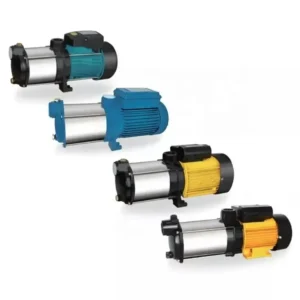
The Surface Pump Series includes centrifugal, jet and peripheral pumps installed above the water level, typically with flooded suction or limited suction lift.
Best fits
- Industrial and commercial booster systems
- Tank‑to‑tank transfer with small elevation differences
- Washing, spraying, cooling water where source is in a pit or tank
- Light industrial uses where access and quick maintenance are critical
Key engineering characteristics
- Economic and simple installation
- Easy integration with pressure tanks and control valves
- Largest risk is poor suction conditions (air entrainment, high temperature, low NPSH_a)
If your source can be kept flooded (below‑grade tank or pit with the pump at or below liquid level), a surface pump is often the easiest to design and service.
2.2 Submersible Pumps – For Sumps, Pits, Drainage and Wastewater
Submersible pumps operate underwater, eliminating suction lift and making them ideal where installing a pump room is impractical.
Best fits
- Industrial sumps and collection pits
- Construction and mine dewatering
- Sewage and wastewater lift stations
- Flood control and stormwater management
Key engineering characteristics
- No suction pipe—pump pushes directly, so NPSH issues are reduced
- Cable routing, sealing and corrosion protection are critical
- Impeller type (vortex, channel, semi‑open) must match solids content
If your fluid contains grit, fibers or solids, or the source is below accessible floor level, submersible pumps usually win on reliability and installation cost.
2.3 Deep Well Pump Series – For Boreholes and High‑Head Water Supply
The Deep Well Pump Series represents multistage submersible pumps with a slim diameter for deep boreholes and high heads.
Best fits
- Industrial facilities drawing water from deep aquifers
- Municipal or community borehole water supply
- High‑head agricultural and industrial irrigation
- Process water intake where water table is far below grade
Key engineering characteristics
- Multistage hydraulics provide high heads (60–300 m or more) at moderate flows
- Installation depth, cable sizing and motor cooling must be engineered carefully
- Sensitive to sand and abrasives if well completion is poor
When TDH is high and the water source is vertical and constrained in diameter, deep well pumps are nearly always the right series to consider.
2.4 Solar Pump Series – For Off‑Grid or Hybrid Power Projects
The Solar Pump Series is defined by the energy source: photovoltaic (PV) power with dedicated controllers. Hydraulically, they can be surface or deep well submersibles.
Best fits
- Off‑grid industrial or agro‑industrial sites
- Remote irrigation fields and livestock watering
- Rural community water supply where extending grid is uneconomical
- Hybrid systems that reduce diesel generator runtime
Key engineering characteristics
- Must match PV array, controller and pump curve for optimal daily yield
- Typically sized around daily volume rather than instantaneous peak
- Often combined with elevated storage tanks to buffer solar variability
When grid stability or fuel logistics are chronic risks, solar pump systems can dramatically reduce OPEX while improving resilience.
3. Performance Matching: From Duty Point to Pump Series
Once the application points to one or more pump families, you must verify hydraulic and mechanical compatibility via a structured process.
3.1 Calculate Total Dynamic Head (TDH)
For most water‑like applications:
Where:
- HstaticH_{static}: elevation difference between liquid surface at source and discharge point
- HfrictionH_{friction}: pipe, valve and fitting losses (use Darcy–Weisbach or Hazen–Williams)
- HpressureH_{pressure}: outlet pressure head (e.g., 3 bar ≈ 30 m)
- HmiscH_{misc}: entry/exit losses, special equipment losses (heat exchangers, filters, etc.)
Rule of thumb: always apply a realistic safety margin (typically 5–15%, depending on data quality) but avoid oversizing more than necessary.
3.2 Plot Duty Point on Pump Curves
For each candidate series (e.g. one from the Surface Pump Series and one from the Pipeline Centrifugal Pump Series):
- Identify models whose curves cover your duty point (Q, H).
- Evaluate efficiency at that point—prefer operation near the Best Efficiency Point (BEP).
- Check NPSH_r (required) vs NPSH_a (available) for relevant models.
- Confirm the motor rating (kW, service factor) provides adequate margin.
3.3 Continuous vs Intermittent Operation
Pump series and motor choices must reflect thermal loading:
- Continuous duty near BEP → standard models in the relevant series are usually fine.
- Frequent starts/stops → check motor and control design (soft starters, VFDs).
- Wide flow variation → consider variable speed control with pumps from the Pipeline Centrifugal Pump Series or multi‑pump arrangements.
4. Application‑Driven Selection Examples
Below we map typical industrial and commercial applications to specific JG PowerTech pump series so you can see how the logic works in practice.
4.1 Factory Process Water & Cooling Circulation
Scenario
- Closed loop for cooling jackets, heat exchangers, or HVAC
- Low to medium head (15–80 m), relatively stable flow
- Clean water at moderate temperature
Recommended series
- Pipeline Centrifugal Pump Series for inline installation in pipelines
- For small auxiliary circuits, selected models from the Surface Pump Series
Why this fit
- Inline pipeline pumps reduce footprint and piping complexity
- Close‑coupled designs integrate well with motors from the Electrical Motors Series
- Easy to combine with VFDs for flow control and energy savings
4.2 Raw Water Intake From River or Canal
Scenario
- Open channel or river source
- TDH 10–40 m, flows 20–200 m³/h depending on plant size
- Potential for debris and varying water levels
Recommended series
- Robust end‑suction units within the Surface Pump Series
- For mobile or backup intake, engine‑driven sets from Gasoline & Diesel Water Pump and Dynamo
Why this fit
- Surface pumps allow easy access for screen cleaning and maintenance
- Engine‑driven sets ensure intake continuity during grid failures
- Pre‑screening reduces solids load on downstream treatment equipment
4.3 Industrial Wastewater and Effluent Lift Stations
Scenario
- Mixed industrial wastewater, possibly with solids, fibers, oils
- Multiple lift stations from workshops to central treatment plant
- Variable flow, risk of clogging
Recommended series
- Sewage and drainage models in Submersible pumps
Why this fit
- Submersible sewage pumps with vortex or channel impellers handle solids better
- Eliminate suction lift and long suction piping (frequent source of issues)
- Pump station structures can be compact, with easy top‑side access to guide rails
4.4 Deep Borehole Supply for Industrial Park
Scenario
- Industrial park or cluster with dedicated deep boreholes (80–200 m)
- Demand for reliable, potable or process water supply
- Grid power available, but long‑term OPEX is a concern
Recommended series
- Multistage stainless deep well units from the Deep Well Pump Series
Why this fit
- High head at good efficiency in slim boreholes
- Long service intervals when wells are properly designed
- Compatible with above‑ground control panels, pressure vessels and treatment systems
Optional hybrid
- To cut energy costs and increase resilience, combine deep well series hydraulics with solar controllers in the Solar Pump Series.
4.5 Off‑Grid Agro‑Industrial Irrigation
Scenario
- Large farm or agro‑processing site without reliable grid
- Need to pump from a borehole or open pond to fields or storage
- Strong motivation to reduce diesel consumption
Recommended series
- Off‑grid solutions from the Solar Pump Series, using submersible or surface hydronics as appropriate
- Backup diesel or gasoline sets from Gasoline & Diesel Water Pump and Dynamo for low‑sun periods
Why this fit
- Solar pumps align pump power with solar availability, optimized around daily water demand
- Elevated storage tanks decouple irrigation schedule from solar peak hours
- Hybrid setups drastically reduce generator runtime and fuel expenses
5. Integrating Motors, Controls and Accessories
Matching the right series also means coordinating drives, controls and system accessories.

5.1 Motor Selection and Efficiency
Industrial engineers should:
- Choose motors from the Electrical Motors Series with appropriate power rating, enclosure and efficiency class.
- Consider VFD‑ready motors for applications with variable duty.
- Check voltage, frequency and ambient temperature conditions.
Using pumps and motors from the same china pump supplier simplifies alignment of frame sizes, coupling options and spare parts.
5.2 Controls and Protection
Key protections regardless of series:
- Overload and short‑circuit protection
- Dry‑run protection (especially for surface and deep well pumps)
- Phase loss and phase reversal protection for three‑phase systems
- Thermal protection for motors in harsh environments
Solar pumps will additionally need:
- MPPT (Maximum Power Point Tracking) controllers
- Overspeed and overvoltage protection
- Monitoring for low sun conditions and tank full levels
5.3 Mechanical and Piping Accessories
Use Pump Accessories and related equipment to complete a robust installation:
- Check valves, isolation valves, strainers
- Flexible connectors to reduce vibration
- Pressure gauges, flow meters, temperature sensors
- Expansion tanks and air separators in closed loops
In industrial environments, you may also need:
- Air compressor Series for instrument air
- Axial fans Series for ventilation of pump rooms
- Kerosene/Diesel Forced Air Heaters Series for cold‑climate temporary heating during installation and maintenance
6. Lifecycle and Maintainability Considerations
Pump series selection must look beyond day‑one performance. Industrial engineers should evaluate:
- Accessibility
- Surface and pipeline pumps: easy to inspect, replace seals, align couplings
- Submersible and deep well pumps: require lifting equipment—design wellheads and guides for safe retrieval
- Spare parts strategy
- Favor standard series (e.g., Surface Pump Series, Pipeline Centrifugal Pump Series) with long‑term parts support
- Standardize across sites to reduce inventory complexity
- Energy efficiency over time
- For continuously running systems, small efficiency gains from better pump series and motor class pay back quickly
- Solar pumps shift OPEX burden from energy to CapEx amortization
- Scalability and modularity
- Multi‑pump arrangements with smaller standardized units can offer better turndown and redundancy than one large custom pump
- Solar fields and pump sets can be expanded in phases as production or population grows
7. Practical Selection Workflow for Industrial Engineers
You can formalize selection into a repeatable workflow:
- Define system duty and constraints
- Fluid, Q–H duty, environment, power supply
- Choose candidate pump families
- Surface, submersible, Deep Well Pump Series, Pipeline Centrifugal Pump Series, Solar Pump Series
- Evaluate series‑level suitability
- Installation geometry (above/below liquid, open vs closed system)
- Water quality (clean vs solids‑laden)
- Operation mode (continuous vs intermittent, turndown requirement)
- Select specific models
- Plot duty points on curves
- Verify efficiency, NPSH, motor power and margins
- Specify motors and controls
- From Electrical Motors Series and appropriate control gear
- Integrate system accessories
- Valves, gauges, protection, ventilation and auxiliary systems using Pump Accessories and environment equipment series
- Review lifecycle factors
- Maintainability, spare parts, energy cost, expansion plans
8. Conclusion: Use Standardized Pump Series to De‑Risk Your Project
For industrial engineers, the question “Which pump series fits your application?” is fundamentally about system thinking:
- Geometry and hydraulics (where the fluid is, and where it must go)
- Power and control philosophy (grid, diesel, solar, VFDs)
- Operations and maintenance (access, spares, lifecycle cost)
By working with well‑defined series—such as the Surface Pump Series, Submersible pumps, Deep Well Pump Series, Solar Pump Series and Pipeline Centrifugal Pump Series—from a single china pump supplier like JG PowerTech, you can:
- Reduce design risk
- Shorten specification and procurement time
- Simplify spare parts management
- Optimize total cost of ownership across the project life
Treat series selection as an engineering decision backed by data, rather than a catalog guess. When you align pump series with clearly defined application requirements, the rest of the design—from piping to controls—falls into place much more smoothly.

0 Comments