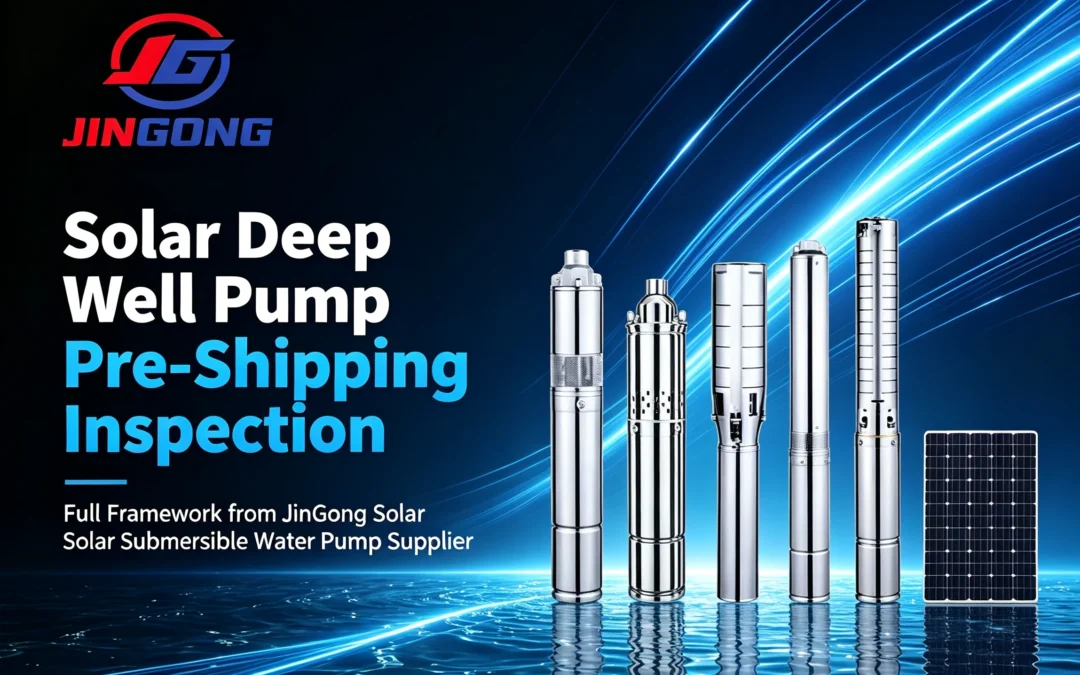
When sourcing solar deep well pumps for challenging environments—from the arid farms of Africa to the remote agricultural sites in Southeast Asia—the moment the container leaves the factory is when your risk profile truly begins. At Jingong Tech, a Zhejiang-based manufacturer with over a decade of expertise in pumps (including solar, submersible, land, and engine-driven models), we understand that cross-border returns are rarely feasible. A mismatched voltage controller or a micro-crack in a submersible shell that fails 80 meters down a borehole can transform a profitable project into a logistical nightmare.
This guide is not a generic “QC checklist” copied from a third-party blog. It is a comprehensive Pre-Shipping Inspection (PSI) framework forged from Jingong’s 10+ years of exporting to 40+ countries. We will detail the exact protocols we use to ensure every solar submersible water pump meets rigorous international standards. Use this as your definitive lens to vet potential suppliers or as a blueprint to standardize your own supply chain quality control.
1. Introduction — Why Solar Deep Well Pump Pre-Shipping Inspection Is the First Filter for Overseas Buyers

What Cross-Border Pump Buyers Actually Worry About
In our daily inquiries at Jingong Tech, we identify five core anxieties among international B2B buyers:
- Parameter Integrity: Will the head, flow, and voltage specifications precisely match the Proforma Invoice?
- Logistics Survival: Will the pump body withstand the humidity and stacking pressure of a 30-day ocean voyage?
- Regulatory Compliance: Are the CE and RoHS documents current enough to pass customs scrutiny in 2025?
- After-Sales Liability: Who bears the cost of air-freight replacements if defects emerge?
- Supplier Authenticity: Am I dealing with a factory with real engineering capabilities or merely a trading company?
A glossy product photo solves none of these. A transparent, documented, and repeatable PSI process does.
How Jingong’s Solar Deep Well Pump Export Experience Shapes This Framework
As a Industry-Trade Integrated enterprise, Jingong operates four distinct production lines:
- Solar Pump Series: Deep well, surface, and pool pumps.
- Submersible Pump Series: Clean water, sewage, and QDX-QX-WW types.
- Land/Centrifugal Pump Series: Booster, jet, and self-priming pumps.
- Gasoline/Diesel Engine Pump Series: Agricultural and construction drainage.
This multi-line expertise is vital because solar deep well pumps possess a unique risk profile. Unlike standard AC submersibles, they integrate sensitive electronics (controllers) and face extreme static pressure. This framework highlights these distinctions to help you adapt inspections across your entire pump portfolio.
2. Why Solar Deep Well Pumps Need a Different Inspection Logic
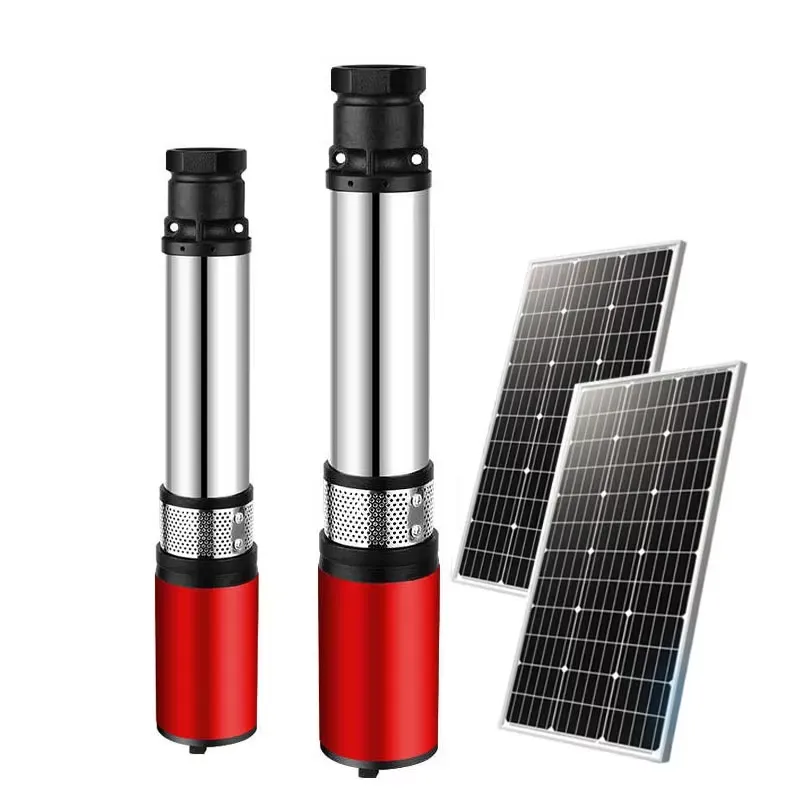
Structural & Logistics Risk Mapping by Pump Type
A 3-inch solar deep well pump may resemble a standard AC submersible on paper, but the failure modes differ significantly:
| Risk Dimension | Solar Deep Well Pump | Plain Submersible (AC) | Land Pump | Engine Pump |
|---|---|---|---|---|
| Electrical System | DC + MPPT Controller + PV Mismatch Risk | AC Motor Only | AC Motor | Engine + Coupler |
| Fragile Components | Controller, Sensors, Connectors | None | Switch Box | Carburetor |
| Depth Pressure | High (Static + Thermal Cycling) | High | N/A | N/A |
| Customs Sensitivity | CE + RoHS + TÜV (Often Mandatory) | CE Basic | CE Basic | Emission Docs Required |
The Real Cost of Failure
Quality control is an investment, not an expense. Consider the math:
- Air Freight Replacement: $180–$260/unit (vs. $28–$40 via sea).
- Downtime Costs: Up to $120/day for delayed irrigation projects.
- Warranty Processing: $300–$600 per incident without local agents.
Implementing a strict PSI based on AQL 1.0 standards reduces defective rates from an industry average of 3–7% down to <0.8%. For a 200-unit tender, that is the difference between replacing 14 units versus just one.
3. Pre-Inspection Preparation — Standardizing the Workflow

3.1 Order Parameter Verification
Before any physical testing, we conduct a tri-source verification against:
- The signed Proforma Invoice (PI).
- The technical datasheet (crucial for custom voltages or cable lengths).
- The internal Production BOM (Bill of Materials).
For solar deep well pumps, we specifically verify: Motor Power (e.g., 750W/1200W DC), Rated Voltage Range (24V/48V/72V), Max Head, Rated Flow, Outlet Diameter, Cable Length (standard 15m or custom), Controller Type (MPPT/PWM), and the Accessories Kit. Any deviation exceeding tolerance (Head ±3%, Flow ±5%) results in an immediate production hold.
3.2 Calibration of Inspection Tools
Data is only as reliable as the instruments producing it. All Jingong test benches undergo quarterly calibration against Zhejiang Metrology Bureau standards. Key tools include:
- True-RMS Multimeter: For precise voltage/current readings.
- Pressure Test Manifold: 0–25 bar capacity for seal integrity.
- Electromagnetic Flow Meter: For accurate flow rate measurement (0.5–30 m³/h).
- Insulation Resistance Tester: 500V DC Megger.
- Noise Meter: dB(A) measurement at 1m distance.
3.3 Export Document Pre-Archiving
To prevent delays, document packs are staged before inspection begins:
- ISO 9001:2015 Certificate
- CE Declaration of Conformity (LVD + EMC)
- RoHS Compliance Statement (Updated for 2025)
- Draft Packing List (PL), Invoice (INV), and Certificate of Origin (CO)
3.4 Batch Sampling Rule (AQL 1.0 / 2.5)
We adhere to international AQL standards to ensure statistical significance:
- Orders ≤ 50 units: 100% functional testing.
- Orders 51–500 units: AQL S-3 / S-4 sampling (Critical: 0, Major: 1.0, Minor: 2.5).
- Orders > 500 units: AQL General Level II sampling.
Note: For solar pumps, “Critical” defects include electrical safety failures or controller mismatches (0 tolerance).
4. Core Item Inspection Checklist — The Heart of the Framework

4.1 Solar Pump Main Body Inspection
The foundation of reliability lies in the build quality:
- Material Verification: 304 or 316L Stainless Steel (magnet test + cert spot-check).
- Thread Integrity: BSPT/NPT threads free of burrs.
- Cable Gland: IP68 rated, tightened to 8–10 N·m torque.
- Mechanical Seal: Carbon/Ceramic or SiC/SiC, visually inspected for lubrication.
- Permanent Marking: Laser-etched Model, Serial Number, and Date Code (>0.2mm depth).
4.2 Electrical & Solar Matching System Inspection
This is the defining differentiator for solar pumps:
- Controller Enclosure: IP54 minimum (IP65 preferred).
- MPPT Efficiency: Verified ≥ 98% using a programmable DC source.
- Input Voltage Validation: Ensuring the controller’s Vmax rating matches the panel configuration (e.g., preventing a 150V controller from being paired with an incompatible array).
- Terminal Security: Torque checked at 1.2–1.5 N·m.
- Wiring Continuity: MC4 connectors pull-tested (≥ 90 N axial force).
4.3 Performance Functional Testing
Every pump undergoes a simulated borehole test:
- No-Load Run: Startup under simulated solar ramp (0→Nominal voltage).
- Load Run: 3–5 minutes at mid-head point. Flow and head are measured simultaneously. Tolerance: Flow ±5% at rated head; Head ±3% at rated flow.
- Efficiency Check: Motor efficiency verified (typically 85–92% for BLDC motors).
- Noise Level: dB(A) @ 1m kept within specification (typically 45–52 dB).
- Low-Light Simulation: Pump must not stall at 25% simulated irradiance.
4.4 Accessories & Spare Parts Inspection
Missing accessories cause as much downtime as faulty pumps. We verify:
- Solar Controller (pre-tested)
- MC4 Branch Connectors
- Stainless Steel Rope Clamps
- Inlet Filter/Strainer (weld integrity checked)
- Spare Mechanical Seal Kits
- English Manuals & Warranty Cards
An accessory matrix sheet is initialed by QC for every carton.
4.5 Solar Deep Well Pump Appearance & Export Labeling
Compliance is visual. We ensure:
- Rating Plate: Includes Model, SN, Power, Voltage, IP Rating, and “Made in China”.
- Carton Marks: N/W, G/W, Dimensions, “FRAGILE,” “THIS SIDE UP,” and buyer logos.
- Regional Compliance: Arabic translations for the Middle East/Africa; UV-resistant outer tape for the Middle East; ISPM-15 stamps for wooden crates.
5. Packaging & Container Loading Inspection — The Cross-Border Pain Point
5.1 Moisture-Proof & Shockproof Packaging Tiers
Ocean containers frequently experience 80–98% humidity. Jingong employs a 3-tier packaging protocol:
- Tier A (Unit): 2-layer PE wrap, EPE foam caps, 5-ply honeycomb carton, and silica gel sachets (10g–20g depending on route).
- Tier B (Controller): Separate carton with bubble wrap to prevent crushing.
- Tier C (Consolidation): Plywood crates (heat-treated ISPM-15) for larger units, featuring corner braces and strapping.
5.2 Container Loading Supervision
Loading is supervised by a dedicated export team:
- Pre-Load Check: Container must be dry, odor-free, and structurally sound.
- Palletization: Orders over 200 cartons are palletized (80x120cm standard).
- Stacking Limits: Max 5 cartons high for 3-inch pumps; 4 high for 4-inch+.
- Lashing: Polyester straps and dunnage boards used to prevent shifting.
- Photo Documentation: Six-angle photos (Front, Back, Left, Right, Top, Seal) provided to buyers within 4 hours.
5.3 Destination-Specific Adjustments
- West Africa (Rainy Season): Double silica gel, PE inner bags.
- Middle East (Summer): UV-resistant outer tape.
- EU (Rotterdam/Hamburg): Strict ISPM-15 compliance, visible CE labels.
6. Document & Certification Verification — The Trust Anchor
6.1 CE Marking: LVD + EMC
A solar pump is treated as two products for CE compliance:
- The Motor: Compliant with LVD (2014/35/EU) and EN 60335-2-41.
- The Controller: Compliant with LVD + EMC (2014/30/EU) and EN 55014/EN 61000.
Jingong provides separate Declarations of Conformity (DoC) for both components, listing specific directive numbers and harmonized standards.
6.2 RoHS 2.0 Compliance (2025 Updates)
With the 2025 revisions to lead exemptions (EU 2025/2363 & 2364), updated documentation is critical. Our RoHS reports explicitly cover the 10 restricted substances and highlight compliance for copper alloy windings and solder. We also monitor the pending addition of MCCPs and TBBPA to stay ahead of regulatory changes.
6.3 ISO 9001 & Factory Test Reports
Our ISO 9001:2015 certification covers the design, production, and export of water pumps. Each batch includes a Factory Test Report detailing the PO reference, model quantities, serial ranges, test dates, AQL results, and authorized signatures.
6.4 Commercial Documents
The final export pack includes: Packing List (PL), Commercial Invoice (INV), Bill of Lading (BL), Certificate of Origin (CO), CE DoC, RoHS Statement, and Factory Test Report. For regulated markets (Kenya PVoC, Saudi SABER, UAE ECAS), pre-shipment certifications are arranged prior to loading.
About Jingong Tech
Zhejiang Jingong Technology Co., Ltd. is a leading manufacturer and supplier of high-quality water pumps. With over ten years of experience, we specialize in Solar Pumps, Submersible Pumps, Land Pumps, and Gasoline/Diesel Engine Pumps. Our commitment to rigorous quality control and international standards makes us a trusted partner for global distributors and project contractors.
Related Resources: