
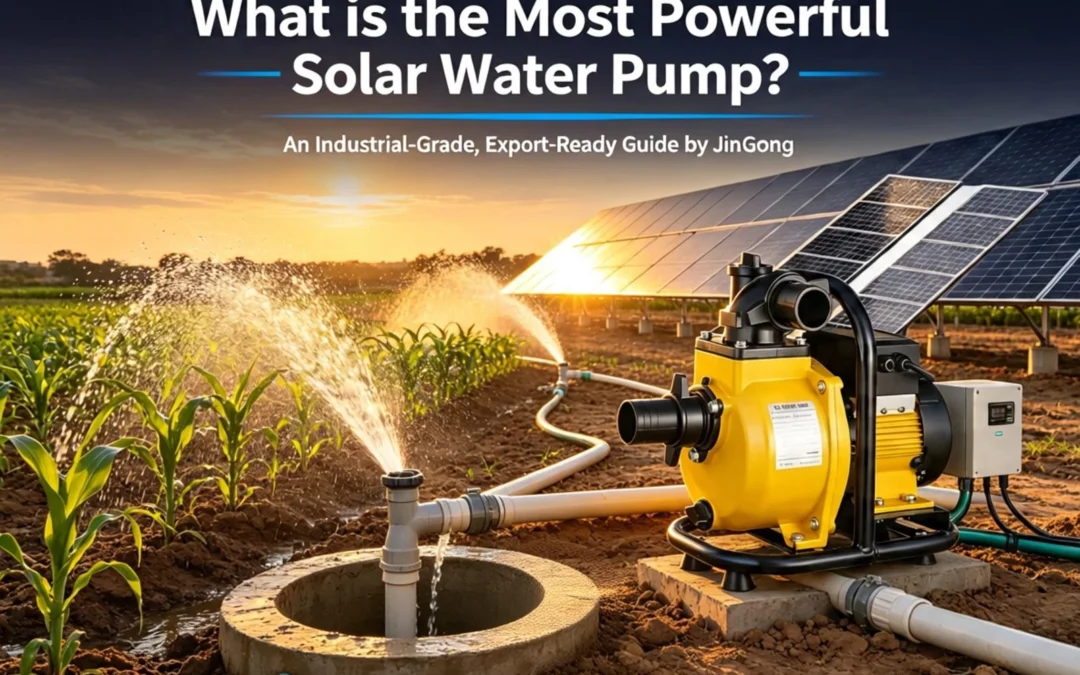
When international buyers search “most powerful solar water pump,” they usually aren’t looking for a single horsepower number on a brochure. They are looking for a solution that doesn’t stall during a Nigerian dry season, doesn’t overheat in a Saudi Arabian borehole, and doesn’t require unstable grid power in a remote Peruvian valley.
At JinGong (Zhejiang JinGong Technology Co., Ltd.), we have been manufacturing water pumps for over 20 years—ranging from booster pumps, submersibles, and surface pumps to gasoline/diesel engine pumps and, increasingly, industrial-grade solar pumping systems. Our products are shipped globally to Africa, the Middle East, South America, and Southeast Asia.
This guide is written from a combined shop-floor and export-operations perspective. We will deconstruct “most powerful” into three measurable dimensions—power/efficiency, scenario adaptability, and long-term stability—then analyze pump types, core technologies, global brands, verified case studies, and a practical sourcing checklist for serious distributors and project owners.
Why “Most Powerful” Isn’t Just About kW — What International Buyers Actually Need

A “30kW” label on a solar pump means very little if the motor efficiency plummets below 70% under partial load, the controller fails to track the Maximum Power Point (MPPT) when PV voltage fluctuates, or the pump curve was designed for a 30m head while your borehole sits at 180m.
In the export markets we serve daily, “powerful” translates into specific operational outcomes:
- High Flow (50–500 m³/h): Essential for canal diversion and large-scale farm irrigation.
- High Head (150–800m+): Critical for deep boreholes, mountainous villages, and cliff-side agriculture.
- Industrial Endurance: Required for harsh environments like seawater desalination, mining dewatering, and desert greening projects where temperatures exceed 50°C.
Therefore, the honest answer to “what is the most powerful solar water pump?” is: It is the system whose hydraulic curve, motor technology, and environmental rating precisely match your site conditions.
Defining High-Power Solar Water Pumps — Industry Benchmarks + Export Reality

The 5kW Threshold — How the Industry (and JinGong) Classifies “High Power”
While there is no single global legal definition, across international export catalogs and IEC-aligned specifications, the industry generally agrees on these tiers:
| Category | Power Range | Typical Flow | Typical Head | Use Case |
|---|---|---|---|---|
| Small / Residential | 0.1–1.5 kW | 0.5–10 m³/h | 10–60 m | Home, small garden |
| Mid-range | 1.5–5 kW | 10–50 m³/h | 40–120 m | Small farm, guest house |
| High-Power | 5–30 kW | 50–300 m³/h | 80–400 m | Large farm, village, EPC projects |
| Industrial-Grade | 10–100+ kW | 100–1000+ m³/h | Up to 800m+ | Desalination, mining, desert projects |
At JonGong’s Zhejiang production facility, our solar pump line covers 0.75 kW all the way to 100 kW (with custom OEM solutions available up to 132 kW). Most export inquiries we classify as “high-power” fall within the 7.5 / 11 / 15 / 22 / 30 kW brackets—the sweet spots for African irrigation cooperatives and Middle Eastern deep-well tenders.
Nominal Power vs. Actual Operating Power

This is the #1 technical clarification our engineering team provides to new distributors. A solar pump “rated 10kW” refers to its motor nameplate rating, not the guarantee that it will pull 10kW from the PV array all day.
Actual operating power depends on:
- Irradiance (W/m²): Cloud cover and time of day drastically affect input.
- PV Array Sizing: Many suppliers undersize panels. If you pair a “15kW pump” with only 12 panels (~4.8kW DC), the motor will never reach its rated flow.
- Pump Load Point: Where the pump operates on its Head-Flow curve.
- Controller Efficiency: Quality MPPT controllers achieve 96–99%; inferior units struggle at 85–90%.
We have audited tenders in the Middle East where three bidders’ “15kW” pumps measured actual peaks of 9.2 kW, 11.4 kW, and 14.1 kW on-site. Only one met the daily volume requirement. This wasn’t a pump problem; it was a system design failure.
International Standards You Should Check
For government projects or EU-funded irrigation programs, compliance is non-negotiable:
- ISO 9906: Rotodynamic pump performance testing (Acceptance Class 1 or 2).
- IEC 61215: Crystalline silicon PV module reliability.
- IEC 61730: PV module safety standards.
- ISO 9001: Factory Quality Management System.
- CE: Mandatory for the European Union market.
- FDA / WRAS: Required for pumps supplying potable (drinking) water.
JonGong’s solar pump lines are backed by ISO 9001 certification, featuring CE and IEC-compliant controllers. For EU drinking water projects, we supply wetted parts in 316L stainless steel and FDA-grade seals upon request.
Three Dimensions to Judge “The Most Powerful” (Not One Number)

Dimension 1 — Power & Efficiency
For high-power solar pumps (>5kW), three sub-components dictate true performance:
- Motor Type: BLDC (Brushless DC) motors dominate modern solar pumps above 1kW. Efficiency typically ranges from 85–93% across the load range, compared to 60–75% for AC induction motors under partial load. They require no brushes, reducing maintenance in dusty environments.
- MPPT Controller Quality: The brain of the operation. It tracks the PV array’s maximum power point as clouds pass or the sun moves. Premium units offer 98%+ efficiency and wide DC input ranges (e.g., 200–850V DC for 10kW+ systems).
- PV Array Match: As a rule of thumb, JonGong engineers recommend sizing the DC array nameplate at 1.3–1.5 × the motor’s rated kW for high-sun regions (Africa/Middle East) and 1.5–1.8× for cloudier or tropical zones (SEA, parts of South America).
Dimension 2 — Scenario Adaptability
“Powerful” also implies resilience—the ability to operate without failing in hostile environments.
| Environment | Common Failure Points (Cheap Pumps) | JonGong Engineering Solution |
|---|---|---|
| Desert / Sahel | Sand abrasion, mechanical seal failure | Stainless steel sand guard + Silicon Carbide seals + Optional SS316 construction |
| Tropical / SEA | Condensation, rust, UV degradation | IP65 controllers, marine-grade terminals, UV-resistant cables |
| Deep Borehole (200m+) | Motor overheating, thrust bearing wear | Oil-filled or water-filled BLDC motors, high-thrust angular contact bearings |
| High-Mineral Water | Impeller corrosion, scaling | SS304 standard; SS316/Duplex stainless steel for aggressive waters |
Dimension 3 — Long-Term Stability
From an importer’s perspective, “most powerful” ultimately means the lowest Total Cost of Ownership (TCO) over a 5–7 year horizon:
- Warranty: JonGong offers a standard 2-year / 24-month warranty on motors and controllers, extendable to 3 years for key project accounts.
- Spare Parts: We include 1% free spare parts (seals, bearings, controller components) with container orders and guarantee 10-year parts availability—a critical factor for World Bank or AFDB-funded projects.
- Off-Grid Resilience: Our AC/DC hybrid models allow the pump to run on grid power or a diesel generator when PV output is low, ensuring 24/7 operation in monsoon or winter zones.
Common Myths JinGong Engineers See in Export Orders

Myth 1: “Higher kW Always Means Better Performance”
We once consulted for a Nigerian distributor who requested “the 30kW model” for a 60m-head rice irrigation project. The issue? The 30kW unit was a high-head screw profile optimized for 200m+. A 7.5kW multistage centrifugal would have delivered twice the flow at half the PV investment cost.
Solution: Always specify based on Flow + Head + Water Type, then size the power. Never the other way around.
Myth 2: “If It Says 10kW, It Runs 10kW”
As detailed in the Nominal vs. Actual Power section, many tenders are won on paper but fail in the field due to undersized PV arrays or inefficient controllers. Verification through ISO 9906 test reports is essential.
Myth 3: “Any Solar Pump Works in Desert or Tropical Climates”
A controller rated IP54 might survive a Norwegian summer, but in a Sudanese wheat farm (48°C ambient, 60°C panel backsheet), it will fail prematurely. JonGong ships IP65 controller boxes with fan-assisted heatsinks for MENA (Middle East/North Africa) accounts by default.
Types of High-Power Solar Water Pumps — Which One Fits Your Project?
High-Flow Type (Centrifugal / Multistage Centrifugal)
Ideal for large-scale agricultural irrigation and canal filling.
- JonGong Series: JG-SOLAR-C (5.5 / 7.5 / 11 / 15 / 22 / 30 kW).
- Specs: Flow 50–350 m³/h; Head 20–150 m.
- Motor: BLDC, driven via external MPPT controller.
- Export Tip: For farms exceeding 500 hectares, paralleling two 15kW units often provides better redundancy and MPPT flexibility than a single 30kW unit.
High-Head Type (Screw / Deep Well Submersible)
Essential for mountainous regions and deep boreholes where water tables are low.
- JonGong Series: JG-SOLAR-S (Screw) + JG-SOLAR-D (Deep Well Submersible).
- Specs: Power 3–30 kW; Head 100–800m+; Flow 8–120 m³/h.
- Tech: Oil-filled BLDC motors or potable-water-filled motors, high-thrust bearings, sand guards.
Industrial-Grade Type (Corrosion-Resistant, High-Temp)
Built for the most demanding applications outside of standard agriculture.
- Specs: Power 11–100+ kW; Flow 100–1000+ m³/h.
- Materials: SS316L, Duplex Steel, Bronze impellers.
- Applications: Seawater desalination, mining dewatering, construction site drainage, desert greening.
Comparison Table: High-Power Solar Pump Types
| Type | Power Range | Flow (m³/h) | Head (m) | Best Application | JonGong Series |
|---|---|---|---|---|---|
| High-Flow Centrifugal | 5–50 kW | 50–500 | 20–150 | Farms, Canals | JG-SOLAR-C |
| High-Head Screw | 3–15 kW | 10–80 | 80–250 | Shallow Boreholes | JG-SOLAR-S |
| Deep Well Submersible | 5.5–30 kW | 8–120 | 100–800+ | Deep Boreholes | JG-SOLAR-D |
| Industrial Centrifugal | 11–100+ kW | 100–1000+ | 30–300 | Desalination, Mining | JG-SOLAR-I |
Core Technologies That Make a Solar Pump “Powerful”
BLDC Brushless Motor Technology
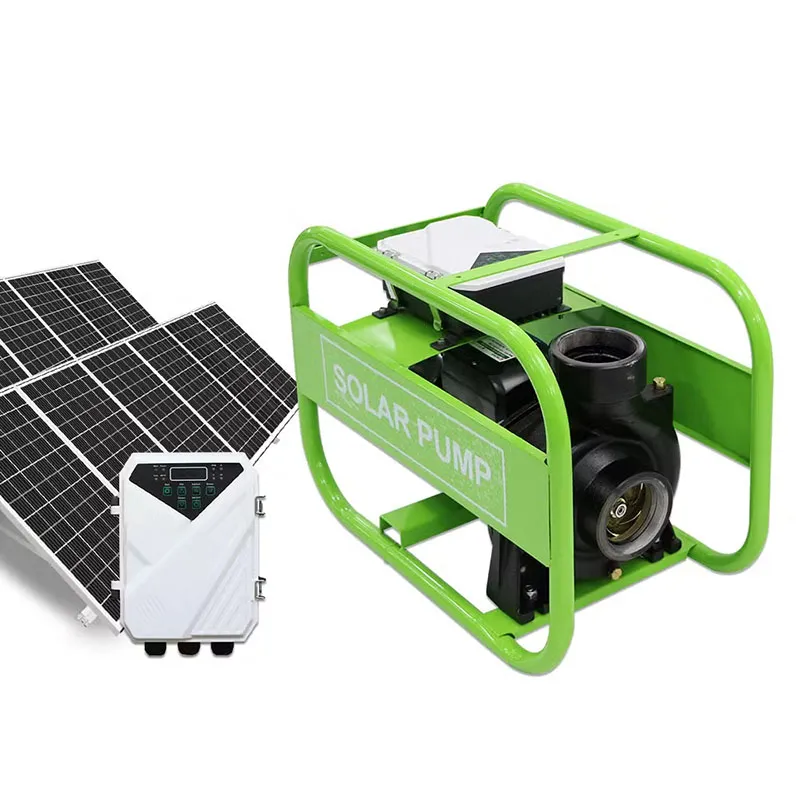
Above 5kW, BLDC is not a premium feature; it is the baseline for efficiency. JonGong’s 5.5–30kW solar motors consistently deliver 88–92% efficiency across 30–110% of their load range. Our in-house production controls critical design points:
- Laminated stators to minimize eddy current losses.
- N42UH Neodymium magnets rated for 180°C.
- C3 clearance double ball bearings to accommodate thermal expansion.
MPPT (Maximum Power Point Tracking) Controller
For 5.5kW+ units, JonGong utilizes external MPPT controllers rather than integrated ones. This allows for superior cooling and easier field servicing. Key specifications of our 15kW controller include:
- Wide DC Input: 250–820V.
- MPPT Efficiency: ≥98.2%.
- Comprehensive Protection: Over-voltage, Under-voltage, Over-current, Over-temperature, Dry-run, and Lightning Surge (TVS protection).
AC/DC Hybrid Systems
This is a major differentiator for projects in monsoon or winter zones. JonGong’s hybrid models feature automatic switching logic:
- PV Sufficient: Direct DC drive from solar panels.
- PV Low: Automatic switch to grid or generator AC power via VFD mode.
- No Manual Changeover: Reduces labor and ensures continuous water supply.
This feature is highly valued in the Middle East for 24/7 village water supply, where relying solely on PV would necessitate oversized arrays and expensive battery banks.
Certifications & Compliance — Non-Negotiable for Export
| Target Market | Required Certifications | JonGong Capability |
|---|---|---|
| European Union | CE, IEC 61215, IEC 61730, ISO 9001 | ✅ Fully Compliant |
| Africa (Govt. Projects) | ISO 9001, SONCAP (Nigeria), PVOC (Kenya) | ✅ ISO/CE Ready (Local agents handle SONCAP) |
| Middle East | IEC, CE, SASO (KSA) | ✅ Fully Compliant |
| Potable Water (Global) | FDA (USA), WRAS (UK), ACS (France) | ✅ Available On Request |
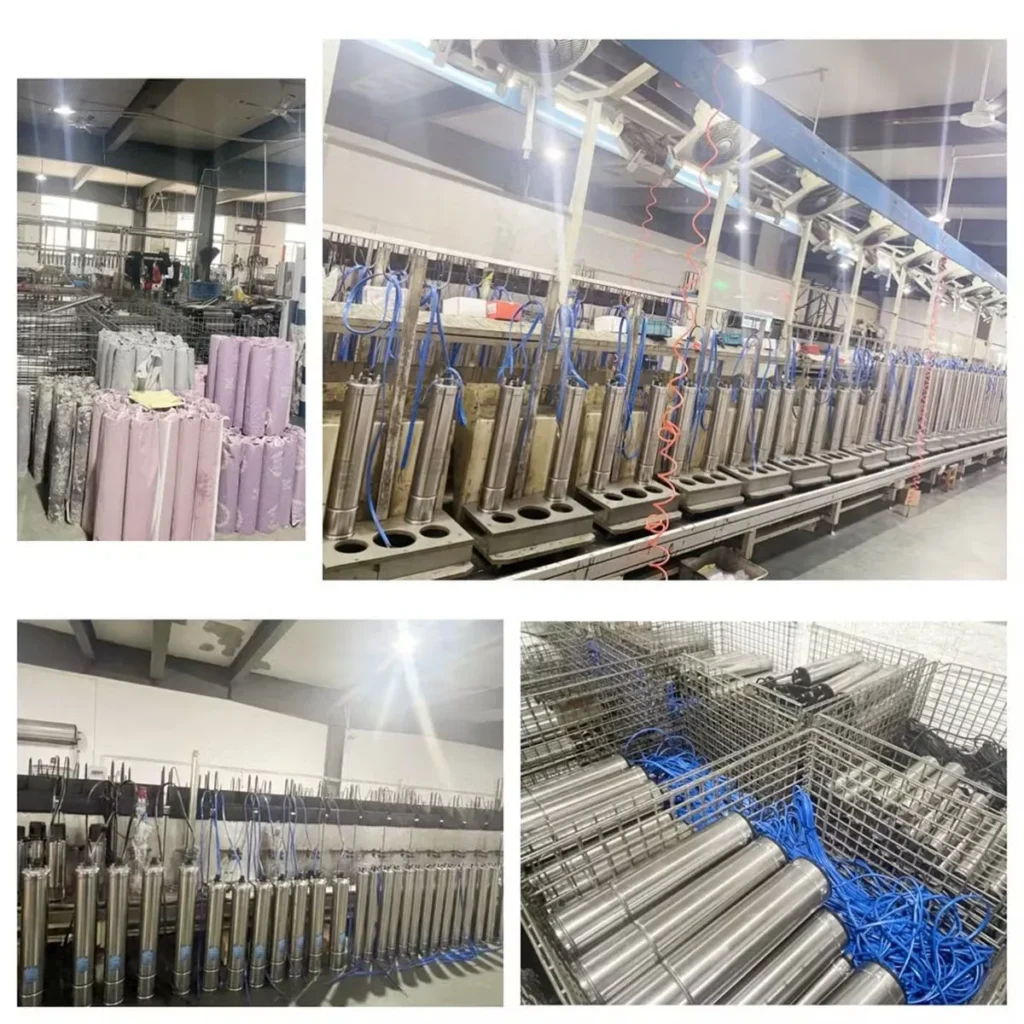
Distributor Insight: When bidding on World Bank or AFDB irrigation projects, always ask for an ISO 9906 test report (Class 2 minimum). Many trading companies cannot provide this level of verified data. JonGong can, thanks to our closed-loop hydraulic test bench located in our Zhejiang facility.
Top Global Brands — And Where JonGong Sits in the Market
Grundfos (Denmark)
The premium tier. Their SQFlex and SP Solar lines are industry benchmarks for deep-well applications. Known for exceptional reliability but priced at a 3–5x premium over Chinese equivalents. Primarily serves the EU, Gulf States, and NGO markets.
Lorentz (Germany)
A leader in high-head solar pumping (PS/PS2/CS series). Their German engineering reputation and robust MPPT technology make them popular in African NGO projects and Middle Eastern deep-well installations. Pricing is typically 2.5–4x Chinese alternatives.
Rafsun / Sunmoy (China)
Strong players in the cost-performance segment. Rafsun has good market penetration with AC/DC hybrid messaging. Sunmoy focuses heavily on the submersible pump sector. Both offer faster lead times than European brands.
JinGong (China · Zhejiang)
JonGong bridges the gap between premium EU brands and entry-level Chinese trading companies. With over 20 years as a pump manufacturer (producing booster, submersible, surface, engine pumps, and solar pumps), we offer:
- Technology: BLDC + AC/DC hybrid integration across our 5.5kW+ SKUs.
- Verification: In-house test bench providing ISO 9906 reports.
- Assurance: 2-year warranty, 1% free spares, and a 10-year parts availability guarantee.
- Service: Comprehensive OEM/ODM services (logo branding, customized curves, multilingual manuals).
- Logistics: Standard lead time of 25–35 days; 20 days for repeat orders.
We position ourselves as the ideal partner for distributors targeting Africa, the Middle East, South America, and Southeast Asia who require better QC and documentation than typical trading companies, but at a far more competitive price point than Grundfos or Lorentz.
Real-World High-Power Solar Pump Projects (Verified Cases)
Case 1: Xuanwei, Yunnan — 826m Head, 10,000-Acre Irrigation
While not a JonGong project, this domestic Chinese government initiative serves as a benchmark for what is hydraulically possible. Utilizing multistage centrifugal solar-PV lift systems, the project achieves a total dynamic head of 826m (combining pipe friction and geographic lift) to deliver approximately 15,000 m³ of water daily. It proves that ultra-high-head solar lifting is viable when the entire system is engineered correctly.
Case 2: Nigeria Ogun State — 20kW JonGong, 150 m³/h
Crop: Maize and Cassava. Scale: 1,000 hectares. System: 20kW JG-SOLAR-C centrifugal pump paired with 28 × 550W high-efficiency monocrystalline panels. Result: Provided critical dry-season supplementation to existing diesel systems, saving the cooperative an estimated $8,200 per month in fuel costs. Since commissioning in 2022, the system has experienced zero downtime, aside from one controller swap following a localized lightning strike.
Case 3: Saudi Arabia — 15kW High-Head Deep Well
Site: Remote village, no grid connection. Borehole: 300m depth. System: 15kW JG-SOLAR-D deep well submersible pump, powered by 12 × 550W panels, utilizing our AC/DC hybrid controller (allowing generator backup during frequent sandstorms). Result: Reliably meets the daily demand of 80 m³ for potable water and livestock, ensuring community resilience.
How to Select & Source — A 5-Step Checklist for Importers
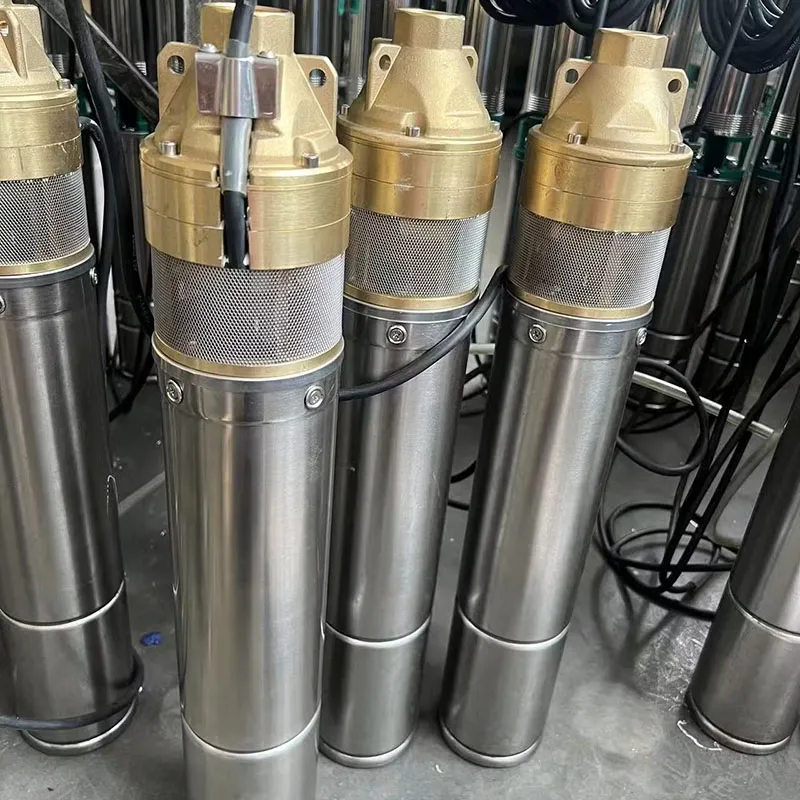
Step 1: Confirm Flow & Head Requirements
Use these fundamental formulas: Required Flow (Q): Q (m³/h) = (Area × Crop Coefficient × Evapotranspiration) / Operating Hours Required Head (H): H (m) = Static Lift + Friction Loss + Pressure Head
JonGong provides a simple one-page selection sheet (link below). Fill in your flow, head, water type, and average sun-hours, and our engineering team will return a matched pump curve and PV configuration within 24 hours.
Step 2: Match Power & Hybrid Needs
If your site enjoys steady sun (Sahel, KSA), a pure DC system is cost-effective. However, for mission-critical applications or regions with monsoons/winter (SEA, parts of SA), investing in an AC/DC hybrid system prevents costly downtime.
Step 3: Verify Certificates & Third-Party Reports
Never rely solely on a supplier’s catalog. Request copies of valid certificates and, crucially, the ISO 9906 hydraulic performance test report. This is your primary defense against “parameter inflation.”
Step 4: Evaluate Spare Parts & After-Sales Support
Ask specific questions: What spare parts are included free of charge? What is the lead time for a replacement controller or seal kit? Can a local electrician service the unit, or are proprietary tools required?
Step 5: Compare Lead Time & OEM Flexibility
Standard lead times vary widely. At JonGong, our standard production cycle is 25–35 days. Factor in OEM customization (logo, manual, packaging), which typically adds 5 days. Understand the Minimum Order Quantity (MOQ)—JonGong is flexible, with a minimum of one 20ft GP container for mixed models.
Market-Specific Tips for Exporters
Africa
Priority: High flow over extreme head, dust-proofing, and cost-per-cubic-meter. Hot Sellers: 5.5 / 7.5 / 11 kW centrifugal pumps. Sales Angle: Emphasize the diesel displacement story—calculate monthly fuel savings to win tenders.
Middle East
Priority: High head (deep wells), extreme heat resistance (≥50°C), and strict certifications. Hot Sellers: 7.5–22 kW deep well submersibles, AC/DC hybrid systems. Compliance: SASO (KSA) and IEC standards are strictly enforced.
South America
Priority: Large-scale farm coverage, flexible voltage compatibility (127/220/380V). Hot Sellers: 11–30 kW centrifugal pumps for Soy and Corn irrigation.
Southeast Asia
Priority: Humidity resistance, AC/DC hybrid capability (monsoon), and corrosion protection. Hot Sellers: 3–15 kW range, with frequent requests for Stainless Steel 316 upgrades.
Industry Trends — Where High-Power Solar Pumps Are Headed
- Trend 1: Standardization of 10–100kW Systems: Driven by large-scale Agri-EPC projects funded by the World Bank and AFDB, single-unit power ratings are climbing.
- Trend 2: IoT and Remote Monitoring: JonGong’s next-generation controllers support RS485/4G connectivity, allowing distributors and project managers to receive real-time alerts for dry-run conditions or efficiency drops.
- Trend 3: Hybrid + Battery Buffering: Moving from a premium add-on to an expected feature in monsoon and winter zones to ensure true 24/7 operation.
- Trend 4: Carbon-Neutral Procurement: EU-funded irrigation projects are beginning to request “embodied carbon” documentation from suppliers, favoring manufacturers with transparent environmental practices.
Frequently Asked Questions (FAQ)
Q1: What is the maximum power of a solar water pump? A: Commercially, 100kW is the common ceiling for a single unit. JonGong provides OEM solutions up to 132kW. For requirements exceeding this, parallel unit configurations are recommended for redundancy.
Q2: Which type of solar water pump is the most powerful for farm irrigation? A: For large-scale irrigation, a multistage centrifugal pump in the 7.5–30kW range, equipped with a BLDC motor and MPPT controller, offers the best balance of flow and efficiency.
Q3: How can I verify the actual power of a solar water pump when purchasing? A: Request an ISO 9906 test report (Class 2) from the supplier. Additionally, ensure the PV array sizing is 1.3–1.8 times the motor’s nameplate rating depending on your solar irradiance.
Q4: What certifications are required for exporting high-power solar water pumps to the EU? A: You must have CE certification, along with IEC 61215 and IEC 61730 for the PV components, and ISO 9001 for the manufacturing process. For potable water, FDA or WRAS certification is also mandatory.
Q5: Which brand of high-power solar water pump offers the best value for the African market? A: Factory-direct Chinese manufacturers with robust documentation (like JonGong or Rafsun) offer significantly better value than trading companies. While Grundfos and Lorentz offer premium quality, their prices are typically 3-5 times higher.
Conclusion: The Most Powerful Pump is the Best Matched Pump
The search for the “most powerful solar water pump” should not be a search for the highest number on a specification sheet. It is a search for the perfect fit between your site’s hydraulic needs (flow and head), your environmental conditions (heat, sand, humidity), and the underlying technology (BLDC efficiency, MPPT accuracy, system redundancy).
At JonGong, we don’t lead with “we have 100kW.” We lead with: “Send us your borehole depth, your acreage, and your average sun-hours—we will engineer the optimal solution, whether it requires 7.5kW or 30kW, a screw pump or a centrifugal, a hybrid or a pure DC system.”
Next Steps: Partner with JonGong
Ready to specify the right high-power solar pump for your project or distribution portfolio?
- 🔧 Download the JonGong Solar Pump Selection Sheet — Fill out our one-page form, and our engineers will respond within 24 hours.
- 📦 View the Full JonGong Solar Pump Catalog — Explore our range from 0.75 kW to 100 kW.
- 📩 Contact the JonGong Export Team — Speak with our technical sales team in English, Spanish, or Arabic.
Published by the JonGong Engineering Team. Zhejiang-based manufacturer of industrial water pumps since 2003. ISO 9001 Certified.