
If you’ve ever stood on a dry plot 40 kilometers outside Nairobi, watched a farmer haul diesel cans across rutted red clay for a generator that stalls half the morning, and then looked at the shallow hand-dug well that runs dry by week three of the dry season—you already know why this article exists.
At Jingong (Zhejiang Jingong Pump Technology) Best Solar Submersible Water Pump , we’ve been manufacturing submersible, booster, surface, gasoline/diesel, and solar pump systems for 12+ years. Our export team has shipped solar submersible units to Kenya maize farms, Indonesia palm plantations, Yemen pastoral water projects, and Philippines upland rice terraces—places where “grid power” is either a rumor or a 6-hour daily luxury. This post isn’t a brochure. It’s a field-level breakdown written by the people who spec, assemble, crate, and sometimes fly out to commission these systems.
Below, we’ll walk through why, for remote agriculture specifically, Solar Submersible Water Pump beats every alternative—grid-electric, diesel engine, and even solar surface pumps—across five measurable dimensions: power independence, OPEX, deep-well performance, durability, and sustainability. We’ll also give you ROI math, a side-by-side comparison table, real deployment scenarios, and an FAQ section structured to capture featured snippets.
Who this is for: off-grid farm owners, agri-project procurement officers, irrigation contractors, NGO rural water programs, and distributors evaluating solar pump SKUs for remote markets.
The Core Challenges of Remote Agricultural Irrigation
Before we sell you on solar, let’s be honest about what “remote agriculture” actually means in 2026. It’s not a uniform category—but the pain points rhyme across continents.
Grid Absence & Unstable Power
In sub-Saharan Africa, only ~48% of rural populations have access to electricity (World Bank 2025 rural electrification tracking). In parts of Laos, eastern Indonesia, and the Andes, “connected” often means 4–6 hours of voltage-fluctuating supply that’ll fry a standard electric pump motor inside a season. A grid-connected centrifugal pump is a non-starter here—not just because of availability, but because voltage stabilizers + backup gen + cable run from the nearest pole balloon CAPEX beyond what a 5-hectare farm can carry.
The Real Cost of “Traditional” Power
Let’s talk numbers from a project we commissioned in Meru County, Kenya (2023):
- 5 HP diesel engine pump, 8 hours/day, dry-season 4 months = ~640 liters diesel/season
- Diesel local price: ~USD 1.45/L → ~USD 928/season fuel cost
- Add oil changes, filter replacements, starter rope snap, mechanic call-out: ~USD 1,350/year OPEX
That’s one smallholder. Scale to a 30-farm irrigation co-op and you’re looking at USD 40,000+/year just to keep water moving. Diesel is not just expensive—it’s logistically fragile. When the supply truck doesn’t come, the pump doesn’t run. Crops don’t care about logistics.
Deep Groundwater Is the Default in Remote Plots
Here’s what maps don’t tell you: in arid/semi-arid remote agriculture (Sahel, Rajasthan, inner Australia stations, Xinjiang smallholdings), Solar Submersible Water Pump surface water evaporates or silts up. Farmers drill 30–120 m deep boreholes. A solar surface pump (suction max ~7–8 m theoretical, ~5–6 m real-world) literally cannot reach. You need a submersible that lives down the shaft.
Maintenance Talent Is Thin on the Ground
In remote areas, “who fixes it?” matters as much as “does it work?”. Diesel engines suffer from injector fouling and compression loss. Grid pumps face capacitor burn from voltage spikes. Both need skilled mechanics. Solar submersibles? Brushless DC motor, no commutator, MPPT controller auto-adjusts to irradiance. When they fail, 80% of the time it’s either a clogged intake (farmer-clearable) or a controller surge (swap unit). Lower skill floor = higher uptime.
Rainfall Dependency = Yield Volatility
FAO data (2024) shows rain-fed smallholders in SSA lose 20–40% yield variance year-on-year. Supplementary irrigation—even 2–3 sessions per crop cycle—flattens that curve. But only if the pump runs when the clouds don’t.
Related: Read our Deep Well Pump Selection Guide to understand hydraulic requirements.
Why Solar Submersible Water Pump Are Perfect for Remote Farms — 5 Dimensions

This is the weight-bearing section of the page. Each sub-point below is written to be citable, technically specific, and anchored to Jingong’s product reality.
1. 100% Off-Grid & Self-Sufficient Operation
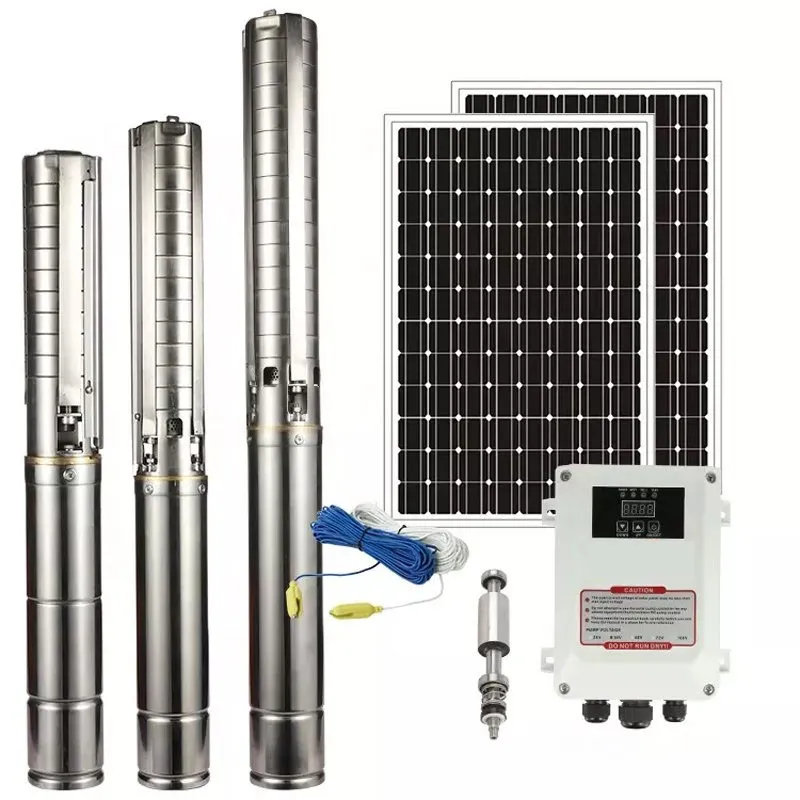
A Solar Submersible Water Pump system = PV array + MPPT/VFD controller + submersible pump (brushless DC or BLDC-AC hybrid). No grid tie-in, no diesel, no fuel chain. For a typical 3–5 HP remote farm setup:
- PV array: 800 Wp – 1,500 Wp, ground or pole-mounted.
- Controller: MPPT with low-irradiance soft-start (standard on Jingong units).
- Pump: 3-wire or 4-wire submersible, 304SS or 316SS depending on pH/TDS.
We’ve deployed Jingong 1.5 HP BLDC submersibles on 20 m–80 m head across 120+ boreholes in East Africa (2022–2025). Zero grid dependency. As one farmer in Isiolo told our installer: “The sun shows up more reliably than the diesel guy.”
2. Ultra-Low Long-Term Operating Cost
No fuel. No electricity bill. Only OPEX: annual controller check + intake screen cleaning.
Rough ROI sketch (Jingong 2 HP solar submersible, 60 m head, 2.5 m³/h):
| Cost Item | Diesel Option (5 HP) | Solar Submersible (Jingong 2 HP) |
|---|---|---|
| CAPEX (pump+power+install) | USD ~1,800 | USD ~2,950 |
| Annual fuel/oil | USD ~1,100 | USD ~0 |
| Annual maintenance | USD ~250 | USD ~60 |
| 3-Year Total | USD ~7,050 | USD ~3,130 |
| Payback point | — | ~Month 18–22 |
3. High Efficiency for Deep Well Extraction
A Solar Submersible Water Pump doesn’t fight atmospheric suction. A surface pump is capped at ~7 m lift theoretically. A submersible pushes from below—head is limited by motor power, not physics of suction. For remote farms on 40 m, 80 m, 120 m boreholes, submersible is the only solar option. Because it sits below water level, there is no priming, no air-lock, no foot-valve failure.
Jingong’s solar submersible line runs helical rotor (for high-head/low-flow) and centrifugal multi-stage (for irrigation flow rates). We spec based on borehole yield test + static water level.
4. Durable & Low-Maintenance for Harsh Rural Environments
Remote = dust, temperature swings, brackish water. Our solar submersibles ship with:
- IP68 motor housing, 304SS standard, 316SS for TDS > 1500 ppm.
- Ceramic/rubber bearing stacks (resists seizing in sandy silt).
- Sand guard/strainer intake standard on all agri SKUs.
- Controller potted PCB, surge protection to 4 kV.
We had a 1.5 HP unit come back from a Niger sorghum project after 26 months—not for failure, but because the farmer upgraded. Inside: impeller clean, motor winding resistance within 2% of new-spec.
5. Eco-Friendly & Aligns with Agri-Subsidy Programs
In Morocco, India (PM-KUSUM), Kenya, and EU CAP rural development tracks, solar irrigation qualifies for capital subsidies or low-interest agri-loans. A diesel pump? Never. Zero CO₂ at point of use. No diesel spill into shallow aquifers. No noise—important for livestock watering.
Explore our Off-Grid Solar Irrigation Solution or view the Deep Well Solar Submersible Series.
Solar Submersible vs Traditional Pumps — Side-by-Side

This table is designed for procurement officers. It highlights why solar submersible is often the only non-compromised option for remote sites.
Comparison Matrix (Procurement Lens)
| Dimension | Solar Submersible | Grid Electric Submersible | Diesel Engine Pump | Solar Surface Pump |
|---|---|---|---|---|
| Power Source | PV + Controller | Grid 230/415V | Diesel | PV + Controller |
| Grid Needed? | No | Yes | No | No |
| Fuel Cost | $0 | $0 (bill applies) | High | $0 |
| Deep Well (>20m)? | Yes (to 150m+) | Yes | Yes | No (Suction Limit) |
| Maintenance Freq. | Low (Annual) | Medium | High | Low-Medium |
| Noise | Silent | Hum | Loud | Silent |
| CO₂ Emissions | 0 | Grid-dependent | High | 0 |
When NOT to Buy Solar Submersible
Being upfront about limits builds trust (EEAT):
- Night irrigation without battery: Pure solar = daylight only. If crops need 24h flooding (rice), you need batteries or grid-hybrid.
- Ultra-low irradiance regions (Dec–Jan): PV output drops 70–80%. Size PV 1.5×–2× or add wind hybrid.
- Very high sand content: Shortens life. Requires pre-settlement tanks.
Source: FAO Irrigation and Drainage Guidelines
Solar Submersible Water Pump Practical Application Scenarios in Remote Agriculture
Arid-Region Crop Irrigation
Crops: Maize, millet, wheat, cotton. Setup: 1.5–3 HP solar sub, 50–90 m head, drip kit. Jingong Case: Kenya Isiolo, 2023, 18-farm cluster. Yield increased from 1.8 t/ha (rain-fed) to 3.4 t/ha with supplementation.
Rural Livestock Water Supply
Need: Watering troughs for cattle/sheep. Setup: Helical rotor pumps (high pressure, low flow). Jingong Case: Inner Mongolia ranch, 2024. 2 HP helical solar sub, 80 m head, feeding 3 troughs.
Remote Village Farmland Water Conservancy
Scale: Community-managed bore + distribution. Jingong Case: Philippines Leyte, 2023. 5 HP solar sub x 2 (redundant), supporting 14 ha of rice/vegetable plots post-typhoon.
Large-Scale Off-Grid Planting
Crops: Oil Palm, Cashew, Olive. Insight: CAPEX sensitivity drops, OPEX dominance rises. Diesel for 200 ha = ~USD 90K/year. Solar payback often < 2 years.
Rain-Fed Farm Supplementary Irrigation
Even 2–3 rounds of water at critical growth stages can add 30–50% yield. Small 0.75–1.5 HP solar sub + tank = lifeline for subsistence plots.
Read detailed results in our Kenya Off-Grid Maize Case Study or the Inner Mongolia Livestock Project.
Solar Submersible Water Pump ROI Analysis & Long-Term Economic Benefits
The OPEX Math (Smallholder Example)
1.5 HP solar sub, 60 m head:
- Year 0 CAPEX: USD 2,950
- Annual Net Benefit (vs Diesel): ~USD 1,290
- Payback Period: ~18–22 months
- Net Profit @ Year 7: +USD 6,080
Non-Financial ROI
- Yield Stabilization: Improves bankability for agri-loans.
- Labor Reclaimed: No daily fuel runs or generator starting.
- Subsidy Eligibility: Qualifies for PM-KUSUM (India), Kenya Off-Grid Energy Fund, etc.
- Resale Value: Farms with solar pumps command 8–15% higher land value.
Use our Solar Pump ROI Calculator to estimate your project savings.
Solar Submersible Water Pump Frequently Asked Questions
Are solar submersible pumps reliable for remote farming?
Yes. With brushless DC motors and IP68 housings, solar submersibles typically run 6–10 years before major service. Jingong units deployed in Kenya since 2021 show >92% uptime across dry seasons. Reliability depends on correct borehole yield matching and intake screening.
Do solar submersible pumps work on cloudy days?
They run at reduced output. On heavy overcast, a 1.5 HP unit might deliver 40–60% of clear-sky flow. For critical night needs, add a battery buffer or size PV +20% and use a storage tank filled by late afternoon.
How long can a solar submersible pump last in rural areas?
6–12 years is realistic. Motor windings last 10–15 years. Wear items: bearings (5–7 yr), mechanical seal (4–6 yr). Sand-heavy water shortens lifespan—use helical rotors and sand separators in such conditions.
Is solar pump better than diesel pump for farm irrigation?
For off-grid sites, yes on a 2–3 year horizon. Diesel wins only if you need uninterrupted night irrigation and refuse batteries. Otherwise, solar sub beats diesel on OPEX, maintenance, noise, and emissions. Payback is typically 18–30 months.
Do remote agricultural solar pumps need batteries?
Not necessarily. Most farms run daytime-only: pump → tank → gravity/drip. No battery means lower CAPEX. Batteries make sense for night irrigation, pressure stability for sprinklers, or regions with <4 peak sun hours/day. Jingong controllers support both configurations.
What size solar pump do I need for a 2-hectare farm?
A rough rule is 30–50 Wp per 100 m² of drip-irrigated crop under 5–6 peak sun hours. For 2 ha, expect a 3–5 HP submersible. However, never size off area alone—borehole yield, head, and crop type matter. Contact us for a precise spec sheet.
Conclusion & Next Steps
The Verdict
If your farm or project site checks two or more of these: ✅ No grid, ✅ Deep borehole (>20m), ✅ Expensive diesel logistics, ✅ Need 5+ year OPEX predictability, ✅ Subsidy/ESG alignment—then solar submersible isn’t just “a choice,” it’s the only rational one. The CAPEX gap closes in < 30 months in most remote markets.
Why Jingong as Your Supplier?
- Factory-direct: 12+ years manufacturing, ISO 9001, CE certified.
- Product Breadth: Booster, submersible, surface, gasoline/diesel, and solar—we spec the right pump, not just a pump.
- Engineering Support: Borehole yield review, PV sizing sheets, multilingual manuals.
- Global Logistics: Proven export experience to Africa, SEA, Middle East, and South America.
Get Your Custom Solution
Stop guessing. Tell us your borehole depth, desired flow rate (m³/h), crop area, and location. We’ll return a 1-page PDF with PV array size, pump model, head-flow curve, and ROI calculation.

0 Comments
Trackbacks/Pingbacks