
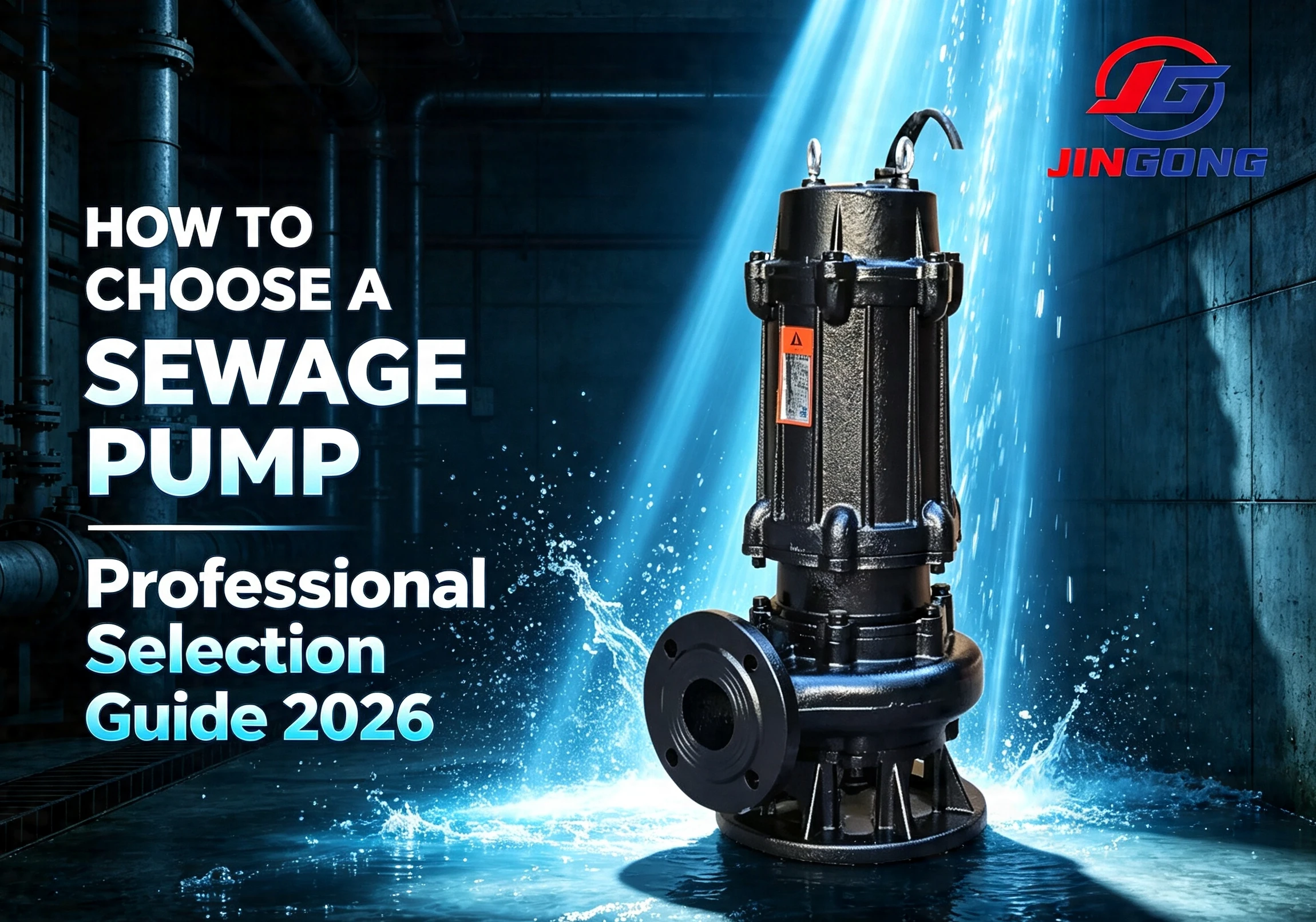
Choosing a sewage pump for overseas projects is rarely about picking the cheapest unit from a catalogue. If you’re a procurement officer, project engineer, distributor, or EPC contractor, you already know the pain points: solids clogging, wrong head sizing, voltage mismatch between 50Hz/60Hz regions, solar-diesel hybrid confusion in off-grid sites, and after-sales gaps once the container lands.
This guide is written by the engineering team at Jingong Technology. We’ve exported to 50+ countries across Southeast Asia, Africa, the EU, and LATAM. No AI fluff. No generic “check the flow rate” advice. We’ll go module by module, from definition → working principle → classification → parameters → scenarios → the 7-step selection framework → maintenance → troubleshooting.
Why This Guide – 15+ Years Export Experience Behind Every Recommendation
Most online articles are written for homeowners. This one is written for B2B buyers. We focus on international standards (CE/ISO), harsh media conditions, and the specific challenges of cross-border logistics and voltage adaptation. Our goal is to help you avoid costly mistakes that lead to pump failure within the first year.
1: What Is a Sewage Pump & Where It Differs from Clean Water Pumps
Quick Definition for Procurement Teams
A sewage pump is a centrifugal or positive-displacement pump designed to move wastewater containing solids (typically ≤80mm), fibrous matter, sludge, or semi-liquid industrial discharge from a lower elevation (sewage pit, sump, lagoon) to a higher discharge point or treatment system.
In Europe, compliant units often reference EN 12050 (Wastewater lifting plants) and carry CE marking under the Machinery Directive. For performance testing, ISO 9906 (Rotodynamic pumps — Hydraulic performance acceptance tests) is the baseline Jingong follows on every batch.
Sewage Pump vs Clean Water Pump – 5 Structural Differences
| Dimension | Clean Water Pump | Sewage Pump |
|---|---|---|
| Solids handling | ≤2mm | 20–80mm (cutter up to shredding rags) |
| Impeller | Closed radial | Vortex / Channel / Cutter |
| Seal design | Single mechanical | Double mechanical + oil chamber |
| Duty media | pH 6–8, no fiber | pH 4–10, fibers, sand, sludge |
| Typical use | Booster, irrigation | Municipal, estate, industrial waste |
2: Working Principle in Plain Engineering Language
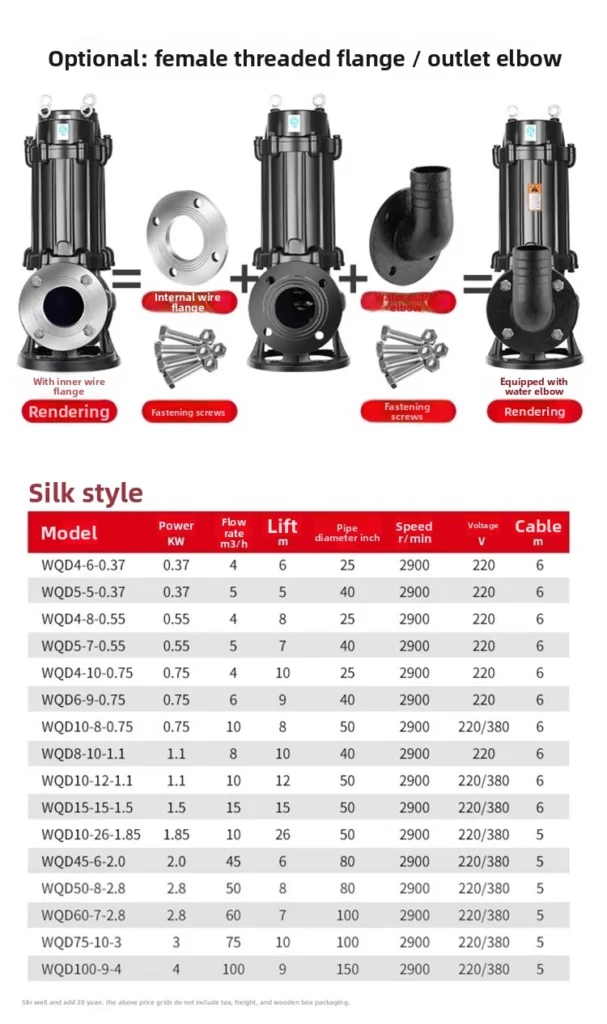
Submersible Sewage Pump – How It Works (Jingong Model Reference)
The motor and pump share a common shaft inside a sealed casing. Wastewater enters through the suction inlet, hits the impeller (vortex or cutter type), gains kinetic energy, and is discharged through the volute. The oil chamber above the mechanical seal acts as a leak detector—if the seal fails, the oil emulsifies, triggering an optional leakage electrode.

Solar & Diesel Driven Variants – Off-Grid Logic
Solar sewage pump: BLDC motor + MPPT controller + PV array. Ideal for African rural sanitation and remote camps.
Diesel/Gasoline sewage pump: Engine-driven, portable. Used for construction dewatering and flood relief.
Internal Links: Explore our Solar Pumping Systems | Diesel Engine Driven Pumps.
Sewage Pump Types – Match Our 4 Product Lines to Your Project

By Drive (Jingong’s Full-Range Advantage)
- Electric (Grid): 220V/380V/415V/460V/690V, 50Hz & 60Hz compatibility.
- Solar Powered: DC brushless motors for zero energy costs.
- Gasoline / Diesel: High mobility for sites with no electricity.
By Duty Scenario
- Residential/Commercial: Submersible 1.5–22kW with auto float switches.
- Industrial/Mining: High-head, high-flow submersibles with cutter impellers.
- Agricultural: Solar or Diesel units for lagoon management.
4: Design Standards & Key Parameters You Must Verify

Impeller Type: Vortex / Channel / Cutter
Selecting the right impeller is critical for preventing clogs:
- Vortex (Non-clog): Passes 65–80mm solids. Best for raw municipal sewage.
- Cutter (Grinder): Shreds rags. Use cautiously in sandy environments as blades wear.
Jingong Field Note: A palm oil farm in Thailand switched from a cutter to a vortex impeller after experiencing rapid blade wear. The vortex unit has now run for 3+ years without clogging.
Head / Flow / Power – The 20% Overage Rule
Never size a pump exactly to your calculated needs. Use this formula:
Selected Head = (Static Head + Friction Loss) × 1.2
Selected Flow = Peak Hour Flow × 1.15–1.3
This accounts for pipe scaling and future capacity expansion. A pump running at 85–90% of its Best Efficiency Point (BEP) lasts significantly longer.
5: Application Scenarios & How Jingong Matches Solutions
Municipal & Estate Drainage
Jingong supplied 60+ units for a Vietnam municipal upgrade (2024). Specs included 7.5–22kW vortex impellers, auto-coupling systems, and CE certification meeting EN 12050 standards.
Off-Grid Rural Africa
Kenya school sanitation project: 2× DC solar sewage pumps paired with bio-digesters. Result: Zero operational expenditure after installation.
6: How to Choose a Sewage Pump – 7-Step Selection Framework (Core)
Step 1: Define the Media
Obtain exact details: Solids size (mm), fiber length, pH, temperature, and abrasive content (sand %).
Step 2: Calculate Required Head & Flow
Use a friction loss calculator. Always apply the 20% overage rule mentioned in Module 4.
Step 3: Power Source Audit
Match the drive type to site conditions:
– Stable Grid: Electric Submersible.
– Unstable Grid: Diesel backup.
– No Grid (Sunny): Solar DC.
– No Grid (Night/Cloud): Diesel or Solar + Battery Hybrid.
Step 4: Installation Environment
Verify pit depth, pipe diameter, and whether explosion-proof (ATEX) motors are required for gas-prone wastewater treatment plants.
Step 5: Climate & Regional Factors
Tropical/Coastal regions require SS304 minimum. Winter freeze regions (Eastern Europe) require oil heat tracing.
Step 6: Budget vs TCO (Total Cost of Ownership)
Don’t compare ex-works prices alone. Calculate TCO over 5 years including energy consumption and spare parts.
Step 7: Certification & After-Sales
Ensure your supplier provides CE/ISO test reports and stocks spare parts in your region.
Ready for a tailored recommendation? Request a Selection Sheet from Jingong Engineers
7: Operation & Maintenance – Extend Service Life
Preventive Schedule Table
| Frequency | Submersible Electric | Solar Pumping System | Diesel Surface Pump |
|---|---|---|---|
| Weekly | Visual pit inspection | PV panel dust check | Oil level check |
| Monthly | Amperage draw log | MPPT error log review | Fuel filter visual |
| Yearly | Replace seal kit | Controller firmware update | Injector pressure test |
8: Common Faults & Troubleshooting
“Pump Runs But No Flow”
Four common root causes: 1. Clogged impeller, 2. Excessive suction lift, 3. Reverse phase (3-phase motors), 4. Closed discharge valve.
Solar Unit Low Flow at Noon
Counter-intuitively, this is often caused by undersized DC cables causing voltage drop at the MPPT controller. Upsizing cables typically restores flow.
Internal Link: Visit our Sewage Pump Troubleshooting FAQ for more solutions.
9: Why Jingong – Factory-Direct Sewage Pump Manufacturer
Unlike trading companies, we control the entire manufacturing process:
- 4 Lines, 1 Factory: Submersible, Surface, Solar, and Diesel-Gas engines.
- Certifications: CE (MD+EMC), ISO 9001, ISO 14001.
- Customization: Voltage, Hz, cable length, OEM branding, and multilingual manuals (EN/ES/FR/ID).
Internal Links: About Jingong Factory | Download Certificates.
FAQ – Sewage Pump Selection & Procurement
- Q: Are solar sewage pumps reliable for 24/7 duty?
- A: For sunlight hours, yes. For nighttime operation, we recommend a battery hybrid system or a dual diesel backup configuration.
- Q: Which is better – submersible or surface sewage pump?
- A: Submersible pumps are quieter and ideal for deep pits/lagoons. Surface pumps are better when service access is a priority. Read our detailed comparison: Submersible vs Surface Sewage Pump.
- Q: Sewage pump installation requirements for EU tender?
- A: Typically requires CE marking, compliance with EN 12050, a noise declaration, and WRAS approval if near potable water sources. Contact us for a full EU-ready dossier.
Get a Tailored Quote from Jingong Engineering Team
If you have a project specification (media / head / flow / voltage / country), send it over. Our engineering team replies within 24h with datasheets, curves, and pricing.

0 Comments