
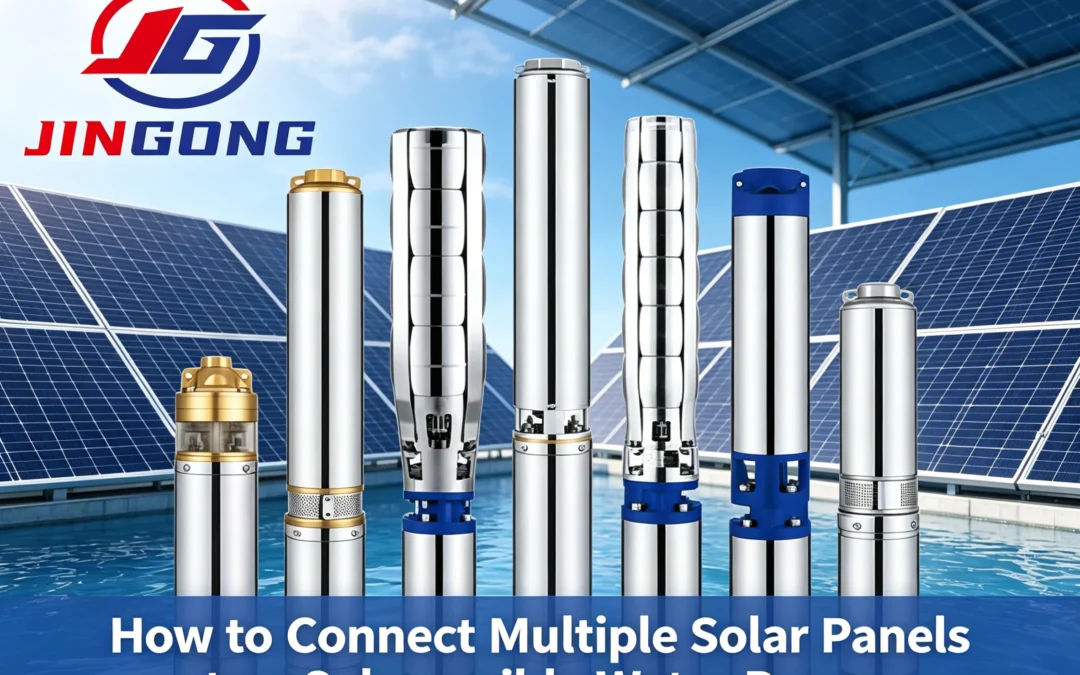
Connecting multiple solar panels to a Solar Submersible Water Pump isn’t “just wire them together.” Series boosts voltage for 24V/48V deep-well pumps but risks overvoltage on cloudy-cold mornings. Parallel keeps voltage low and extends runtime in weak sun but needs proper fusing. Hybrid is where most agricultural systems actually live. This guide walks through parameter matching, the 1.5× redundancy rule, MC4 step-by-steps for all 3 topologies, DC vs AC pump differences, and a troubleshooting table—written by a pump factory that builds solar submersible pump ,booster pumps, surface pumps, and DC/AC well pumps shipped globally.
1. Introduction – Why Solar Submersible Water Pump Wiring Is Different
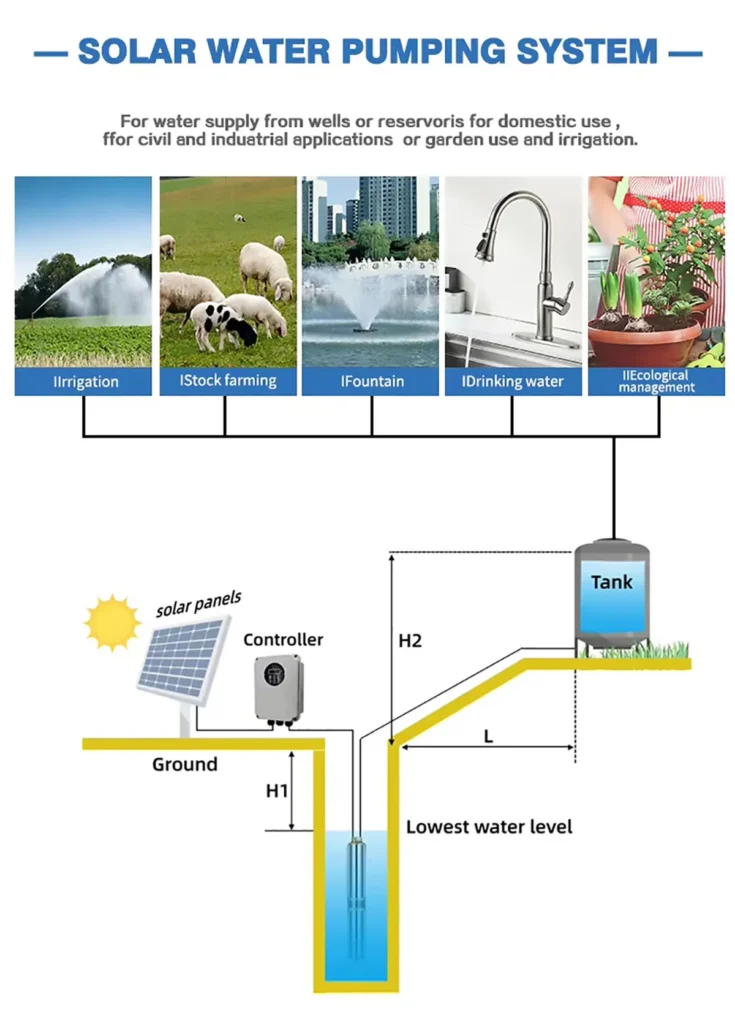
Most “how to wire solar panels” articles are written for RV or home battery setups. A submersible water pump system is a different animal entirely:
- Inductive Load: Pumps have startup surges (3–7× rated current for AC, 1.5–2× for DC brushless).
- Narrow Controller Window: Exceed Voc on a cold morning, and your MPPT controller fails instantly.
- Harsh Environment: Wiring goes underground or into a well cap—waterproofing isn’t optional.
- No Battery Buffer: In most off-grid pump setups, panel output maps directly to pump behavior.
If you treat a solar submersible like a cabin light circuit, you’ll either burn the controller in week one or wonder why the pump “runs but no water.”
Off-Grid Scenarios: Agriculture, Deep Well, Livestock, Remote Cabins
At Jingong, we see these configurations daily from our distributors:
| Scenario | Typical Pump | Recommended Panel Config |
|---|---|---|
| Small farm irrigation (shallow) | 12V DC submersible, 100–200W | 2 × 100W parallel |
| Deep well (30–80 m) | 24V/48V DC or 220V AC, 750W–1.5kW | 4–6 × 400W series / hybrid |
| Livestock watering (pasture) | 24V DC, 300–500W | 2 × 300W series |
| Remote cabin / village | 220V AC, 1.1–2.2kW | 6–10 × 450W hybrid + pure sine inverter |
The 3 Most Expensive Mistakes DIYers Make
- Mixing Panels: Using panels with different Voc/Isc in the same string creates a “shortest plank” effect, dragging down the whole system.
- Ignoring Cold-Weather Voc: Voltage can spike 20% higher than Standard Test Conditions (STC); this is what kills controllers.
- Undersized Wiring: Using AC wire charts for DC circuits leads to voltage drop and heat buildup, causing pump startup failures.
What This Solar Submersible Water Pump manufacturer Guide Covers
✅ 3 wiring topologies with specific use cases
✅ Sizing math with real-world examples (12V / 24V / 48V)
✅ DC pump (controller only) vs AC pump (inverter required)
✅ MC4 step-by-steps + safety protocols
❌ No “solar is free energy” myths—we deal in engineering reality.
2. Basic Working Principles & Connection Types
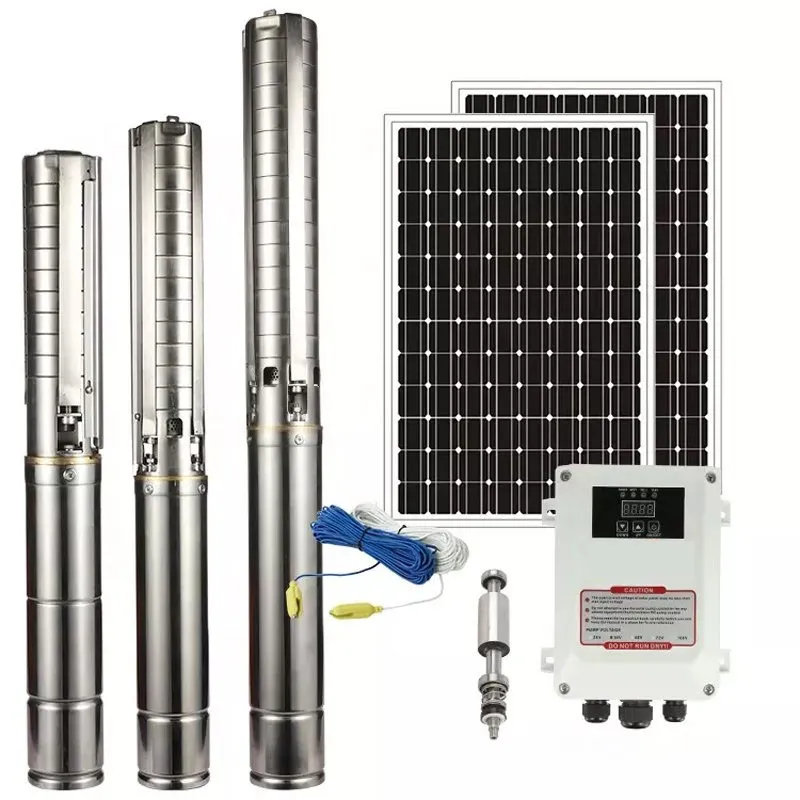
Before touching a wire, you must understand the core parameters. This is the foundation of Solar Panel Wiring for Submersible Pump success.
Key Parameters You Must Read
Panel Side (STC):
- Pmax: Rated watts.
- Voc (Open-Circuit Voltage): The maximum voltage a panel can produce. Critical for cold-weather limits.
- Vmp (Voltage at Max Power): The sweet spot voltage for charging.
- Imp (Current at Max Power): Amps delivered at Vmp.
Pump & Controller Side:
- Rated Voltage: 12V / 24V / 48V / 220V.
- Max PV Input Voltage: The absolute limit your controller/inverter can handle.
- Surge Capacity: For AC pumps, look for 3–7x startup surge capability in your inverter.
Series Connection – Boost Voltage, Same Current
Panel 1 (+) → Panel 2 (−)
Panel 2 (+) → Panel 3 (−)
String (+) → Controller PV In
String (−) → Controller PV In
- Math: Voc_total = Voc₁ + Voc₂…
- Use When: Wiring 24V/48V high-voltage DC pumps or long wire runs (higher voltage reduces transmission loss).
- Warning: Never exceed the controller’s max PV voltage, especially when accounting for cold temperatures.
Parallel Connection – Boost Current, Same Voltage
All Panel (+) → MC4 Y Branch (+)
All Panel (−) → MC4 Y Branch (−)
→ Controller PV Input
- Math: Isc_total = Isc₁ + Isc₂…
- Use When: 12V systems, regions with frequent cloud cover, or when you need extended runtime rather than high torque.
- Warning: Every parallel branch must have its own fuse to prevent back-feeding if one panel is shaded.
Series-Parallel Hybrid – When One String Isn’t Enough
This is the standard for agricultural Off-Grid Solar Submersible Pump System Setup. Example: 4 panels as 2S2P (Two sets of two panels in series, then those sets paralleled).
- Benefit: Increases both voltage and current, allowing for larger pumps.
- Rule: Panels in the same series string must be identical (model, orientation, tilt).
Why “Randomly Mixing Panels” Burns Controllers
A common failure: mixing old 250W panels with new 400W panels. In series, Solar Submersible Water Pump manufacturer the lower-wattage panel restricts the current flow for the entire string. In parallel, the higher-voltage string can backfeed the lower-voltage one, creating hot spots and fire risks. Factory Rule: Never mix different wattages in a series string.
3. Pre-Installation Preparation & System Sizing Calculation

Component Checklist
| Item | Specification Note |
|---|---|
| Solar Panels | Match wattage; 72-cell preferred for higher Vmp. |
| MC4 Connectors | UV-rated, genuine brands (Stäubli/MC4). |
| Combiner Box | IP65+ rated with DC fuses and surge protection. |
| Controller / Inverter | MPPT type; pure sine wave for AC pumps. |
| Cable | Copper, PV-rated (XLPE), sized for distance. |
| Fuses | Rated at 1.56 × Isc per branch. |
The 1.5× Power Redundancy Rule
Off-grid pumps lack batteries, so panels must cover the pump even in suboptimal conditions.
Formula: P_pv_total ≥ P_pump_rated × 1.5
Example (12V DC Pump, 120W):
- Required PV: 120W × 1.5 = 180W.
- Solution: 2 × 100W panels (200W total) in parallel.
Example (220V AC Pump, 1.5kW):
- Required PV: 1500W × 1.5 = 2250W.
- Solution: 6 × 400W panels (2400W) in a 3S2P configuration.
Voltage Window Matching (The Cold Temp Factor)
Temperature Coefficient (β_voc) is usually around -0.3%/°C. At -10°C, your voltage increases by ~10.5%.
Voc_cold = Voc_stc × [1 + (Tc − 25) × β_voc]
Rule of Thumb: Ensure your coldest expected Voc is less than 80% of your controller’s max PV input voltage.
Wire Gauge Selection
Aim for ≤ 3% voltage drop from array to controller. For a 10m run on a 24V system pulling 20A, 8 AWG copper is typically required. Consult an ampacity chart for specifics.
4. Step-by-Step Connection Guide (3 Methods)
⚠️ Safety First: Always cover panels with an opaque cloth before working on connections. A disconnected panel in the sun is still live at Voc. Use a multimeter to verify 0V before touching pins.
4.1 Series Wiring – 24V/48V DC Submersible (Deep Well)
Scenario: Jingong 24V DC Solar Submersible (750W) with 4 × 350W 60-cell panels.
- Verify: All panels are identical, same tilt, same azimuth.
- Cover: Place cardboard over each panel.
- Link: Connect Panel A(+) to B(−), B(+) to C(−), C(+) to D(−).
- Measure: Use a multimeter on the free ends. Expect ~4 × Voc (e.g., 140V STC).
- Run Cable: Use UV-resistant AWG wire from the array to the wellhead controller.
- Connect: String (+) → DC Breaker → Controller PV+. String (−) → Controller PV−.
- Uncover: Remove covers, turn on breaker. Observe MPPT lock-in.
4.2 Parallel Wiring – 12V DC, Low Light, Extended Runtime
Scenario: 12V DC livestock pump (100W) with 2 × 100W panels.
- Cover Panels.
- Branch: Use MC4 Y-branches. Panel 1(+) and Panel 2(+) go to the Y-Branch (+). Same for (−).
- Fuse: Install a 10A fuse on each branch inside a combiner box.
- Connect: Combined output to DC breaker, then to Controller PV input.
- Test: Uncover panels. Monitor runtime during hazy conditions.
4.3 Series-Parallel Hybrid – Agricultural 1.5kW AC Pump
Scenario: 6 × 400W panels, 220V AC 1.5kW pump, 3kW pure sine inverter.
- Build Strings: Create String A (Panels 1-2-3 in series) and String B (Panels 4-5-6 in series).
- Measure: Check Voc of both strings; they must match.
- Combine: Bring both strings to a combiner box. Fuse each string individually.
- Inverter: Combined (+) and (−) to Inverter PV input.
- Output: Inverter AC output → Breaker → Pressure Switch → Submersible Pump.
5. DC vs AC Solar Submersible Water Pump System Matching
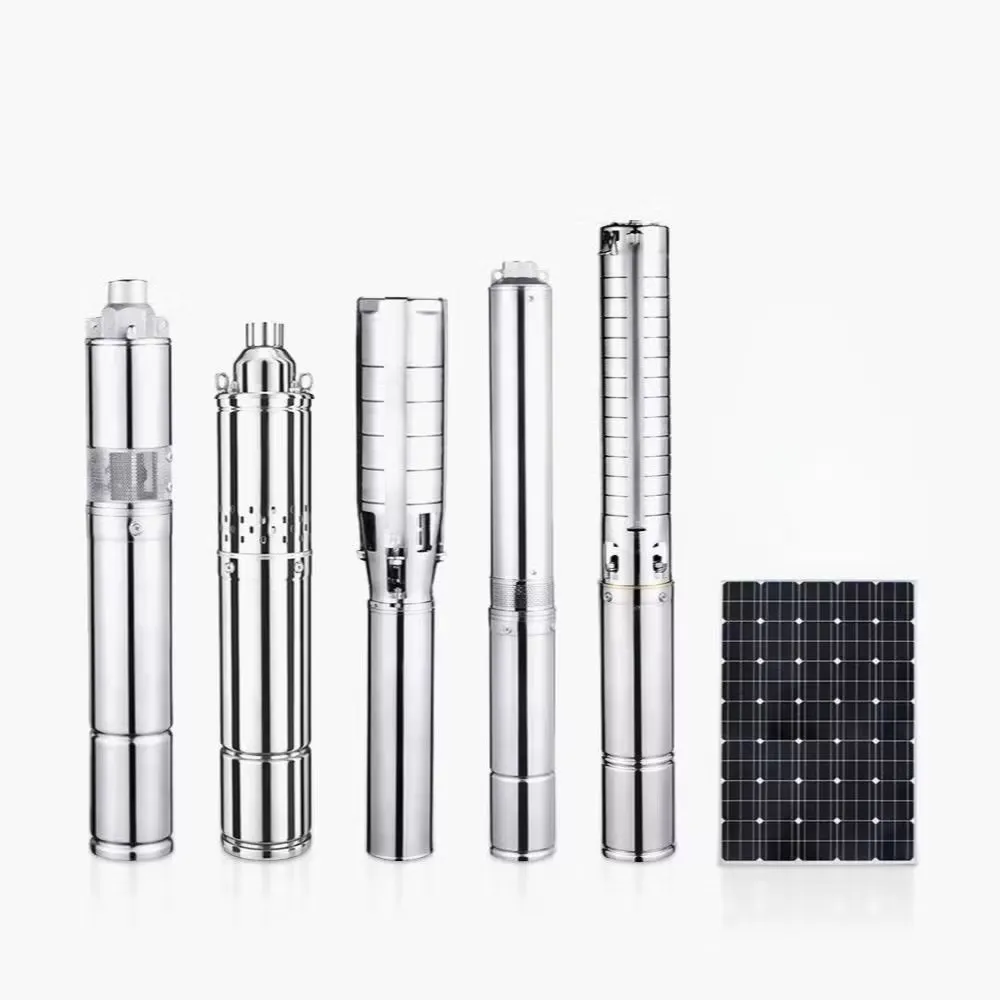
Understanding the difference between DC and AC Solar Submersible Water Pump systems is vital for correct wiring.
DC Submersible Pumps – Simplicity and Efficiency
- Setup: Panels → Combiner/Disconnect → MPPT Solar Pump Controller → Pump.
- Pros: No inverter losses, simpler wiring, ideal for remote locations.
- Cons: Limited to specific DC pump voltages.
AC Submersible Pumps – Versatility and Power
- Setup: Panels → Combiner/Disconnect → Pure Sine Wave Inverter → Pump.
- Pros: Can run standard 220V AC pumps; easier to source replacement parts globally.
- Cons: Requires a high-quality inverter; slightly lower system efficiency due to DC-AC conversion.
- Critical Note: Never use a modified sine wave inverter for a submersible pump. It will overheat and destroy the motor windings within weeks.
Wiring Difference Cheat Sheet
| Feature | DC System | AC System |
|---|---|---|
| Core Component | MPPT Controller | Pure Sine Inverter |
| Wiring Complexity | Lower | Higher (requires AC safeguards) |
| Efficiency | Higher (~95%) | Slightly Lower (~90-92%) |
| Cost | Lower initial cost | Higher initial cost |
6. Common Mistakes & Troubleshooting
Even with perfect parts, installation errors can cause failures. Here is the Jingong diagnostic table:
| Symptom | Likely Cause | Fix |
|---|---|---|
| Pump won’t start in morning | Insufficient voltage (cold weather Voc drop or undersized array) | Check panel orientation; add panels to increase string voltage. |
| Pump starts/stops rapidly | Voltage fluctuation at MPPT window edge | Check wire gauge (voltage drop); ensure 1.5x power redundancy. |
| Low water flow | Partially shaded panel; dirty panels; incorrect Vmp match | Clean panels; remove shading; verify controller settings. |
| Controller overheats/shuts down | Poor ventilation; overcurrent; ambient temp too high | Mount controller in shade; check fusing; improve airflow. |
| Burnt controller terminals | Loose MC4 connections; wrong polarity; voltage spike | Ensure “click” on MC4s; install lightning arrestor; replace controller. |
Seasonal Optimization
In winter, tilt panels steeper (latitude +15°) to compensate for the lower sun angle. In summer, flatten them (latitude -15°) to avoid overheating and reduce voltage spikes.
7. Safety Standards & Efficiency Optimization
Waterproofing and IP Ratings
Your controller and combiner boxes should be IP65 or higher. For wellhead connections, use marine-grade epoxy-filled heat shrink or specialized Solar Submersible Water Pump submersible splice kits. Never rely on electrical tape alone underwater.
Lightning and Grounding
In open fields, lightning strikes are a real threat. Ground your array frame, controller chassis, and inverter chassis to a single earth ground rod (minimum 8 feet deep). Install DC surge protectors in your combiner box.
Efficiency Optimization Tips
- Avoid Shading: Even a small leaf shadow on one cell can reduce the output of an entire string by 50%.
- Keep Panels Clean: Dust can reduce output by 15-20% in arid agricultural zones.
- Tilt Matters: Adjusting tilt seasonally can yield 10-25% more annual energy.
8. FAQs (Featured Snippet Targets)
Can you connect different wattage solar panels to a submersible pump?
It is not recommended to mix different wattages in a series connection, as the current will be limited by the lowest-wattage panel. In parallel, you can mix wattages only if you use individual fuses for each branch and the panels have similar Voc ratings.
Which is better: series or parallel for a solar water pump?
For deep wells and long distances, series is better because higher voltage reduces transmission loss. For cloudy regions or 12V systems, parallel is better as it maintains voltage while increasing current (runtime).
How many solar panels do I need for a 24V submersible pump?
First, find the pump’s wattage (e.g., 500W). Multiply by 1.5 (redundancy) = 750W needed. If using 400W panels, you would need 2 panels. Depending on the controller’s voltage range, these might be wired in series or parallel.
Do I need a controller for a Solar Submersible Water Pump ?
Yes. A solar pump controller (MPPT) is essential. It tracks the maximum power point of the panels and converts the variable DC voltage to the optimal level for the pump motor, protecting it from overvoltage and dry-running.
Can a solar submersible pump work in cloudy days?
Yes, but with reduced performance. Properly sized systems (using the 1.5x rule) will continue to pump water even under heavy cloud cover, though the flow rate will be lower and runtime shorter.
9. Conclusion + Buying / Sizing Guide
Connecting multiple solar panels to a Solar Submersible Water Pump manufacturer submersible pump requires precision, respect for electrical laws, and quality components. By following the series, parallel, or hybrid methods outlined above—and adhering to the 1.5x redundancy rule—you ensure a reliable water supply for agriculture, livestock, or remote living.
As a leading manufacturer, Jingong Tech Solar Submersible Water Pump manufacturer provides industrial-grade submersible pumps, booster pumps, and complete solar pumping systems designed for harsh environments. We don’t just sell pumps; we provide engineering solutions.
Ready to build your system?
Request a Custom Sizing Quote or Read Our Controller Selection Guide