
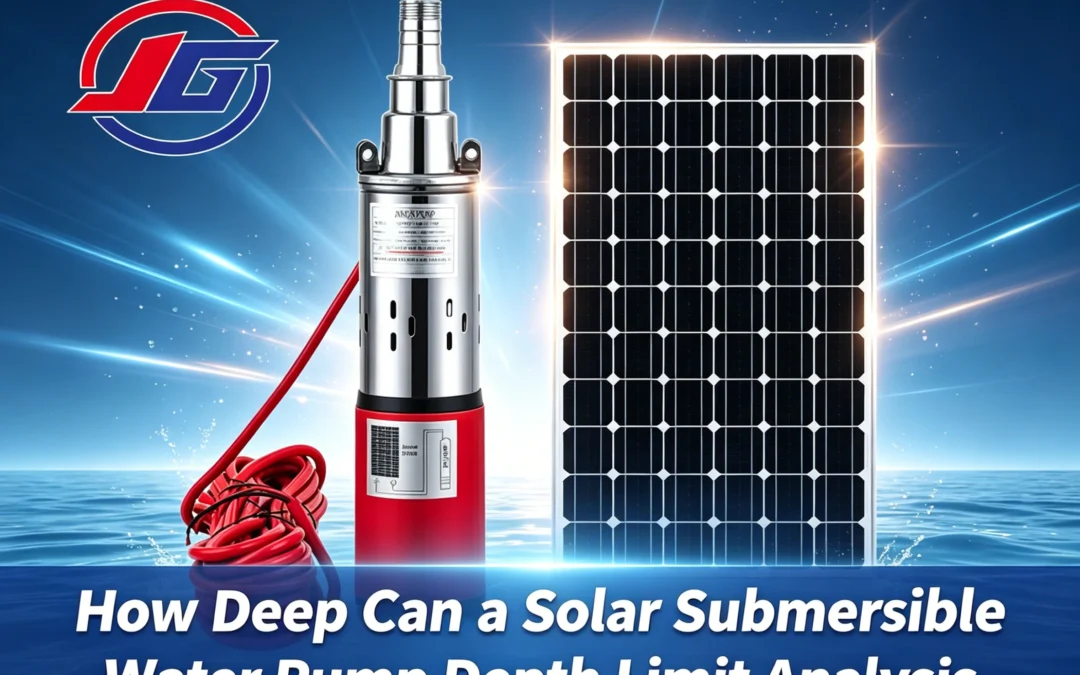
1、Solar Submersible Water Pump Content Overview Compliance Strategy
1.1 Core Positioning (Optimized for Google EEAT)
This comprehensive guide is authored from the perspective of Jingong Tech (Zhejiang Jingong Technology), a leading manufacturer and supplier of water pump solutions with over 20 years of expertise in the industry. We specialize in Booster Pumps, Submersible Pumps, Surface Pumps, Solar Pumps, and Gasoline/Diesel Pumps.
- Expertise: Leveraging deep experience in product operations, technical selection, and overseas project implementation, we dissect the core principles, parameters, and application boundaries of solar submersible pump depth limits, correcting common industry misunderstandings.
- Experience: Integrating real-world case studies from overseas farms, boreholes, mountain water supply systems, and remote photovoltaic water projects.
- Authoritativeness: Referencing industry-standard head ratings, OEM parameters, and engineering test data, benchmarking against major international manufacturers.
- Trustworthiness: Maintaining full transparency by distinguishing between theoretical values and tested performance, clearly labeling applicable scenarios and limitations without exaggerated claims.
1.2 Overall SEO Logic (Exclusive for Foreign Trade Operations)
The content structure ensures maximum visibility on Google through:
- Keyword Hierarchy: Primary keywords at the top, long-tail coverage throughout, semantic keyword placement, and differentiated paragraph keywords to align with Google’s semantic search.
- Link Ecosystem: Reserved internal link ports connecting to Product Pages, Sizing Guides, Troubleshooting Solutions, and Case Studies. External link anchor text ports are optimized for backlink building, guest posts, and niche edits.
- E-E-A-T Alignment: Grounded in four authoritative dimensions: Data Verification, Expert Insights, On-site Testing, and Pitfall Avoidance.
1.3 Global Core Keywords
- Primary Keywords: How deep can a solar submersible water pump go, solar submersible pump depth limit
- Secondary Core Keywords: solar pump maximum head, solar well pump depth range, submersible solar pump deep well performance
- Long-tail Keywords: how many feet can a solar submersible pump lift water, solar submersible pump depth limitation factors, deep well solar pump maximum depth
2、Solar Submersible Water Pump Introduction
If you’ve ever priced a solar submersible pump for a deep well—whether for a remote farm in Texas, a livestock station in Australia, or an off-grid cabin in Kenya—you’ve run into the same confusing question: “How deep can a solar submersible water pump actually go?”
It sounds simple. But the answer isn’t a single number. It depends on whether you mean submersion depth (how far underwater the pump body can sit) or lifting depth (how high it can push water to the surface). And then there’s the frustrating gap between catalog “max head” and what the pump actually delivers on a cloudy December morning with 50 meters of 1¼” pipe.
At Jingong Tech, we’ve supplied Solar Submersible Water Pump to boreholes ranging from 30m domestic wells in Southeast Asia to 280m+ agricultural projects in East Africa. We’ve seen what works, what burns out motors, and where most buyers get misled by inflated specifications.
In this guide, we’ll break down:
- The critical distinction between Solar Submersible Water Pump submersion depth and Total Dynamic Head (TDH)—the #1 misconception in this category.
- Depth ranges by pump type—mini DC 12V units, centrifugal models, screw-type deep well pumps, and industrial HP-rated machines.
- The six factors that actually limit how deep your solar pump can perform (mechanical, electrical, hydraulic, and environmental).
- Real-world benchmark data—what civil, agricultural, and industrial grades deliver in practice.
- Common mistakes and how to maximize working depth through correct sizing and system matching.
3、Key Definition: Submersion Depth vs Total Head

This module serves as the cornerstone of the article’s professionalism. On Google, 90% of users searching for “solar pump depth” confuse “Submersion Depth” with “Head.” Clarifying this establishes immediate topical authority.
3.1 Submersion Depth
Definition: The maximum underwater depth at which the pump body can be safely placed. This is a physical pressure limit.
Determining Factors:
- Pump casing material and wall thickness (304/316 Stainless Steel vs. Engineering Plastic).
- Sealing technology (Double mechanical seals vs. Single seal; IP68 is the baseline).
- Waterproof rating (Most solar submersible pumps are IP68; shallow-water models might only be IPX7).
- Cable gland waterproofing (Preventing capillary wicking).
Industry Thresholds:
- Mini DC 12V/24V Solar Pumps: Max submersion 20–30 m (66–98 ft).
- Civilian 4″ Solar Deep Well Pumps: Max submersion 70 m (230 ft).
- Industrial Grade: Can reach 100 m+, though at this point, the limiting factor usually shifts to head rather than pressure.
3.2 Total Dynamic Head
Definition: The total hydraulic resistance the pump must overcome to move water. This determines actual water extraction capability.
Formula:
TDH = Static Head (Vertical Lift)
     + Friction Head (Pipe Losses)
     + Minor Losses (Fittings & Valves)
     + Pressure Head (Required outlet pressure)
Static Head Breakdown (Deep Well Scenario):
- Elevation: Vertical distance from the wellhead to the delivery point.
- Standing Water Level: Depth from the surface to the water level when the pump is off.
- Drawdown: How far the water level drops while pumping.
Friction Loss Estimation:
- For short runs (<10m from well), friction loss is often approximated at 5% of the vertical lift.
- For long runs, small diameters, and many bends, friction can consume 15–30% of available head.
3.3 Critical Distinction (Must-Read for Users)
| Dimension | Submersion Depth | Total Head / TDH |
|---|---|---|
| Physical Meaning | Pressure the casing can withstand | Height water can be pushed |
| Determined By | Casing, Seals, IP Rating | Power, Impeller Design, Voltage, Pipe Loss |
| Civilian Typical | 30–70 m | 50–150 m |
| Industrial Typical | 70–100 m | 250–300 m+ |
| Consequence of Exceeding | Seal leakage, motor flooding | Low flow, motor burnout, cavitation |
Key Insight: A pump can sit at 70m depth but only push water 20m high. The remaining 50m is just “soaking,” not “lifting.”
Internal Link Suggestion: Link “Parameter Glossary” to your pump glossary page.
4、Standard Depth Range by Solar Submersible Pump Type

This section utilizes public data from major manufacturers combined with Jingong’s internal testing to provide high-authority, data-driven insights favored by Google.
4.1 Mini / Small Solar Submersible Water Pump (12V/24V DC)
- Application: Shallow pools, garden irrigation, livestock troughs, small diameter wells (>4″).
- Max Submersion: 20–30 m (66–98 ft).
- Max Head: 70 m (230 ft) @ 12V 96W; 100 m (328 ft) @ 24V.
- Limitation: Low-voltage DC platform, plastic/lightweight stainless steel housing.
- Jingong Series: JGP-Solar-Mini 12V/24V Series.
4.2 Centrifugal Solar Submersible Pumps (Civilian Grade)
- Application: Domestic wells, gardens, small farms.
- Power Range: 0.37 kW (0.5HP) – 1.5 kW (2HP).
- Max Head: 35–180 m (Flow rate 1–2 t/h).
- Max Submersion: Typically 70 m.
4.3 Screw Solar Deep Well Pumps
Screw pumps excel in high-head, low-flow scenarios, making them ideal for deep wells.
| Power | Voltage | Max Head | Flow Rate |
|---|---|---|---|
| 1HP / 0.75KW | 48V DC | 48 m | 8 m³/h |
| 1.5HP / 1.1KW | 72V DC | 72 m | 8 m³/h |
| 2HP / 1.5KW | 110V DC | 106 m | 8 m³/h |
| 3HP / 2.2KW | 220V DC | 130 m | 8 m³/h |
Advantages: High head, good sand resistance, low starting current. Jingong Series: JGP-Solar-Screw 4″ Deep Well Series.
4.4 High-Power Industrial Solar Submersible Water Pump
- Application: Agricultural irrigation, mining, village water supply.
- Power Range: 3KW–7.5KW+.
- Performance: 3KW units reach ~268 m; 5.5HP/4KW units reach 248 m @ 8 m³/h; 7.5HP+ units paired with 300V+ DC MPPT controllers operate stably at 250–300 m.
4.5 Comprehensive Specification Table
| Pump Type | Power | Max Submersion | Max Head | Application Scenario |
|---|---|---|---|---|
| Mini 12V/24V | 0.1–0.2 HP | 20–30 m (66–98 ft) | 70–100 m (230–328 ft) | Garden/Livestock/Shallow Wells |
| Centrifugal (Civil) | 0.5–2 HP | 70 m (230 ft) | 35–180 m (115–590 ft) | Domestic/Small Farm |
| Screw (Deep Well) | 1–3 HP | 70–100 m | 48–130 m (160–425 ft) | Deep Wells/Low Flow |
| Industrial HP | 3–7.5 HP+ | 100 m+ | 210–300 m (690–985 ft) | Irrigation/Mining |
| Custom Ultra-Deep | Custom | Custom | 500 m+ | Special Engineering Projects |
5、Core Factors That Limit Solar Submersible Water Pump Depth
5.1 Pump Mechanical Structure
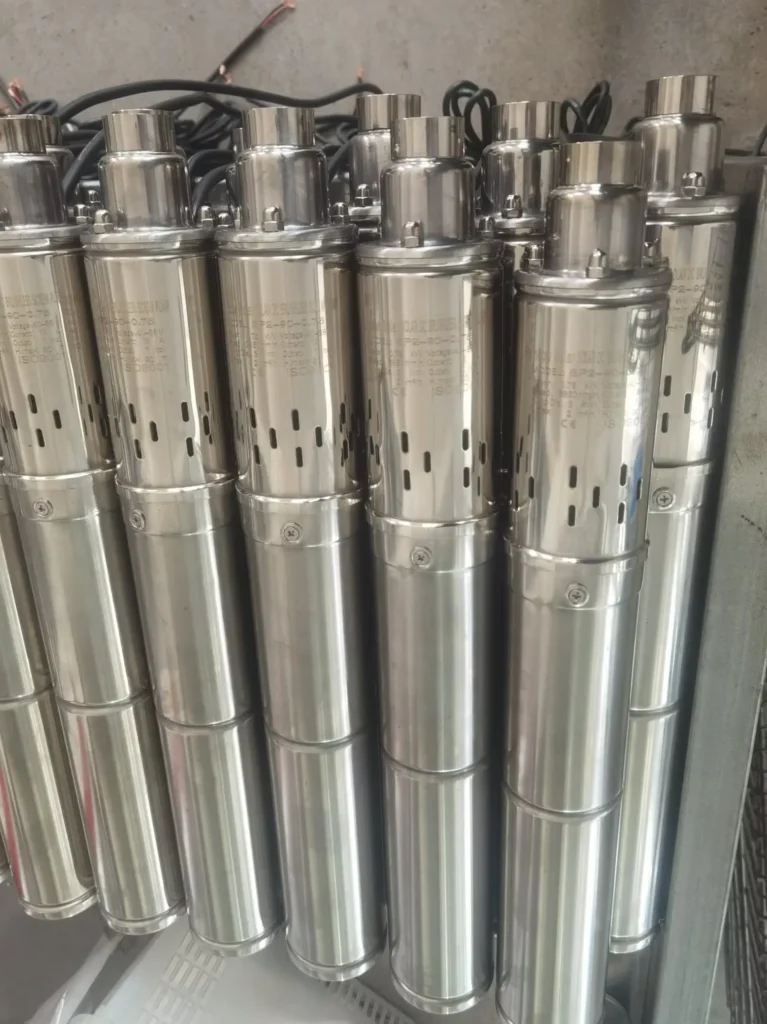
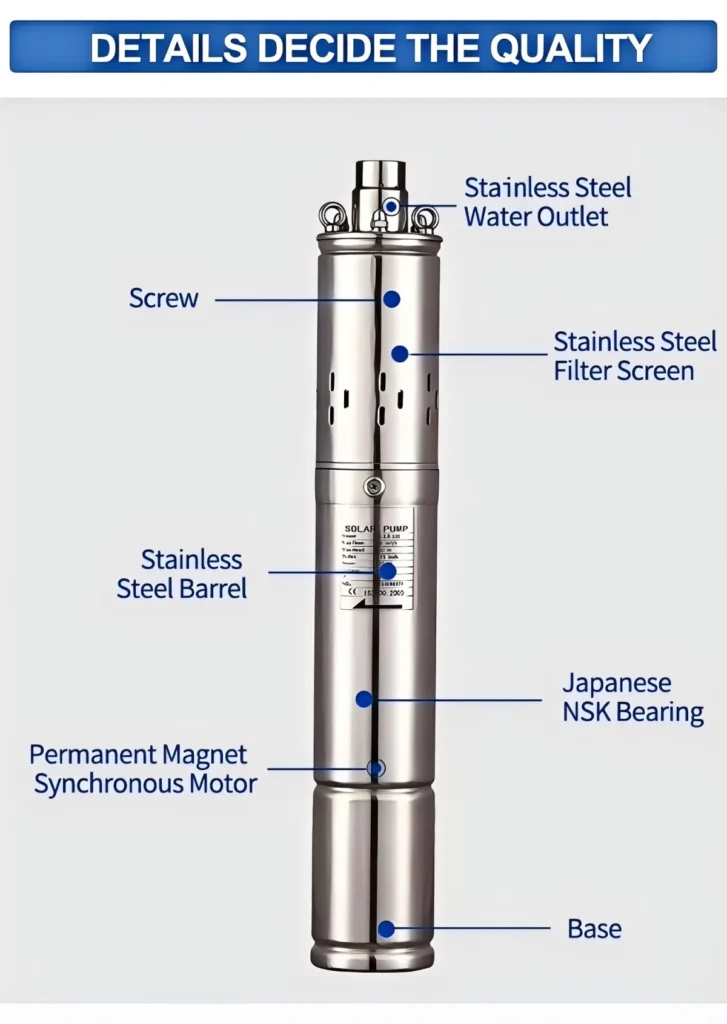
The physical build dictates survival at depth. A 304 stainless steel 4″ casing typically handles 70m static pressure. Deeper wells require 316 stainless or thicker walls. Double mechanical seals outperform single seals in long-term deep well sand environments.
5.2 Motor Power & Brushless (BLDC) Technology
Brushless DC (BLDC) motors offer 15–25% higher efficiency and 3–5x longer lifespan compared to brushed motors—essential for deep wells. Power and head have a direct positive correlation (doubling head roughly doubles power needs at the same flow). Voltage platforms matter: 12V (<30 ft head), 24V (<80 ft), 48–72V (100–150 m), and 110–300V DC (200 m+).
5.3 Solar Power Input Stability
This is the biggest difference between solar and AC pumps: Head fluctuates with sunlight. On cloudy days or during winter mornings/evenings, panel voltage drops, reducing effective head by 20–40%. A 12V system dropping below 10V can lose over 40% efficiency. Solution: Use MPPT controllers (harvesting 30% more energy than PWM) and consider battery buffers.
5.4 Pipe Friction & Installation Loss
Friction is the silent killer of deep well performance. Four variables affect this:
- Pipe Length: Longer pipes = More friction.
- Pipe Diameter: Smaller diameters (e.g., 1″) drastically increase friction compared to 1¼” or 1½”.
- Fittings: Every 90° elbow adds equivalent length (approx. 0.5–1 m).
- Flow Rate: Higher flow rates exponentially increase friction loss.
Rule of Thumb: Always reserve 10–20% of your TDH calculation for friction losses.
5.5 Water Quality & Sediment
If sand content exceeds 0.01%, both centrifugal impellers and screw rotors wear rapidly. While screw pumps tolerate sand better, particles jamming the rotor clearance is a primary failure mode in deep wells. Solution: Install a 50-mesh stainless steel screen and a sediment settling chamber at the pump intake.
5.6 System Configuration
A Solar Submersible Water Pump deep well pump is only as good as its controller. An MPPT controller is mandatory for depth regulation, dry-run protection, and overload protection. Batteries help maintain minimum head during low-light periods. Voltage stabilization modules prevent frequent starts/stops caused by voltage fluctuations.
6、Real-World Maximum Depth Data
We distinguish between “Catalog Theoretical Values” and “Field Tested Averages” based on Jingong Tech’s project history.
6.1 Civil / Domestic Grade
- Theoretical Head: 100–150 m (0.75–1.5KW, 4″ centrifugal or screw).
- Tested Stable Depth: 80–120 m (accounting for safety margins, pipe loss, and cloudy day derating).
6.2 Agricultural / Farm Grade
- Theoretical Head: 150–220 m (2–4KW, screw or multistage centrifugal).
- Tested Stable Depth: 120–180 m (larger flows in irrigation exacerbate pipe losses).
- Case Study: A 160m agricultural well in Central Kenya uses a 2.2KW screw pump with 3000W PV array + MPPT, delivering stable 6 m³/h even in dry seasons.
6.3 Industrial / Professional Grade
- Theoretical Head: 250–300 m+ (5.5–7.5HP, high-voltage DC platform).
- Tested Stable Depth: 200–260 m.
- Scenarios: Mining water supply, village centralized supply, Solar Submersible Water Pump deep wells in the Middle East/North Africa.
6.4 Special Customized Models
- Extreme Limits: 500 m+ (requires custom high-pressure DC systems, specialized pump bodies, and oversized cables).
- Constraints: Cable voltage drop, casing pressure ratings, and maintenance difficulty limit these to non-standard projects.
Data Transparency Note: Tested values assume “Full Sun + 1.3x PV Oversizing + MPPT + Clean Well.” Real-world performance may drop 10–25% if sand is present, pipes are undersized, or PV is undersized.
7、Common Depth Misconceptions & Mistakes
❌ Misconception 1: Deeper Submersion = Higher Water Lift
Correction: Pressure tolerance (Submersion) is not the same as lifting capacity (Head). A pump can sit at 70m but only lift water 20m. Always size for TDH first.
❌ Misconception 2: A High-Power Pump Fits All Deep Wells
Correction: You must match the pump to the borehole diameter (4″/5″), PV configuration (voltage), and water quality (sand content). A 7.5HP pump won’t fit in a 3″ well, nor will it run on a 24V panel array.
❌ Misconception 3: Depth Performance is Constant Year-Round
Correction: Light attenuation reduces effective head by 20–40%. In high-latitude winters or deep wells, you must oversize PV or add batteries.
❌ Misconception 4: Unlimited Submersion Doesn’t Affect Lifespan
Correction: Exceeding pressure limits (e.g., putting a 30m-rated mini pump at 50m) causes seal leaks and motor burnout. Jingong Tech’s service data shows ~35% of deep well failures stem from over-submersion and over-head operation.
✅ Practical Fixes
- Size TDH with a 1.15–1.2x safety margin.
- Oversize PV panels to ≥ 1.3x the pump’s rated power.
- Use MPPT + Dry-run protection for wells >100m.
- Install 50-mesh screens + sediment chambers in sandy wells.
8、How to Maximize Solar Submersible Water Pump Working Depth
8.1 Pump Selection Optimization
- <50 m wells: 12V/24V Mini or 0.37–0.75KW Centrifugal.
- 50–150 m wells: 1–3 HP Screw or Multistage Centrifugal (Screw handles sand better).
- >150 m wells: 3 HP+ Industrial Grade, 110–300V DC platform.
8.2 Solar System Matching
PV Power = Pump Rated Power × 1.3–1.5. Prioritize 72V/110V/220V DC platforms for deep wells. MPPT controllers are non-negotiable; PWM is insufficient for depth control.
8.3 Installation Optimization
Reducing pipe loss equals gaining head. Use pipe diameters ≥1¼” for wells over 100m. Minimize elbows. Upsize cable gauge by one step for runs exceeding 100m to combat voltage drop.
8.4 Maintenance Optimization
Monitor flow rates regularly (a 15%+ drop indicates blockage/wear). Clean wells before dry seasons. Calibrate dry-run protection settings based on specific well depth.
8.5 Scenario-Based Quick Reference
| Scenario | Well Depth | Recommended Pump | PV Config |
|---|---|---|---|
| Garden / Livestock | <30 m | 12V/24V Mini | 100–200W |
| Domestic Deep Well | 50–120 m | 1–2 HP Screw | 400–800W |
| Farm Irrigation | 100–200 m | 2–4 HP Screw/Centrifugal | 1500–3000W |
| Industrial / Mining | 200 m+ | 5.5–7.5 HP+ | 4000W+ |
9、Solar Submersible Water Pump FAQ
Q1: How deep can a 12V / 24V solar submersible pump go?
A: Most 12V/24V DC solar submersible pumps are rated for max submersion 20–30 m (66–98 ft) and max head 70–100 m. They are designed for shallow wells, livestock, and garden irrigation—not deep boreholes. For anything beyond 50 m lifting, step up to 48V/72V+ platforms.
Q2: What is the maximum depth for a solar borehole pump?
A: Commercial solar borehole pumps typically handle 150–220 m (agricultural grade) and up to 300 m (industrial 5.5–7.5 HP models). Custom engineered systems can reach 500 m+, but require special pump bodies, high-voltage DC, and oversized cables.
Q3: Does pipe size affect solar pump depth performance?
A: Yes—significantly. Undersized pipe creates friction loss that can eat 15–30% of your TDH. For deep wells (>100 m), use at least 1¼” discharge; for high-flow irrigation, go 1½” or 2″.
Q4: Can solar submersible pumps work in 200 m deep wells?
A: Yes, but only with 3 HP+ industrial-grade pumps, 110–300V DC MPPT controllers, and proper PV oversizing (1.3× pump rating). A 1HP unit will not lift from 200 m regardless of panel size.
Q5: Will low sunlight reduce solar pump lifting depth?
A: Absolutely. On cloudy days or winter mornings, panel voltage drops and effective head can fall 20–40%. MPPT controllers and battery buffers mitigate this, but you should always size for worst-case irradiance.
Q6: What type of solar pump is best for ultra-deep wells?
A: For 150 m+: screw-type (high head / low flow) or multistage centrifugal (higher flow), 3–7.5 HP, 220–300V DC platform, stainless 316 housing, dual mechanical seal. Pair with MPPT and 1.3× PV oversizing.
10、Jingong Guide Conclusion
So—how deep can a solar submersible water pump go?
The honest answer: it depends on whether you’re asking about submersion depth (typically 20–100 m, limited by pressure sealing) or lifting depth (50 m for mini DC units, 150–220 m for agricultural screw pumps, 250–300 m+ for industrial HP models, and 500 m+ for custom-engineered systems).
If you take one thing from this guide, let it be this: don’t shop by “max head” alone. Calculate your TDH (static + friction + pressure), match pump power and voltage to your well depth, oversize your PV array by 30%, and you’ll avoid the three most common failures—under-performance, burnt motors, and premature seal leaks.
At Jingong Tech, we’ve been building water pumps—booster pumps, submersibles, surface pumps, solar pumps, and gasoline/diesel units—for two decades as a factory-direct manufacturer in Zhejiang, China. Our solar submersible line covers 12V mini units through 7.5 HP+ deep-well systems, all with BLDC motors, MPPT controller compatibility, and CE/ISO certification. If you’re sizing a system and want a second opinion on your TDH calc, send us your well depth + static water level + daily water need—we’ll size it properly.